How Much Does It Cost to Reface Cabinets?
Cabinet refacing usually costs about $7,220 nationally, with a typical range of $4,501 to $10,546 and a broad per-linear-foot range of about $210 to $750. Costs rise when the project includes more doors, more drawer fronts, higher-grade veneer, soft-close hardware, or repairs to the cabinet boxes.
Cost estimates by kitchen size and component
This table gives a practical starting point for estimating cabinet refacing by kitchen size. It uses a consistent pricing method: national-average project totals, a typical project range, and the main variables that widen the spread.
| Kitchen size | Approx. linear feet | Typical door style | Doors | Drawer fronts | Veneer / finish | Hardware upgrades | Repairs / end panels | Regional labor sensitivity | Likely total |
|---|---|---|---|---|---|---|---|---|---|
| Small kitchen | 15 to 20 | Flat or simple shaker | $700 to $1,800 | $150 to $450 | $500 to $1,200 | $100 to $350 | $150 to $600 | Lower in low-cost markets; higher in major metros | $3,650 to $8,000 |
| Medium kitchen | 20 to 30 | Shaker or raised-panel | $1,200 to $3,000 | $250 to $700 | $800 to $1,800 | $150 to $500 | $250 to $900 | Moderate regional labor impact | $5,400 to $11,500 |
| Large kitchen | 30 to 40 | Custom, detailed, or mixed styles | $2,000 to $5,000 | $400 to $1,100 | $1,200 to $3,000 | $250 to $800 | $400 to $1,500 | Highest in expensive labor markets | $8,350 to $18,400 |
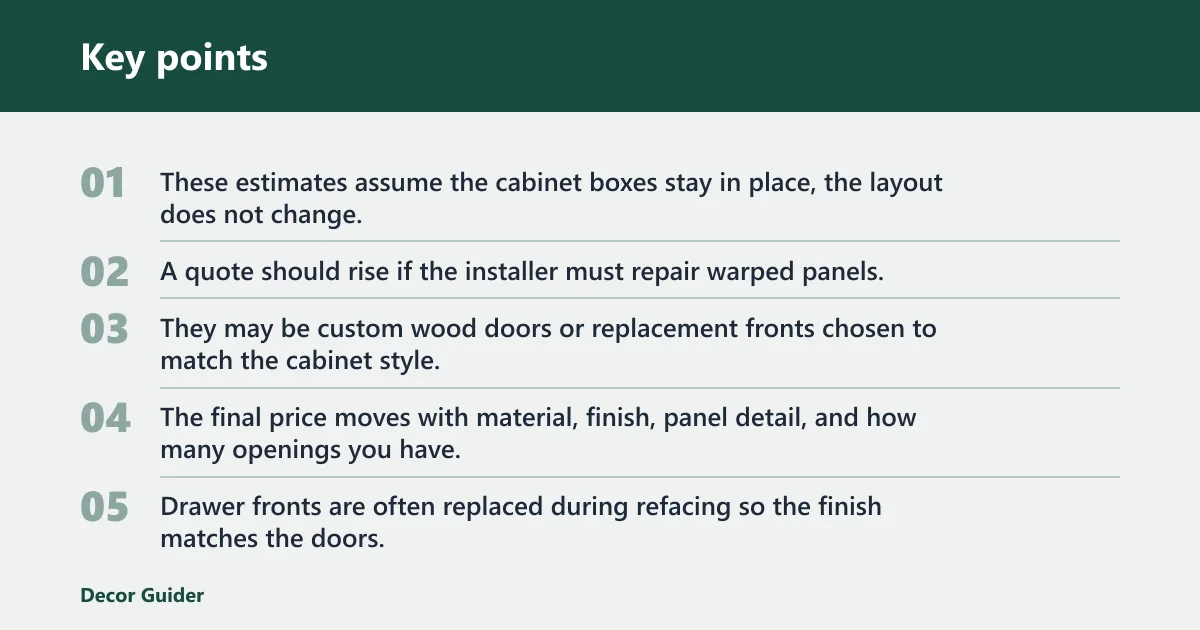
These estimates assume the cabinet boxes stay in place, the layout does not change, and the project focuses on new doors, drawer fronts, and visible surface updates. A quote should rise if the installer must repair warped panels, replace damaged end panels, or work around tight access.
What each line item includes
Doors are usually the biggest visible cost. They may be custom wood doors or replacement fronts chosen to match the cabinet style. The final price moves with material, finish, panel detail, and how many openings you have.
Drawer fronts are often replaced during refacing so the finish matches the doors. More drawers mean more material and more labor, especially if the new fronts need precise sizing and alignment.
Veneer covers face frames and exposed sides. Budget projects may use laminate, while higher-end projects may use high-quality veneer or real wood veneer. That material choice strongly affects the total.
Hardware includes hinges, knobs, and handles. Soft-close hinges or upgraded pulls can add to the bill, even when the visible style stays simple.
Repairs and end panels cover fixes to damaged face frames, small cabinet repairs, and finishing exposed cabinet ends so the new surfaces look continuous.
Labor covers removal, fitting, installation, and finishing. Tight spaces, odd cabinet sizes, and repair work increase labor time and cost.
How much does cabinet refacing cost?
That pricing spread reflects kitchen size, door count, material grade, hardware, and whether the installer must correct box or face-frame damage.
Refacing is often 30% to 50% less than replacement because the cabinet boxes stay in place. The exact savings depend on how much of the project is custom, how many visible surfaces need new material, and whether the quote includes upgraded hinges or repair work.
What most estimates include
Most quotes cover the cabinet doors, drawer fronts, visible veneer or laminate, basic hardware, and installation labor. Some quotes also include removing old faces, minor adjustments, and cleanup. They may not include box repairs, trim changes, disposal, or upgraded soft-close hinges.
A quote near the middle of the national range usually fits a sound, standard kitchen with no layout changes. If the same kitchen has swollen panels, loose face frames, or exposed ends that need extra finishing, the price should move up before installation starts.
What drives the total price?
The biggest cost drivers are kitchen size, cabinet count, material choice, labor, and repair needs. Two kitchens with the same square footage can land at very different totals if one has more drawers, more corner cabinets, or a more demanding finish.
Kitchen size and cabinet count
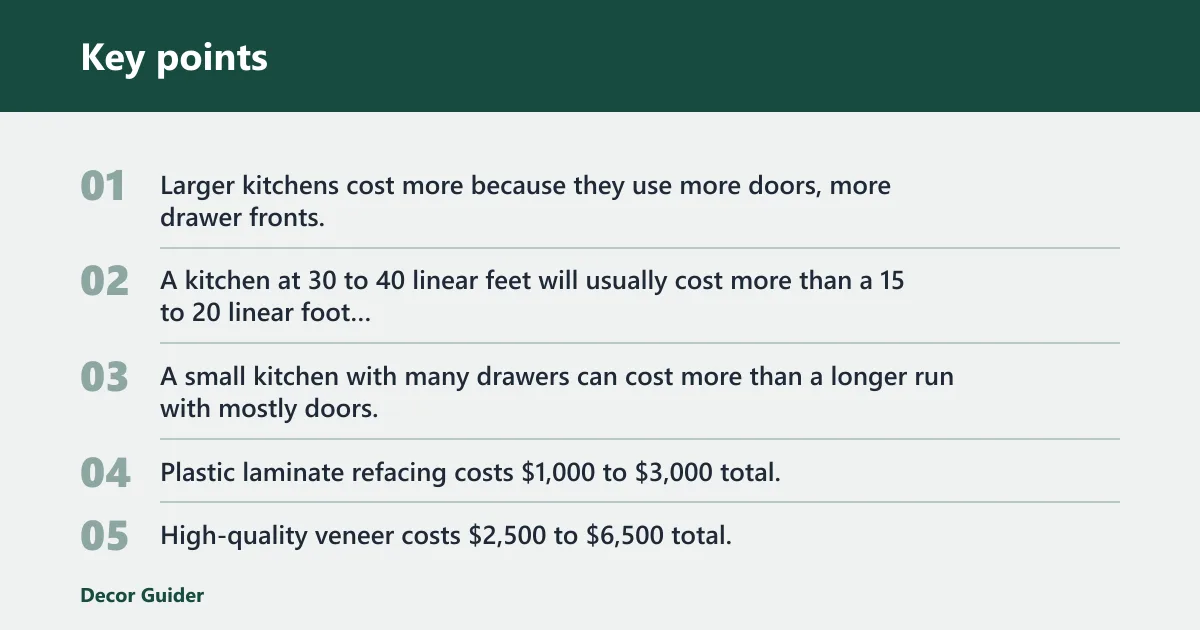
Larger kitchens cost more because they use more doors, more drawer fronts, and more veneer. A kitchen at 30 to 40 linear feet will usually cost more than a 15 to 20 linear foot galley, even before upgrades are added.
Cabinet count matters as much as room size. A small kitchen with many drawers can cost more than a longer run with mostly doors.
Door and drawer front material
Material choice changes the price sharply. Plastic laminate refacing costs $1,000 to $3,000 total, and rigid thermofoil laminate also costs $1,000 to $3,000 total. High-quality veneer costs $2,500 to $6,500 total, while real wood veneer costs $6,000 to $14,000 total.
That spread is why refacing quotes can look so different. A flat slab door in laminate is one thing. A stained wood door with matching drawer fronts is another.
Veneer type and finish
Veneer covers what you see on the cabinet box. Laminate is usually the least expensive choice, while high-quality veneer and real wood veneer move the project into a higher price band. Stain matching, grain direction, and edge finishing all influence labor time.
Labor, repairs, and hardware upgrades
Labor depends on location, installer skill, and the difficulty of the layout. Add repairs for damaged face frames, sagging cabinet boxes, or water-swollen areas, and the price can climb fast.
Hardware upgrades matter too. Basic knobs and pulls are inexpensive compared with a full soft-close hinge upgrade across every door. If a quote includes new hinges, ask whether they are standard or soft-close.
What materials are used for refacing?
Cabinet refacing usually uses laminate, veneer, or real wood for the visible surfaces, plus new doors and drawer fronts. The material you pick changes both the look and the price, so this is one of the biggest decision points in the whole project.
Laminate
Laminate is the low-cost option and works well when you want a clean finish without a premium material bill. It is often used on the face frames and cabinet sides. It is also the lowest-cost path in the source range.
Veneer
Veneer gives a more natural appearance and can be a strong middle-ground choice. High-quality veneer sits above laminate in price but below full real wood veneer. It is a practical option when you want a better finish without crossing into premium territory.
Real wood
Real wood veneer or solid-wood doors create the highest-cost refacing projects. These materials usually suit kitchens where the existing boxes are in very good shape and the owner wants a more traditional look. They also cost more because matching, finishing, and installation are less forgiving.
Hardware and soft-close options
New hinges, knobs, and handles are usually part of the project. Soft-close hinges are a common upgrade, but they add to the budget. Hardware seems minor until you price every door and drawer front together.
Suppose a 20-linear-foot kitchen has good boxes but dated brass pulls and noisy hinges. Changing only the visible surfaces may still leave the kitchen feeling old unless the hardware is replaced too.
Is refacing cheaper than replacing?
Yes. Refacing is usually cheaper than replacing because it keeps the cabinet boxes and layout in place. Replacement costs roughly $400 to $3,500 per linear foot, while refacing typically costs about $210 to $750 per linear foot. Refinishing is cheaper still, but it does less.
Refacing vs. replacement
Replacement makes sense when you want a different layout, new storage, or major structural changes. It also makes sense if the cabinet boxes are damaged beyond repair. But it usually costs far more and can involve countertop, flooring, or plumbing changes.
Refacing vs. refinishing
Refinishing cabinets typically costs $3,000 to $5,000. That is cheaper than refacing, but refinishing is paint or stain only. It does not replace doors or drawer fronts, so it is best when the cabinet faces are in good shape and you mainly want a color change.
Refacing is the middle ground. It changes the look more than refinishing, but it avoids the cost and disruption of a full replacement.
When replacement makes more sense
Replacement becomes the better spend if the layout no longer works, if the cabinets are warped, or if water damage has spread into the boxes. Mold, rot, and crumbling particleboard are warning signs that surface work will not fix the real problem.
When does cabinet refacing make sense?
Refacing makes the most sense when your cabinet boxes are structurally sound, the layout still works, and you want a new look without rebuilding the kitchen. It is a poor fit when the boxes are damaged, the finishes are failing from moisture, or you plan to change the room’s footprint.
Good candidates for refacing
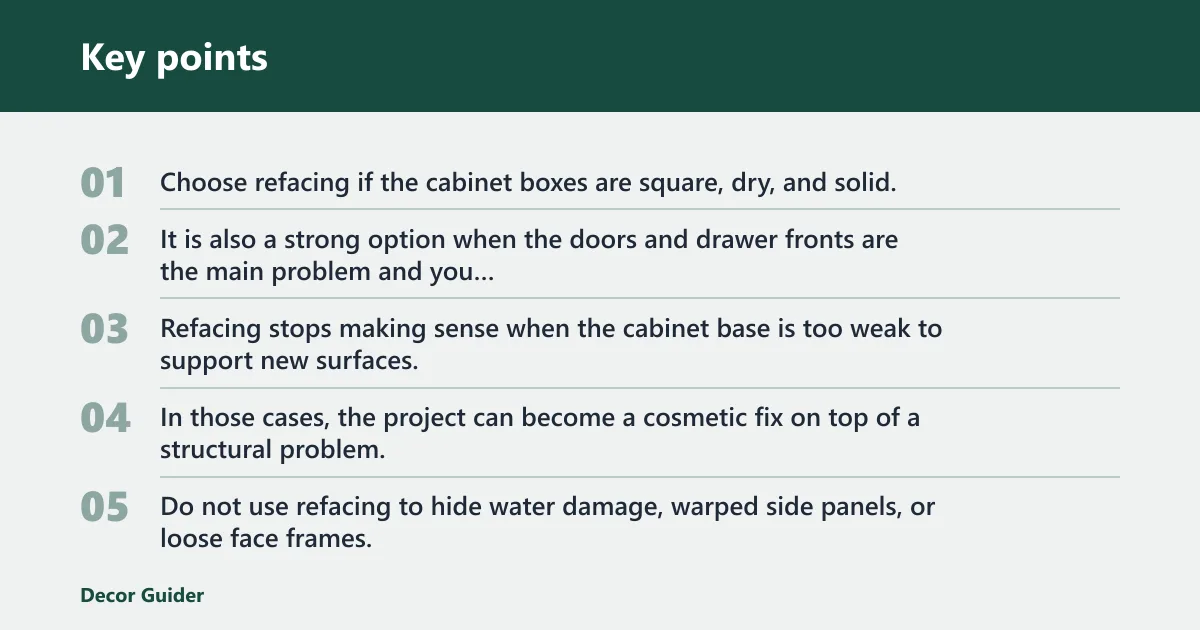
Choose refacing if the cabinet boxes are square, dry, and solid. It is also a strong option when the doors and drawer fronts are the main problem and you want to keep the same kitchen layout.
When refacing stops making sense
Refacing stops making sense when the cabinet base is too weak to support new surfaces, when a layout change is needed, or when the repair list starts approaching the cost of replacement. In those cases, the project can become a cosmetic fix on top of a structural problem.
| Warning sign | What it usually means | Refacing or replacement? |
|---|---|---|
| Box condition is poor | Warping, loose face frames, or sagging boxes | Replacement is usually better |
| Layout needs to change | New footprint, new storage, or moved appliances | Replacement is usually better |
| Moisture damage is present | Swelling, mold, rot, or water-stained particleboard | Replacement is usually better |
| Boxes are low-end or failing | Thin material, damaged construction, or repeated repairs | Replacement is often better value |
| Repair costs keep rising | Fixes, upgrades, and finish work are stacking up | Replacement may be the smarter spend |
When boxes are damaged
Do not use refacing to hide water damage, warped side panels, or loose face frames. Those problems tend to get worse under new surfaces. A surface-only project can leave you paying for finish work that sits on top of a failing base.
When a layout change is planned
If you want to move appliances, add a pantry run, or change cabinet placement, replacement is usually the better path. Refacing does not add storage or alter the floor plan. It only updates the surfaces you already have.
Cabinet refacing checklist
Use this checklist before you request quotes. It helps you compare bids on the same terms and catch missing costs before the work starts.
- Measure cabinet count and linear feet.
- Check the box condition for water damage, swelling, or warping.
- List the finish you want, including laminate, veneer, or real wood.
- Decide whether you want new hinges, knobs, handles, or soft-close upgrades.
- Ask whether the quote includes repairs, trim work, and cleanup.
- Compare labor, materials, and hardware side by side.
A common first-timer mistake is comparing two quotes that cover different scopes. One contractor may include soft-close hinges and veneer on every visible side, while another prices only the doors. Those bids are not equal.
How long does cabinet refacing take?
Cabinet refacing usually takes 2 to 5 days. The timeline depends on kitchen size, repair work, and how much finishing or hardware replacement is included. A simple project moves faster than one with detailed trim or damaged cabinet boxes.
Professional installation is usually faster than a full replacement because the cabinet boxes stay in place and the layout does not change. The job still needs careful prep, fitting, and alignment, so rushing it can lead to gaps or uneven door reveals.
Frequently asked questions
How much does it cost to reface cabinets?
The final price depends on kitchen size, material choice, hardware, and whether the boxes need repairs. Most homeowners should expect a quote somewhere in the middle of that range.
How much does it cost to reface cabinets in a small kitchen?
A small kitchen often lands closer to the low end of the range, especially if it has fewer drawers and simple finishes. For a compact layout, the total may fall around $3,650 to $8,000, with laminate or thermofoil keeping the price lower.
How much does it cost to reface kitchen cabinets?
For a typical kitchen, refacing often falls around $4,500 to $11,000, depending on size and finish. Kitchens with more linear feet, more drawer fronts, or real wood veneer usually cost more. If you only need a basic update, laminate can keep the total down.
What affects the cost of cabinet refacing?
The main cost drivers are cabinet count, linear feet, material quality, veneer type, hardware upgrades, labor, and repair needs. A kitchen with damaged boxes or a complex layout will cost more than a simple run of sound cabinets with standard hinges and basic doors.
Is refacing cabinets cheaper than replacing them?
Yes. Refacing can cost 30% to 50% less than replacing cabinets. Replacement is only the better value when you need layout changes or have major box damage.
Should I reface or refinish my cabinets?
Choose refinishing if the doors and drawer fronts are in good shape and you mainly want a new paint or stain color. Choose refacing if you want new doors, new drawer fronts, and updated visible surfaces. Refinishing costs less, but it changes less.
Products related to this article
Sponsored / affiliate links. As an Amazon Associate I earn from qualifying purchases. I may earn additional commission from eligible campaigns.