How Much Do Custom Cabinets Cost?
Custom cabinets are often priced at roughly $500 to $1,500 per linear foot installed, and a typical kitchen can land around $12,000 to $30,000 before countertops, appliances, or wall changes. Miss the details, and a quote that looks affordable can balloon once finish upgrades, storage inserts, and installation labor are added. This guide breaks cabinet pricing into box style, door material, finish, and install extras so you can compare quotes on the same terms.
Typical cost range
For installed pricing, a common range is $500 to $1,500 per linear foot, with a full kitchen often quoted at $15,000 to $45,000. That range changes fast when you move from simple box layouts to tall pantry units, inset doors, specialty finishes, and full installation.
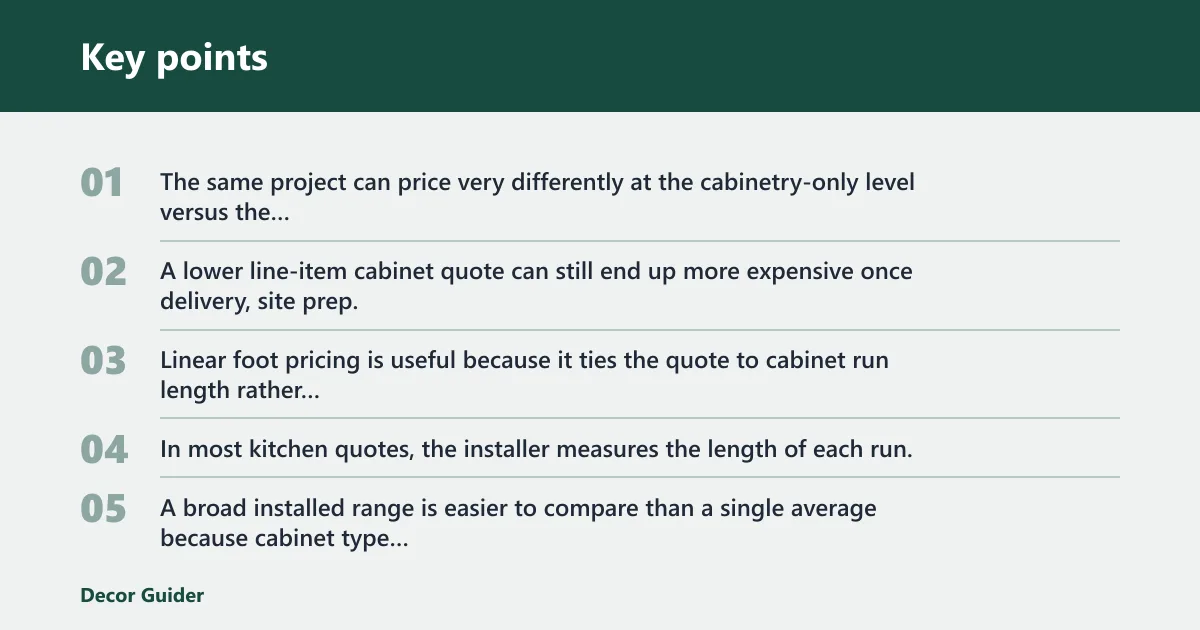
The same project can price very differently at the cabinetry-only level versus the installed total. A lower line-item cabinet quote can still end up more expensive once delivery, site prep, leveling, scribing, trim, panels, and hardware are added.
Installed cost range by linear foot
Linear foot pricing is useful because it ties the quote to cabinet run length rather than floor area. In most kitchen quotes, the installer measures the length of each run, then prices the cabinet mix along that total.
A broad installed range is easier to compare than a single average because cabinet type matters. Base cabinets, drawer bases, and tall units do not price the same, and a run with more drawers or pantry towers can climb quickly.
Why small kitchens can cost more per foot
Small kitchens often carry a higher price per foot because fixed costs are spread over fewer linear feet. Design time, delivery, templating, and site labor do not shrink in direct proportion to cabinet length.
Say your kitchen is only 12 linear feet of cabinetry but still needs a sink base, two drawer bases, a pantry cabinet, finished ends, and full installation. The per-foot figure can look high because the job still includes the same planning and setup steps as a larger room.
Cabinetry-only vs installed pricing
Cabinetry-only pricing covers the boxes and sometimes doors and drawer fronts, depending on the seller. Installed pricing adds the work needed to get those cabinets into the room, leveled, fastened, scribed, and trimmed out.
That distinction matters most when comparing bids. A quote that includes only the cabinet boxes can look cheaper than one that bundles installation, but the installed total is what determines the real budget.
What counts as a custom cabinet quote?
Custom cabinet pricing can include fully custom, semi-custom, or stock components, and those labels are not interchangeable. Fully custom is built to order for your dimensions and details; semi-custom uses a narrower menu of sizes and finishes; stock cabinets rely on standard sizes with the least flexibility.
Per-square-foot pricing is less useful because cabinets do not fill a room evenly the way flooring does. Kitchen cost is driven by linear runs, cabinet height, internal storage, door style, and finish complexity, not by floor area alone.
What linear foot pricing usually includes
A linear foot rate often covers cabinet boxes, doors, drawer fronts, standard shelving, and basic finish work. Some quotes also include standard pulls or knobs, but many do not.
It may exclude delivery, installation, molding, finished ends, appliance panels, or specialty accessories. Read the quote line by line, because those omissions can change the total by thousands of dollars.
When square-foot pricing misleads
Square-foot pricing can make a large room sound expensive and a compact kitchen sound cheap, even when cabinet complexity tells a different story. A narrow galley with tall pantry cabinets may cost more than a wider room with mostly base and upper units.
Quote comparison works better when you focus on cabinet runs and each component in the design. A per-square-foot number hides that difference.
Cabinet construction and cost
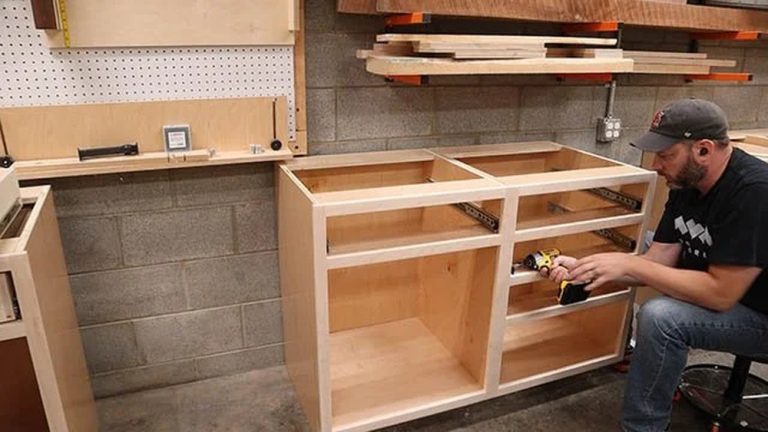
Construction style changes labor time, fit tolerance, and the amount of material used. Face-frame, frameless, inset, overlay, and full-access construction all price differently because they require different joinery, milling, and installation precision.
Face-frame vs frameless
Face-frame cabinets use a front frame attached to the box, which can make installation more forgiving and adds a traditional look. Frameless cabinets, often called full-access or euro-style, remove that front frame and create a wider opening inside the cabinet.
Frameless construction usually demands tighter factory tolerances and more exact installation. That can raise labor and manufacturing cost, especially in kitchens with uneven walls or floors.
Inset vs overlay doors
Inset doors sit inside the cabinet opening and require very consistent spacing. Overlay doors sit over the face-frame or box front, which is generally less labor-intensive.
Beaded inset adds another layer of detail and usually costs more because the face-frame treatment and alignment are more exacting. Overlay is often the more budget-friendly route when you want custom sizing without the same fit demands.
Full-access and fit tolerance
Full-access cabinets maximize interior width, but they do not forgive sloppy walls. The fitter has to account for out-of-square rooms, floor variation, and appliance openings with care.
That is one reason installation can matter as much as the cabinet box itself. Fine joinery only looks right when the room is measured, shimmed, and scribed correctly.
What drives the price up?
The biggest cost drivers are material, door style, finish, hardware, and storage accessories. A quote with maple boxes and simple slab doors will usually price lower than one with walnut, raised panel doors, painted finish, and multiple pull-out systems.
Wood species and material choice
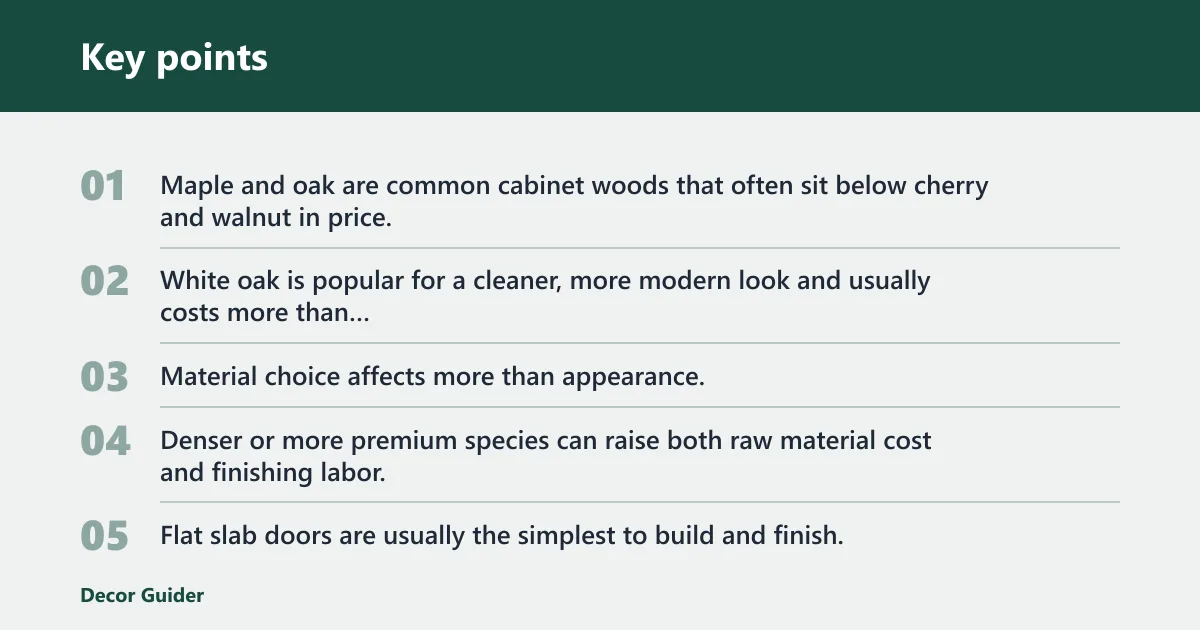
Maple and oak are common cabinet woods that often sit below cherry and walnut in price. White oak is popular for a cleaner, more modern look and usually costs more than standard oak, with walnut near the top of the group because of its material cost and visual appeal.
Material choice affects more than appearance. Denser or more premium species can raise both raw material cost and finishing labor, especially when grain matching matters across doors and drawer fronts.
Door style complexity
Flat slab doors are usually the simplest to build and finish. Shaker doors add rails and stiles, which increase labor but remain a common mid-range choice.
Raised panel and beaded inset doors are more detailed and often more expensive because they require more machining and finishing time. More parts mean more sanding, more setup, and more care at the edges.
Finish type and labor time
Painted finishes typically require more prep, more sanding, and more coats than a simple clear topcoat. Stained finishes can save some finishing steps, but grain consistency becomes more visible, so surface prep still matters.
Hand-rubbed oil finishes can be labor-intensive because the finish is applied and worked carefully in stages. The more coats and prep steps a finish needs, the more the quote usually climbs.
Hardware and storage accessories
Soft-close hinges and undermount slides are common upgrades that improve daily use but add to the hardware line. Pull-outs, trash and recycle units, and pantry organizers can change a quote quickly because they are specialty inserts rather than basic shelf space.
Cabinets by Alan lists base cabinets at $495 per lineal foot, drawer base cabinets at $660 per lineal foot, pantry cabinets at $1,320 per lineal foot, $220 per cabinet for installation, $300 each for pull-out shelves, and $660 each for garbage and recycle pull-out units. Those line items show why two cabinet quotes with the same room size can land in very different totals.
Room-by-room cost differences
The pricing rules are similar across rooms, but the mix of cabinet types changes the total. Kitchens usually include the widest range of boxes and accessories, while baths, closets, mudrooms, and built-ins often have fewer cabinet styles but more site-specific trim work.
Kitchen cabinets
A full kitchen is often quoted at $15,000 to $45,000, and H & J Cabinets says full-custom kitchens typically run $35,000 to $85,000. A 250+ square-foot kitchen can exceed $120,000, especially when the design includes tall units, specialty finishes, and detailed trim.
A common first-timer mistake is comparing a small U-shaped kitchen to a large open-plan kitchen using the same per-foot expectation. The larger room can have a lower price per foot, while the compact room may carry more fixed labor per foot.
Vanities and bathrooms
Bathroom vanities are often quoted at $2,500 to $12,000. The total depends on whether the unit is a simple single vanity, a double vanity, or a custom piece with drawers, tall linen storage, and a specialty top cutout.
Bathrooms often need careful coordination around plumbing, which can affect cabinet depth and drawer layout. That usually means more custom sizing than a buyer expects.
Pantries, closets, mudrooms, and built-ins
Pantries and tall storage units often price higher per foot because they use more material and more finish area. Custom closets can be priced differently from kitchen cabinets because shelves, hanging sections, and drawers are configured for apparel storage rather than cookware.
Gear closets and mudrooms often sit between cabinet and closet pricing. The quote should spell out whether you are paying for storage boxes only or for hooks, cubbies, drawers, and full trim-out.
Cabinet budget worksheet
Use this worksheet to build a real budget instead of relying on a single average. Fill in the unit counts, unit prices, and separate install charges before you compare bids.
| Line item | Quantity | Unit price | Subtotal |
|---|---|---|---|
| Base cabinets | _____ | $_____ | $_____ |
| Drawer bases | _____ | $_____ | $_____ |
| Uppers | _____ | $_____ | $_____ |
| Pantry or tall units | _____ | $_____ | $_____ |
| Finished ends | _____ | $_____ | $_____ |
| Appliance panels | _____ | $_____ | $_____ |
| Molding | _____ | $_____ | $_____ |
| Pull-outs | _____ | $_____ | $_____ |
| Trash/recycle units | _____ | $_____ | $_____ |
| Installation | _____ | $_____ | $_____ |
Total cost formula: Base cabinets + drawer bases + uppers + pantry or tall units + finished ends + appliance panels + molding + pull-outs + trash/recycle units + installation = total project cost
What each quote must include
- Cabinet count and type: base, drawer base, upper, pantry, and any tall cabinet counts.
- Construction style: face-frame, frameless, inset, overlay, or full-access.
- Wood species and finish: maple, oak, cherry, walnut, white oak, painted, stained, clear topcoat, or oil.
- Hardware and accessories: hinges, slides, pull-outs, trash/recycle units, and pantry organizers.
- Installation scope: delivery, site prep, leveling, scribing, fastening, and trim work.
- Exclusions: countertops, appliances, plumbing, electrical, drywall repair, and painting if not included.
How to compare cabinet quotes
Compare quotes by scope, not by headline price. A lower number can hide missing installation, unfinished sides, or no allowance for accessories, while a higher quote may include more of the work you actually need.
Ask for the same cabinet schedule from every bidder, then compare line by line. That is the only clean way to see whether you are paying for the same boxes, finishes, and install work.
Inclusions and exclusions
Confirm whether the quote includes delivery, site protection, leveling, scribing, toe kicks, fillers, crown, light rail, finished ends, and appliance panels. Those items are often the difference between a bare cabinet order and a complete install-ready package.
Also confirm what is excluded. If the quote omits demolition, patching, or old-cabinet removal, you need to price those separately.
Allowance items to verify
Some bids use allowances for hardware, finish upgrades, or specialty storage inserts. If the allowance is too low, the final bill can rise once selections are made.
Make the allowance specific. A quote that says “hardware allowance” is harder to compare than one that names the hardware type and quantity.
Change-order risk controls
- Request cabinet drawings with dimensions and finish notes before signing.
- Verify which items are fixed price and which are allowances.
- Confirm whether installation includes scribing, shimming, and trim.
- Check whether appliance panels, fillers, and finished ends are listed separately.
- Get the change-order process in writing before work starts.
Suppose a quote for a small kitchen looks modest until the installer adds finished ends, crown molding, and two pull-out trash units. The cabinetry line may still be in range, but the total can rise fast once the full install scope is captured.
Frequently asked questions
How much do custom cabinets cost per linear foot?
Custom cabinets usually cost $500 to $1,500 per linear foot installed. That range is broad because wood species, door style, finish, and installation scope all change the final number. A base-heavy layout often costs less than a tall-unit or drawer-heavy design.
How much do custom cabinets cost for a kitchen?
A full kitchen is often quoted at $15,000 to $45,000, though full-custom kitchen projects can run higher. The total depends on cabinet count, finish level, built-in storage, and whether install, molding, and panels are included in the same bid.
How much do custom cabinets cost for a small kitchen?
A small kitchen can still cost a lot because fixed labor and fabrication costs do not shrink much with room size. That means the price per foot can be higher than in a larger kitchen, especially if the layout uses pantry towers, drawers, and custom trim.
How much do custom cabinets cost per square foot?
Square-foot pricing is less useful than linear-foot pricing for cabinets. Cabinet cost follows run length, cabinet type, and accessory count, so two rooms with the same floor area can price very differently. Use square footage only as a rough comparison, not the main budget tool.
How much do custom cabinets cost on average?
A broad installed range is $500 to $1,500 per linear foot, and many standard projects cluster somewhere inside that span. The “average” means little unless you know the cabinet mix, because slab doors and painted inset doors do not belong in the same budget bucket.
How much do custom closets cost?
Custom closets are often priced differently from kitchen cabinets because the storage mix is different, but the same idea applies: measure the runs, count the units, and separate accessories from the box price. Tall towers, drawers, and specialty inserts raise the total faster than simple shelving.
Products related to this article
Sponsored / affiliate links. As an Amazon Associate I earn from qualifying purchases. I may earn additional commission from eligible campaigns.