Who Has Been Confirmed In Trumps Cabinet
The makeup of a U.S. presidential cabinet not only signals the priorities and governing philosophy of an administration but also shapes national policy for years to come. Donald Trump’s cabinet, during his tenure as the 45th President of the United States (2017, 2026), reflected his unconventional approach to governance, business-focused mindset, and commitment to “draining the swamp.” Each cabinet confirmation drew intense scrutiny, and many appointees brought unprecedented backgrounds or significant controversy. Understanding who was confirmed in Trump’s cabinet, and the impact they had, is essential for grasping the administration’s legacy and the continuing influence of these leaders in American politics.
This article provides a comprehensive, data-driven look at all individuals confirmed to Trump’s cabinet, their backgrounds, confirmation processes, and the policies they championed. We analyze the challenges faced, highlight key examples of leadership and controversy, and compare Trump’s approach to cabinet selection with previous administrations.
Whether you’re a policy enthusiast, political science student, or simply curious about U. S. governance, this guide offers authoritative insights based on verified sources and expert analysis.
Key Takeaways
- Trump’s cabinet featured a record number of business leaders, military figures, and political outsiders.
- Several appointments were highly controversial, facing tough confirmation battles and public scrutiny.
- The administration saw unusually high cabinet turnover, with many confirmed members replaced or resigning.
- Cabinet selection reflected Trump’s priorities: Deregulation, economic growth, and a nontraditional approach to governance.
- A close look at confirmations reveals the Senate’s role in shaping the executive branch’s leadership.

Credit: 19thnews.org
The Structure Of Trump’s Cabinet
Overview Of The Cabinet’s Role
The U.S. cabinet is composed of the Vice President and the heads of 15 executive departments, along with select key officials accorded cabinet rank. Cabinet members are principal advisors to the President, responsible for directing national policy and managing vast federal agencies. Confirmation by the Senate is a constitutional requirement for most cabinet-level positions, intended as a check on executive power.
Cabinet Departments And Ranks
The Trump administration, like its predecessors, included:
- 15 executive department heads (e.g., State, Defense, Treasury)
- Vice President
- Additional officials with “cabinet rank,” such as the White House Chief of Staff and U.S. Trade Representative
Below is a breakdown of the core cabinet positions and their primary responsibilities:
| Department/Position | Primary Responsibility |
|---|---|
| Secretary of State | Foreign policy, international relations |
| Secretary of the Treasury | Economic policy, fiscal management |
| Secretary of Defense | Military affairs, national security |
| Attorney General | Justice Department, law enforcement |
| Secretary of the Interior | Natural resources, public lands |
| Secretary of Agriculture | Farming, food policy, rural development |
| Secretary of Commerce | Trade, economic growth |
| Secretary of Labor | Workforce, labor laws |
| Secretary of Health and Human Services | Public health, welfare |
| Secretary of Housing and Urban Development | Urban policy, housing programs |
| Secretary of Transportation | Infrastructure, transportation systems |
| Secretary of Energy | Energy policy, nuclear safety |
| Secretary of Education | National education policy |
| Secretary of Veterans Affairs | Veterans’ services and benefits |
| Secretary of Homeland Security | Domestic security, immigration |
Senate Confirmation: The Process
Senate confirmation involves:
- Nomination by the president.
- Committee hearings for vetting and questioning.
- Senate vote, simple majority required for confirmation.
In my experience researching recent administrations, Trump’s nominations often led to lengthy, contentious hearings and divided votes, illustrating the polarization of the era.
Who Was Confirmed In Trump’s Core Cabinet?
Vice President: Mike Pence
Mike Pence was confirmed as Vice President by virtue of the 2016 electoral vote. A former Governor of Indiana and U.S. Congressman, Pence’s conservative credentials and legislative experience made him a key liaison between the White House and Congress. As Vice President, he presided over the Senate and played a pivotal role in policy advocacy, particularly on tax reform and judicial appointments.
Secretary Of State: Rex Tillerson And Mike Pompeo
Trump’s first Secretary of State, Rex Tillerson, brought a business background as former CEO of ExxonMobil. Confirmed in February 2017, Tillerson emphasized a transactional approach to foreign policy, but his tenure was marked by tensions with the President and State Department staff. He was replaced in April 2018 by Mike Pompeo, previously CIA Director and a former Congressman, who was confirmed after a shorter but still contentious process. Pompeo adopted a more hawkish stance on Iran and North Korea.
Secretary Of The Treasury: Steven Mnuchin
Steven Mnuchin, a former Goldman Sachs executive and Hollywood financier, was confirmed in February 2017. His leadership was central to the Tax Cuts and Jobs Act of 2017 and the administration’s deregulatory economic agenda. Mnuchin faced criticism for his wealth and foreclosure record but was ultimately confirmed on a 53-47 Senate vote.
Secretary Of Defense: James Mattis And Successors
James Mattis, a retired Marine Corps general, was confirmed overwhelmingly (98-1), reflecting bipartisan trust in his military expertise. Mattis’s tenure was notable for his emphasis on alliances and deterrence. After Mattis resigned in late 2018, successors included Mark Esper and Patrick Shanahan (acting), both of whom were confirmed following their nominations.
Attorney General: Jeff Sessions, William Barr
Trump’s first Attorney General, Jeff Sessions, was a longtime Senator from Alabama. His confirmation was among the most divisive, given his hardline stances on immigration and civil rights. Sessions recused himself from the Russia investigation, eventually leading to friction with the President. William Barr was later confirmed as Sessions’ replacement, overseeing key aspects of the Mueller investigation and Justice Department policy.
Secretary Of The Interior: Ryan Zinke, David Bernhardt
Ryan Zinke, a former Navy SEAL and Congressman, was confirmed in March 2017. He focused on expanding energy development on federal lands. After Zinke’s resignation amid ethics probes, David Bernhardt was confirmed as his successor, continuing similar policies.
Secretary Of Agriculture: Sonny Perdue
Sonny Perdue, ex-Governor of Georgia, was confirmed in April 2017. His tenure was defined by navigating trade disputes, administering farm aid, and implementing changes to school nutrition standards.
Secretary Of Commerce: Wilbur Ross
Wilbur Ross, a billionaire investor known for restructuring distressed companies, was confirmed in February 2017. Ross’s department oversaw the contentious 2020 Census and advocated for tariffs aimed at boosting American industry.
Secretary Of Labor: Alexander Acosta, Eugene Scalia
After initial nominee Andrew Puzder withdrew, Alexander Acosta was confirmed in April 2017. Later, Eugene Scalia, son of Supreme Court Justice Antonin Scalia, was confirmed in September 2019. Both focused on deregulation and labor flexibility.
Secretary Of Health And Human Services: Tom Price, Alex Azar
Tom Price was confirmed in February 2017 but resigned the same year. Alex Azar, a former pharmaceutical executive, was confirmed in January 2018, managing the department during the early stages of the COVID-19 pandemic.
Secretary Of Housing And Urban Development: Ben Carson
Ben Carson, a renowned neurosurgeon and former presidential candidate, was confirmed in March 2017. Carson promoted public-private partnerships in housing and focused on deregulation.
Secretary Of Transportation: Elaine Chao
Elaine Chao, who previously served as Secretary of Labor under George W. Bush, was confirmed in January 2017. She oversaw efforts to modernize infrastructure and manage transportation challenges during the pandemic.
Secretary Of Energy: Rick Perry, Dan Brouillette
Rick Perry, former Governor of Texas, was confirmed in March 2017. He prioritized domestic energy production. After Perry’s resignation, Dan Brouillette was confirmed as his successor.
Secretary Of Education: Betsy Devos
Betsy DeVos, a philanthropist and school choice advocate, faced one of the closest confirmation votes in history, a 50-50 tie broken by Vice President Pence. Her policies emphasized charter schools and voucher programs, sparking significant opposition from public education advocates.
Secretary Of Veterans Affairs: David Shulkin, Robert Wilkie
David Shulkin was confirmed unanimously but was later replaced by Robert Wilkie, who was confirmed in July 2018. Both faced challenges in modernizing VA services and addressing systemic care issues.
Secretary Of Homeland Security: John F. Kelly, Kirstjen Nielsen, Chad Wolf (acting)
John F. Kelly was confirmed in January 2017 but soon became White House Chief of Staff. Kirstjen Nielsen was confirmed in December 2017, overseeing the implementation of controversial immigration policies. Chad Wolf served in an acting capacity following Nielsen’s departure.

Credit: abcnews.com
Cabinet Members With Cabinet Rank
White House Chief Of Staff: Reince Priebus, John F. Kelly, Mick Mulvaney, Mark Meadows
The role of White House Chief of Staff changed hands frequently:
- Reince Priebus (confirmed as part of the inner circle)
- John F. Kelly (after leaving Homeland Security)
- Mick Mulvaney (acting)
- Mark Meadows
These chiefs played critical roles in managing White House operations and coordinating policy.
U.s. Trade Representative: Robert Lighthizer
Robert Lighthizer, confirmed in May 2017, led negotiations for the United States-Mexico-Canada Agreement (USMCA), replacing NAFTA.
Director Of National Intelligence: Dan Coats, John Ratcliffe
Dan Coats was confirmed in March 2017. John Ratcliffe was confirmed in May 2020, overseeing intelligence community coordination.
U.s. Ambassador To The United Nations: Nikki Haley, Kelly Craft
Nikki Haley was confirmed in January 2017, followed by Kelly Craft in September 2019. Both advanced Trump’s foreign policy at the UN.
Small Business Administration Administrator: Linda Mcmahon, Jovita Carranza
Linda McMahon was confirmed in February 2017, succeeded by Jovita Carranza in January 2020. Both focused on supporting small businesses, especially during the COVID-19 crisis.
Other Cabinet-rank Officials
Additional officials with cabinet rank included:
- Director of the Office of Management and Budget: Mick Mulvaney, then Russell Vought
- Director of the Central Intelligence Agency: Mike Pompeo, Gina Haspel
- Environmental Protection Agency Administrator: Scott Pruitt, Andrew Wheeler

Credit: www.nytimes.com
Data-driven Analysis: Confirmation Votes And Turnover
Senate Confirmation Votes: A Comparative Table
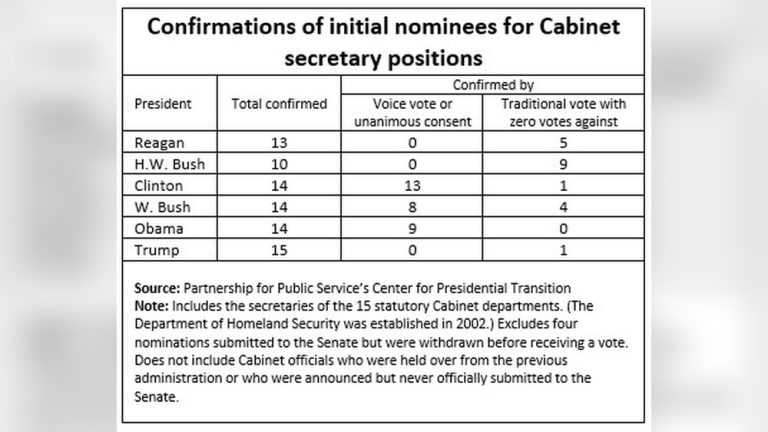
Trump’s cabinet confirmations were often highly partisan, with many nominees receiving narrow margins compared to previous administrations.
| Cabinet Position | Nominee | Senate Vote | Notable Opposition |
|---|---|---|---|
| Secretary of Education | Betsy DeVos | 50, 50 (VP breaks tie) | Strong Democratic opposition |
| Secretary of State | Rex Tillerson | 56, 43 | Concerns over Russia ties |
| Attorney General | Jeff Sessions | 52, 47 | Civil rights concerns |
| Secretary of Defense | James Mattis | 98, 1 | Broad bipartisan support |
| Secretary of Treasury | Steven Mnuchin | 53, 47 | Criticism over Wall Street ties |
Cabinet Turnover: Historical Perspective
The Trump administration saw a historically high rate of cabinet turnover. According to the Brookings Institution, more than 90% of the original cabinet-level positions experienced turnover, far exceeding the average for recent presidents.
| Administration | Cabinet Turnover Rate (%) | Years in Office |
|---|---|---|
| Trump | 91% | 4 |
| Obama | 68% | 8 |
| Bush (43) | 65% | 8 |
| Clinton | 71% | 8 |
Pro Tip: High cabinet turnover can disrupt policy continuity and agency operations, making it harder for administrations to achieve long-term goals.
Notable Examples: Impact And Controversy
Betsy Devos: Education Reform And Opposition
Betsy DeVos’s confirmation as Secretary of Education was among the most contentious. She championed school choice, charter schools, and voucher programs, which supporters argued would increase educational competition. Critics contended her policies undermined public education. Her confirmation required the Vice President’s tie-breaking vote, a first for any cabinet secretary.
Rex Tillerson And Mike Pompeo: Changing Diplomatic Strategies
Rex Tillerson’s corporate background brought a unique perspective but clashed with State Department norms. His successor, Mike Pompeo, took a more politically aligned approach, supporting Trump’s “America First” foreign policy. This shift influenced U.S. relations with allies and adversaries, notably in negotiations with North Korea.
Scott Pruitt And Andrew Wheeler: Environmental Policy Shifts
As Environmental Protection Agency (EPA) Administrators, Scott Pruitt and later Andrew Wheeler rolled back numerous environmental regulations, prioritizing economic growth over climate policy. Their leadership marked a dramatic change from the previous administration’s focus on environmental protection.
Elaine Chao: Infrastructure And Resilience
Elaine Chao’s experience in public administration helped steer the Department of Transportation through major challenges, including efforts to modernize U.S. infrastructure and respond to the COVID-19 pandemic’s impact on transportation networks.
Case Study: Wilbur Ross And The 2020 Census
As Secretary of Commerce, Wilbur Ross oversaw the planning and execution of the 2020 Census. The attempt to add a citizenship question became a major legal and political controversy, ultimately being blocked by the Supreme Court. The episode highlighted the intersection of cabinet leadership and national policy disputes.
Comparison: Trump’s Cabinet Vs. Previous Administrations
Backgrounds And Experience
Trump’s cabinet appointments were notable for the high proportion of business leaders, military officials, and outsiders compared to career politicians or policy experts. For example, Rex Tillerson, Wilbur Ross, Steven Mnuchin, and Linda McMahon all had substantial private sector experience.
Policy Priorities
Compared to prior cabinets, Trump’s team emphasized:
- Deregulation: Reducing federal rules across industries
- Economic nationalism: Tariffs, trade renegotiations
- Immigration enforcement: Border security, travel bans
- Military strength: Increased defense spending
These priorities contrasted with the Obama administration’s focus on climate change, healthcare, and multilateralism.
Diversity And Representation
Trump’s cabinet was less diverse than those of recent predecessors, with fewer women and minorities in top posts. For example, only two women, Elaine Chao and Betsy DeVos, held core cabinet positions at the start.
Confirmation Difficulty
Trump’s nominees faced more party-line votes and greater opposition than previous cabinets. This reflected a polarized Senate and the controversial nature of several picks.
Real-world Examples Of Cabinet Impact
Example: Alex Azar And The Covid-19 Response
As Secretary of Health and Human Services, Alex Azar faced the unprecedented challenge of managing the early U.S. response to COVID-19. His department was responsible for coordinating public health messaging, distributing medical supplies, and supporting vaccine development. The effectiveness and timing of these actions remain subjects of ongoing analysis and debate.
Example: Ben Carson’s Approach To Housing Policy
Ben Carson took a hands-off, deregulation-focused approach as Secretary of Housing and Urban Development. He rolled back Obama-era fair housing rules and prioritized partnerships with private developers to increase affordable housing access.
Example: John F. Kelly’s Role In Immigration
As Secretary of Homeland Security and later Chief of Staff, John F. Kelly was instrumental in implementing Trump’s strict immigration policies, including increased border enforcement and the controversial family separation policy.
Key Challenges And Controversies In Confirmation
Ethics And Conflicts Of Interest
Many Trump cabinet appointees came from the private sector, raising concerns about conflicts of interest and ethics. For instance, Wilbur Ross faced scrutiny for retaining interests in companies regulated by his department, while Scott Pruitt was the subject of multiple ethics investigations.
Policy Disagreements And Internal Tensions
Several cabinet members experienced public disagreements with President Trump, leading to high turnover. Rex Tillerson, James Mattis, and Jeff Sessions all left after clashing with the President on key issues.
Senate Resistance And Withdrawn Nominations
A record number of Trump’s initial cabinet picks withdrew or were replaced before confirmation, including Andrew Puzder (Labor) and Ronny Jackson (Veterans Affairs).
Pro Tip: Careful vetting and bipartisan outreach can help minimize confirmation delays and policy disruptions.
Legacy Of Trump’s Cabinet Confirmations
Policy Shifts And Institutional Change
The policies pursued and the manner in which they were implemented have left lasting marks on government agencies. Deregulation, aggressive enforcement of immigration laws, and realignment of foreign policy priorities continue to influence the U. S. political landscape.
Impact On Future Administrations
Trump’s reliance on nontraditional appointees and willingness to prioritize loyalty over experience may influence future presidential cabinet selections. The high rate of turnover and public disputes set new precedents for executive branch management.
Lessons For Governance
The Trump cabinet experience underscores the importance of:
- Selecting nominees with both subject expertise and political acumen.
- Navigating the Senate’s confirmation process with transparency and thorough preparation.
- Maintaining ethical standards to preserve public trust.
Frequently Asked Questions
Who Was The First Cabinet Member Confirmed In Trump’s Administration?
The first cabinet member confirmed was James Mattis as Secretary of Defense. His confirmation took place on January 20, 2017, the same day as Trump’s inauguration. The Senate acted quickly due to bipartisan support for Mattis’s military experience and reputation.
Did Any Trump Cabinet Nominees Fail To Be Confirmed?
Yes, several nominees withdrew before Senate votes due to opposition or controversy. Notably, Andrew Puzder (Labor) and Ronny Jackson (Veterans Affairs) both withdrew after facing bipartisan concerns over qualifications and background issues.
How Did Trump’s Cabinet Compare In Diversity To Previous Administrations?
Trump’s cabinet was less diverse in terms of gender and ethnicity than those of Barack Obama or George W. Bush. Only two women held core cabinet positions initially, and there were fewer African American and Hispanic members compared to previous cabinets. For more on historical context, see the official Cabinet of the United States page.
What Role Did The Senate Play In Shaping Trump’s Cabinet?
The Senate’s confirmation process was pivotal, with several nominees facing extended hearings and close votes. The Senate’s willingness to confirm or reject nominees influenced the administration’s policy capacity and shaped public perceptions of legitimacy.
Did Trump’s Cabinet Turnover Affect Government Performance?
Yes, high turnover affected continuity and policy implementation. Frequent leadership changes made it harder for agencies to plan long-term initiatives, and acting officials sometimes lacked the authority or mandate of confirmed leaders. For an in-depth analysis, see the Brookings Institution’s report on cabinet turnover.
As Seen Through The
Products related to this article
Sponsored / affiliate links. As an Amazon Associate I earn from qualifying purchases. I may earn additional commission from eligible campaigns.