Plywood Cabinets vs MDF Cabinets: Which Is Better?
Use plywood for cabinet boxes, sink bases, and exposed end panels; use MDF for painted doors and fixed shelves in dry zones. I have seen the wrong call swell, sag, and chip fast near sinks and dishwashers, and the repair bill climbs just as fast. This guide compares plywood and MDF by cabinet part and kitchen risk zone.
| Decision factor | Plywood Cabinets | MDF Cabinets | Winner |
|---|---|---|---|
| Moisture tolerance | Cross-grained veneer plies cut thickness swelling and shrinkage, so edges and faces hold up better near sinks and dishwashers. | More moisture-sensitive; edge swell, bubbling, and breakdown show up faster when water reaches raw edges or cutouts. | Plywood Cabinets |
| Painted finish quality | Can telegraph grain unless the finish system includes more prep and filling. | Smooth, flat, and grain-free, so paint lays more evenly on doors and fronts. | MDF Cabinets |
| Boxes, shelves, and install handling | Stronger resistance to bending, better shelf span behavior, and lighter handling during install. | Good dimensional consistency, but heavier feel and more edge damage risk during drilling and fastening. | Plywood Cabinets |
| Cost and finish system | Higher material cost, but less risk in wet zones and fewer failure repairs over time. | Often costs less than plywood alternatives, especially where painted or laminate fronts are planned. | MDF Cabinets |
Plywood cabinets vs MDF cabinets: the core trade-off


Plywood and MDF solve different cabinet problems. Plywood is built from thin layers, or plies, of wood veneer stacked and glued together, with alternating grain directions that create cross-graining. MDF is made from wood fibers or pulp and resin under heat and pressure, which gives it a smooth, flat, grain-free face that paints cleanly.
The cabinet part matters more than the label. A sink base lives a harsher life than a dry pantry panel, and a painted shaker door asks for a different surface than a long shelf under dishes. That is why one material wins in one spot and loses in another.
What each material is made of
Plywood uses layered veneers, and the cross-grained build helps reduce splitting at edges and improves dimensional stability. It also cuts thickness swelling and shrinkage, which is why cabinetmakers reach for it in structural parts. Softwood plywood is usually made from cedar, Douglas fir, spruce, pine, or fir, while hardwood plywood is known for excellent strength, stiffness, durability, and resistance to creep.
MDF is a fiber board, not a veneer stack. That matters at cut edges, hinge bores, and sink cutouts, where exposed fibers take on moisture faster than a veneered panel.
Where each material tends to perform best
Plywood does the load-bearing work well. MDF does the paint-ready work well. When the job is a visible painted front with tight profiling, MDF often gives the cleaner result; when the job is a load-bearing box or a shelf that must stay flat, plywood is the safer bet.
Why the cabinet part matters more than the label
Cabinet boxes, doors, shelves, sink bases, and end panels do different jobs. Boxes need fastening strength and handling durability. Doors need clean profiles and stable edges. Shelves fight bowing. End panels need dent resistance and a clean painted face. One material rarely wins all five.
📊 The common plywood sheet size is 1.2 by 2.4 metres, or 4 feet by 8 feet. Source: Plywood.
How plywood and MDF behave in cabinet boxes
Plywood usually fits cabinet boxes better because it handles load, fasteners, and daily abuse with less trouble. MDF can work in some box systems, especially where panel thickness is consistent and the cabinet is protected from water, but it is less forgiving when edges get banged or when installers keep adjusting hardware.
Framed cabinets versus frameless cabinets
Framed cabinets can hide small panel differences because the face frame adds structure and tolerance. Frameless cabinets depend more on precise panels, flat parts, and consistent edge quality, which is why MDF is often favored in certain frameless builds. MDF is often suited to laminate cabinets and frameless cabinets.
Panel thickness, flatness, and fit tolerance
Plywood gives consistent strength across directions because of the cross-grain build, but sheet quality still matters. Lower-grade or inconsistent cores can change how a box fits, how a hinge screws bite, and how square a run stays after installation. MDF is very flat and uniform, which helps cabinet sides line up cleanly when the design depends on exact part size.
Weight, handling, and fastener durability during install
Plywood is often lighter and easier to handle during installation. That matters on long runs, upper cabinets, and any job where installers must hang boxes, drive anchor screws, and avoid corner blowouts. MDF can chip more at edges and screw points, so repeated fastening adjustments can increase the risk of strip-out or damage.
Which material works best for cabinet doors?
MDF often works well for painted cabinet doors, especially when a smooth finish or routed profiles are desired. Plywood can work for doors too, but its grain can telegraph through paint and its edges often need more build-up and prep to look as flat as MDF.
Painted doors and profile milling
MDF machines into clean, consistent profiles. That makes it a strong choice for shaker fronts, flat panels, and other painted doors where surface uniformity matters more than visible wood character. Plywood can show veneer layers at edges and may need extra sealing to keep the finish even.
Laminate-faced doors and edge stability
For laminate-faced doors, a smooth, stable substrate matters. MDF gives a very even face for laminate adhesion, while plywood can show more texture transfer if the finish system is thin. The catch is edge protection: once water gets to unsealed MDF edges, failure moves faster.
Screw holding for hinges and repeated adjustments
Door hardware gets adjusted more than people expect. MDF can hold hinges well when the holes are clean and the cabinet remains dry, but repeated adjustments or over-tightening can strip the substrate. Plywood is usually more forgiving when screws are reset or moved after installation.
Does moisture make plywood the safer pick?
Plywood is often the safer pick in damp cabinet zones because it tends to handle moisture better than MDF. MDF can look fine in a dry room, then fail quickly if water gets into a cut edge, a sink cutout, or a toe-kick area. The failure mode is often edge swell first, then bubbling, then breakdown.
Humidity, wet dishes, and everyday kitchen exposure
General kitchen humidity is not the same as a leak, but it still matters at seams and exposed edges. Plywood tolerates that background moisture better. MDF can stay stable in dry, painted areas, yet it needs stronger edge sealing and more caution around dish drying, steam, and standing water.
Sink base risk, dishwasher splash, and edge swell
The sink base is the danger zone. Even a small leak, a wet bottle, or repeated drips at the cabinet floor can start swelling at an MDF edge long before the owner notices. Dishwasher-adjacent panels face the same problem when steam and splash hit the lower corners repeatedly.
Typical failure modes: bubbling, swelling, and breakdown
MDF does not usually fail by dramatic cracking first. It swells, rounds over at edges, and then breaks down as fibers separate. Once that starts at a sink base or toe kick, repair often means replacing the affected part, not just sanding and touching up.
Use the cabinet-part decision matrix
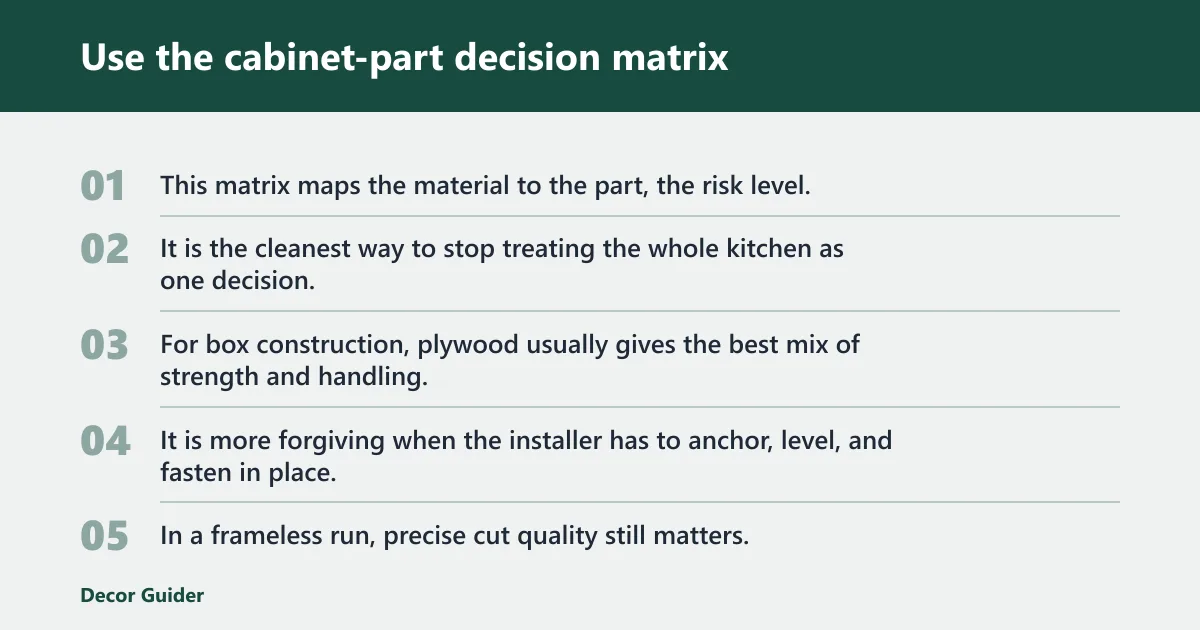
This matrix maps the material to the part, the risk level, and the finish system that makes sense. It is the cleanest way to stop treating the whole kitchen as one decision.
| Cabinet part | Preferable material | Risk level | Finish type | Reason |
|---|---|---|---|---|
| Boxes | Plywood | Medium | Paint, stain, or veneer finish | Better resistance to bending, better install handling, and more forgiving fastener behavior. |
| Doors | MDF for painted doors; plywood only when wood grain is wanted | Low to medium | Paint or laminate | Smooth, flat surface limits grain telegraphing and supports crisp profiles. |
| Shelves | Plywood for long spans; MDF only for short, dry spans | Medium | Paint, veneer, or laminate | Plywood resists bowing under heavy dishware and moisture better than MDF shelves. |
| Sink bases | Plywood | High | Moisture-tolerant finish, sealed edges | Wet exposure, leaks, and cut-edge risk make MDF a poor choice here. |
| End panels | Plywood or MDF with strong edge sealing | Medium | Paint or veneer face | Plywood resists dents and swelling better; MDF can work if the panel stays dry and fully sealed. |
Boxes
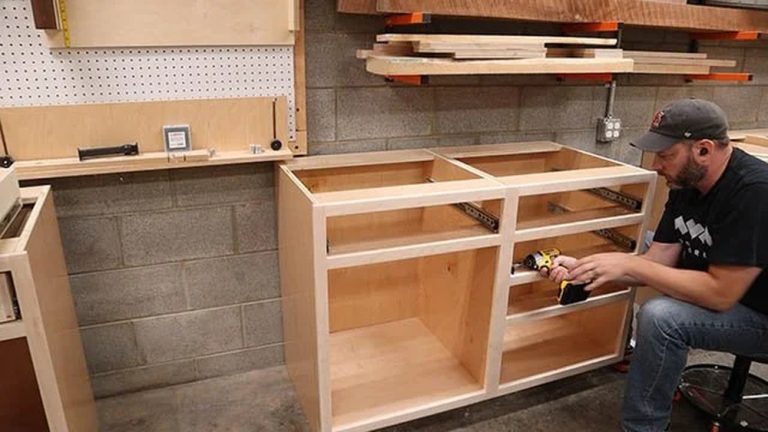
For box construction, plywood usually gives the best mix of strength and handling. It is more forgiving when the installer has to anchor, level, and fasten in place. In a frameless run, precise cut quality still matters, but the box itself stays less vulnerable to edge damage than MDF.
Doors
For painted doors, MDF is often the cleanest substrate. For wood-look doors or finishes that should read as real veneer, plywood is the more natural fit. The choice comes down to whether the door needs paint perfection or wood character.
Shelves
Shelf bowing under dishware load is a real problem. Lamont Bros says plywood shelving resists bowing under heavy dishware and moisture better than MDF shelves, and that tracks with how each material handles spans. Use plywood where the shelf is long, deep, or near steam and splashes.
Sink bases
Sink bases belong in the high-risk category. A minor leak can turn into edge swell quickly if MDF is left unsealed or if water reaches a cut edge. Plywood gives more margin for error, which matters because sink leaks are rarely caught on day one.
End panels
End panels are the face the room sees, so paint quality and dent resistance both matter. MDF gives a smoother painted face, but plywood usually holds up better when carts, vacuums, or shoes hit the panel over time. In busy kitchens, that damage resistance matters as much as appearance.
Choose plywood if… / Choose MDF if…
Choose plywood when the part must carry weight, tolerate moisture, or survive repeated installation adjustments. Choose MDF when the part is dry, painted, and visible enough that finish quality matters more than raw toughness. A mixed build is often the practical answer.
Choose plywood if…
- the cabinet is a sink base or dishwasher-adjacent run;
- the part is a box, long shelf, or exposed end panel;
- the installer expects repeated hinge or level adjustments;
- the kitchen sees steady moisture, steam, or wet dish traffic.
Choose MDF if…
- the part is a painted door or flat panel with profiles;
- the finish system depends on a smooth, grain-free face;
- the cabinet zone stays dry and edge sealing is thorough;
- budget pressure matters and the part is not structural.
Mixed-material cabinet builds that make sense
A strong cabinet spec often uses plywood for the box, sink base, and shelves, then MDF for painted doors and some non-structural fronts. That split keeps the wet and load-bearing parts protected without forcing plywood into every visible surface. It also controls installed cost better than a blanket plywood upgrade.
Frequently asked questions
Are plywood cabinets better than MDF
For structural parts and wet zones, plywood is usually the better cabinet material. It handles bending, moisture, and fastener stress better than MDF. For painted doors and other smooth front-facing parts, MDF can be the better surface. The answer changes with the cabinet part, not the brand of the whole kitchen.
Plywood vs MDF cabinets
Plywood and MDF should be compared by component, not as one full-cabinet winner. Plywood is stronger and more moisture-resistant for boxes, shelves, and sink bases. MDF gives a smoother paint surface and often a lower installed cost on painted doors. A mixed build is common for good reason.
Is MDF or plywood better for kitchen cabinets
Plywood is usually better for the cabinet structure, especially in kitchens with sinks, dishwashers, or heavy use. MDF is usually better for painted doors and some flat fronts where finish quality matters. In dry, low-risk areas, MDF can perform well if edges are sealed and hardware is not over-tightened.
Solid wood vs MDF cabinets
Solid wood is a different conversation because it moves more with humidity and can show seasonal change. MDF is often chosen for painted parts because it stays flatter and gives a cleaner finish face. For cabinet doors and panels, MDF can outperform solid wood on paint quality, while solid wood may be preferred for a natural-grain look.
Plywood vs MDF for cabinets
For cabinet boxes, shelves, and moisture-prone zones, plywood usually wins. For painted doors and smooth, machine-cut profiles, MDF usually wins. Cost also differs: MDF cabinets can cost 10-15% less than plywood alternatives, but the installed value depends on which parts need paint quality versus moisture protection.
Are MDF cabinets good
MDF cabinets are good when the design calls for painted fronts, flat panels, and dry conditions. They are less suitable where water can reach cut edges or where hardware will be adjusted many times. Used in the right part of the cabinet, MDF performs well and can keep finish quality high.
Products related to this article
Sponsored / affiliate links. As an Amazon Associate I earn from qualifying purchases. I may earn additional commission from eligible campaigns.