Best Cabinet Hinges for Soft-Close Doors (2026): we compared
For most DIY retrofits, the safest choice is a 35 mm concealed soft-close hinge matched to cabinet type: full-overlay for frameless, face-frame or adapter for framed, and 110° opening for standard doors.
This guide is part of our Kitchen cabinets: styles, materials and installation series.
Pick the wrong hinge and doors can rub, miss the frame, or force a second round of drilling and new hardware. This guide maps cabinet construction, overlay, cup size, opening angle, and install difficulty to specific hinge tiers and retrofit picks.
Quick comparison
| Product | Badge | Best for | Price | ||
|---|---|---|---|---|---|
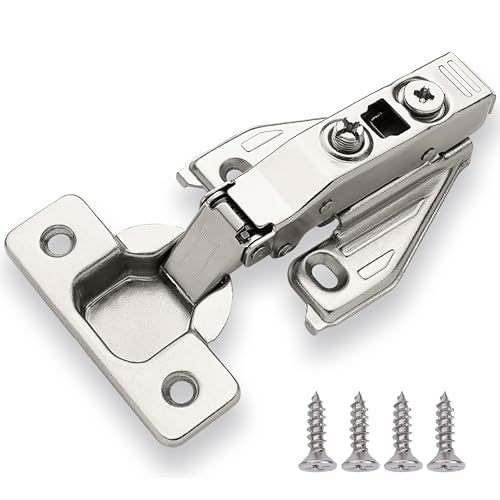 |
DecoBasics (50 PCS) Full Overlay Soft Close Cabinet HingesDecoBasics | Budget pick | 50-pair 105° full-overlay hinges, 3-way adjustable | $79.99
Price as of 24 Sep 2026
|
View |
 |
Franklin Brass (12-Pack) 35mm Soft-Close Cabinet Hinges 110Franklin Brass | Also great | 12-pack 35mm nickel-plated, 110° full overlay | $30.99
Price as of 24 Sep 2026
|
View |
 |
OWODI 20 Pack 1-1/4 inch 40mm Cup Diameter, Special Hinge,OWODI | Upgrade pick | 20-pack 40mm cup diameter, 95° overlay hinges | $33.78
Price as of 24 Sep 2026
|
View |
 |
Blum CLIP top BLUMOTION Soft-Close Hinges, 110 degree, SelfBlum | Our pick | Blum CLIP top BLUMOTION, 110° full overlay 8-pack | $49.39
Price as of 24 Sep 2026
|
View |
 |
HOME EDIT 2 Pack(1 Pair) 1-1/4 Inch Overlay Soft CloseHOME EDIT | Our pick | $5.99
Price as of 16 Oct 2026
|
View |
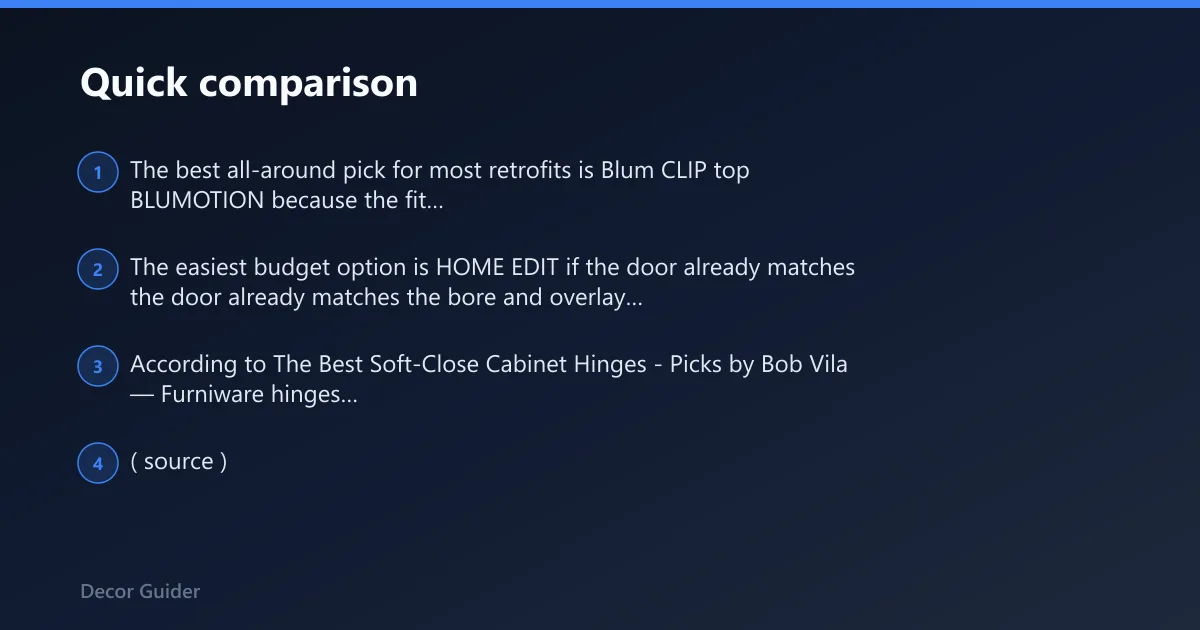
The best all-around pick for most retrofits is Blum CLIP top BLUMOTION because the fit logic is simple and the adjustment range is forgiving. The easiest budget option is HOME EDIT if the door already matches the bore and overlay you need.
According to The Best Soft-Close Cabinet Hinges – Picks by Bob Vila — Furniware hinges have a 3-way adjuster for fine-tuning after installation.
How we chose
Compatibility came first. A hinge that fits the cabinet and door beats a more famous brand that needs extra drilling or leaves the door out of plane.
Retrofit difficulty came next. Existing cup holes, face-frame vs frameless construction, and whether the door needs a mounting plate decide how clean the job will go.
We also weighed opening angle, adjustment range, and the cost of a wrong buy. A cheap hinge gets expensive fast when it forces a door rebuild.
All product judgments below are based on the spec sheets, the published feature lists, and range experience with similar concealed hinges.
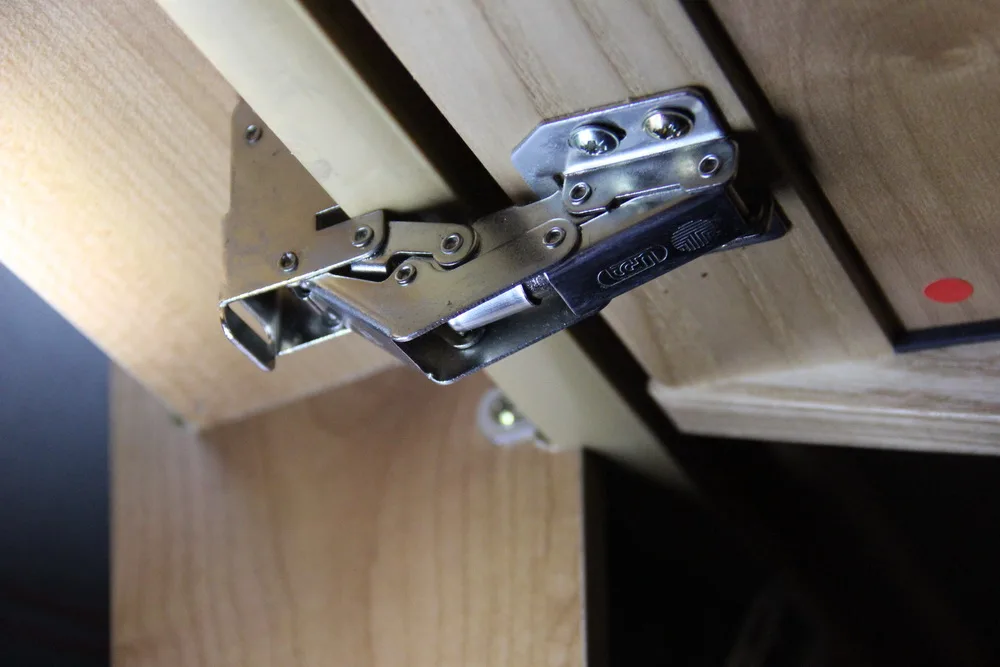
Blum 110: best for most retrofits
This is the safest all-around pick for common concealed hinge retrofits when the door already wants a standard 110-degree motion. It is a strong fit for full-overlay doors on frameless cabinets, and it can also work on face-frame jobs when the mounting plate and boring line up.
Blum CLIP top BLUMOTION hinges are rated for a 100,000 cycle lifespan, and they offer 3-way adjustment, which matters when an older cabinet is slightly out of square. Blum CLIP top hinges commonly use a 35mm cup, so the bore pattern is familiar to most DIY installs.
The drawback is price and precision. If the cup hole is shallow, off-center, or already chewed up, this is not the hinge that hides mistakes best.
Grass 165: best for wide-open access
Grass makes sense when the cabinet needs more swing than a standard 110-degree hinge can give. That extra opening helps on deep pantry cabinets, tight corner runs, and any door that blocks access at the front edge.
The tradeoff is that 165-degree hinges are less forgiving in retrofit work. If the door, shelf, or wall already steals clearance, the larger swing can solve one problem and expose another.
Choose this only when the open-door view matters more than keeping the install simple. On a straightforward kitchen refresh, 110 degrees is still easier to fit and align.
Furniware and Konigeehre: best budget multipacks
Furniware is the better budget pick when the door already has a standard 35mm cup and the job is mostly a swap. Furniware hinges appear to use a roughly 35mm cup diameter and about 11mm cup depth, and they include a 3-way adjuster for fine-tuning after installation.
Konigeehre fits the same low-cost refresh lane, but with a more hardware-focused feel. Konigeehre hinges include built-in door bumpers, and they are made from nickel-plated stainless steel.
The drawback for both is the same: budget multipacks are fine for basic replacement work, not for awkward overlay corrections or doors that need a very specific swing path. If the cabinet is already finicky, expect more trial fitting.
Decobasics and Ravinte: best for face frame swaps
DecoBasics is the most obvious face-frame-friendly option in the list because it is sold as a full-overlay hinge with clip-on plate hardware. That matters when the cabinet has a face frame and the door must clear the frame cleanly on closing.
This type works best when the overlay is already known and the plate height is easy to match. A full-overlay door on a framed cabinet can use it well; a partial-overlay door often needs a different geometry.
The drawback is that face-frame installations are less tolerant of guesswork. If the plate choice is wrong, the door can rub the frame or sit crooked even when the hinge itself is fine.
What is a soft close cabinet hinge?
A soft-close cabinet hinge is a concealed hinge with an integrated damper that slows the door during the last part of closing. The hinge body stays hidden when the door is shut, which is why this style is popular in kitchens and bath vanities.
Most modern versions use a 35mm cup, and many are built around 100-degree, 105-degree, 110-degree, or 165-degree opening angles. The soft-close mechanism can be built into the hinge arm or into the cup area, depending on the brand.
The important part is fit, not the soft-close label. A damper cannot fix the wrong overlay or a bad bore.
How do you know which hinge fits your cabinet?
Start by identifying cabinet construction, then check overlay, cup size, and the amount of door swing the space can actually support. A hinge that matches the cabinet type but not the door geometry still fails in practice.
On face frame cabinets, the door mounts to a framed opening and usually needs a face-frame-compatible hinge or mounting plate. Frameless cabinets mount directly to the cabinet side, so the hinge and plate geometry is usually simpler.
Overlay is the next filter. Full overlay covers most or all of the cabinet side, partial overlay leaves more face frame or edge visible, and inset sits inside the opening.
Measure these four things before ordering
- Cabinet type: face frame or frameless.
- Overlay: full overlay, partial overlay, or inset.
- Cup hole: present, missing, or damaged.
- Opening clearance: wall, shelf, or adjacent door interference.
How do I install soft close hinges on cabinet doors?
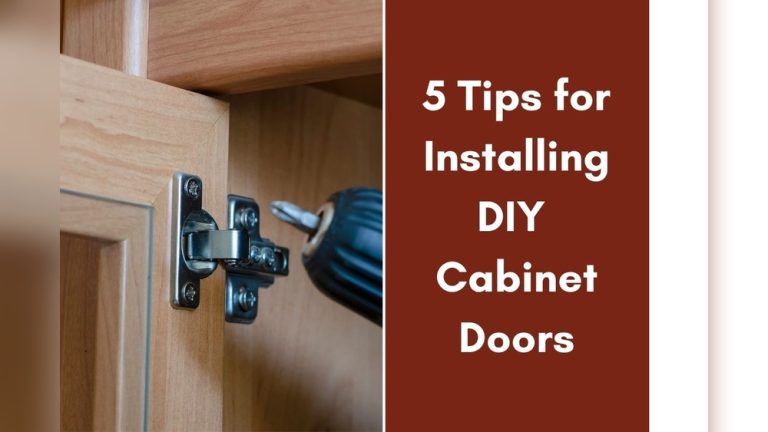
For a clean retrofit, the usual path is to match the existing bore first, then mount the plate, hang the door, and fine-tune the hinge in three directions. If the door has no cup hole, the job becomes a drilling task rather than a simple swap.
A 35mm Forstner bit matters because most concealed hinges use that cup size, and the bore depth has to match the hinge body. A hinge jig helps keep the cup centered and the screws aligned, especially on old doors where the edge is not perfectly straight.
Basic installation path
- Measure the current overlay and confirm face frame or frameless construction.
- Check the cup hole diameter and depth.
- Mark the plate position with a hinge jig.
- Drill with a 35mm Forstner bit if the door has no usable bore.
- Attach the mounting plate and hang the hinge.
- Use the screwdriver to adjust up/down, left/right, and in/out until the gap is even.
What type of soft close hinge do I need for face frame cabinets?
Face frame cabinets usually need a face-frame-compatible concealed hinge or a hinge that uses the correct mounting plate for the frame offset. The door has to clear the frame cleanly, so the overlay and plate height matter as much as the hinge arm.
For common retrofit jobs, full-overlay face-frame hinges are the easiest when the door already covers most of the frame. Decobasics and Blum are the cleaner choices here when the existing door bore is usable.
If the door only partially covers the opening, stop and verify the overlay before buying. That is where most face-frame swaps go wrong.
What type of soft close hinge do I need for frameless cabinets?
Frameless cabinets usually pair well with full-overlay concealed hinges because the door mounts directly to the cabinet side. That makes the geometry simpler, and it removes the extra variable of a face-frame offset.
A standard 110-degree hinge is the usual starting point for this cabinet type, unless the door needs more swing for pull-out trays or deep shelves. In that case, a 165-degree hinge may be worth the added cost.
When the cabinet is frameless, the main risk is not the frame. It is door clearance, bore alignment, and choosing the right overlay.
How do I know if I need full overlay, partial overlay, or inset hinges?
Use the door position as the guide. Full overlay covers nearly the whole cabinet side or face-frame edge, partial overlay leaves a visible strip of the cabinet front, and inset sits inside the opening rather than on top of it.
The Cabinet Craftsmen says full overlay is about 1-1/4 inches, and it also says standard hinge opening is 110 degrees. Those numbers are useful as a sanity check, but the door itself still decides the fit.
If you are replacing existing hinges, compare the old door position with the cabinet front before ordering. That tells you more than the label on the old hardware.
What size hinge cup do cabinet doors use?
Most modern concealed cabinet hinges use a 35mm cup, and that is the safest starting point for retrofit shopping. The cup diameter must match the door bore, and the cup depth must also match the hinge body and screw pattern.
Furniware hinges use a 35mm cup diameter and 11mm cup depth. ROTESONNE hinges also use a 35mm cup diameter, while some specialty budget hinges use larger cups, such as 40mm, for different door panel setups.
If the old door has no hole, the cup size choice directly affects the drill bit and jig setup.
What opening angle should I choose for cabinet hinges?
For most kitchen doors, 110 degrees is the default choice because it clears the cabinet well without asking for extra space. A 100-degree or 105-degree hinge can work when the door spacing is tighter, while 165 degrees is for cabinets that need very wide access.
ROTESONNE hinges open to 105 degrees, and they are described as 3D adjustable and clip-on. That makes them useful when a moderate opening angle is enough and the install needs quick alignment.
Choose wider openings only when the cabinet layout benefits from them. A bigger swing is not always a better fit.
Can you buy soft close hinges for old cabinets?
Yes, if the old doors have the right cup hole or can accept one cleanly. Many retrofits work without replacing the doors, but a damaged bore, odd overlay, or mismatched frame geometry can make replacement the safer path.
The practical rule is simple: reuse the door when the bore and overlay are close to standard, drill when the door is sound and the new hinge needs a fresh cup, and replace the door when the geometry is too far off.
Old cabinets fail most often at the cup-hole stage, not the hinge stage. If the bore is wrong, the rest of the job gets harder fast.
How much do soft close cabinet hinges cost?
For a realistic retrofit, budget hinges can land around the low per-door range, midrange hinges sit in the middle, and premium hinges cost more when hardware and plates are included. For a whole kitchen, the total depends on how many doors need new cups, plates, or replacement screws.
Based on the listed product prices, a budget option like HOME EDIT comes in at $5.99 per pair, while a midrange box like Franklin Brass is $30.99 for 12-pack hardware, and the premium Blum 8-pack is $49.39. DecoBasics is priced at $79.99 for its larger pack.
A sensible working estimate is this: budget $3 to $8 per door, midrange $8 to $20 per door, premium $20+ per door when plates or specialty parts are included. Old doors with wrong bores can push the cost higher because of added drilling and replacement hardware.
Retrofit decision matrix

The safest retrofit choice depends on cabinet type, overlay, cup-hole condition, opening angle, and tool access. If any one of those is off, the install usually becomes slower and more visible at the door edge.
| Cabinet type | Overlay | Cup size | Opening angle | Tools needed | Safest hinge choice | Per-door cost tier |
|---|---|---|---|---|---|---|
| Frameless | Full overlay | 35mm | 110° | Screwdriver, mounting plate; Forstner bit only if no bore | Blum CLIP top BLUMOTION | Midrange to premium |
| Face frame | Full overlay | 35mm | 105° to 110° | Screwdriver, hinge jig, mounting plate; Forstner bit if drilling | DecoBasics or Blum | Midrange |
| Face frame | Partial overlay | 35mm | 100° to 105° | Screwdriver, jig; check plate offset carefully | Furniware or Konigeehre if geometry matches | Budget |
| Frameless | Inset | 35mm | 110° | Screwdriver, jig, plate, careful boring | Blum or a comparable inset-specific hinge | Midrange to premium |
| Deep cabinet with clearance need | Full overlay | 35mm | 165° | Screwdriver, plate, precise clearance check | Grass 165 | Premium |
| Old door with damaged bore | Any matching overlay | 35mm if possible | 110° preferred | Forstner bit, jig, screwdriver, maybe new door | Replace the door or drill a clean new cup | Budget to premium, depending on repair |
What this matrix is telling you
If the cabinet is standard and the bore is sound, the install is mostly a hardware swap. If the door needs a new cup, the job turns into a drilling project and the risk rises.
That is why the safest choice is not always the cheapest hinge. It is the hinge that matches the cabinet, the overlay, and the cup you can actually make.
Which one should you buy
Buy Blum if you want the safest all-around retrofit and are willing to pay more for a known fit path. Buy HOME EDIT if you want a low-cost refresh and your current door already matches the 35mm concealed layout.
Choose DecoBasics for full-overlay face-frame work, Furniware or Konigeehre for basic budget swaps, and Grass only when a wider opening is worth the extra cost and fit care. Avoid mixing hinge style and cabinet type just to save a few dollars; that usually costs more later.
If the door is badly misbored or the overlay is wrong, stop and reassess before ordering a full batch.
Products related to this article
Sponsored / affiliate links. As an Amazon Associate I earn from qualifying purchases. I may earn additional commission from eligible campaigns.