Cabinet Hinge Cost
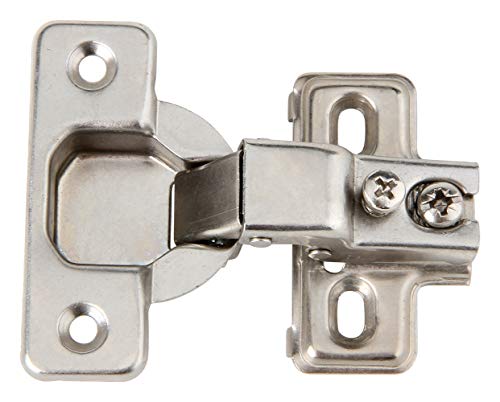
Cabinet hinge prices are often around $2 to $12 per hinge for standard concealed models, $15 to $40 for specialty soft-close or overlay hinges, and professional replacement for a small batch of doors is commonly around $75 to $200. Buying the wrong type can lead to doors that rub, won’t close correctly, or need a second round of labor. This guide breaks down part prices, installation costs, and replacement triggers so you buy only the hinge you need.
Factors affecting hinge cost


Cabinet hinge cost has three parts: the hinge itself, the labor to fit it, and any repair or replacement work tied to damaged doors or misaligned boxes. The part price can look small, but the wrong hinge style can raise labor or force a second visit.
Part price versus installation cost
Retail hinge prices usually rise when you add soft-close damping, more adjustment, a larger opening angle, or a specialty mount for inset, overlay, or angled doors. Installation cost rises when the existing holes do not match the new hinge, the door needs patching, or the installer has to correct sagging and strike issues.
A single straightforward swap on a wood cabinet door is usually less costly than a full changeover from exposed hinges to concealed cup hinges. Labor also climbs when hinges are sold in bulk but the cabinet set needs drilling, alignment, and door removal one by one.
What drives a higher hinge price
Material often sets the price floor. Cold-rolled steel, stainless steel, and aluminum each suit different load demands, moisture exposure, and finish needs. Nickel plating and other corrosion-resistant finishes usually cost more than plain steel hardware.
Motion and hardware complexity matter too. A soft-close mechanism adds damping parts, and fine adjustment screws add setup control. Higher load ratings, wider opening angles, and specialty geometry for inset or angled installs usually push the part price higher than a standard concealed hinge.
When repair costs beat replacement
Repair makes sense when the hinge is still structurally sound and the problem is limited to loose screws, a mis-set adjustment, or a worn mounting plate. Replacement is usually the better call when the arm is bent, the spring no longer holds tension, or the damping action has failed.
Picture a kitchen door that sits low on the latch side because the mounting screws have backed out of particleboard. Re-tightening or using proper anchors can solve it. If the hinge cup is cracked or the arm is twisted, replacement is the safer fix.
Cabinet hinge cost matrix
This matrix compares common hinge types by use case, price driver, durability, install difficulty, and whether repair or replacement is the better move. Use it to match the hinge to the door before you pay for features you do not need.
| Hinge type | Typical use case | Price driver | Expected durability | Install difficulty | When to replace versus repair |
|---|---|---|---|---|---|
| Standard concealed | Kitchen cabinets, wardrobes, furniture doors | Basic steel body, common 100° opening, simple adjustment | Good for normal duty when the finish resists corrosion | Moderate; drilling and alignment matter | Repair loose screws or minor alignment; replace if spring action fails or the cup is damaged |
| Soft-close | Bedroom furniture, kitchens, rental units, family homes | Integrated damping, often built into the hinge boss | Strong when the damper is rated for repeated cycles | Moderate to higher because setup must be precise | Replace if damping weakens, closes unevenly, or the mechanism leaks or binds |
| Heavy-duty | Large wood doors, thicker doors, high-use cabinets | Higher load rating, thicker steel, stronger hinge arm | Higher vertical load capacity and better long-life performance | Higher; door weight and screw holding power matter | Repair only if fasteners loosen; replace if load has exceeded the hinge or the arm bends |
| Inset | Flush doors inside the frame line | Special geometry and tighter fit requirements | Good if the fit is correct and the cabinet stays stable | Higher; alignment tolerance is tighter | Replace when the door no longer aligns after adjustment or the hinge cannot hold the reveal |
| Overlay | Most modern face-frame and frameless cabinets | Overlay amount, adjustment range, soft-close option | Good to very good, depending on material and cycle rating | Moderate; overlay must match the cabinet face | Repair if the issue is setup; replace if overlay geometry is wrong for the door |
| Specialty-angle | Corners, angled cabinets, glass or aluminum frame applications | Nonstandard geometry and compatibility parts | Varies widely by application and mounting quality | Higher; fit and angle selection are critical | Replace when the hinge angle does not suit the cabinet or the door swings into adjacent fronts |
What affects hinge price?
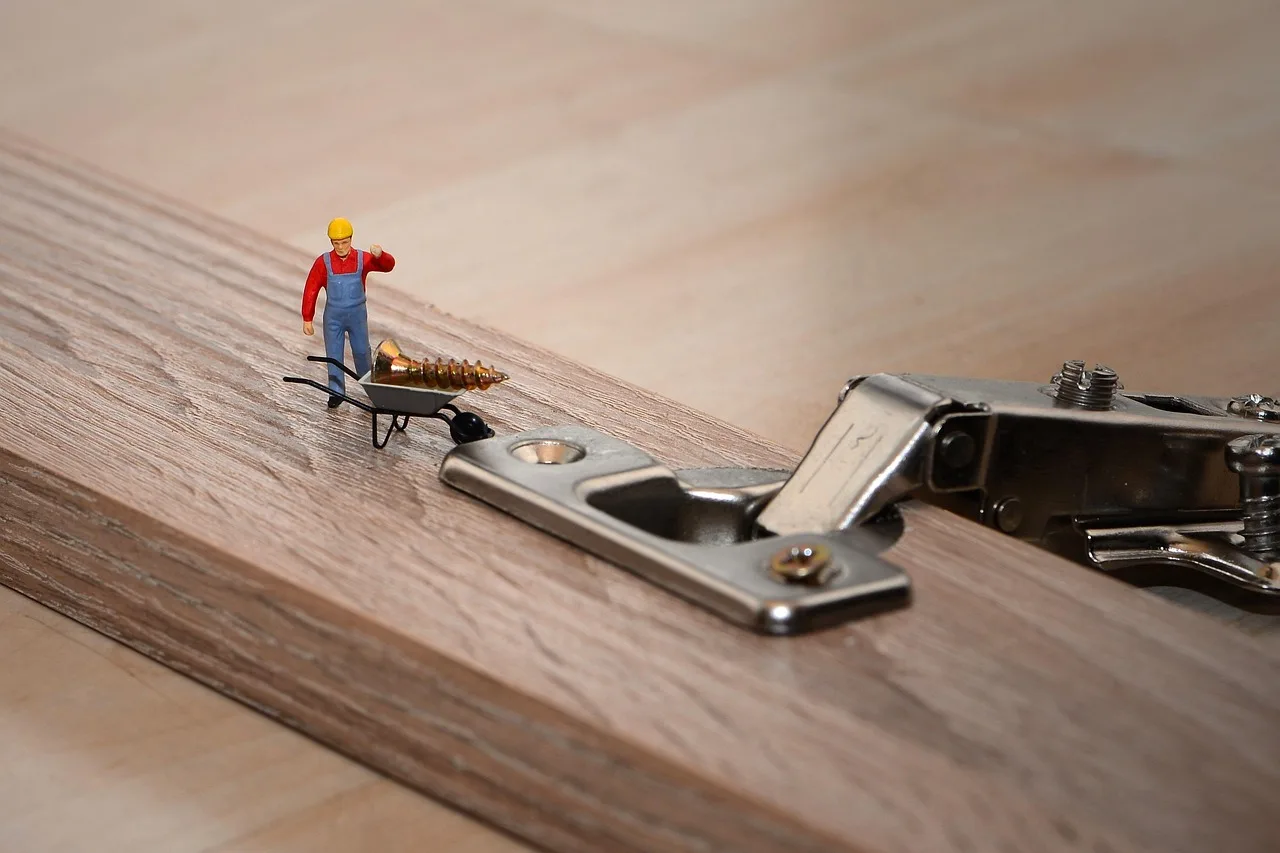
The biggest price drivers are material, finish, motion type, adjustment range, load rating, and testing claims. A basic hinge can cost very little, while a soft-close model with more adjustment and a stronger finish costs more because the hardware does more work and lasts longer under repeated use.
Material choice and finish
Steel is the common baseline. Cold-rolled steel with nickel plating is a practical choice for many wood cabinet doors because it balances strength and corrosion resistance. Stainless steel works better where moisture or cleaning exposure is higher, while aluminum is often chosen for lighter-duty or frame-based applications.
Finish affects both appearance and wear. A plated or coated finish can slow corrosion and keep the hinge moving smoothly for longer. That matters in kitchens and laundry rooms, where steam and cleaning products can shorten service life.
Opening angle and motion type
Standard concealed hinges often open to around 100 degrees, which is enough for many cabinet doors. Specialty options can open wider or work at different geometry, such as 45 degrees, 90 degrees, 135 degrees, or 165 degrees, depending on the catalog line and cabinet layout.
One-way motion means the door moves in the normal direction only. Two-way or specialty motion can solve clearance problems, but it usually adds cost. Soft-close hinges also cost more because damping parts must control the closing speed without slamming.
Adjustability and mounting style
Adjustment hardware is a strong buying signal. Side adjustment changes left-right position, depth adjustment moves the door in or out, and height adjustment raises or lowers the door. Screw-based fine tuning helps you correct gaps without remounting the cabinet.
Mounting style matters too. Concealed cup hinges hide most of the hardware, while exposed hinges show the knuckle and leaf. Concealed styles usually give more setup control, which is why they are common in kitchens and fitted furniture.
Load rating and cycle testing
Load rating tells you how much vertical weight the hinge can support. For heavier doors, that rating matters as much as the opening angle. Cycle testing is the other major signal, since a hinge that survives more open-close cycles is more likely to hold alignment over time.
AOSITE states its hinge can bear up to 30KG vertically and was tested for over 80,000 cycles. Blum says its hinges were tested for 200,000 opening and closing cycles and that all hinges include side, depth, and height adjustment. Blum also states its cabinet hinges are BIS certified under IS 18297:2023.
Which hinge type fits your cabinet?
The right hinge depends on the door material, cabinet frame, and how far the door must swing. Kitchen cabinets, wardrobes, furniture doors, glass fronts, and aluminum frames all place different demands on the hinge body and mounting system.
Kitchen cabinets and wardrobes
Kitchen cabinets often use concealed overlay or soft-close hinges because the doors get frequent use and people value quieter closing. Wardrobes and furniture doors can use standard concealed hinges if weight is moderate and the door thickness matches the hinge spec.
Blum offers three hinge lines: CLIP top BLUMOTION, CLIP top, and MODUL. That line split matters because it lets you choose between soft-close, standard, and more specialized fit needs instead of paying for one premium feature on every door.
Wood doors, glass doors, and aluminum frames
Wood doors need the hinge cup and screw pattern to match the door thickness and the cabinet material. The same source says its hinge fits wood cabinet doors 16-20mm thick. That range helps narrow the purchase to the actual door build.
The same source says its hinges support multiple material thicknesses and angled applications. That is useful for mixed projects where some doors are wood and others are framed or angled. Glass and aluminum frame applications usually need a hinge built for that material system, not a standard wood-door cup hinge.
Inset, overlay, and angled applications
Inset doors sit inside the frame opening and need tighter reveal control. Overlay doors cover part of the face frame or carcass and are easier to standardize, which is one reason they are common in retail hinge packs.
Angled applications need a hinge that matches the cabinet geometry, not just the door size. Tallsen lists 165-degree, 135-degree, 90-degree, and 45-degree options in its hinge category list, which shows how specialized angle work can be. A mismatch here usually means poor clearance or an unsightly gap.
How do you choose the right size?
Choose hinge size by checking door thickness, door weight, cabinet material, and the amount of cover space the hinge must handle. If those numbers do not fit the hardware, no amount of adjustment will fully fix the door.
Door thickness and cabinet material
Start with the door thickness. The hinge must be rated for the actual panel thickness, especially on wood cabinet doors. Softer cabinet materials can strip fasteners more easily, so the mounting style and screw length matter as much as the hinge body.
For framed cabinets, check the base plate and the hole pattern against the cabinet material. A hinge that works on solid wood may not hold the same way in MDF or particleboard without the correct screws or anchors.
Door weight and load limits
Heavier doors need stronger arms, better screw holding, and a hinge with a higher load rating. A lightweight door can use a basic concealed hinge, but a thick panel or a tall pantry door usually needs a stronger model with better long-life performance claims.
Durability claims are only useful when they are tied to a rating or test. Cycle counts, vertical load numbers, and finish resistance are all easier to compare than vague quality language.
Checking cover space, depth, and base
Cover space is the amount of door edge the hinge must account for when the door closes. Depth adjustment helps set how far the door sits from the cabinet front. Base height and plate type matter when you need the door to line up with adjacent fronts.
Say your overlay door has 19mm thickness and keeps rubbing the pull side after installation. A hinge with side and depth adjustment can correct the gap if the geometry is right; if the overlay itself is wrong, a different hinge style is the better fix.
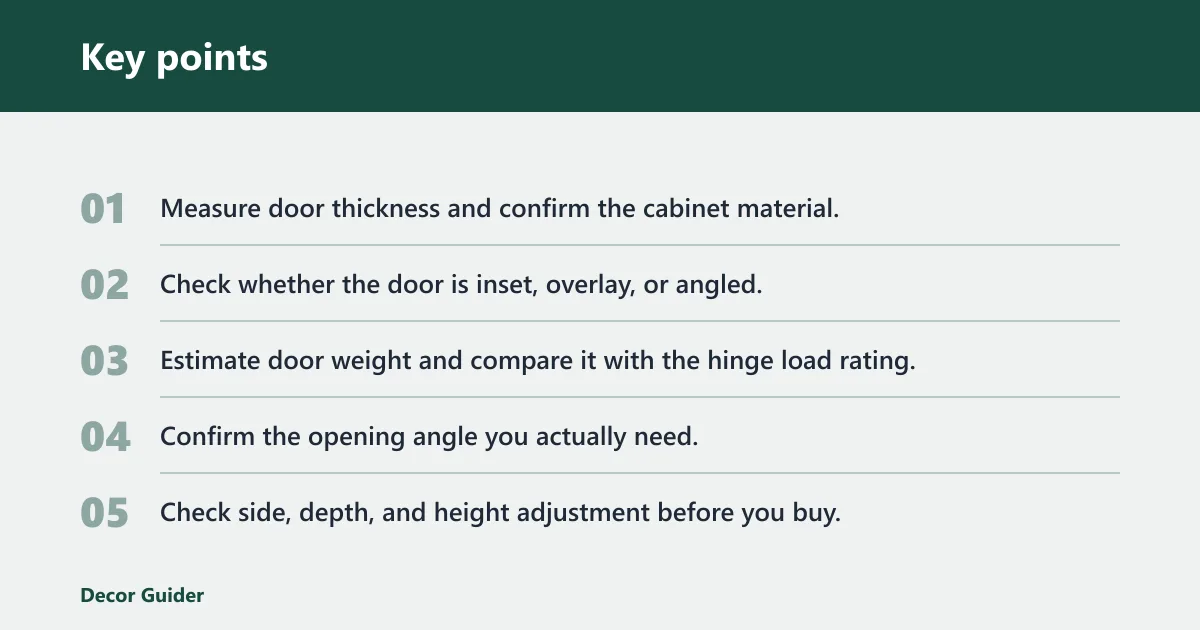
- Measure door thickness and confirm the cabinet material.
- Check whether the door is inset, overlay, or angled.
- Estimate door weight and compare it with the hinge load rating.
- Confirm the opening angle you actually need.
- Check side, depth, and height adjustment before you buy.
- Match the finish to the room’s moisture and wear level.
How much does replacement cost?
Replacement cost depends on whether you are changing one hinge, swapping a whole door set, or paying a pro for fitting and alignment. The more the new hinge differs from the old one, the more the job shifts from a quick swap to a small hardware project.
Single hinge swap versus full-door replacement
A single hinge swap is cheapest when the hole pattern matches and the door remains in good shape. Full-door replacement becomes necessary when the hinge layout is wrong, the door is split, or the cabinet front needs a new overlay or inset setup.
That is why cabinet hinge replacement cost can move well beyond the part price. If the old hardware leaves damaged screw holes or the door needs patching, the total job includes carpentry time, not just hardware.
Labor cost for DIY and pro installs
DIY labor is mostly your time and the tools you already have: drill, driver, measuring tape, and a level. Pro labor rises when the installer has to remove old hardware, patch holes, drill new cups, and tune the door line across several cabinets.
For a small batch of doors, professional replacement often lands around $75 to $200, depending on region and complexity. A local market with higher labor rates or custom cabinet work will usually land higher than a basic retrofit.
Wholesale, retail, and bulk order buying
Retail buying works well for one-off repairs. Wholesale buying makes more sense when you need matching hinges for multiple cabinets, a rental turn, or a full kitchen set. OEM and ODM supply can help contractors and cabinet shops specify exact geometry, finish, and packaging.
Ask about bulk order availability, shipping terms, and whether the hinges are packed with screws, base plates, and adjustment hardware. Those details affect both cost and install time. A cheaper hinge without the right mounting parts is not a bargain.
When should you repair or replace?
Repair the hinge when the body is sound and the issue is adjustment, loose screws, or a mounting problem. Replace it when the hinge has visible damage, weak spring action, failed damping, or repeated misalignment that returns after tuning.
Loose screws and worn adjustment hardware
Loose screws often point to stripped holes or a soft cabinet substrate, not a failed hinge. In that case, repair can be as simple as improving the screw hold and resetting the side, depth, or height adjustment.
Worn adjustment hardware is different. If the screw heads strip or the hinge no longer holds position, replacement is usually faster and more reliable than forcing a weak part to keep working.
Bent arms, failed springs, and damping loss
A bent hinge arm changes the geometry of the door and usually cannot be corrected cleanly. Failed spring action is another replacement trigger, especially on standard concealed hinges that no longer hold the door closed.
Soft-close hinges should shut with controlled damping. If the door slams or closes unevenly, the damper may have worn out. At that point, replacement is usually better than trying to salvage a mechanism that no longer controls motion.
Corrosion, finish wear, and repeated misalignment
Surface rust, flaking finish, or pitted metal are signs that the hinge is past simple repair, especially in kitchens, laundry rooms, or humid spaces. Corrosion can also make adjustment screws bind, which turns a small fix into a larger job.
Repeated misalignment is another warning. If you keep correcting the same door and it drifts out again, the hinge or the mounting substrate has likely lost stability. Replacing the hinge, or switching to a better load-rated model, is usually the more durable choice.
Frequently asked questions
How much do cabinet hinges cost?
Most standard concealed cabinet hinges cost $2 to $12 per hinge at retail, while specialty soft-close, overlay, or heavy-duty versions often cost $15 to $40 each. Bulk buying can lower unit price, but shipping, mounting plates, and finish quality can change the final total.
What are the best cabinet hinges?
The best cabinet hinges are the ones that match the door type, weight, and cabinet geometry without extra features you will not use. For many kitchens, a concealed hinge with side, depth, and height adjustment is the safest all-around choice. For heavier doors, choose a higher load rating and stronger material.
What is cabinet hinge replacement cost?
Cabinet hinge replacement cost includes the hinge, any patching or drilling, and labor if you hire it out. A small professional job often falls around $75 to $200 for a few doors, but the total rises when old holes need repair or when the new hinge style does not match the original.
What size cabinet hinges do I need?
You need a hinge sized to the door thickness, weight, cabinet type, and required opening angle. Check whether the door is wood, glass, or aluminum frame, and confirm the amount of cover space and base adjustment needed. A hinge that fits the wrong material or thickness will not align correctly.
Are soft-close cabinet hinges worth it?
Soft-close hinges are worth it when noise control, finger safety, and slower closing matter more than the lowest price. They add damping hardware, so they cost more than standard hinges, but they can reduce slam wear and improve day-to-day use in kitchens, bedrooms, and shared spaces.
Products related to this article
Sponsored / affiliate links. As an Amazon Associate I earn from qualifying purchases. I may earn additional commission from eligible campaigns.