Kitchen Cabinet Shelf Problems
Kitchen cabinet shelf problems usually come from four causes: loose or wrong pins, stripped holes, shelf sag from overload or span, or moisture-damaged material. Replace parts only after you identify which failure is present. If you guess wrong, the shelf will keep slipping, bowing, or collapsing, and you may damage the cabinet sides. This guide shows how to diagnose each failure, choose the right fix, and know when to replace the shelf, pins, or hardware.
What you’ll need


- Tape measure
- Flashlight
- Phillips and flat screwdrivers
- Replacement shelf pins or pegs in the correct diameter
- Cabinet shelf supports or retainers
- Wood glue and filler for minor hole wear
- Drill and drill bits for worn holes
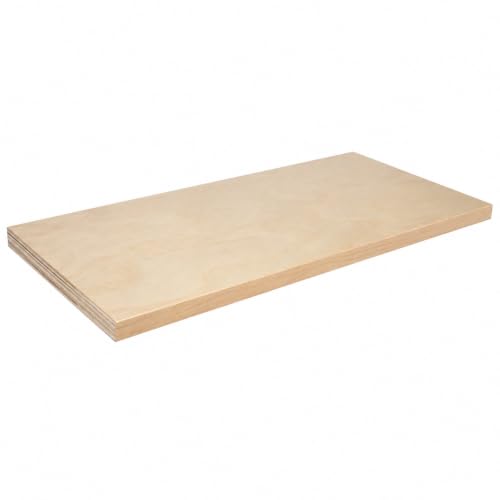
- Replacement shelf board material: particleboard, MDF, plywood, or solid wood
- Edge banding for cut shelf edges
- Level or straightedge
Measure the replacement parts before you buy them. The key checks are peg diameter, hole diameter, shelf thickness, shelf depth, inside cabinet width, and the amount of visible sag, bow, or edge damage. If the cabinet uses adjustable shelves, both sides must match or the shelf will not sit flat.
How do you diagnose the failure?
Start by sorting out pin slip, hole wear, shelf sag, board damage, and moisture swelling. That order matters because a shelf can look “bad” when the real issue is only a mismatched peg or a worn hole. Adjustable shelves depend on aligned cabinet side holes on both sides, so one weak point can make the whole shelf unstable.
- Remove the shelf and inspect the pins or pegs.
- Check both cabinet side holes for oval wear, cracking, or misalignment.
- Measure shelf thickness, span, and depth before choosing a replacement.
- Inspect for swelling, chipped edges, delamination, or a permanent bow.
Look at the shelf system first
Adjustable shelf systems rely on matched pins and hole spacing. Shelf pins, also called shelf pegs, support movable shelves and often come in plastic on budget cabinets. Some are metal, clip-style, or printed replacements. If the cabinet uses a fixed shelf, pin repair will not solve the problem.
A common first-timer mistake is replacing one broken peg with a random part that “almost fits.” Suppose one side hole accepts a loose peg and the shelf drops when loaded with plates. The fix is not a stronger-looking peg alone; it is a matched diameter and a check for worn cabinet side holes.
How do you fix loose shelf pins?
Loose pins usually mean the peg diameter is wrong, the hole is worn, or the support style is too weak for the load. Shelf pins must match the cabinet side-hole spacing and the hole size. If the shelf rocks on the pegs, upgrade the supports before you reload it.
- Measure the hole diameter and buy the matching peg size.
- Replace cracked plastic pegs with metal, printed, or clip-style supports.
- Insert the shelf, then press down at each corner to check for rocking.
What are cabinet shelf pegs called?
They are usually called shelf pins, shelf pegs, or shelf supports. Some cabinets also use retainers that stop the shelf from slipping out by accident. In cabinets with worn holes, a basic peg may hold the shelf in place but still allow movement under load, so a retainer or upgraded support can be the better choice.
If the old peg snapped, do not assume the shelf itself failed. Some cabinet shelf pegs are made of cheap plastic and can break often. A replacement shelf peg can also be made using 3D printing when a matching part is hard to find, but the printed part still has to fit the original hole diameter.
How do you stop shelf sag?
Shelf sag comes from load and span. Thin boards bend more, and deep upper cabinets show the problem sooner because the shelf spans farther and often holds heavier dishes. If the bow is permanent, fixing the supports alone will not recover the board.
- Use a simple risk check: deeper shelves, visible bowing, heavy dish storage, and damaged edges all increase the chance of sag.
- Reinforce the shelf if more than one of those conditions is present.
- Replace the board if the sag stays after unloading or if the surface is swollen or delaminated.
How do you fix broken cabinet shelf?
Broken shelves usually fail at the edge, the span, or the fastener points. Particleboard and MDF are common shelf-board materials, but they need sound edges and dry conditions. Plywood resists sag better than particleboard at the same nominal thickness, while solid wood can work well if the board stays flat and the grain direction is sensible.
Say your under-sink shelf is swelling near the front edge and the pegs still fit. That points to moisture damage, not a pin failure. Edge banding helps limit moisture damage, but once a board has swollen or softened, replacement is safer than patching.
How do you add shelf inside kitchen cabinet?
Adding a shelf is simplest in a cabinet that already has a vertical row of side holes. The new shelf must fit the width and depth of the opening, and both sides need matching support points. In framed and modular cabinets, the adjustable shelf system usually makes repositioning easier than drilling a new fixed shelf from scratch.
- Measure inside width, depth, and hole spacing before cutting the board.
- Cut the shelf to fit with a little side clearance so it does not bind.
- Install matching shelf pins on both sides and test the shelf before loading it.
How to remove shelf from cabinet
For an adjustable shelf, lift the board slightly, clear one side from the pegs, then angle it out. If the cabinet uses retainers or locking supports, release those first so the shelf does not chip the edge on removal. Hard-to-reach corner cabinet storage often needs the shelf pulled forward slowly to avoid scraping the back wall.
Cabinet shelf diagnosis table
This table separates the failure modes that competitors often blur together. Use it to match the symptom to the real cause, then choose the least invasive repair that still fits the load. When the board or holes are too damaged, replacement is faster than repeated patching.
| Symptom | Likely cause | Quick test | Fix | Replacement threshold |
|---|---|---|---|---|
| Shelf drops on one side | Loose or wrong shelf pin diameter | Remove one peg and compare fit in the cabinet side hole | Install matching shelf pins or better retainers | Replace supports if pegs rock or slip after reseating |
| Shelf wobbles front to back | Worn holes or missing supports | Press down on each corner and watch for lift | Use clip-style or metal supports | Replace or plug and redrill if holes are oval |
| Board bows in the middle | Span too long, board too thin, or overload | Place a straightedge across the shelf | Add a reinforcement rail or move heavy items lower | Replace if sag stays after unloading |
| Edges chip or swell | Moisture exposure or poor edge banding | Check under sinks and near leaks | Dry the cabinet and seal exposed edges | Replace if swelling or delamination is visible |
| Shelf will not sit flat | Misaligned side holes or warped board | Measure hole height on both sides | Reset supports and replace warped boards | Replace if the cabinet sides are no longer aligned |
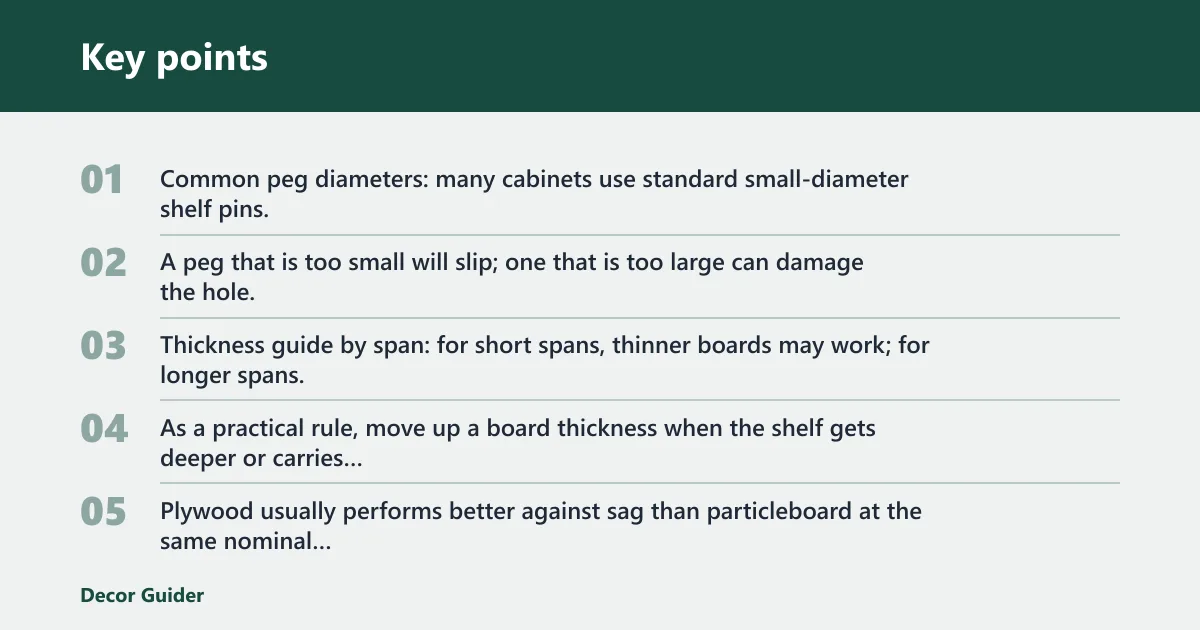
Common peg diameters: many cabinets use standard small-diameter shelf pins, but the exact size must match the hole. Measure rather than guess. A peg that is too small will slip; one that is too large can damage the hole.
Thickness guide by span: for short spans, thinner boards may work; for longer spans, thicker boards resist sag better. As a practical rule, move up a board thickness when the shelf gets deeper or carries dense loads like dishes or small appliances. Plywood usually performs better against sag than particleboard at the same nominal thickness.
Load-risk rule: score 0 to 1 as low risk, 2 as moderate, and 3 or more as high risk. For a high-risk shelf, reinforce or replace it rather than waiting for it to fail. In corner cabinet storage, treat depth as a load multiplier because access problems often lead people to stack items too far back.
Common mistakes
The first mistake is using the wrong pin size. The second is keeping a bowed or swollen shelf in service because it still “sort of fits.” The third is ignoring moisture damage under sinks, where particleboard and MDF can soften, swell, and lose edge strength faster than many owners expect.
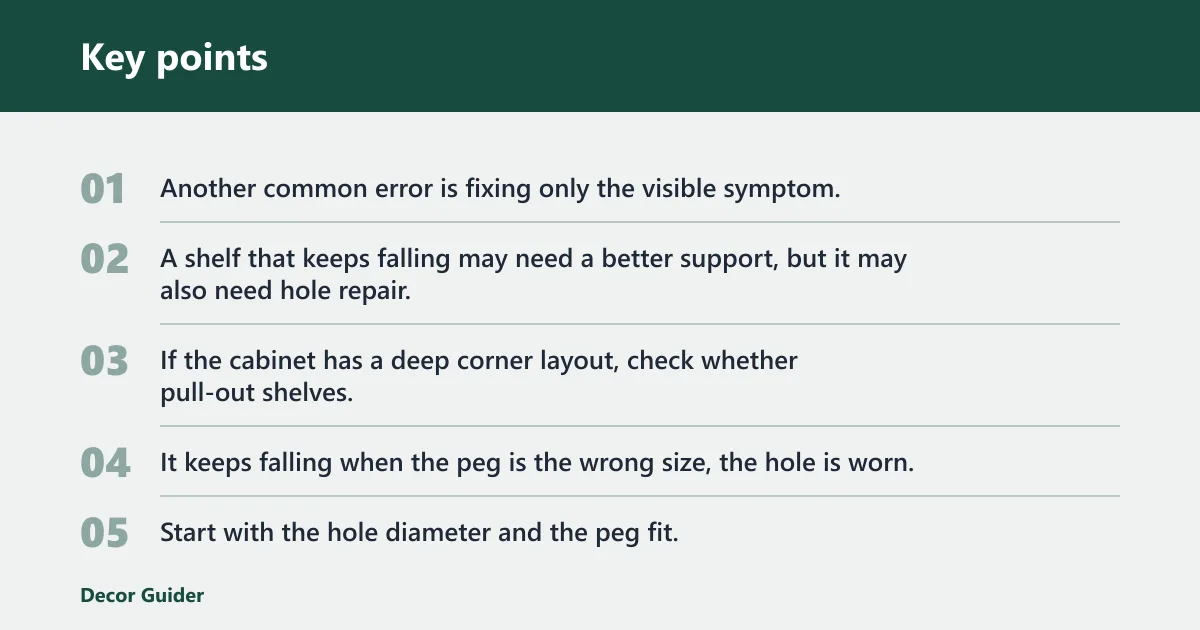
Another common error is fixing only the visible symptom. A shelf that keeps falling may need a better support, but it may also need hole repair, a stronger board, or a lighter load. If the cabinet has a deep corner layout, check whether pull-out shelves, a rotating shelf, or full extension slides would solve access and loading at the same time.
Why does my cabinet shelf keep falling?
It keeps falling when the peg is the wrong size, the hole is worn, or the support style cannot hold the load without rocking. Start with the hole diameter and the peg fit. If the shelf still slips, upgrade to retainers or replace the damaged support points before refilling the cabinet.
How do I stop a cabinet shelf from sagging?
Unload the shelf, measure the span, and check whether the board is already bowed. Add support first if the shelf is still flat; replace the board if the sag remains after unloading. Plywood or a thicker replacement board is usually a better choice than reusing a thin, damaged panel.
What can I use to replace broken shelf pins?
Use a pin or peg that matches the cabinet hole diameter and the cabinet side-hole spacing. If the original plastic part keeps failing, choose metal supports, clip-style retainers, or a printed replacement that matches the same dimensions. The best replacement is the one that fits without rocking.
When should I replace a cabinet shelf instead of repair it?
Replace the shelf when the board is swollen, delaminated, permanently bowed, or too thin for the span and load. Also replace it when the edge is chipped enough that the support points no longer sit flat. If the cabinet is a deep corner unit, replacement is often the cleaner fix.
How to adjust shelves in kitchen cabinets
Pull the shelf out, move the pins to a new hole pair at the same height, then set the board back in place and test for rocking. Adjustable shelf systems depend on both sides staying level, so move each side to the same hole row. Recheck after loading the shelf.
How to fix shelves in kitchen cabinets
First identify whether the issue is pins, holes, the board, span, or moisture. Then match the fix to the failure: replace worn supports, repair minor hole wear, reinforce a sagging shelf, or swap in a new board. For corner cabinet storage or deep shelves, consider pull-out shelves or full extension slides if access keeps causing overload.
Products related to this article
Sponsored / affiliate links. As an Amazon Associate I earn from qualifying purchases. I may earn additional commission from eligible campaigns.