Kitchen Cabinet Latch Not Working
If a kitchen cabinet latch is not working, start with the symptom: a latch that clicks but will not hold usually means the striker plate is out of line, while a door that will not meet the frame points to hinges or cabinet alignment. Ignoring it can leave doors swinging open, stressing hinges and chipping finishes. This guide shows how to tell latch failure from striker, hinge, and alignment problems before you buy replacement hardware.
Why the cabinet door will not latch
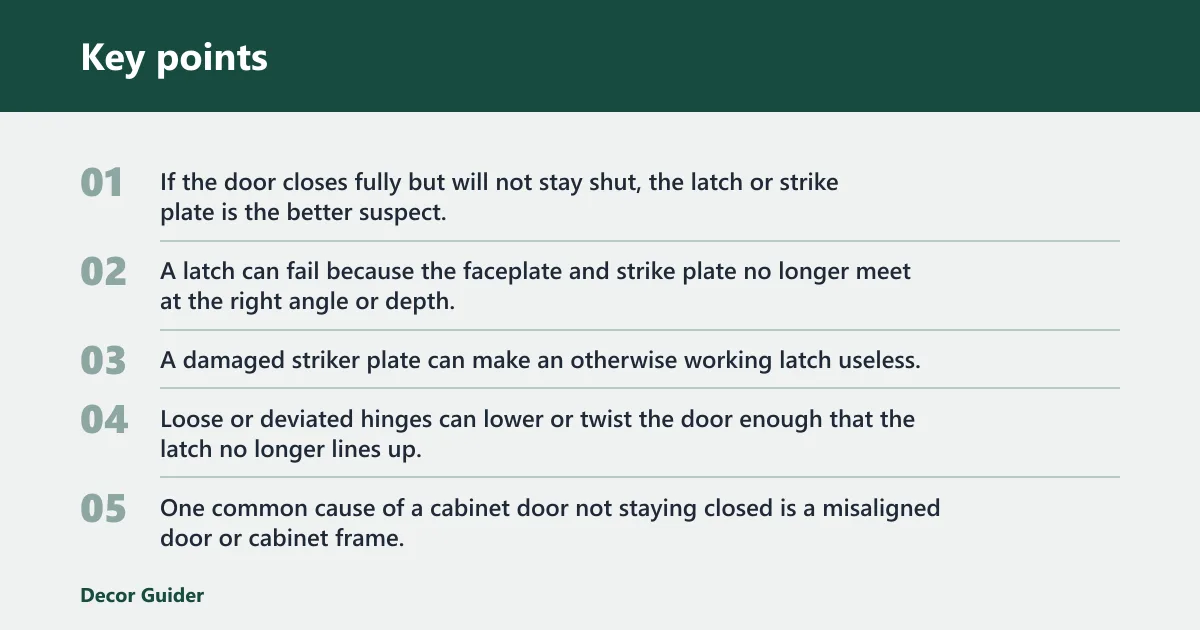


A cabinet door that will not latch often has one of three problems: the latch and striker plate may not meet cleanly, the hinges may have shifted, or the door or frame may be out of square. A cabinet latch keeps a door closed by pairing the latch body with a matching strike plate, so small alignment errors matter.
Check the door first. If the gap changes at the top, bottom, or latch side, the problem may be hinge sag or frame shift rather than a broken latch. If the door closes fully but will not stay shut, the latch or strike plate is the better suspect.
Latch body and striker plate mismatch
A latch can fail because the faceplate and strike plate no longer meet at the right angle or depth. Hardware wear, a loose mounting screw, or a slight shift in placement can leave the latch clicking without fully engaging. A damaged striker plate can make an otherwise working latch useless.
Hinge sag and frame shift
Loose or deviated hinges can lower or twist the door enough that the latch no longer lines up. One common cause of a cabinet door not staying closed is a misaligned door or cabinet frame. A poor hinge position can affect both the look and functioning of a cabinet. If the top gap is wider than the middle or bottom, or the latch side reveal changes as you close the door, adjust the hinges before replacing the latch. In most cases, a latch fix will not hold if the door is still hanging out of square.
Warped door or compressed seal
A warped door can push the latch out of line on one edge while leaving the rest of the door looking normal. On some cabinets, a rubber gasket or seal can shrink over time, which changes the closing pressure and stops full engagement. If the door barely closes, the seal may be part of the problem. If the door is bowed enough that a straightedge shows a visible gap along the edge, latch adjustment alone is unlikely to solve it.
Cabinet latch troubleshooting matrix
Use this matrix to separate latch failure from hinge, frame, and seal problems before replacing parts. Start with the symptom you can see, then run the quick test in order. The replace threshold tells you when adjustment is no longer the sensible fix.
| Symptom | Likely cause | Quick test | Fix | Replace threshold |
|---|---|---|---|---|
| Door bounces open | Striker plate too shallow or latch spring weak | Close the door slowly and watch whether the latch clicks before the door seats | Reposition the striker plate or tighten its screws | Replace the latch if it still rebounds after reset |
| Door won’t catch | Latch body and striker plate are out of line | Mark the contact point with pencil and close the door once | Shift the striker plate to meet the latch body squarely | Replace the assembly if the latch hook is worn or bent |
| Latch feels too tight | Strike plate sits too high or too deep | Open and close the door with light hand pressure only | Back the striker plate off slightly and retest | Replace if the mechanism binds even after realignment |
| Latch clicks but door opens | Damaged striker plate or weak hold at the catch | Pull the door gently after it clicks | Tighten the plate screws and check for wear at the catch | Replace the striker plate if the notch is rounded or cracked |
| Screw spins | Stripped screw hole in door or frame | Turn the screw and note whether it tightens at all | Move to a larger fastener or repair the hole before refitting | Replace the mounting area if the wood no longer holds fasteners |
| Striker plate misaligned | Plate shifted or mounted at the wrong height | Look for scrape marks above or below the catch | Reposition the plate so the latch meets it squarely | Replace if the plate is bent or the screw holes are worn out |
| Hinge sag | Loose hinge screws or worn hinge leaves | Lift the door at the handle and check for play | Tighten hinges and realign the door reveal | Replace worn hinges when tightening no longer removes the drop |
| Warped door | Door panel has twisted or bowed | Hold a straight edge along the door edge | Adjust the strike only if the warp is minor | Replace the door if the warp keeps breaking alignment |
| Loose knob or handle | Hardware shifts the pull point and makes closing awkward | Wiggle the knob and watch whether the door moves with it | Tighten the handle screws and test closure again | Replace the handle if the mounting pulls out repeatedly |
| Worn cabinet frame | Frame has shifted or lost square over time | Check the reveal at the top and latch side | Shim, reset, or rehang if the movement is small | Replace or rebuild when the frame will not hold alignment |
| Door meets seal and stops short | Rubber gasket or seal has shrunk or hardened | Close the door against the seal and feel for extra resistance | Replace the seal if it no longer compresses evenly | Replace the latch only after the seal issue is ruled out |
How to check the latch before replacing parts
Before you buy a new latch, confirm that the existing hardware is actually the problem. A door that will not close can still be caused by hinge play, a shifted frame, or a seal that keeps the latch from reaching its catch point. Quick testing saves unnecessary part swaps.
-
Test catch engagement.
Close the door slowly and listen for the click. Then pull the door open with light pressure to see whether the latch holds. If it clicks but releases easily, the strike plate placement or latch wear is the better lead.
-
Check screw holes and hold.
Look closely at the plate screws and mounting holes. If a screw spins, the wood may be stripped and the plate cannot stay in position. Tightening helps only when the fastener still grips the material. A screw that will not bite again usually needs the hole repaired before the plate can be trusted.
-
Inspect the door reveal.
Measure the visible gap around the door with your eye, or compare the top and latch-side gaps. A change in reveal points to hinge sag or frame shift, both of which can make latch hardware seem faulty when it is only out of line. If the reveal changes most at the top, middle, or bottom, that location helps identify where the adjustment belongs.
Say your pantry door clicks shut on the bottom edge but pops open at the top. That pattern points more toward hinge sag than a broken latch, because the latch is missing the strike at one end of the door line. Replacing hardware without correcting the hinge would leave the symptom in place.
How to fix a cabinet door that will not stay closed
Start with the least invasive repair and move up only if the symptom stays the same. Tightening, shimming, and repositioning are reasonable when the hardware is sound but off by a small amount. Replace the latch assembly when the body, catch, or plate is visibly worn, cracked, or bent. If the door is warped or the reveal is uneven at the top, middle, or bottom, adjust the hinges first; latch work should come after the door itself closes squarely.
-
Tighten loose hardware.
Snug the latch and hinge screws first, then retest the door. This improves stability when the problem is simple loosening, which is common on cabinets that get frequent use. Do not over-tighten stripped holes, because that can worsen the damage.
-
Reposition the striker plate.
Loosen the plate just enough to move it, then shift it in small increments until the latch seats squarely. Tighten the screws holding the plate to improve stability, then test open-and-close action several times to confirm the catch holds. A striker plate adjustment is often enough when the door already closes flush and the latch only misses by a small amount.
-
Adjust or replace hinges.
If the door droops, reset the hinges before touching the latch again. A poor hinge position can change the door angle enough to defeat otherwise good hardware. Replace the hinge when the screws hold but the door still sags or rubs. If you are dealing with hinge sag or frame shift, fix that first; latch replacement alone will not correct a door that is no longer tracking straight.
-
Swap the latch assembly.
Choose this when the latch body is broken, the spring is weak, or the strike plate is worn past correction. A broken latch is one of the most common issues behind an unstable door, and replacement is usually cleaner than repeated patchwork. A soft-close hinge can substitute for a spring-style latch only when the cabinet does not need a separate catch and the door already aligns well; it is not a cure for a warped door or a cabinet that relies on positive latch tension.
Picture a base cabinet with a latch that feels stiff only when the door is nearly shut. That is often a sign that the strike plate sits too deep or the door has shifted just enough to force the mechanism sideways. A small plate move can solve it; a warped door may not. If the latch only binds at the last moment and the reveal is still even, the plate is the better first adjustment.
When a repair is no longer worth it
Repair stops making sense when the cabinet body or door can no longer hold alignment. Old cabinets can become worn out and lose proper alignment over time, and stripped holes or repeated sagging will keep undoing new adjustments. At that point, replacement is more reliable than another round of tweaks.
If the frame is soft, cracked, or out of square, a new latch will not stay aligned for long. The same is true when the door is warped enough that the latch side never meets the frame cleanly. Replacing the assembly may help only if the structure behind it can still hold position. When the door sits out of square at the top, middle, and bottom all at once, the structure is usually past a simple latch fix.
Signs replacement beats another adjustment
- The screw holes will not grip after repair.
- The door reveal changes again within a short time.
- The latch body, plate, or catch is visibly bent.
- The cabinet frame has shifted enough that shimming no longer helps.
Choose the right hardware for the cabinet
Hardware choice should match how the cabinet is used, who needs access, and how much force the user can manage. A knob is not the closing mechanism; it only gives your hand something to pull. Latch hardware uses a visible faceplate and a matching strike plate, so it can provide more controlled closure and better security than a plain knob.
Knob versus latch hardware
A latch requires a coordinated grip-and-rotate action, while a simple knob is easier to grasp and pull. A simple knob is the easiest cabinet for a toddler to open, which may be a drawback for child access control. For some adults, that same latch rotation can be awkward if hand strength is limited. Use simpler pull hardware when easy opening matters more than securing the door; use a latch when controlled closure and retention matter more than convenience.
Soft-close hinge alternatives
Soft-close hinges can replace some latch functions when the goal is controlled closure without a separate spring latch. They help the door settle closed with less impact, which can be useful on cabinets that no longer need rotational latch action. They also reduce slamming that can loosen alignment over time. They are not a substitute when the cabinet needs a positive catch to stay shut or when the door depends on a separate latch to hold it closed.
Child safety cabinet latch use cases
Child safety cabinet latch hardware is used when you want to limit inadvertent opening by toddlers or children. That use case favors a closure method that is less intuitive for small hands and better at controlling access to cleaners, sharp tools, or breakables. Choose the hardware based on access and security, not just appearance.
Frequently asked questions
Why does my door not latch?
The usual causes are misalignment, loose hinges, a broken latch, a seal problem, loose hardware, or a worn cabinet frame. Start with the symptom: if the door will not meet the frame, look at the hinges and alignment first. If it meets but will not hold, inspect the latch and strike plate.
Why door won’t latch
A door that will not latch often has a strike plate that sits too high, too low, or too deep for the latch body. A damaged plate can also block engagement even when the rest of the hardware looks fine. Check screw tightness and the contact mark before buying a replacement latch.
Why is my door not latching?
Look at the closing path, not only the latch. If the door rubs, drops, or stops short, the hinges or frame may be out of line. If it closes fully and still opens again, the latch body, striker plate, or both may be worn and should be reset or replaced.
Products related to this article
Sponsored / affiliate links. As an Amazon Associate I earn from qualifying purchases. I may earn additional commission from eligible campaigns.