President’s Cabinet Members: The Complete Guide to Who Serves and Why It Matters
You hear the phrase on every news channel. The president’s cabinet members are meeting. A new nominee is facing Senate confirmation. Someone resigned. But the coverage rarely steps back to explain the actual machinery behind those headlines. What does the cabinet do, exactly? Why does one position outrank another? And how does a person go from private citizen to one of the most powerful officials in the federal government?
This guide walks through the entire system. You’ll learn the constitutional basis for the cabinet, the 15 executive departments, who gets cabinet-rank without running a department, how the line of succession works, and the messy process of confirmation and removal. By the end, you’ll be able to follow any cabinet-related news story and understand the stakes underneath it.

VZONE
VZONE Trump Playing Cards—MAGA Poker Deck, Standard…
- 🎴 Patriotic-Themed Playing Cards – Each suit features a unique American-inspired design, incorporating symbols of national pride.…
- 🎁 Perfect Gift for Patriotic Americans & Political Enthusiasts – This latest edition is designed for those who appreciate politica…
- ♠️ High-Quality Poker Cards – Professionally crafted playing cards with a unique theme while meeting high industry standards. Made…
As an Amazon Associate I earn from qualifying purchases.
If you enjoy following presidential politics and want a conversation piece for game night, the VZONE Trump deck offers a satirical take on political figures. It’s a standard 52-card deck with waterproof cards, so it works for poker while sparking discussion about the personalities that shape the executive branch.
What Is the President’s Cabinet?
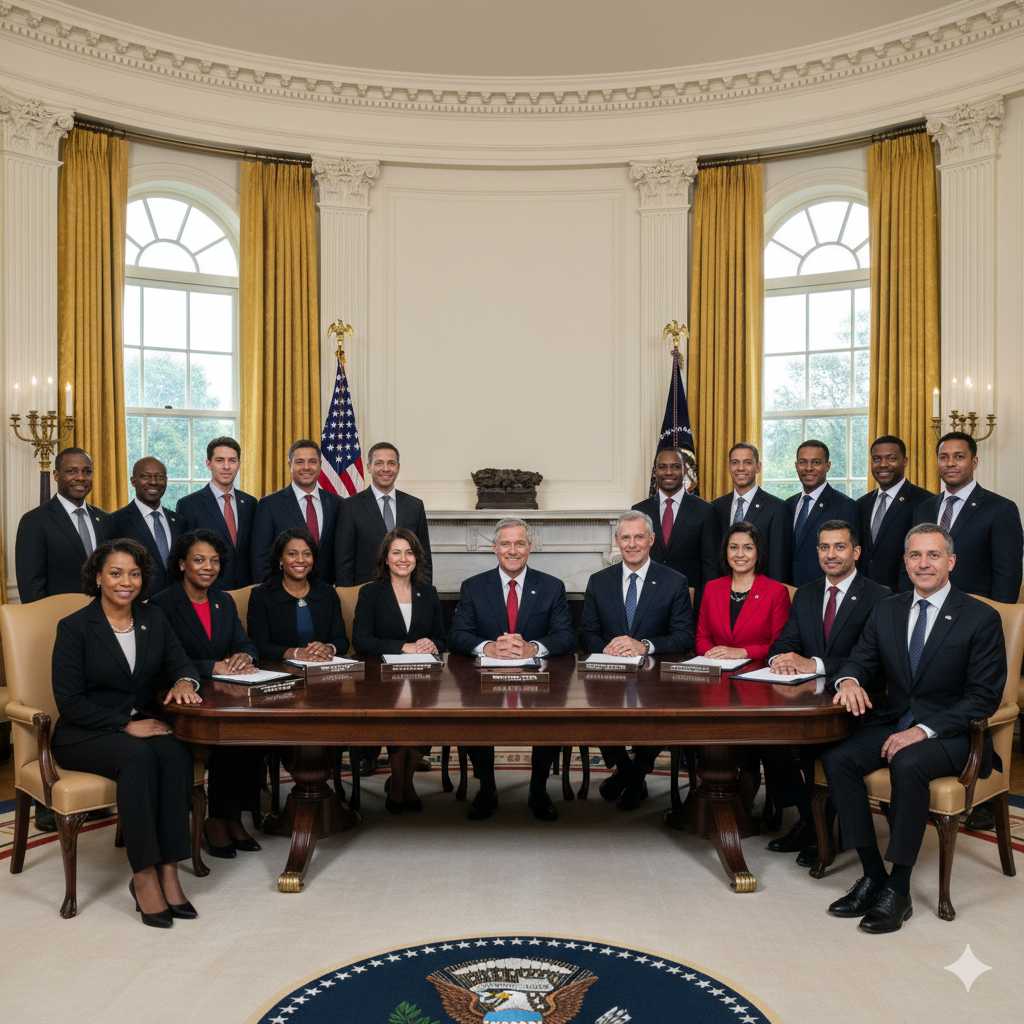
The cabinet is a group of senior advisors to the president. It includes the heads of the 15 executive departments, plus a handful of other officials who hold cabinet-rank. They meet, advise, and oversee the massive federal bureaucracy that carries out the president’s agenda.
The Constitutional Basis vs. Modern Practice
The word “cabinet” never appears in the Constitution. That surprises most people. Article II, Section 2, Clause 1 gives the president power to require “the Opinion, in writing, of the principal Officer in each of the executive Departments” on any subject relating to their duties. That’s it. That single clause is the entire constitutional foundation for the cabinet.
George Washington started the tradition by convening his four department heads: Secretary of State Thomas Jefferson, Secretary of the Treasury Alexander Hamilton, Secretary of War Henry Knox, and Attorney General Edmund Randolph. Washington met with them regularly, and every president since has done the same. The cabinet operates through custom and statute, not constitutional mandate.
Modern practice differs from the early days in one big way. Washington’s cabinet was tiny. Today, the president’s cabinet members oversee departments with hundreds of thousands of employees and budgets in the hundreds of billions. The relationship has also shifted. Early cabinets were genuinely deliberative bodies. Modern cabinets are more like a management team executing the president’s vision, with the White House staff often wielding more daily influence than individual secretaries.
The 15 Executive Departments and Their Secretaries
Each department has a Secretary who sits in the cabinet. The one exception is the Department of Justice, which is led by the Attorney General. These 15 positions form the core of the cabinet.
Current Members (2026) with Roles and Key Priorities
Here is the breakdown of the 15 departments, their leaders, and what they actually do.
- Department of State – The Secretary of State handles foreign affairs, diplomacy, and international relations. This is the most senior cabinet position and fourth in the line of succession.
- Department of the Treasury – The Secretary manages federal finances, collects taxes, pays the nation’s bills, and oversees financial sanctions. The Treasury Secretary is fifth in the succession line.
- Department of Defense – The Secretary oversees the armed forces and military operations. This department has the largest budget of any cabinet agency, exceeding $800 billion annually.
- Department of Justice – The Attorney General leads federal law enforcement, prosecutes federal crimes, and provides legal advice to the president. The position dates back to 1789.
- Department of the Interior – Manages public lands, national parks, and natural resources. The Secretary handles roughly 20% of the nation’s landmass.
- Department of Agriculture – Oversees farming policy, food safety, nutrition programs, and rural development. The USDA employs nearly 100,000 people.
- Department of Commerce – Promotes economic growth, trade, and business development. It also runs the Census Bureau and the Patent and Trademark Office.
- Department of Labor – Enforces workplace safety laws, sets labor standards, and administers workers’ compensation programs.
- Department of Health and Human Services – Manages Medicare, Medicaid, the CDC, the FDA, and the NIH. This department alone accounts for about a quarter of all federal spending.
- Department of Housing and Urban Development – Oversees housing policy, homelessness programs, and fair housing enforcement. HUD is one of the smaller departments by budget.
- Department of Transportation – Regulates highways, aviation, railroads, and public transit. The FAA and the National Highway Traffic Safety Administration fall under this umbrella.
- Department of Energy – Manages nuclear weapons stockpile, energy research, and environmental cleanup from nuclear sites. The Secretary also oversees the Strategic Petroleum Reserve.
- Department of Education – Administers federal student aid, enforces civil rights in schools, and distributes funding to K-12 districts. It’s a frequent target for elimination but remains active.
- Department of Veterans Affairs – Runs the largest integrated healthcare system in the United States. The VA serves over 9 million veterans annually.
- Department of Homeland Security – Created after 9/11, this department handles border security, immigration enforcement, disaster response, and the Secret Service. It’s the newest cabinet department, established in 2026.
The current administration has filled each of these roles. Some nominees sailed through confirmation. Others faced sharp partisan fights. That’s normal in modern politics, though the margins have narrowed over the past few decades.
| Department | Established | Current Focus (2026) |
|---|---|---|
| State | 1789 | Diplomacy, strategic competition with China, Ukraine support |
| Treasury | 1789 | Debt management, tax enforcement, sanctions implementation |
| Defense | 1947 | Modernization, Pacific deterrence, technology integration |
| Justice | 1870 | Election integrity, violent crime reduction, antitrust enforcement |
| Interior | 1849 | Energy production on federal lands, park maintenance |
| Agriculture | 1862 | Farm subsidies, food assistance programs, rural broadband |
| Commerce | 1903 | Export controls, semiconductor supply chains, trade enforcement |
| Labor | 1913 | Workplace standards, union relations, apprenticeship expansion |
| Health and Human Services | 1953 | Drug pricing, pandemic preparedness, mental health services |
| Housing and Urban Development | 1965 | Affordable housing supply, homelessness reduction |
| Transportation | 1966 | Infrastructure spending, autonomous vehicle regulation, aviation safety |
| Energy | 1977 | Grid reliability, nuclear waste cleanup, advanced reactor research |
| Education | 1979 | Student loan portfolio, school choice, Title IX enforcement |
| Veterans Affairs | 1930 | Healthcare access, claims backlog, veteran suicide prevention |
| Homeland Security | 2026 | Border operations, cybersecurity, disaster response |
Cabinet-Rank Officials: Who Else Sits at the Table?
The 15 department heads are the cabinet. But the president can elevate other officials to cabinet-rank. These people attend cabinet meetings and advise the president, but they don’t run an executive department.
The White House Chief of Staff holds cabinet-rank. So does the Director of the Office of Management and Budget, the U.S. Trade Representative, the Administrator of the Environmental Protection Agency, and the Director of National Intelligence. The Chair of the Council of Economic Advisers also sits at the table.
Here’s the key distinction: cabinet-rank officials are not in the line of succession. The law that governs succession, the Presidential Succession Act of 1947, lists only the department heads. So the UN Ambassador might attend every cabinet meeting and have the president’s ear, but if the president, vice president, and every eligible department head were incapacitated, the Speaker of the House would take over before the UN Ambassador.
Cabinet-rank status is entirely at the president’s discretion. A president could theoretically grant it to anyone. In practice, it’s reserved for positions that deal with cross-cutting issues requiring presidential-level coordination. The EPA Administrator, for example, deals with environmental policy that touches energy, transportation, and agriculture. Being at the table helps coordinate those efforts.
The Presidential Line of Succession Explained
The line of succession determines who becomes president if the president and vice president can’t serve. The order is fixed by law, and cabinet members hold positions 4 through 18.
- Vice President
- Speaker of the House
- President Pro Tempore of the Senate
- Secretary of State
- Secretary of the Treasury
- Secretary of Defense
- Attorney General
- Secretary of the Interior
- Secretary of Agriculture
- Secretary of Commerce
- Secretary of Labor
- Secretary of Health and Human Services
- Secretary of Housing and Urban Development
- Secretary of Transportation
- Secretary of Energy
- Secretary of Education
- Secretary of Veterans Affairs
- Secretary of Homeland Security
Why is the Secretary of State fourth? Two reasons. First, the State Department is the oldest and most prestigious cabinet position. Second, the Secretary of State is the only cabinet member with a clear constitutional role beyond advising the president: receiving ambassadors and conducting foreign relations. The framers viewed foreign policy as the president’s personal domain, so the person running it was seen as the natural successor.
The order also reflects the age of the departments. State, Treasury, and Defense (originally War) were the original three departments. The newer departments sit at the bottom. Homeland Security, created in 2026, is last.
One practical detail: a cabinet secretary must be a natural-born citizen and at least 35 years old to serve as acting president. If a secretary doesn’t meet those requirements, the line skips them. That’s why a foreign-born Secretary of State, like Henry Kissinger, would have been passed over in the succession.
How Cabinet Members Are Confirmed (and Removed)
Getting into the cabinet is a two-step process. The president nominates, and the Senate confirms. The Constitution gives the Senate the “advice and consent” role, and the Senate takes that responsibility seriously.
The Senate Confirmation Process
Once the president announces a nominee, the nomination goes to the Senate. The relevant committee holds hearings. The Senate Judiciary Committee handles the Attorney General. The Foreign Relations Committee handles the Secretary of State. Each committee questions the nominee, reviews their background, and votes to send the nomination to the full Senate.
A simple majority of the Senate is required for confirmation. That’s 51 votes if all 100 senators are present. The vice president can break a 50-50 tie. In practice, most nominees get confirmed. Since 1981, the Senate has rejected only three cabinet nominees outright. The last was in 1989, when John Tower was rejected as Secretary of Defense.
The process has gotten slower and more partisan. In the 1970s, a typical cabinet nomination took a few weeks. Today, it’s common for nominations to take two or three months. Some recent nominees faced unanimous opposition from the minority party. The record for the longest confirmation delay goes to the current Secretary of Health and Human Services, who waited over 70 days.
Vacancies and the Vacancies Act
Cabinet positions don’t stay empty when someone leaves. The Federal Vacancies Reform Act of 1998 governs who can act in the role. If a secretary resigns, is fired, or dies, the deputy secretary typically becomes the acting secretary. The president can also appoint someone else, but that person must have served in the department for at least 90 days in the preceding year.
The law limits how long someone can serve in an acting capacity. The general rule is 210 days. After that, the president must nominate someone, or the position stays vacant. This rule exists to prevent presidents from circumventing the Senate’s confirmation power by keeping “acting” officials in place indefinitely.
Presidents do have workarounds. They can nominate someone, let the nomination sit, and the acting official can continue serving while the nomination is pending. This has become a point of contention in recent administrations, with critics arguing it undermines the confirmation process.
A Brief History of the Cabinet’s Expansion
The cabinet didn’t start with 15 departments. It started with four. Washington’s cabinet had State, Treasury, War, and the Attorney General. The Justice Department itself wasn’t created until 1870, though the Attorney General position existed from the start.
Each new department reflects a moment of national need. The Interior Department came in 1849 to manage westward expansion and the growing federal landholdings. Agriculture followed in 1862, driven by the need to support farmers during the Civil War. Commerce and Labor were split in 1913 after business-labor tensions made a single department unworkable.
Defense replaced War in 1947. The National Security Act consolidated the Army, Navy, and Air Force under a single secretary. Health, Education, and Welfare was created in 1953, then split into separate departments in 1979. The most recent addition, Homeland Security, consolidated 22 agencies after the September 11 attacks.
The pattern is consistent: the cabinet grows when the federal government takes on new responsibilities. It rarely shrinks. The Education Department has faced abolition attempts for decades, but it remains. The same goes for the Commerce Department. Once a department exists, it builds a constituency that fights to keep it.
Why the Cabinet Matters More Than You Think
The cabinet gets overshadowed by the White House staff in public perception. The Chief of Staff, the National Security Advisor, and the press secretary dominate the news cycle. But the cabinet secretaries are the ones who actually run the government.
Consider the scale. The Department of Health and Human Services alone spends over $1.5 trillion per year. The Department of Defense employs nearly 3 million people, both civilian and military. The Treasury Secretary’s decisions on debt issuance affect global financial markets. These are not advisory roles. These are operational commands.
The confirmation process matters because it’s one of the few checks on presidential power. The Senate can force a president to reconsider a bad nominee. It can extract commitments on policy. It can delay and embarrass. That’s why every nomination becomes a political battle. The stakes are real.
Cabinet meetings themselves are often more symbolic than substantive. Real decisions happen in one-on-one meetings with the president or in small groups. But the cabinet serves a public function: it signals who has the president’s trust and what the administration’s priorities are.
For citizens, tracking cabinet changes is a way to monitor the administration’s direction. When a Secretary of Defense resigns, it’s usually a sign of policy disagreements. When a new Attorney General is confirmed, it signals a shift in law enforcement priorities. Following the cabinet is following the government’s operating system.
Frequently Asked Questions About the Cabinet
How many people are in the president’s cabinet?
The core cabinet has 15 members: the 15 department heads. With cabinet-rank officials added, the full cabinet typically has 22 to 24 people. The exact number varies by president because cabinet-rank is discretionary.
Can the president fire a cabinet member?
Yes. The president can remove any cabinet member at any time, for any reason. There’s no Senate vote needed for removal. Supreme Court precedent from 1926 (Myers v. United States) affirmed the president’s exclusive removal power over executive officers. Most cabinet secretaries serve at the president’s pleasure.
What happens if a cabinet member dies in office?
The deputy secretary becomes acting secretary under the Vacancies Act. The president then nominates a permanent replacement, who must be confirmed by the Senate. The line of succession would skip the deceased secretary, moving to the next eligible official.
Do cabinet members have to be confirmed by the Senate?
Yes, all 15 department heads require Senate confirmation. Cabinet-rank officials also require confirmation in most cases, including the EPA Administrator and the U.S. Trade Representative. The White House Chief of Staff does not require confirmation because it’s a White House position, not a statutory office.
Why is the Secretary of State ahead of the Secretary of Defense in the succession line?
Historical precedent and constitutional design. The State Department is the oldest cabinet department, established in 1789. The Secretary of State also has a direct constitutional role in foreign affairs. Defense didn’t exist as a unified department until 1947. The succession order tracks the age of the departments, with newer ones at the bottom.
What to Remember About the Cabinet
- The cabinet has 15 department heads, plus a variable number of cabinet-rank officials the president chooses.
- The Constitution doesn’t mention the cabinet. It’s built on Article II’s provision for written opinions from department heads, plus 230 years of tradition.
- Senate confirmation requires a simple majority. It’s a political process, not just a vetting exercise.
- Cabinet-rank officials attend meetings but are not in the line of succession. Only department heads are.
- The line of succession skips anyone who isn’t a natural-born citizen or hasn’t reached age 35.
- The Vacancies Act limits acting secretaries to 210 days, but presidents can extend that by submitting a pending nomination.
- Cabinet departments rarely get eliminated. They grow with national needs and build lasting constituencies.
Understanding the cabinet means understanding how the federal government actually operates. The next time you see a confirmation hearing or a resignation announcement, you’ll know what’s at stake and what comes next. For a lighter take on the political figures who populate these roles, the VZONE deck puts a satirical spin on the faces behind the policy. And if you’re curious about how the term “cabinet” applies outside government, this comparison of furniture styles covers a different kind of cabinet entirely.
Products related to this article
Sponsored / affiliate links. As an Amazon Associate I earn from qualifying purchases. I may earn additional commission from eligible campaigns.