Cabinet Hinges vs Concealed Hinges: Which to Choose
Use visible hinges for traditional cabinets, inset doors, or when you want easy replacement; choose concealed hinges for cleaner lines, wider adjustment, and most modern frameless or overlay doors. Pick the wrong hinge style and you can end up with doors that bind, gap unevenly, or force a costly retrofit. This guide compares cabinet hinges vs concealed hinges by cabinet construction, door style, installation risk, and long-term adjustability.
Cabinet hinges vs concealed hinges: the core trade-off
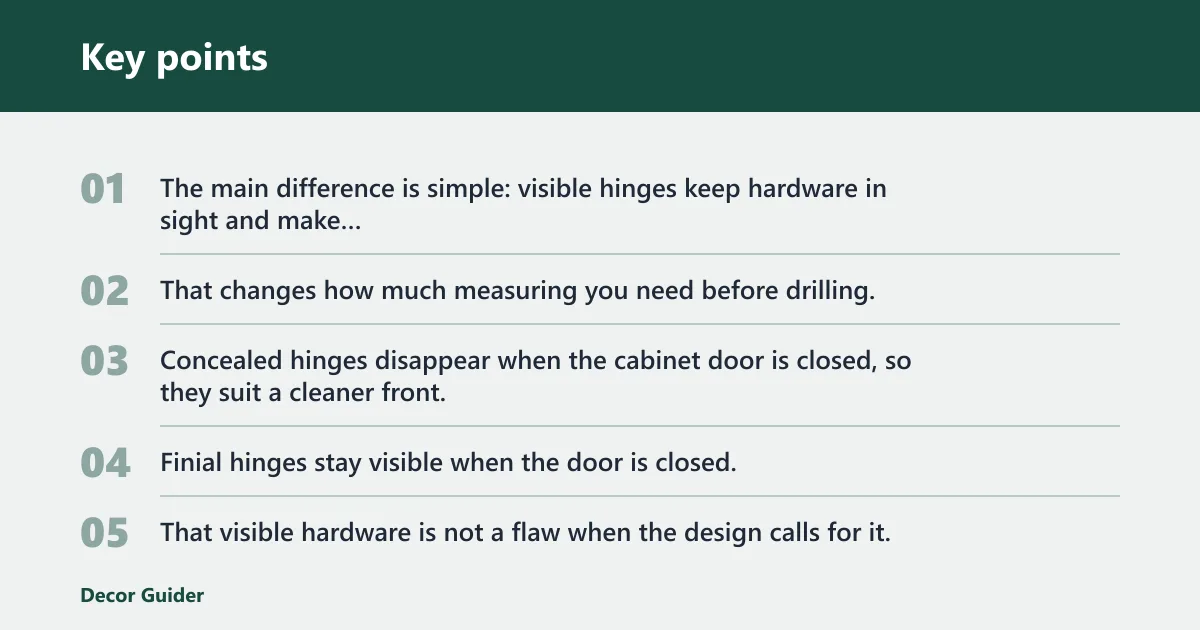
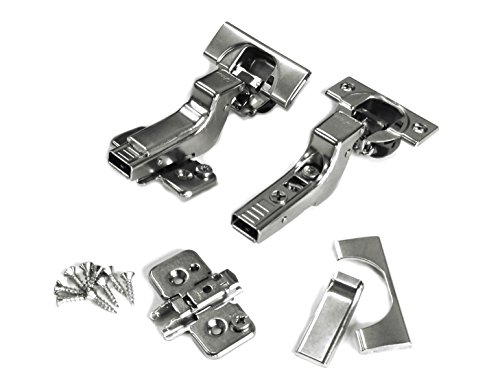

The main difference is simple: visible hinges keep hardware in sight and make replacement straightforward, while concealed hinges hide the mechanism and allow post-install adjustment. That changes how much measuring you need before drilling, how much clearance you get at the opening, and how forgiving the system is if the cabinet shifts over time.
| Decision factor | Cabinet Hinges | Concealed Hinges | Winner |
|---|---|---|---|
| Appearance | Visible when the door is closed | Out of sight when the door is closed | Concealed Hinges |
| Adjustment after installation | Usually limited, depending on hinge design | Adjustable after installation | Concealed Hinges |
| Fit tolerance for tricky door layouts | Works well when the style is forgiving | Works well when measurements and geometry match | Tie |
| Best use case | Traditional, farmhouse, heritage, and easy-replacement projects | Frameless, overlay, and many modern kitchens | Tie |
| Install risk | Lower for simple replacement jobs | Higher if cup-bore, overlay, or opening angle are wrong | Cabinet Hinges |
Appearance is not the whole decision
Concealed hinges disappear when the cabinet door is closed, so they suit a cleaner front. Finial hinges stay visible when the door is closed, which can be the point on a farmhouse or period-style cabinet. That visible hardware is not a flaw when the design calls for it.
Adjustment and clearance are the real performance divide
Concealed hinges are adjustable after installation, so small alignment errors can usually be corrected later. That does not fix a bad hinge choice or a wrong bore position. A hinge can be adjustable and still fail if the opening angle, overlay, or door thickness is wrong.
Cabinet construction changes the answer
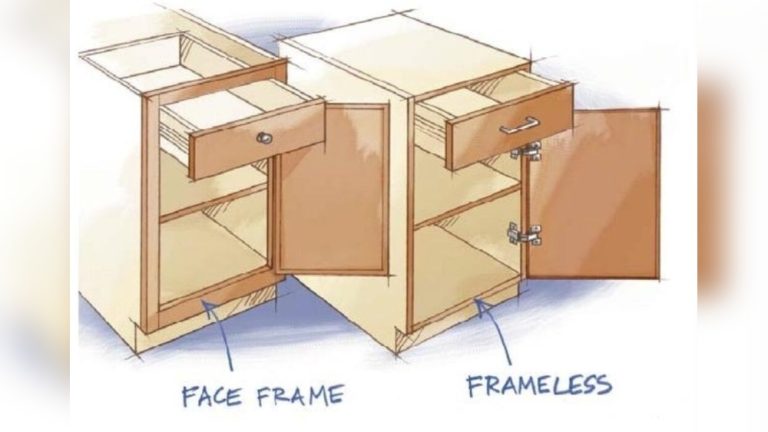
Face-frame cabinets have a frame on the front of the box, while frameless cabinets have no front frame. That changes where the hinge mounts and how much geometry you need to get right before drilling. The wrong style can cause rubbing, poor reveal, or doors that do not close cleanly.
What is a concealed hinge?
A concealed hinge is a hidden cabinet hinge, often called a Euro hinge, that stays out of sight when the door is closed. It is commonly used on modern kitchens and usually allows post-install adjustment, though it still depends on accurate measurements and cup-bore compatibility.
How it sits on the door and cabinet
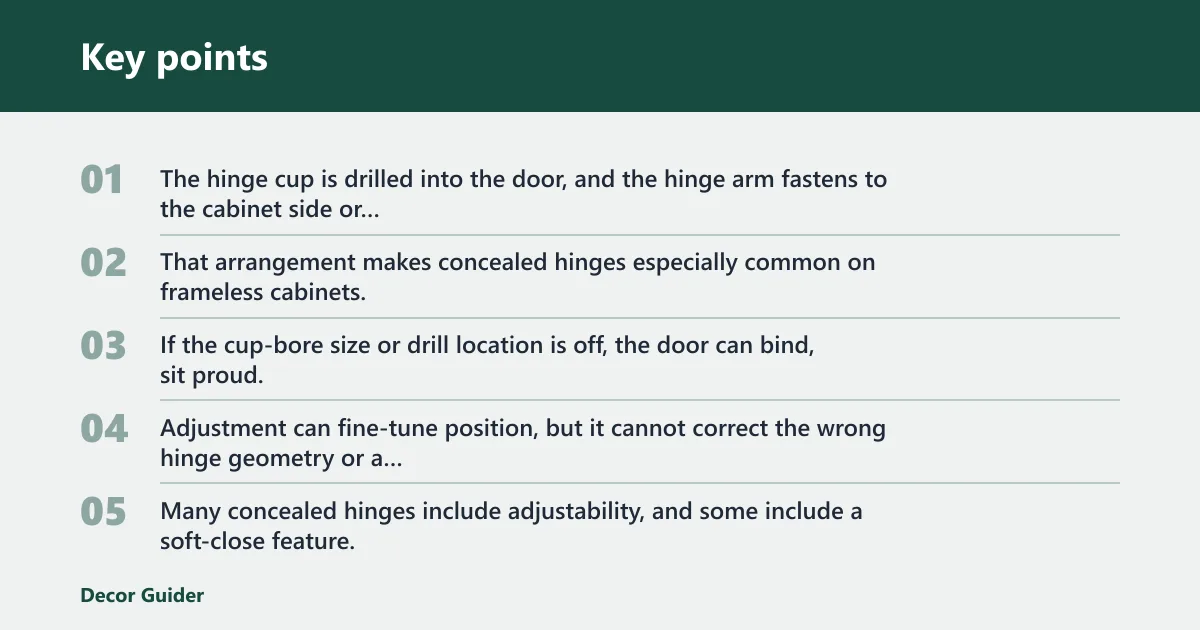
The hinge cup is drilled into the door, and the hinge arm fastens to the cabinet side or mounting plate. That arrangement makes concealed hinges especially common on frameless cabinets, where the hinge mounts directly to the side panels.
Why cup-bore size and drill location matter
If the cup-bore size or drill location is off, the door can bind, sit proud, or leave uneven gaps. Adjustment can fine-tune position, but it cannot correct the wrong hinge geometry or a misplaced bore.
Typical features buyers should check
Many concealed hinges include adjustability, and some include a soft-close feature. Opening angle matters too, especially if the door must clear pulls, walls, or appliances. The spec sheet should match the cabinet and door, not just the style preference.
How do cabinet hinges differ from concealed hinges?
Cabinet hinges are the broader category, and concealed hinges are one type within it. The practical difference is visibility, mounting geometry, and how much adjustment you get after installation. Exposed decorative hinges can be easier to replace and can suit traditional cabinets better than a hidden Euro-style hinge.
What you gain with visible hardware
Visible hinges are easy to see, easy to match to traditional trim, and often easier to swap in a like-for-like replacement. They are a strong fit when the hinge is part of the cabinet’s look, not something to hide.
What you gain with concealed hardware
Concealed hinges give cleaner sightlines and often allow multiple adjustment directions. That matters when a door needs fine tuning after installation, especially on cabinets where seasonal movement or minor framing shifts can affect reveal.
When visible hinges are the better fit
Choose visible hinges when the style calls for exposed hardware, when you want a simpler replacement path, or when you are matching existing traditional cabinets. They can also make sense in a retrofit where the cabinet face or door thickness does not suit a concealed cup bore.
Which hinge type works best for inset cabinet doors?
Inset cabinet doors work best with hinges made for tight geometry, because the door sits inside the cabinet frame rather than overlap it. They need a consistent gap around all four sides, and they are less forgiving as wood moves. If the tolerances are off, rubbing and binding show up fast.
Why inset is the hardest setup to get right
Inset doors sit flush inside the cabinet frame, so the reveal has to stay even on every side. Small errors in hinge placement, door squareness, or seasonal movement can create drag on one edge and a gap on the other.
What to watch for before buying
Check inset compatibility first, then confirm the opening angle and the hinge plate depth. A hinge that fits an overlay door may still be wrong for inset work, even if the cup bore looks similar.
Common failure case
Say your inset door is 18 inches tall and the hinge leaves only a small top gap. If the wood swells slightly, the top corner can rub the frame and the latch side may need force to close. That is a fit problem, not a soft-close problem.
How do you choose the right hinge for face-frame vs frameless cabinets?
Face-frame cabinets have a frame on the front of the box, so the hinge usually mounts to the frame or to a plate. Frameless cabinets have no front frame, so the hinge mounts directly to the side panels and concealed European hinges are a common choice. That construction difference drives the entire hinge selection.
Face-frame cabinets
Face-frame cabinets often need hinge arms or plates that account for the frame thickness and the door overlay. Measure the frame, not just the door, because the hinge has to clear the frame opening and still close correctly.
Frameless cabinets
Frameless cabinets are built for concealed hinges more naturally, since the hinge can attach to the side panel without a front frame in the way. The main checks are overlay, cup-bore compatibility, and opening angle.
Overlay matters on both types
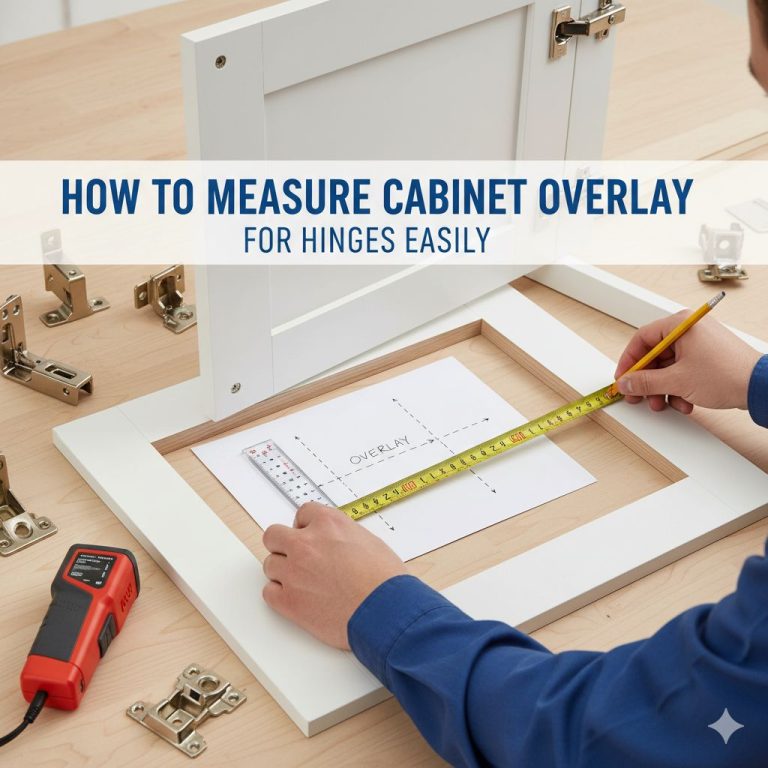
Overlay hinges are selected by how much the door covers the cabinet frame. Full overlay and partial overlay are not interchangeable guesses; the hinge geometry has to match the actual overlap or the door will sit wrong.
How do you measure for concealed cabinet hinges?
Measure the cabinet construction first, then check overlay, inset depth, cup-bore compatibility, door thickness, and opening angle. Those checkpoints matter because concealed hinges can usually be adjusted after installation, but only within the range the hardware allows.
Use this measurement checklist before buying
- Identify the cabinet type: inset, overlay, face-frame, or frameless.
- Measure the door thickness and confirm the hinge cup bore the hinge requires.
- Verify overlay measurement: full overlay or partial overlay.
- Check opening angle against pulls, walls, and nearby appliances.
- Confirm whether the hinge is meant for inset or overlay geometry.
What can go wrong if you skip a step
A common first-timer mistake is ordering by door size alone. Two doors with the same width can need different hinge geometry if one is inset and the other is overlay. The hardware may fit the door, yet still fail at the cabinet opening.
Opening angle deserves attention
Opening angle is one of the key hinge-selection specs because it affects clearance. A door that swings wide enough on paper can still hit a pull, wall, or appliance trim in the real cabinet layout.
How do you install and adjust concealed cabinet hinges?
Concealed hinge installation starts with accurate drilling and alignment, then ends with fine adjustment. The hinge’s adjustability helps you square the door later, but it does not rescue a bad bore location or the wrong cabinet geometry. Install accuracy comes first.
What has to be drilled or aligned before mounting
The hinge cup bore must be in the correct place on the door, and the mounting plate or side-panel attachment must match the cabinet style. If the hole is shallow, offset, or wrong for the hinge family, adjustment will not fully solve the problem.
Three-way adjustment basics
Many concealed hinges allow adjustment for height, side-to-side position, and depth. That makes it easier to clean up reveals, reduce rubbing, and bring the door flush with adjacent fronts after installation.
Common setup errors
Sagging usually points to poor mounting or the wrong hinge rating for the door weight. Rubbing often comes from bad overlay, an off-center bore, or an inset door that leaves too little clearance for seasonal movement. Bounce-back can happen when the soft-close is too aggressive for a light door.
Decision matrix: best fit, avoid, and common mistakes
This matrix turns the comparison into a buying path. Start with cabinet construction, then match the door style and household needs to the hinge family that fits the geometry, not just the look.
| Setup | Best fit | Avoid | Common mistake |
|---|---|---|---|
| Inset | Concealed hinge designed for inset doors; use when you need adjustment and a flush look | Generic overlay hinge | Buying by door width alone and missing the tight tolerance requirement |
| Overlay | Concealed hinge matched to full overlay or partial overlay geometry | Inset-only hardware | Using the wrong overlay measurement and ending with uneven reveal |
| Face-frame | Hinge that mounts to the frame or plate and matches the frame thickness | Frameless-only hinge without the right plate or offset | Ignoring frame depth and creating door-to-frame rubbing |
| Frameless | Concealed European hinge for direct side-panel mounting | Hardware that requires a front frame | Missing cup-bore compatibility or opening angle clearance |
When should you choose exposed decorative hinges instead of concealed hinges?
Choose exposed decorative hinges when the hinge is part of the cabinet’s design language, when you want easy replacement, or when the cabinet style is traditional, farmhouse, or heritage-influenced. Choose concealed hinges when you need hidden hardware, post-install adjustment, and better compatibility with many frameless or overlay cabinets.
Style-driven choices
Visible hinges suit cabinets where the hardware should be seen, not hidden. Finial hinges are visible when the door is closed, which can complement period doors and painted kitchen fronts better than a hidden Euro hinge.
Retrofit versus new build
Retrofits often favor visible hinges when the existing cabinet lacks the right bore pattern or when a hidden hinge would demand invasive drilling. New builds have more freedom to specify concealed hinges from the start, especially on frameless boxes.
When the hinge price is worth it
Higher-priced concealed hinges are worth it when you need adjustability, soft-close damping, or a precise overlay match on a project with many doors. The extra cost makes less sense if the cabinet construction is simple and a visible hinge already matches the design.
Choose Cabinet Hinges if… / Choose Concealed Hinges if…
Choose cabinet hinges if you are matching traditional cabinetry, replacing old visible hardware, or working on a cabinet where easy service matters more than hidden hardware. Choose concealed hinges if you want a hidden hinge, need after-install adjustment, or are fitting frameless, overlay, or many modern kitchen cabinets.
Choose Cabinet Hinges if…
- You want visible hardware as part of the cabinet design.
- You are replacing like-for-like on an existing traditional or farmhouse cabinet.
- You need the simplest path for a retrofit where drilling should stay minimal.
- The cabinet style already works with exposed decorative hardware.
Choose Concealed Hinges if…
- You need hidden hardware when the door is closed.
- You want adjustability after installation for height, side-to-side, and depth.
- You are working with frameless cabinets or many overlay layouts.
- You have checked cup-bore compatibility, overlay measurement, and opening angle.
Frequently asked questions
How do you install concealed cabinet hinges?
Install concealed hinges by drilling the correct cup bore, aligning the hinge plate or side-panel mount, and then fastening the door. After that, use the hinge’s adjustment screws to fine-tune height, side-to-side position, and depth.
How do you adjust concealed cabinet hinges?
Most concealed hinges allow three-way adjustment: height, side-to-side, and depth. Use those screws to even the reveal, reduce rubbing, and bring the door flush, but do not expect adjustment to fix the wrong bore location or a mismatched hinge type.
Products related to this article
Sponsored / affiliate links. As an Amazon Associate I earn from qualifying purchases. I may earn additional commission from eligible campaigns.