Corner Cabinet Pull-Outs vs Lazy Susans: Which Fits?
Choose corner cabinet pull-outs when you need clear sight lines, separated storage, and easier access to deep items. Choose a Lazy Susan when you want 360-degree reach and a simpler retrofit. A poor fit wastes corner space, hides items, and turns daily access into a bend-and-search task. This guide compares fit, access, installation, and cost so you can pick the right corner cabinet retrofit for your cabinet shape, door swing, and inside depth.
This guide is part of our Kitchen cabinets: styles, materials and installation series.
Corner cabinet pull-outs vs Lazy Susans: what actually changes?


Corner cabinet pull-outs favor visibility and item separation. Lazy Susans favor rotation and simpler fit in many corner cabinets. That difference matters more than brand or finish, because the cabinet’s shape, door swing, and inside depth decide whether the mechanism works cleanly or collides with the frame.
| Decision factor | Corner Cabinet Pull-Outs | Lazy Susans | Winner |
|---|---|---|---|
| Access style | Full-extension slide hardware brings trays or drawers out toward you. | 360-degree rotation lets items swing into reach from the cabinet opening. | Corner Cabinet Pull-Outs |
| Item separation | Single- or multi-tier trays keep lids, pans, and small appliances apart. | Open shelves group items together unless you add dividers or bins. | Corner Cabinet Pull-Outs |
| Retrofit installation | More sensitive to width, depth, slide alignment, and door clearance. | Usually simpler to fit in hinged-door corners and many diagonal cabinets. | Lazy Susans |
| Load handling | Works well when each shelf or drawer has a defined weight limit. | Works well when weight is centered; uneven loading can affect stability. | Tie |
| Cabinet compatibility | Best in cabinets with enough side clearance and clean slide travel. | Best in hinged-door corners with a clear swivel zone. | Tie |
Access and visibility
Pull-outs solve the “what is buried in the back?” problem by bringing the contents forward in a fixed layout. Lazy Susans solve the “I need to reach around the corner” problem by rotating stored items into the opening.
Storage layout
Pull-outs separate contents into trays, baskets, or drawers, which helps when you store lids with lids and pots with pots. Lazy Susans use circular or pie-cut shelves, so they suit mixed items that can share a rotating shelf without needing strict separation.
Installation effort
Pull-outs usually demand more measurement accuracy and more attention to slide alignment. Lazy Susans often install with fewer moving parts, especially in hinged-door cabinets where the tray can rotate without requiring full-extension rails.
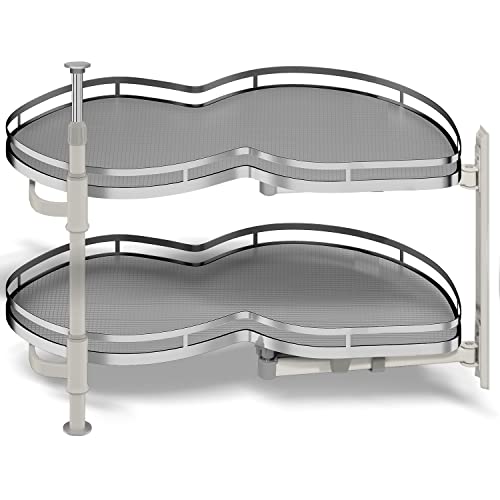
📊 The Rev-A-Shelf Dual Shelves Lazy Susan uses two shelves with a 360-degree swivel. Source: 3 Best Lazy Susans for Corner Cabinet Access in 2026.
Which cabinet type do you have?
The cabinet shape decides the first filter. Hinged-door corner cabinets often accept either system, blind corner cabinets often favor pull-outs, and diagonal base cabinets often work well with rotating shelves if the opening and depth line up.
Hinged-door corner cabinets
These are the most flexible. A Lazy Susan often fits the opening with less fuss, while pull-outs work when the door swing and side walls leave enough room for the slide hardware to move without striking the frame.
Blind corner cabinets
Blind corners usually hide the most wasted space, so pull-outs often make more sense here because they bring the rear section forward. Lazy Susans can work only if the cabinet geometry leaves a usable rotating zone, which is not always true in a blind layout.
Diagonal base cabinets
Diagonal base cabinets give a wider front opening, which can suit rotating shelves and some pull-out systems. The deciding factor is whether the internal width and height support the tray geometry without clipping the door edges.
What measurements decide the fit?
You need inside width, inside depth, inside height, door swing clearance, hinge type, load weight, and cabinet shape before buying either organizer. A 2-inch clearance between wall and unit is a useful starting point for many Lazy Susan installs, but the exact opening still has to match the mechanism.
Measure the cabinet opening first
Measure across the inside cabinet, not the face frame. Record the narrowest inside width, the deepest usable inside depth, and the full inside height from cabinet floor to underside of the top panel.
Check door swing and hinge type
Hinged doors need clearance for both the door edge and the moving tray. Sliding or non-hinged corner cabinets are a poor match for many standard corner organizers because the access path changes, and some systems simply cannot clear the opening.
A simple 2-inch clearance check
For many rotating units, allow at least 2 inches of clearance between the wall and the unit. If that space is missing, the shelf can bind, the door can strike, or the organizer can fail to rotate fully.
Corner cabinet fit checklist and recommendation matrix
| Measurement to capture | What to write down | Pull-out signal | Lazy Susan signal |
|---|---|---|---|
| Inside width | Narrowest inside width in inches | Enough room for slide rails plus tray width | Enough room for shelf diameter or pie-cut span |
| Inside depth | Usable depth from front to back corner | Deep enough for full-extension travel | Deep enough for rotating shelf sweep |
| Inside height | Floor to underside of top panel | Fits single- or multi-tier tray stack | Fits post height and shelf stack |
| Door swing clearance | Door arc and open width | Clear swing path for slide-out hardware | Clear opening for shelf rotation |
| Hinge type | Standard hinge, concealed hinge, or specialty hinge | Works if hinge does not block slide travel | Works best with hinged doors and open access |
| Load weight | Expected contents in pounds | Defined per shelf or drawer load rating | Defined per shelf load rating |
| Cabinet shape | Diagonal, blind, or hinged-door | Often best in blind corners | Often best in hinged-door or diagonal corners |
Recommendation matrix
| Measurement pattern | Recommended option | Why it points there |
|---|---|---|
| Blind corner, deep interior, heavy cookware, clear door swing | Corner Cabinet Pull-Outs | Full-extension access makes the rear corner usable without blind reaching. |
| Hinged-door corner, ample opening width, modest mixed items | Lazy Susan | Rotation gives access with less installation complexity. |
| Diagonal base cabinet, square opening, light-to-moderate pantry goods | Lazy Susan | The circular or pie-cut shelf geometry usually fits the opening cleanly. |
| Door swing clips slide path, hinge leaves little side clearance | Lazy Susan | Pull-outs often fail when rails collide with the door or face frame. |
| Need separated storage for lids, pans, and small appliances | Corner Cabinet Pull-Outs | Tiered trays keep mixed-height items organized by category. |
Common failure cases
A pull-out can hit the door if the slide path is too close to the hinge line or if the inside width is short by even a small margin. A Lazy Susan can feel unstable when heavy weight sits on one side only, especially if the bearing quality is poor or the post is not set to the right height.
Which one stores more, and which handles heavier loads?
Storage capacity depends on the cabinet’s internal dimensions and the tray shape, not the name on the box. Pull-outs usually organize more cleanly by category, while Lazy Susans often make better use of open circular space for items that rotate as a group.
Capacity by shelf, drawer, or tray
Look at the load rating per shelf or drawer, then compare that to the weight of the contents you actually plan to store. The Rev-A-Shelf Dual Shelves Lazy Susan uses two shelves with a 360-degree swivel, its shelf diameter is 28 inches, its height adjusts from 26 to 32 inches, and it is recommended to support up to 68 pounds.
The white ceramic kidney-shaped Lazy Susan measures 28 by 22.5 by 26 inches and holds up to 64 pounds per shelf. The polymer pie-cut Lazy Susan is a two-shelf organizer; its shelves are 28 inches wide and 18.25 inches deep. These figures show why the shape matters as much as the style.
Heavy cookware, lids, small appliances, and mixed-height items
Heavy cookware and small appliances often suit pull-outs because the load sits on a tray that comes fully out of the cabinet. Lids and mixed-height items can work on either system, but pull-outs make separation easier when you want a dedicated place for tall pans, nested bowls, and loose lids.
When 360-degree rotation helps
Lazy Susans help when the cabinet holds frequently used items that you want to reach from either side of the shelf. They also suit lighter pantry goods, spice jars, and grouped containers that do not need strict separation.
Which is easier to install in an existing corner cabinet?
Lazy Susans are usually easier in an existing corner cabinet because the mechanism is often simpler and the retrofit is more forgiving of small measurement errors. Pull-outs ask more of the installer: rail alignment, door clearance, and cabinet width all need to line up or the slide hardware can bind.
Retrofit difficulty and assembly inside the cabinet
Many corner organizers assemble inside the cabinet, so the opening size matters as much as the finished footprint. Pull-outs often require more trial fitting, while Lazy Susans often rely on post height adjustment and shelf placement.
Tool requirements and measurement accuracy
You will typically need a drill, tape measure, level, and screwdriver for either option. Pull-outs demand tighter measurement accuracy because full-extension slide hardware needs straight travel; Lazy Susans are more forgiving, but only if the opening, clearance, and shelf diameter match.
Hardware and mechanism quality
For either type, look for smooth movement, quiet operation, strong bearing quality, and stable support under load. Full-extension slides should move without racking or wobble, while rotating units should turn without scraping or tipping as weight shifts from side to side.
Material choices: maple plywood versus polymer/plastic
Maple plywood suits homeowners who want a stiffer, more furniture-like finish and stronger resistance to flex under load. Polymer or plastic units are easier to clean and often simpler to install, which can matter in a kitchen zone that sees spills, oils, and frequent wiping.
Choose Corner Cabinet Pull-Outs if… / Choose Lazy Susans if…
Choose Corner Cabinet Pull-Outs if you need clear visibility, separated storage, full-extension reach, or a better fit for heavy cookware and mixed-height items. Choose Lazy Susans if you want 360-degree access, simpler retrofit installation, or a layout that works well with a hinged-door corner cabinet and a clean rotation path.
Choose Corner Cabinet Pull-Outs if…
Pick pull-outs when you store pots, pans, lids, or a small appliance that you use often and want to see at a glance. They also make sense when the cabinet is a blind corner and the rear zone would otherwise stay unused.
Choose Lazy Susans if…
Pick Lazy Susans when the cabinet already has enough clearance for rotation and you want the least complicated retrofit path. They are a practical choice for hinged-door corners, light pantry goods, and layouts where the shelf can spin freely without hitting the door or wall.
How do you replace a Lazy Susan in a corner cabinet?
To replace a Lazy Susan, remove the shelves, unfasten the center post or mounting brackets, and measure the cabinet opening before ordering a new unit. Check the inside width, inside depth, inside height, and hinge clearance first, because a replacement that misses any one of those numbers can bind or wobble.
- Empty the cabinet and note the shelf count, post height, and shelf diameter or shape.
- Measure the inside width, depth, and height across the cabinet interior.
- Check door swing clearance and hinge type.
- Remove the old shelves and center hardware.
- Install the new unit with the same opening constraints in mind.
What is the best alternative to a Lazy Susan corner cabinet?
The best alternative is usually a corner cabinet pull-out when you need better separation and deeper reach, especially in blind corners or in cabinets with mixed-height contents. If the cabinet has tight door swing or awkward hinge placement, a pull-out that fits the opening can turn dead space into usable storage without relying on rotation.
Which option works better for heavy pots and pans?
Corner Cabinet Pull-Outs usually work better for heavy pots and pans because the load sits on a slide-supported tray with defined extension travel. Lazy Susans can carry weight too, but heavy items placed unevenly can make rotation less stable, especially in units with weaker bearings or loose post adjustment.
Do pull-outs fit sliding or non-hinged corner cabinets?
Usually no, or at least not without special hardware and careful verification. Pull-outs depend on a predictable slide path and door clearance, so sliding or non-hinged corner cabinets often disrupt the movement or block the tray before it reaches full extension.
What clearance do corner organizers need inside the cabinet?
A practical starting point is 2 inches of clearance between the wall and the unit for many rotating organizers. You also need enough room for door swing, hinge hardware, and the organizer’s full moving range; otherwise the shelf can bind, scrape, or stop short of the opening.
Corner cabinet pull-outs vs Lazy Susans: which stores more?
Neither option always stores more. Capacity depends on cabinet width, depth, height, and tray geometry, plus how much weight the shelves or drawers can carry. Pull-outs often feel larger for separated items, while Lazy Susans can use circular space efficiently when the cabinet shape suits them.
Which is easier to install in an existing corner cabinet?
Lazy Susans are usually easier to install in an existing corner cabinet because they often need less precise slide alignment and fewer clearance checks. Pull-outs take more careful measurement, especially in retrofit jobs where the door swing, hinge line, and cabinet width leave little error margin.
Why is a corner cabinet called a Lazy Susan?
The name refers to a rotating tray or shelf that lets you reach items without stretching deep into the corner. In cabinet use, the term describes a turntable-style storage system with 360-degree access, usually built around a center post or rotating shelf assembly.
How do you replace a Lazy Susan in a corner cabinet?
Start by measuring the inside width, depth, and height, then identify whether the cabinet is diagonal, blind, or hinged-door. Remove the existing shelves and center hardware, confirm hinge clearance, and install the replacement only after checking shelf diameter, post height, and load rating against the new cabinet measurements.
why is a corner cabinet called a lazy susan
It is called a Lazy Susan because the rotating shelf reduces the need to reach and search in the back corner. The term is used for turntable-style corner storage in which the shelves rotate to bring contents forward, especially in hinged-door corner cabinets with enough clearance for movement.
Products related to this article
Sponsored / affiliate links. As an Amazon Associate I earn from qualifying purchases. I may earn additional commission from eligible campaigns.