Cabinet Organizer Cost: What to Budget Before You Buy
Cabinet organizer cost is often reported in the range of about $20 to $800 per cabinet, with simple shelf inserts at the low end and pull-outs, corner units, and drawer systems at the high end. Ignore installation complexity, and a $100 organizer can turn into a $400 project once cabinet size, hardware, and labor are added. This guide breaks down prices by cabinet zone and explains the cost drivers that matter before you buy.
Cabinet organizer cost basics
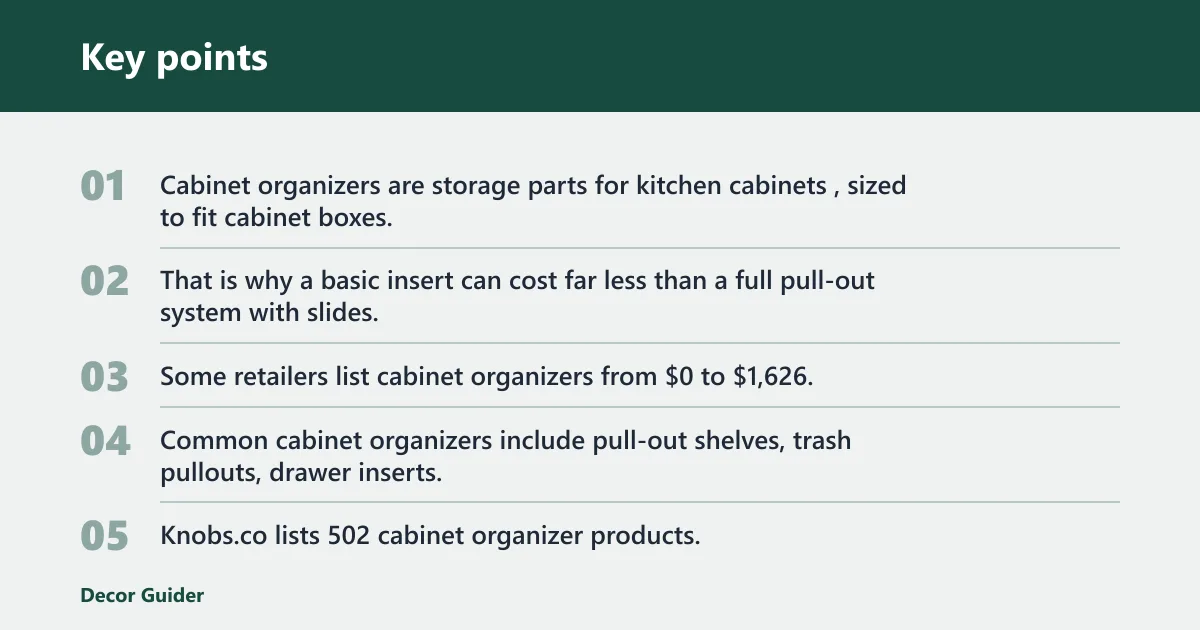


Cabinet organizers are storage parts for kitchen cabinets, sized to fit cabinet boxes, doors, slides, and cutouts around plumbing or hinges. That is why a basic insert can cost far less than a full pull-out system with slides, rails, and door mounting. Some retailers list cabinet organizers from $0 to $1,626, which shows how wide the market can be.
What counts as a cabinet organizer
Common cabinet organizers include pull-out shelves, trash pullouts, drawer inserts, lazy Susans, door-mounted racks, spice organizers, under-sink mats, and corner solutions. Knobs.co lists 502 cabinet organizer products, and its range includes organizers that can convert base, wall, or pantry cabinets. That matters because the same cabinet opening can support very different products.
Cabinet organizers and closet organizers are different product families. Closet organizers usually focus on hanging rods, shoe storage, and shelf towers, while cabinet organizers are sized for cabinet boxes, doors, slides, and plumbing cutouts. A cabinet product often needs tighter width and depth checks than a closet insert.
Why prices vary so widely
Price changes with the cabinet zone, the size of the opening, the material, and the motion hardware. Steel and stainless steel units usually cost more than plastic or polymer parts, and wood or metal drawer systems often sit above simple wire racks. Bundle pricing can lower the per-unit cost, but it can also push the total up if you buy a full system instead of one insert.
Cabinet organizer cost by type
Different organizer types sit in different price bands because they use different hardware and fit different cabinet zones. A simple shelf insert is one purchase. A pull-out drawer is often a product plus slides, mounting brackets, and sometimes a door attachment kit. That is why two items that look similar on a product page can land in very different budget ranges.
Pull-out shelves and trash pullouts
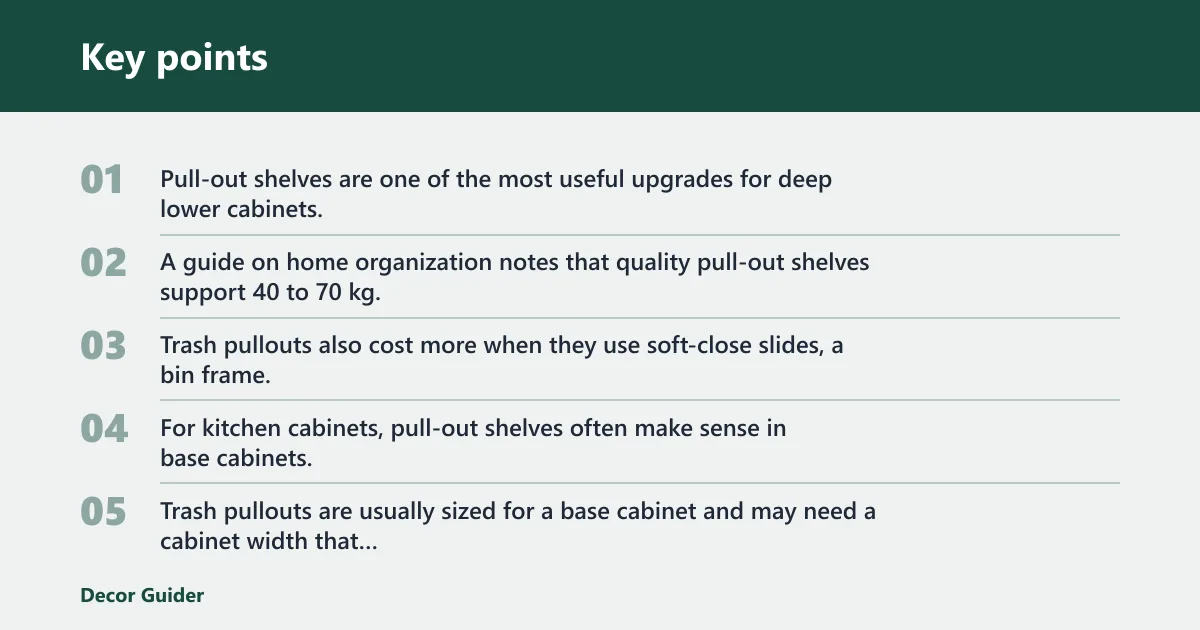
Pull-out shelves are one of the most useful upgrades for deep lower cabinets. A guide on home organization notes that quality pull-out shelves support 40 to 70 kg, which is one reason they cost more than fixed inserts. Trash pullouts also cost more when they use soft-close slides, a bin frame, and a door-mounted front.
For kitchen cabinets, pull-out shelves often make sense in base cabinets, deep storage runs, and pantry towers. Trash pullouts are usually sized for a base cabinet and may need a cabinet width that matches the bin frame, so the final cost depends on the opening rather than the sticker price alone.
Drawer inserts and spice organizers
Drawer inserts usually cost less than pull-outs, but premium versions can still climb fast when they are sized for a specific drawer. KraftMaid lists a Pegged Drawer Organizer from $234.00 to $262.00, Deluxe Dovetailed Roll-Out Trays from $123.00 to $149.00, and a Spice Drawer Organizer Insert Kit from $123.00 to $149.00. KraftMaid also says its storage solutions include insert kits and dividers for drawers.
Drawer organizers fit best in flat drawer storage, utensil drawers, charging drawers, and shallow prep drawers. A 21-inch drawer insert size is common enough to matter when you are comparing products, while a 27-inch charging drawer size can call for a different layout and more expensive divider work.
Lazy Susans, door racks, and corner solutions
Lazy Susans and other corner solutions usually cost more than a basic shelf insert because corner cabinets waste space without a moving platform or tray system. The home organization guide says multi-tier turntables are standard for blind corner cabinets. That kind of fit logic matters, because a blind corner cabinet needs a different product than an open corner base.
Door-mounted racks usually sit in the middle of the price range. The rack itself may be simple, but door mounting adds hinge-clearance checks and installation time. If the door swings into a nearby wall or appliance, the wrong rack can create a return, and the labor bill can grow fast.
Under-sink mats and deep base cabinet options
Under-sink mats and organizers are often cheaper than pull-out systems, but the plumbing cutout and cabinet floor shape can change the price. A 36-inch sink base cabinet often needs a different under-sink layout than a standard base cabinet, especially if the trap, shutoff valves, or disposal take up space. Deep base cabinet fit also raises the stakes on depth and slide length.
Cabinet zone cost guide
Cabinet zone affects both product choice and labor. Base cabinets are the most common home for pull-outs, trash pullouts, and deep storage trays. Wall cabinets often suit lighter racks or spice storage, pantry cabinets can take taller systems, corner cabinets need specialty hardware, and under-sink cabinets need clearance for plumbing. The more the cabinet deviates from a simple box, the more the project cost tends to climb.
Base cabinets and deep storage
Base cabinets are the most common home for pull-outs, trash pullouts, and deep storage trays. They are also where full-extension slides and ball-bearing slides matter most, because you need the tray to come fully forward. In deep base cabinets, a shallow organizer wastes less money than a properly sized pull-out that uses the whole cabinet depth.
Wall cabinets and pantry cabinets
Wall cabinets usually suit lighter organizers, such as spice racks, small door-mounted racks, and shallow shelves. Pantry cabinets can support taller pull-outs and multi-tier storage, but the price rises with height, width, and load capacity. A pantry organizer may also need a finish that matches surrounding cabinet hardware, which can nudge the price up.
Corner cabinets and under-sink cabinets
Corner cabinets often cost more per unit because they need rotating trays, swing-out frames, or blind-corner hardware. Under-sink cabinets can be cheaper in product-only terms, but the installation often takes longer because of plumbing and limited working room. A simple mat is inexpensive; a custom-fit pull-out under a sink can be much more expensive.
What changes the price?
Cabinet organizer price changes most with fit, motion hardware, and cabinet zone. Cabinet width, depth, opening size, finish, and material all matter. If you size the organizer wrong, the product may fit poorly, rub the door, or fail to clear plumbing, which can turn a low sticker price into a higher final bill.
Cabinet width, depth, and opening size
Width and depth are the first checks. A 15-inch opening may work for a slim pull-out, spice unit, or narrow trash pullout, while a wider cabinet can support more storage and heavier hardware. Slide length must match cabinet depth, and a deep cabinet needs an organizer that actually reaches the back without leaving dead space.
Suppose you buy a pull-out shelf for a 15-inch opening, but the slide is too long for the cabinet depth. The installer may need to swap parts, add spacers, or choose a different unit. That adds cost without adding storage.
Materials and finish options
Materials include wood, steel, plastic, metal, aluminum, stainless steel, and polymer. Steel, stainless steel, and aluminum usually cost more than basic plastic parts, while wood and dovetailed trays often sit above simple wire or polymer inserts. Finish options also matter because coated metal, chrome, and specialty finishes can change the product price and the match with nearby hardware.
Slides, mounting, and weight capacity
Full-extension slides, soft-close slides, and ball-bearing slides add cost because they improve motion and load handling. Door mounting adds another layer of hardware, which is common on trash pullouts and some pantry systems. Weight capacity also affects price, and higher-capacity units usually cost more because the frame and slide package are stronger.
Brand, bundle, and dealer pricing
Brand lines can change both price and availability. Rev-A-Shelf, Hardware Resources, and KraftMaid all sit in the cabinet storage market, but they do not price the same way. The same source lists 110 storage accessory results, which shows how quickly a brand catalog can expand when drawer inserts, dividers, trays, and specialty pieces are included. Dealer pricing may differ from online pricing, and some price match retailers can narrow that gap.
Cost matrix for cabinet organizers
| Organizer type | Typical product-only price range | Likely installation complexity | Best-fit cabinet zone | Common size check |
|---|---|---|---|---|
| Pull-out shelves | $80 to $300+ | Medium to high | Base cabinets, pantry cabinets | Opening width and cabinet depth |
| Trash pullouts | $120 to $450+ | Medium to high | Base cabinets | Cabinet width, door clearance |
| Drawer inserts | $20 to $262 | Low to medium | Drawer bases, prep drawers | Drawer size, such as 21-inch or 27-inch layouts |
| Lazy Susans | $40 to $250+ | Medium | Corner cabinets | Cabinet corner shape and tray diameter |
| Door-mounted racks | $25 to $180+ | Low to medium | Wall cabinets, base cabinet doors | Door swing and hinge clearance |
| Spice organizers | $20 to $149+ | Low to medium | Drawer bases, wall cabinets | Shallow drawer height |
| Under-sink mats | $15 to $100+ | Low | Under-sink cabinets | 36-inch sink base cabinet fit and plumbing cutouts |
| Corner solutions | $100 to $500+ | Medium to high | Corner cabinets | Blind-corner access and opening size |
This matrix is a budgeting tool, not a fit guarantee. Product-only price is only one part of cabinet organizer cost, and the labor can matter as much as the hardware when the cabinet has unusual depth, plumbing, or door swing limits.
Installed cost versus DIY cost
Installation is often extra unless the organizer is bundled with a cabinet package, a dealer promotion, or a contractor’s scope of work. DIY saves the most on simple inserts, mats, and low-hardware products. Once you move into slides, door mounting, corner hardware, or a cut-to-fit layout, the labor line starts to matter more.
When installation is usually extra
Installation is usually extra for pull-outs, trash pullouts, and specialty corner systems. These products need square mounting, slide alignment, and in some cases exact door-front spacing. A misaligned slide can make the tray bind, and that fix can cost more than the original savings from a cheaper unit.
When DIY saves the most
DIY tends to work best for drawer inserts, under-sink mats, simple spice organizers, and door racks with straightforward mounting. If the cabinet opening is standard and the hardware is basic, the labor savings can be meaningful. The savings shrink when the organizer needs trim work, extra blocking, or custom spacing.
Common fit mistakes that raise the final bill
- Buying the wrong slide length for cabinet depth.
- Ignoring cabinet width and choosing a unit that rubs the sides.
- Skipping door-clearance checks on racks and pullouts.
- Choosing a load rating that is too low for pantry storage.
- Ordering a corner unit without checking blind-corner access.
A common first-timer mistake is ordering a trash pullout for a 36-inch sink base cabinet without checking plumbing clearance. The bin frame may fit on paper, but the trap or disposal can block the slide path and force a different product.
How much should you budget?
Budget by cabinet zone and by how many organizers you want to upgrade. A few inserts can stay under a few hundred dollars. A full kitchen with pull-outs, trash pullouts, and corner hardware can climb into four figures quickly. The best way to budget is to total product cost, install cost, and any replacement hardware.
Small kitchen budget example
For a small kitchen, a practical budget might include one trash pullout, one spice organizer, and two drawer inserts. A reasonable target is about $150 to $450 for products, with DIY installation often keeping the total closer to the low end. Add labor if the trash pullout needs door mounting or slide work.
Midrange kitchen budget example
For a midrange kitchen, a common package might include two pull-out shelves, one corner organizer, and a drawer insert system. A sensible budget is $450 to $1,100 before any custom carpentry. If you buy through a dealer, ask whether the quote includes mounting hardware, delivery, and installation.
Premium upgrade budget example
For a premium upgrade, the cost can rise fast when you add deep pull-outs, a premium trash system, a blind-corner solution, and custom drawer organizers. A realistic budget is $1,200 to $2,500 or more, depending on cabinet count and finish level. Premium systems usually pay for better slides, stronger frames, and cleaner fit.
Where to buy and what to compare
You can buy cabinet organizers through dealers, cabinet brands, and online retailers. Compare product-only price, whether installation is included, the cabinet size range, and the hardware package. A lower online price can still cost more if shipping, missing parts, or return rules make the project harder to finish.
Rev-A-Shelf, Hardware Resources, and KraftMaid
Rev-A-Shelf and Hardware Resources are common names in cabinet storage, while KraftMaid offers a broader storage accessory catalog through its cabinet line. KraftMaid’s catalog includes drawer dividers, insert kits, and specialty pieces such as the Tiered K-Cup Organizer Drawer. That mix makes brand catalogs useful for comparing system options, not just single products.
Dealer versus online availability
Dealer availability is helpful when you need matching cabinet specs or a bundled install quote. Online availability is useful for fast price checks and broader product comparison. Price match retailers can narrow the gap, but you still need to confirm the exact opening size, slide type, and finish before ordering.
Frequently asked questions
How much closet organizer cost
Closet organizer cost often looks similar at the low end, but the product mix is different, so the pricing logic changes. Closet systems focus on rods, shelves, and towers; cabinet systems focus on slides, door mounting, and cabinet-box fit. A cabinet organizer usually needs more exact dimensional checks.
How much does a cabinet organizer cost?
Cabinet organizer cost usually starts around a few tens of dollars for basic inserts and can reach several hundred dollars for pull-outs, corner units, and drawer systems. Knobs.co lists cabinet organizers from $0 to $1,626, which reflects the spread between simple parts and full systems. Installation can add a lot.
What affects cabinet organizer price
Cabinet organizer price depends on cabinet width, depth, opening size, material, finish, and slide hardware. Brand and buying channel matter too. A pull-out with full-extension slides and a strong weight rating costs more than a simple plastic tray, especially if you also need door mounting or custom fit work.
How much are pull-out shelves for kitchen cabinets?
Pull-out shelves for kitchen cabinets usually cost more than fixed inserts because they need slides and stable mounting. Product-only pricing often starts in the higher basic range and rises with width, load capacity, and soft-close hardware. If the cabinet is deep, the slide package and install time can lift the total.
Where to buy kitchen cabinet organizers
You can buy kitchen cabinet organizers from cabinet dealers, brand catalogs, and online retailers. Look at Rev-A-Shelf, Hardware Resources, and KraftMaid when you want to compare product lines. Price match retailers can help, but always compare cabinet dimensions, hardware type, and whether shipping or install is included.
Which cabinet organizer is worth the money?
The best value is usually the organizer that fixes the biggest access problem in the cabinet you use most. For deep lower cabinets, pull-out shelves are often worth the cost. For drawers, a well-sized insert can be the smarter buy. For corners, a turntable or blind-corner unit usually beats a cheap fixed shelf.
Products related to this article
Sponsored / affiliate links. As an Amazon Associate I earn from qualifying purchases. I may earn additional commission from eligible campaigns.