Best Cabinet Screws for Strong Installs: we compared
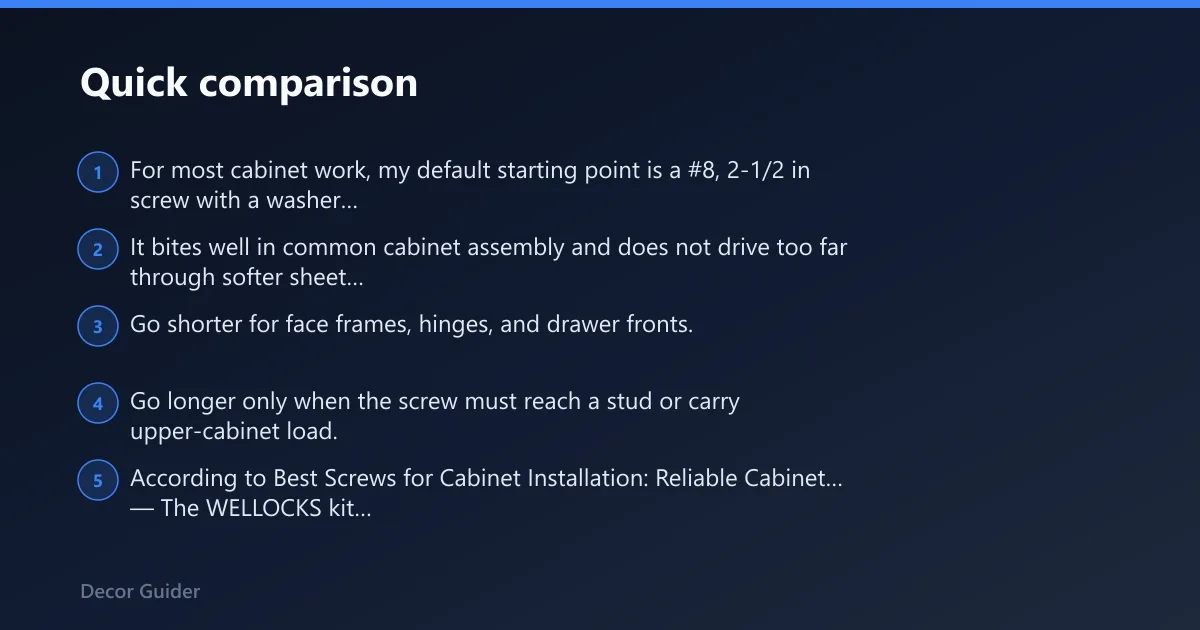
For most cabinet work, my default starting point is a #8, 2-1/2 in screw with a washer head and T-15 drive. It bites well in common cabinet assembly and does not drive too far through softer sheet goods.
Quick comparison
| Product | Badge | Best for | Price | ||
|---|---|---|---|---|---|
 |
Etauwe #8 x 3 Inch Wood Screws, Zinc Coated Drywall Screws,Etauwe | Budget pick | #8 x 3 Inch · 100 PCS · Zinc Coated | $8.54
Price as of 29 Sep 2026
|
View |
 |
Tapcon+ 5/16 x 2-1/4 Inch Heavy-Duty Hex Head ConcreteTapcon | Upgrade pick | 5/16 x 2-1/4 Inch · 15 PCS · Hex Head | $15.94
Price as of 29 Sep 2026
|
View |
 |
JEGONFRI 209PCS Wood Screw Assortment Kit, 6 Sizes FlatJEGONFRI | Also great | 209PCS Assortment Kit · 6 Sizes · Flat Head | $7.96
Price as of 29 Sep 2026
|
View |
 |
FASTENPOWER #8 x 1 Wood Screws Flat Head Particle BoardFASTENPOWER | Our pick | #8 x 1 Inch · 160 PCS · Type 17 Point | $11.99
Price as of 29 Sep 2026
|
View |
Go shorter for face frames, hinges, and drawer fronts. Go longer only when the screw must reach a stud or carry upper-cabinet load.
According to Best Screws for Cabinet Installation: Reliable Cabinet… — The WELLOCKS kit covers cabinet thicknesses from 14 to 45 mm.
How we chose
The comparison below is built around five things that actually change install quality: holding power, split risk, seating quality, drive control, and substrate fit. A screw that feels fine in plywood can be a poor choice in MDF or melamine if the tip, thread, or length is wrong.
#8 gauge keeps showing up because it balances clamp force and split risk well for cabinet work. T-15 also keeps showing up because it gives better bit engagement than a loose Phillips drive, which matters when you are driving overhead or into dense stock.
Job fit came before brand claims. A screw that suits a hinge plate is not automatically the right screw for upper-cabinet anchoring, even if the package says “cabinet screws.”
Cabinet screw selection table
| Installation job | Recommended length | Head type | Drive size | Substrate notes |
|---|---|---|---|---|
| Face frames | 1-1/4 in to 2-1/2 in, matched to material thickness | Low-profile or washer head | T-15 | Use shorter screws near edges in MDF or melamine; predrill brittle spots. |
| Hinge plates and drawer fronts | 1-1/4 in | Low-profile head | T-15 | Best when you need a flush seat and a low snag risk; avoid overlength in thin stock. |
| Cabinet box assembly | 2-1/2 in | Washer head | T-15 | Good general choice for plywood and solid wood; watch for breakout in thin panels. |
| Upper cabinet anchoring | 3-1/8 in | Washer head | T-15 | Use when reaching studs through cabinet cleats or thicker hang points; check stud depth and nearby wiring. |
| Melamine and MDF attachment points | 1-1/4 in to 2-1/2 in | Low-profile or washer head | T-15 | Shorter screws cut split-out and edge blowout risk; predrill more often than you would in plywood. |
Failure-case checklist: split-out happens when the screw diameter or length is too aggressive for the edge distance; cam-out shows up when the bit does not seat firmly; wobble comes from poor thread bite or undersized pilot holes; over-penetration appears when a “helpful” longer screw punches through the wrong side or into a finished face.
Etauwe #8 x 3 inch wood screws: best for general fastening
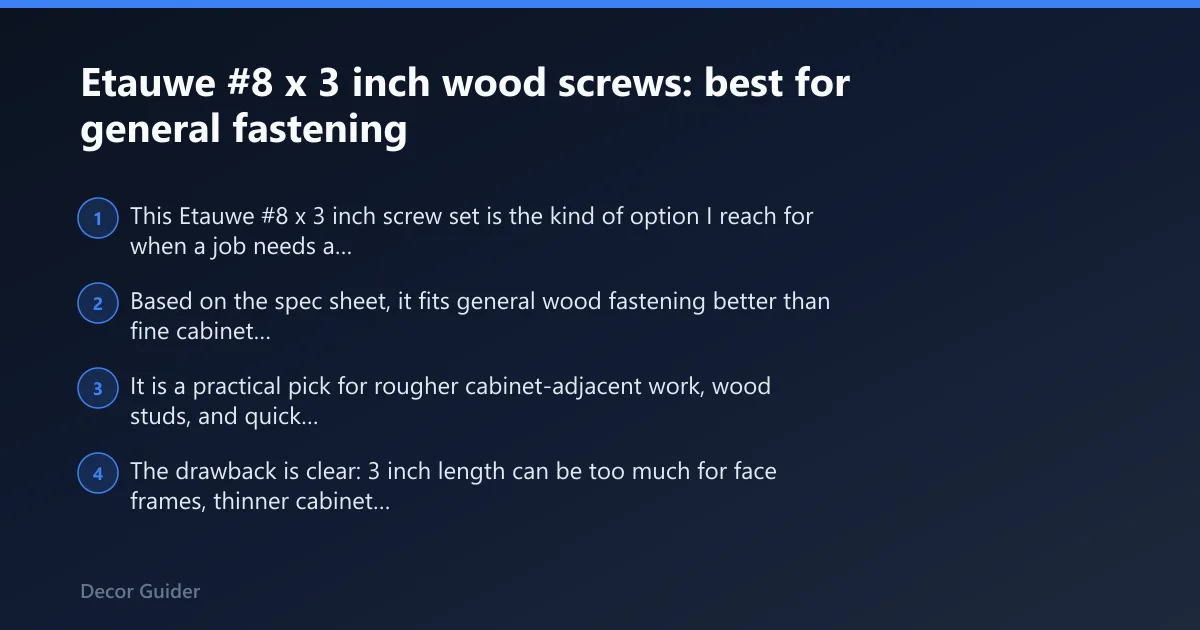
This Etauwe #8 x 3 inch screw set is the kind of option I reach for when a job needs a common size that is easy to drive. Based on the spec sheet, it fits general wood fastening better than fine cabinet detailing, especially where self-starting behavior saves time.
It is a practical pick for rougher cabinet-adjacent work, wood studs, and quick fastening tasks where the package’s self-tapping point matters more than a low-visibility head. The drawback is clear: 3 inch length can be too much for face frames, thinner cabinet panels, or melamine edges, where over-penetration and breakout become real risks.
Tapcon concrete anchors: best for masonry-adjacent installs
This Tapcon anchor is not a standard cabinet screw, but it matters when cabinets or built-ins land on masonry, block, or brick. Based on the listing, it is aimed at concrete anchoring rather than cabinet box assembly, so it belongs in the discussion only for wall conditions that are not wood studs.
The drawback is simple: it is the wrong fastener for plywood boxes, face frames, or hinge plates. If the job is a normal kitchen cabinet install, this is not the first choice.
JEGONFRI wood screw assortment: best for mixed repair work
The JEGONFRI assortment is useful when a cabinet job throws a lot of small fastening sizes at you and you need options in one box. It is a better fit for repairs, shop jigs, and mixed woodworking than for a single-purpose cabinet install plan.
The drawback is consistency. Assortment kits can be convenient, but they are not as targeted as a cabinet screw spec that locks in head shape, drive, and length for one task.
FASTENPOWER #8 x 1 wood screws: best for hinges and light cabinet parts
This FASTENPOWER #8 x 1 wood screw is the shortest, safest-style option in the group for light cabinet components. It fits hinge plates, thin cabinet parts, and other spots where you want less penetration and less chance of blowing out the back side.
Its strength is control. The drawback is reach: for upper cabinets, thicker face frames, or cabinet box anchoring, 1 inch can be too short to develop the grip you need.
1-1/4 in #8 low-profile screw: best for hinges and light cabinet parts
A 1-1/4 in #8 screw is the safer choice for hinge plates, drawer fronts, and thin cabinet parts because it gives enough bite without turning into a split-out problem. In MDF and melamine, shorter screws are often the better call near edges, especially when the panel is thin or brittle.
Where this length fits best
Use this length when the fastener only needs to hold hardware or light trim and does not need to bridge deep material. It is also the length that usually feels least risky on finished cabinet parts where a clean back side matters.
When oversizing causes trouble
A longer screw in a thin hinge area can poke through the box, distort the hardware position, or split the edge. In melamine, the failure often starts with a weak pilot hole and ends with a chipped entry surface.
2-1/2 in #8 washer-head screw: best for general cabinet assembly
This is the top pick for many DIY cabinet installs because it lands in the middle ground. A 2-1/2 in #8 washer-head screw gives solid hold for box-to-box fastening, cabinet assembly, and many face-frame tasks without being as risky as a longer anchoring screw.
Why this is the top pick for many DIY installs
It gives enough length for common cabinet thicknesses while still being manageable in plywood and solid wood. The #8 gauge is a good balance point: thick enough to hold, not so large that split risk jumps unnecessarily.
Why washer-head seating helps
Washer-head screws spread load better than a flat head in many cabinet jobs. That wider bearing surface helps the screw seat more consistently and cuts the chance of pulling through softer sheet goods.
When predrilling still matters
Self-starting tips help, but they do not remove the need to predrill near brittle edges, in hard maple, or in melamine. If the screw is close to the edge or the substrate is prone to blowout, a pilot hole is still the safer move.
3-1/8 in #8 washer-head screw: best for upper cabinet anchoring
A 3-1/8 in #8 screw is the better choice when the screw must reach a stud through a hanger, cleat, or thick cabinet-side build-up. That extra length is worth it when you need holding power for upper cabinets and the wall layout gives the screw enough room to bite deeply.
How to avoid over-penetration
Check the available wall depth before driving the screw. Longer screws can punch through thin blocking or come too close to plumbing, wiring, or finished surfaces if the cabinet backing is thinner than expected.
Why substrate thickness changes the risk
Plywood usually tolerates longer screws better than MDF or melamine, but even plywood has limits at thin edges. Soft sheet goods give less warning before the screw blows out the back or loses clean thread engagement.
Which one should you buy
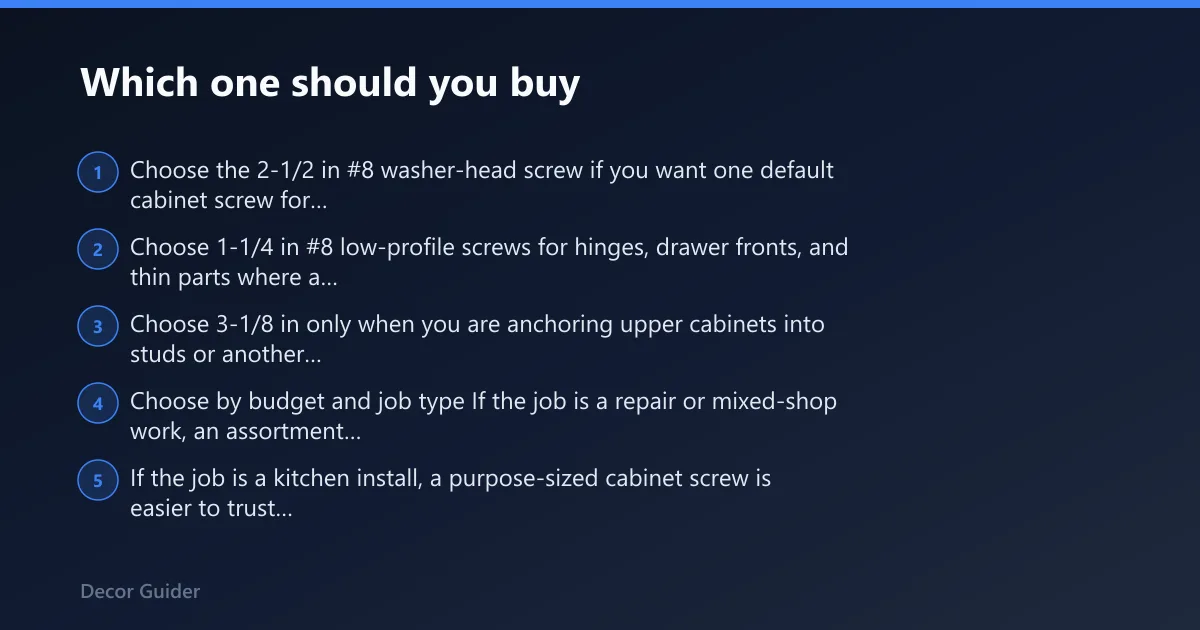
Choose the 2-1/2 in #8 washer-head screw if you want one default cabinet screw for general work. Choose 1-1/4 in #8 low-profile screws for hinges, drawer fronts, and thin parts where a clean seat matters more than long reach. Choose 3-1/8 in only when you are anchoring upper cabinets into studs or another structure that truly needs the extra length.
Choose by budget and job type
If the job is a repair or mixed-shop work, an assortment kit can be practical. If the job is a kitchen install, a purpose-sized cabinet screw is easier to trust because the length and head style are already matched to the task.
Choose by substrate
Plywood is the most forgiving of the common cabinet substrates. MDF and melamine are less forgiving, so shorter screws, careful pilot holes, and controlled drive depth matter more. Solid wood can hold well, but edge splitting is still possible if the screw is too large or driven too close to the end grain.
Choose by failure risk
If split-out is the main risk, shorten the screw and predrill. If cam-out is the main risk, move to T-15 rather than a loose Phillips fit. If wobble is the issue, focus on thread bite and proper seating before you reach for a longer screw.
Are self-tapping cabinet screws better than regular wood screws?
Self-tapping cabinet screws are often better for speed and clean starts, especially in plywood and some cabinet hardware work. They do not replace good technique. In brittle stock, near edges, or in melamine, a pilot hole is still the safer way to avoid split-out and wandering starts.
Where self-tapping tips help
Self-starting points and Zip-Tip style tips improve start accuracy and reduce stripping risk during the first turn. That helps when one hand is holding hardware and the other is driving overhead.
Where they do not solve the problem
A sharp point cannot fix a bad length choice, and it will not make a thick screw safe in thin MDF. If the hole location is too close to an edge, the substrate, not the tip, becomes the limiting factor.
Do I need to predrill cabinets before screwing them in?
Yes, predrilling still matters in many cabinet installs, especially near edges, in MDF, melamine, and hard solid wood. Self-tapping screws help with starts, but they do not remove the need for a pilot hole when the risk of split-out, wandering, or surface blowout is high.
Good times to predrill
Predrill for hinge plates, end-grain anchoring, brittle sheet goods, and any screw driven close to a finished edge. It is also wise when the screw has to pull two parts into alignment without forcing the material apart.
What length screws are best for face frames and hinges?
For face frames and hinges, 1-1/4 in screws are often the safer choice, with 2-1/2 in reserved for thicker joints where the screw must reach deeper material. The shorter screw keeps control high, cuts breakout, and is less likely to distort hinge position or split thin stock.
Face frames
Face frames often reward a low-profile or washer-head screw if the head needs to sit cleanly without snagging. In soft sheet goods, shorter length also lowers the chance of over-penetration on the back side.
Hinges
Hinges need repeatable seating more than brute length. A screw that grabs cleanly and sits flush is usually better than a longer screw that twists the hinge out of alignment.
Which screws work best in plywood cabinets vs MDF cabinets?
Plywood usually tolerates a wider range of screw choices because it holds threads more predictably than MDF. MDF needs more caution: shorter screws, better pilot holes, and a drive style that reduces cam-out are usually the safer path. Melamine is even more sensitive at the surface layer.
Plywood
Plywood gives better withdrawal resistance than many manmade panels, so a #8 screw with a W-cut style thread and T-15 drive is a strong general pairing. It still benefits from careful length matching so the screw does not overrun the back side.
MDF and melamine
MDF and melamine punish aggressive sizing. Use shorter screws near edges, expect more predrilling, and avoid assuming a longer screw will solve a weak joint. It usually makes the edge failure worse.
How do I stop cabinet screws from stripping or cam-out?
Use the right drive, the right bit, and the right seating pressure. T-15 compatibility helps because it keeps the bit engaged more consistently than a loose fit, while washer or low-profile heads seat more predictably when the screw is driven straight.
Practical fixes
- Match the bit to the drive before driving the first screw.
- Keep the driver square to the screw head.
- Stop when the head is seated; do not keep forcing it.
- Use a pilot hole in brittle material or near edges.
- Replace a worn bit before it starts slipping.
A T-15 drive with a washer-head screw usually gives better control than a loose Phillips head in cabinet work. That matters most overhead, where cam-out wastes time and damages the head fast.
What screws should I use to mount upper cabinets to studs?
For upper cabinet anchoring, use a longer #8 screw, commonly around 3-1/8 in when the cabinet and wall build-up require it. The screw needs to reach the stud with enough thread engaged to carry load, and the head needs to seat cleanly against the hanging surface.
Check the wall before driving
Measure the cabinet backing, cleat, and wall layers before choosing the final length. If the screw is too short, hold drops. If it is too long, over-penetration becomes a problem on the far side.
Are washer-head cabinet screws better than flat-head screws?
Washer-head screws are often better for cabinet fastening when you want load spread and more forgiving seating. Flat-head screws can sit well in countersunk holes, but washer heads usually give broader bearing on cabinet parts, which helps cut pull-through in softer panels.
When flat head still makes sense
Flat-head screws can be useful where a countersunk look is required or a hardware plate is made for that seat. For many cabinet assemblies, though, washer-head or low-profile head styles give a better balance of grip and surface support.
Frequently asked questions
What size screws should I use for cabinet installation?
For most cabinet installation tasks, #8 screws are the best starting point because they balance holding strength and split risk well. Use about 1-1/4 in for light hardware work, 2-1/2 in for general cabinet assembly, and 3-1/8 in when you must reach studs or another structural support.
Products related to this article
Sponsored / affiliate links. As an Amazon Associate I earn from qualifying purchases. I may earn additional commission from eligible campaigns.