What Are the Essential Kitchen Cabinet Storage Items?
The essential kitchen cabinet storage items are shelf risers, pull-out bins, turntables, drawer inserts, lid organizers, and under-shelf hooks, chosen by the cabinet problem you need to fix, not by the product itself. If you ignore the problem, you waste vertical space, bury food at the back, and turn deep or awkward cabinets into dead zones. This guide sorts the cabinet zones that fail first and matches each one to the storage item that solves it.
Kitchen cabinet storage decision table


Start with the cabinet that feels hardest to use. The right organizer depends on depth, access, how often you reach for the item, and how much weight the zone has to carry. A shallow utensil drawer needs a different fix from a corner base cabinet, and a pantry door needs a different solution from the space under the sink.
| Problem zone | Exact organizer type | Required measurements | Best-fit item category | Item weight / use-frequency guidance | Skip this organizer when… | Common failure mode to avoid |
|---|---|---|---|---|---|---|
| Utensil drawer clutter | Adjustable drawer organizer | Measure interior width, depth, and side wall height | Utensils, peelers, whisks, small tools | Best for high-frequency tools used every day and lighter items that need fast sorting | Skip rigid inserts when the drawer width is irregular or the drawer needs flexible compartments | Rigid inserts that leave dead space or bind in narrow drawers |
| Dry-goods cabinet | Airtight clear storage container | Check shelf height and the tallest container you can stack safely | Rice, pasta, flour, sugar | Best for staples you refill often and want to see at a glance | Skip tall stacks when shelf height is tight or the cabinet is exposed to heat | Warped plastic near heat or lids that do not seal tightly |
| Corner cabinet | Lazy Susan | Measure shelf diameter and door swing clearance | Spices, oils, cans, jarred goods | Best for medium-weight items you rotate often and need to reach from the front | Skip it when the opening is too tight for the tray to turn freely or the shelf is too small for grouped items | Oversized trays that rub the cabinet sides |
| Cabinet door | Over-the-door organizer | Measure door thickness, top gap, and shelf depth | Wraps, spices, packets, foil, cleaning supplies | Best for light, frequently used items that benefit from vertical access | Skip it when the door has trim, limited clearance, or hardware that blocks hanging bins | Doors that will not close because the bins sit too deep |
| Deep base cabinet | Pull-out cabinet shelf | Measure cabinet depth, width, and center stile clearance | Pots, pans, bowls, small appliances | Best for heavy or awkward items you use often enough to justify easy access | Skip it when the cabinet opening is too narrow for the slide or the load is too light to need hardware | Slides that hit the frame or leave too little front clearance |
| Overflow pantry or fridge zone | Stackable bin | Measure shelf height and the footprint of each bin | Snacks, produce, chilled backup items | Best for grouped items you access often and can label quickly | Skip stacking when the lower bin would become hidden or the contents are awkwardly shaped | Unlabeled stacks that hide smaller items at the bottom |
| Under-sink cabinet | Roll-out under-sink tray | Measure plumbing height, trap location, and cabinet width | Cleaning supplies, sponges, tablets, trash bags | Best for light-to-moderate items that need quick access around plumbing | Skip deeper bins when pipes, the disposal, or filter lines block the tray path | Drawers that collide with pipes or the disposal |
What are the essential kitchen cabinet storage items?
The essential items are the ones that fix the most common cabinet failures: cluttered drawers, buried dry goods, hard-to-reach corners, and wasted door space. For most kitchens, that means adjustable drawer organizers, clear storage containers, lazy Susans, and over-the-door organizers before anything decorative or optional.
Drawer organizers
Drawer organizers are the first fix when utensils and small tools mix into one pile. Adjustable versions fit drawers of many sizes, which matters because kitchen drawers are rarely built to the same width or depth. Choose one with movable dividers if you keep knives, peelers, tongs, and measuring tools in the same drawer.
A common first-time mistake is buying a fixed tray that looks neat in the store and leaves a gap in the drawer. That gap becomes the new clutter zone. Measure the interior, not the drawer face, and leave a little clearance so the tray lifts out without snagging. For a practical sizing reference, many adjustable systems are built to flex around common drawer widths and depths, but the cabinet opening still determines the fit.
Clear storage containers
Clear storage containers work best for dry goods that need visibility and a tighter seal. Airtight lids help keep rice, pasta, flour, and sugar organized in one place, and stackable shapes let you use shelf height instead of spreading items across multiple cabinets. They also make it easier to see when a staple is running low.
Use square or rectangular containers when possible. They waste less shelf area than round ones. If a cabinet sits near a warm appliance or a vent, avoid flimsy plastic that can warp and keep lids from sealing properly. Look for containers that match the shelf height you actually have, not the height you wish you had.
Lazy Susan
A lazy Susan is the simplest fix for a corner cabinet or a deep shelf where items disappear at the back. The rotating tray brings bottles, jars, and cans forward without unloading the whole cabinet. It is especially useful when the back row is the part you forget to use.
Measure the shelf diameter and the cabinet opening before buying. If the tray is too large, it will scrape the sides or block the door. In deep pantry shelves, a low-profile rotating tray often works better than a tall bin because it keeps labels visible and reduces the chance of tipping.
Over-the-door organizers
Over-the-door organizers add storage on pantry doors, cabinet doors, or even a wall when floor and shelf space are tight. They are a strong renter-friendly option because many versions hang without drilling. Use them for wraps, packets, spices, foil, or light cleaning items that are used often.
Check the door thickness and top clearance first. If the bins sit too far out, the door may not close cleanly. For small kitchens, this is one of the best ways to use the cabinet door and other unused vertical space for storage without permanent changes.
Which cabinet organizers save the most space?
The biggest space savings usually come from organizers that recover hidden depth or vertical height. Pull-out shelves, stackable bins, and wall-mounted knife storage solve different problems, but each one frees a cabinet surface that often gets wasted. The best choice depends on where the lost space sits, behind, above, or inside the cabinet.
Pull-out cabinet shelves
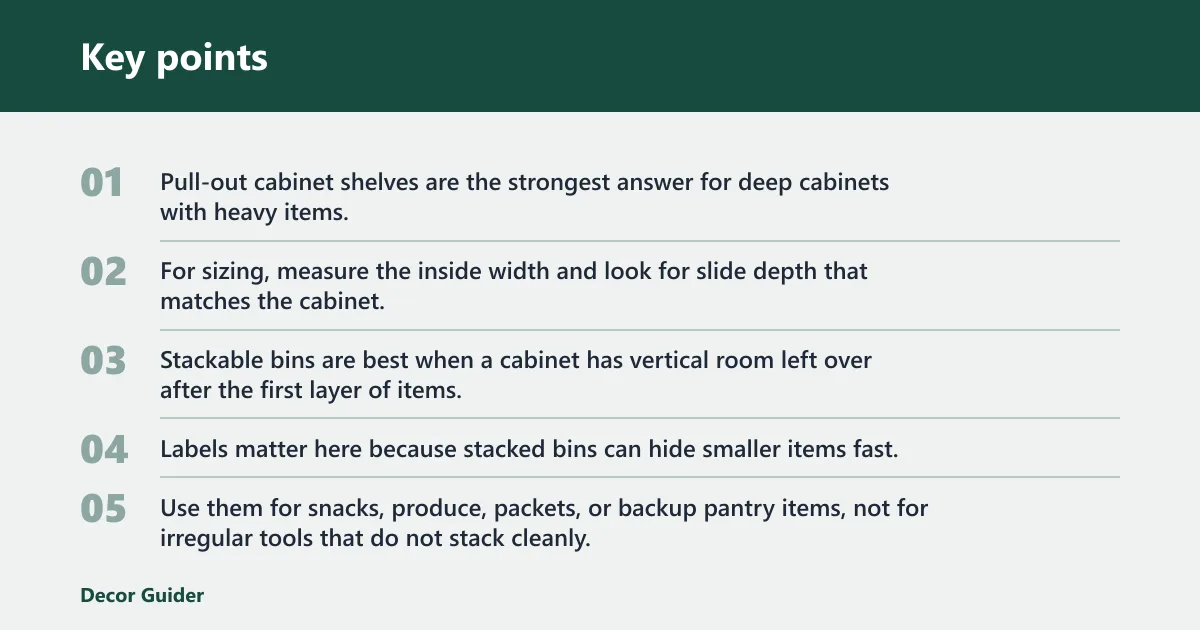
Pull-out cabinet shelves are the strongest answer for deep cabinets with heavy items. Slide-out access makes pots, pans, and bowls easier to reach, especially when the back half of the shelf is otherwise unusable. They also reduce the need to kneel and pull everything out to find one lid or skillet.
For sizing, measure the inside width and look for slide depth that matches the cabinet. A common setup uses about 20-inch drawer glides, but the exact fit depends on the cabinet depth and the hardware profile. If the cabinet has a face frame or a center stile, the base may need to be cut about 1/4 inch narrower than the opening so the pull-out moves freely.
Stackable bins
Stackable bins are best when a cabinet has vertical room left over after the first layer of items. They work in the pantry, fridge, and freezer, which makes them useful for overflow storage and grouped categories. Labels matter here because stacked bins can hide smaller items fast.
Use them for snacks, produce, packets, or backup pantry items, not for irregular tools that do not stack cleanly. If you cannot see into the lower bin, it will become forgotten space. Keep the label on the front edge, not just the lid.
Magnetic knife strip
A magnetic knife strip frees drawer space and clears the counter at the same time. It is a wall-mounted option that keeps knives out of crowded drawers, where blades can dull or chip against other tools. It also helps if your utensil drawer is already full and cannot spare room for a knife block.
Secure mounting matters. The strip has to hold the weight of the knives without loosening over time, so use the right anchors for the wall type. This is a more permanent solution than a drawer insert, which makes it less renter-friendly.
Corner cabinets
Corner cabinets are easiest to use when the organizer rotates or swings the contents into view instead of leaving them buried in the back. A lazy Susan is the most straightforward option, but tiered trays and shaped inserts can also help if the shelf is deep and the opening is awkward. The goal is to reach bottles and jars without taking out everything in front of them.
Measure the shelf diameter, the opening width, and the door swing before choosing a form. If the shelf turns but the door hits first, the organizer is too large for the cabinet. Keep the heaviest items low and the most-used items closest to the front edge.
What should go in deep kitchen cabinets?
Deep kitchen cabinets should hold bulky items that are hard to stack in shallow space, such as pots, pans, bowls, mixing equipment, and rarely used appliances. They also work well for items that benefit from slide-out access, because depth only helps if you can still reach the back without unloading the front.
- Measure the full opening. Check cabinet width, depth, and any center stile or frame that cuts into usable room. Depth matters most here because a shelf that is too long will catch before it slides fully out.
- Assign heavy items first. Put pots, pans, and bowls on pull-out shelves before moving lighter items. Heavy cookware is where slide-out access pays off most, because lifting it from the back of a deep cabinet is awkward and easy to avoid once the shelf moves.
- Keep the front clear. Leave space for the shelf to extend without hitting nearby doors or handles. If the cabinet has a center stile, check whether the slide can pass it or whether the base needs to be trimmed slightly narrower.
Suppose a deep base cabinet holds a mixer, a Dutch oven, and a stack of bowls. Without a pull-out shelf, the mixer stays in front because it is easiest to reach, and the bowls get buried behind it. A slide-out shelf changes that layout without changing the cabinet itself.
What items belong under the kitchen sink cabinet?
Under the sink cabinet should hold light, leak-safe items that fit around plumbing rather than against it. The best choices are under-sink organizer trays with roll-out motion, because they work around traps, supply lines, and disposal units better than fixed bins. Cleaning supplies and sponges belong here; heavy cookware usually does not.
Under-sink organizer trays
Under-sink organizer trays use smooth-action ball-bearing drawer glides, which helps the tray move past pipes and bottles without snagging. That sliding motion is useful because the cabinet is usually split by plumbing, not by a clean rectangular shape. A custom fit matters more here than it does in almost any other cabinet.
Family Handyman says a version of this project can cost as little as $80, uses 20-inch-long side-mount drawer glides, and can be built in a weekend. Those numbers are useful for planning, especially if you are comparing a do-it-yourself tray with a ready-made pull-out unit. The exact total can vary by hardware choice and cabinet size.
Plumbing clearance checks
Before buying or building anything, measure the trap, the disposal, and the supply lines. Leave room for doors to close and for the tray to slide without catching. A base cut 1/4 inch narrower than the cabinet opening is one common adjustment when the cabinet has tight side clearance.
- Map the plumbing first. Trace the lowest pipe, the widest fitting, and the point where the tray must pass. This tells you whether the organizer can be full-width or needs a split layout.
- Choose shallow containers. Store spray bottles, dishwasher tabs, and sponges in low bins that can clear the trap. Deep tubs waste space here because they hit plumbing before they use the cabinet height.
- Keep weight modest. Put light cleaners and spare bags under the sink, not cast iron or stacked cans. The more weight you load onto a drawer glide, the more important secure mounting becomes.
Picture a cabinet with a disposal on one side and a water filter on the other. A tall bin may fit on paper but fail in practice because the lid catches the filter line. A narrower tray often works better than a larger bin that looks more efficient.
How do you choose renter-friendly options?
Renter-friendly storage usually means no-drill or removable solutions that can move with you. Over-the-door organizers, adjustable drawer inserts, stackable bins, and some freestanding clear containers are the easiest place to start. Permanent installs make more sense only when the cabinet is deep, heavy, or badly underused.
No-drill picks
No-drill options are the safer first step when you cannot alter cabinets or walls. Door-mounted storage works well for pantry and cabinet doors, and drawer organizers can be dropped into place without hardware. These are the easiest fixes for a small kitchen because they add structure without changing the cabinet itself.
Choose no-drill products when the cabinet still works but lacks order. If the problem is access, though, a removable bin may not be enough. A deep cabinet that repeatedly hides cookware often needs a slide-out shelf rather than a container.
Permanent installs
Permanent installs make sense for deep cabinets, under-sink spaces, and knife storage that needs a secure hold. Pull-out cabinet shelves and magnetic knife strips are more stable than loose containers, but they require accurate sizing and solid mounting. They are best when the cabinet problem is structural, not cosmetic.
Small kitchen cabinets
Small kitchen cabinets benefit most from organizers that improve access without taking up much footprint. Drawer inserts, over-the-door organizers, stackable bins, and clear containers with square sides are usually the best place to start. When the cabinet is shallow, the right choice is often the one that keeps items visible and reachable instead of adding more layers.
Measure the usable interior before buying anything with a rigid frame. If the cabinet is narrow, a bulky organizer can make the opening feel smaller. Favor slim profiles, light-weight storage, and pieces that can move with the contents rather than locking the layout in place.
Heat and weight limits
Keep warped plastics away from heat sources, especially near ovens, dishwashers, and warm appliance vents. Heavy cookware also belongs on hardware that can support repeated load, such as pull-out shelves or properly mounted glides. If a product feels light enough to wobble empty, it may not be the right choice for a loaded cabinet.
Frequently asked questions
What is popular in kitchen cabinets storage?
Common kitchen cabinet storage items include drawer organizers, clear storage containers, lazy Susans, over-the-door organizers, pull-out shelves, stackable bins, and knife strips. They stay popular because they solve common cabinet problems: clutter, lost items, dead corner space, and hard-to-reach storage. The best choice still depends on the zone.
What storage items do I need for kitchen cabinets?
You need different organizers for different cabinet jobs. Start with drawer organizers, clear containers, and either a lazy Susan or pull-out shelf, depending on whether your biggest problem is clutter, food storage, or access. If your kitchen is small, add over-the-door storage before buying duplicate containers.
Which kitchen cabinet organizers save the most space?
Pull-out shelves and stackable bins often save the most usable space because they recover depth and height. A magnetic knife strip also frees a surprising amount of drawer room. If the cabinet is awkward, though, a space-saving product that does not fit the zone can waste more room than it saves.
What are the best storage options for small kitchen cabinets?
For small cabinets, prioritize renter-friendly organizers that add storage without a big footprint: drawer inserts, over-the-door organizers, stackable bins, and clear containers with square sides. If the cabinet depth is the problem, a pull-out shelf can matter more than any container because it improves access instead of just sorting items.
Products related to this article
Sponsored / affiliate links. As an Amazon Associate I earn from qualifying purchases. I may earn additional commission from eligible campaigns.