Shaker Cabinet Doors Review: What to Know Before Buying
Choose shaker cabinet doors with true 5-piece construction, about 3/4-inch door stock, and size tolerances within about 1/16 inch of your cabinet openings; for refacing, that mix can help reduce fitting errors and hinge headaches. Bad sizing or warped frames can waste doors, hardware, and labor. This review covers construction, finish, and measurement choices that prevent common refacing mistakes.
Verdict

Shaker doors are a strong buy when you want a clean profile that still accepts paint, stain, or clear coat, and when your cabinet boxes can support the overlay or inset layout you plan to use. They are a weaker choice if your cabinets are badly out of square, your hinge pattern is nonstandard, or you need a door that hides uneven reveal lines without extra prep.
Pros
- Simple frame-and-panel construction fits many remodel and refacing projects.
- Works across full overlay, half overlay, and inset layouts.
- Available in unfinished, primed, painted, and clear-coat-ready options.
- Can be matched to replacement drawer fronts and hardware spacing on common hinge patterns.
Cons
- Bad measurements show up fast as uneven gaps or rubbing doors.
- Material choice changes paint durability, edge chipping, and warp risk.
- Inset and nonstandard cabinets often need tighter layout checks.
- Custom sizing can add lead time before installation starts.
Specs at a glance
| Spec area | What to look for | Why it matters |
|---|---|---|
| Construction | Frame-and-panel with a recessed center panel | Keeps the classic shaker profile and helps you compare true shaker doors with flat panel styles |
| Installation fit | Full overlay, half overlay, or inset compatibility | Controls reveal size, hinge exposure, and whether the door suits your cabinet layout |
| Material options | MDF, solid wood, thermofoil, paintable materials, clear-coat-ready woods | Affects warp risk, chip risk, finishing method, and edge durability |
| Finish options | Unfinished, primed, painted, clear finish, custom color selection | Determines labor, turnaround, and how much finishing control you keep |
| Hinge prep | Pre-bored hinge holes matched to your hardware | Prevents drilling errors and compatibility problems during installation |
| Ordering fit | Custom sizing for doors and drawer fronts | Useful when cabinet openings, reveals, or drawer heights are nonstandard |
Who it
Shaker cabinet doors suit you if you want a straightforward door style that can work in refacing, replacement, or a full kitchen remodel without pushing the room toward a highly decorative look. They are also a practical fit when you need matching drawer fronts, common hardware spacing, and a finish that can be painted or clear coated.
They are less suitable if your cabinets are heavily racked, your reveals are already uneven, or you want a door that can hide poor box geometry. A common first-timer mistake is choosing the shaker profile before checking cabinet depth and face-frame clearance; on a pantry tower with uneven reveals, a slight miscalculation can leave the doors rubbing the stile or looking lopsided when closed.
Best fit scenarios
- Refacing existing cabinets with sound boxes and consistent hinge spacing.
- Replacing worn doors and drawer fronts while keeping the cabinet carcasses.
- New builds that need a clean profile without an ornate frame.
When to keep looking
- Cabinet frames are twisted, swollen, or badly out of square.
- You need a flat slab look with fewer profile edges to finish.
- Your project requires unusual hinge placement or custom inset detailing beyond standard specs.
What works
Shaker doors work because the profile is simple and predictable. CabinetDoors.com describes them as frame-and-panel construction with a recessed center panel, which keeps the look crisp without relying on heavy ornament. That same structure makes them easier to coordinate with common kitchen styles, from traditional to modern, and it gives you a clean match for painted, stained, or clear-coated cabinet runs in kitchens with standard wall and base cabinet layouts.
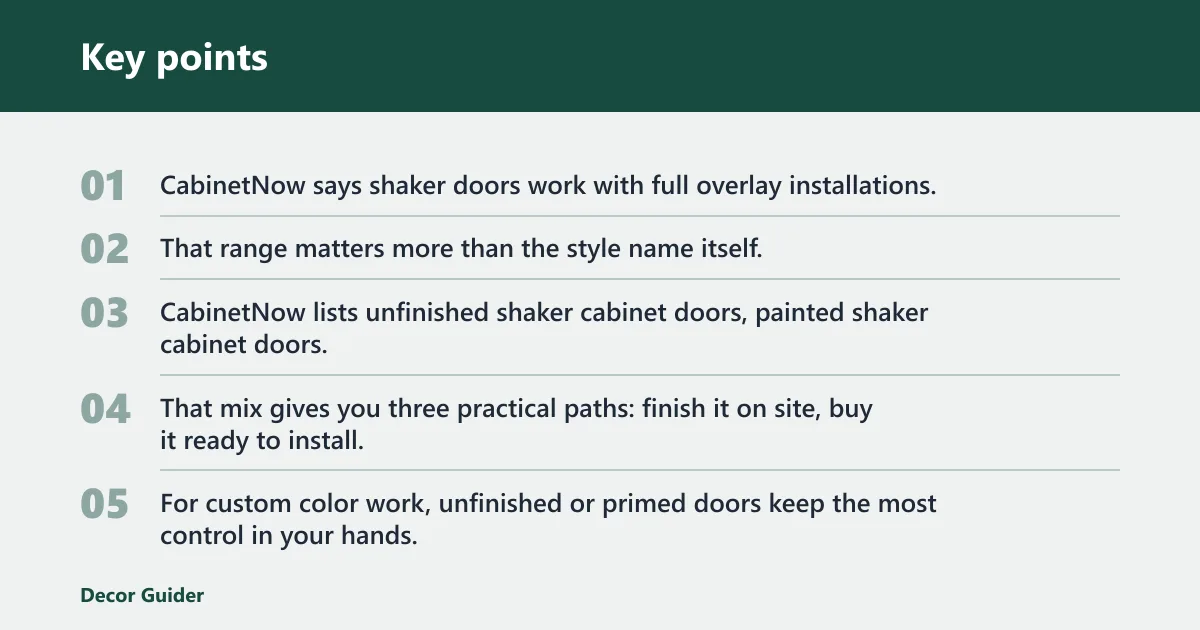
CabinetNow says shaker doors work with full overlay installations, half overlay installations, and inset installations. That range matters more than the style name itself, because the wrong overlay choice can create uneven reveals, misaligned drawer fronts, or a hinge that sits too close to the cabinet face.
Finish and material flexibility
The same source lists unfinished shaker cabinet doors, painted shaker cabinet doors, and a clear-coat shaker option. That mix gives you three practical paths: finish it on site, buy it ready to install, or choose a protective clear finish when you want the wood tone to show.
For custom color work, unfinished or primed doors keep the most control in your hands. Painted doors reduce finishing steps, while clear-coated doors make the grain visible and avoid the color-matching problem that comes with site painting.
Styles within the shaker family
The same source says its shaker collection includes slim shaker, beaded shaker, wide shaker, inset shaker, and more. That matters because “shaker” is not one exact profile. A slim frame reads lighter, wide rails read more traditional, and a beaded edge changes the shadow line enough that it may suit a different room style or cabinet depth.
Picture a 12-inch drawer stack on a face-frame cabinet with a painted kitchen plan. A slim shaker can keep the front from looking heavy. On an inset cabinet, an inset shaker may read cleaner because the door already sits inside the frame and the reveal becomes part of the look.
What does not?
Shaker doors are not a fix for bad cabinet geometry. If the box is out of square, the door can still show a tilted reveal, rub at one corner, or leave a shadow line that looks wider on one side than the other. Those problems become more obvious on inset work, where the reveal is supposed to stay even all around.
Material choice can create different failure modes. MDF is often chosen for paintable work, but edge chipping becomes a concern if the finish is handled roughly. Solid wood gives a clear finish more natural grain, yet it can move more with humidity. Thermofoil can simplify cleaning, but once the surface is damaged, repair is less forgiving than a paint touch-up on unfinished wood or MDF.
Common failure modes
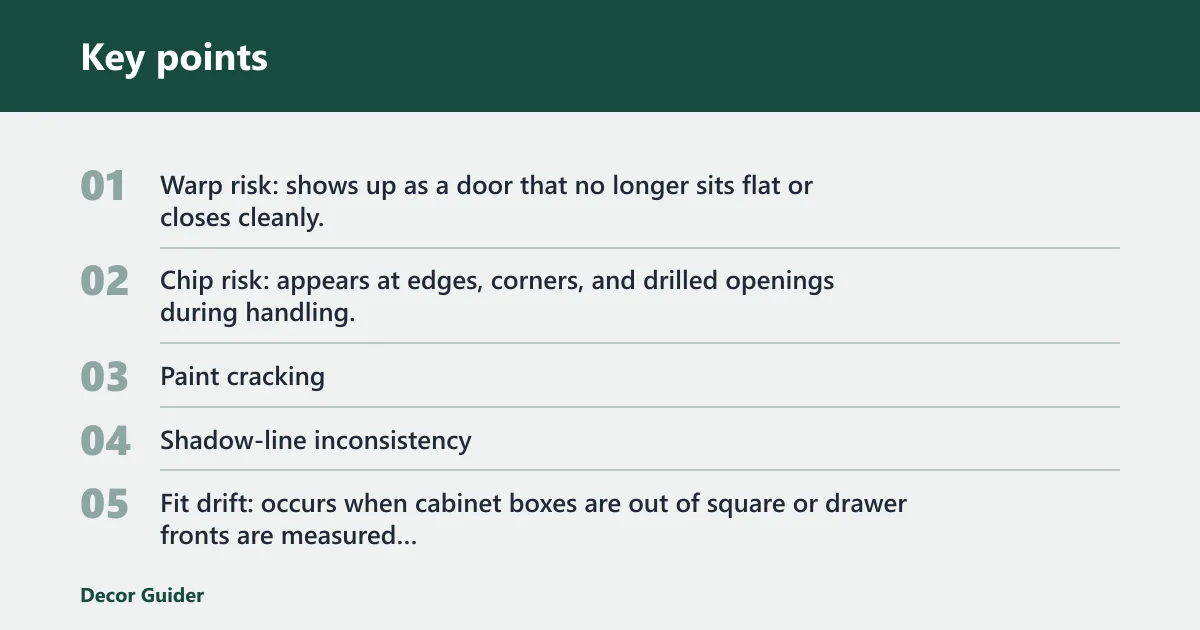
- Warp risk: shows up as a door that no longer sits flat or closes cleanly.
- Chip risk: appears at edges, corners, and drilled openings during handling.
- Paint cracking: can happen when finish moves with the substrate or the door is too tightly fitted.
- Shadow-line inconsistency: visible when inset or overlay reveals vary from side to side.
- Fit drift: occurs when cabinet boxes are out of square or drawer fronts are measured without checking gaps.
Suppose your cabinet opening is about 18 inches wide, but the frame is out of square by about 1/8 inch from top to bottom. If you order to the nominal opening without accounting for that drift, the new shaker door may look fine on paper and still scrape at one corner during installation.
Shaker cabinet doors decision table
Use this table as an ordering filter. It links cabinet type, finish goal, and risk level to the safest spec choices before you submit a custom order.
| Cabinet type | Finish goal | Primary risk | Safest shaker spec choice |
|---|---|---|---|
| Face-frame | Painted | Fit drift | Full or half overlay shaker, paintable material, pre-bored hinges, verified drawer-front matching |
| Face-frame | Clear coat | Chip risk | Solid wood shaker, sanded or ready-for-finish surface, rounded handling edges, hardware matched before drilling |
| Face-frame | Stained | Warp risk | Solid wood shaker with stable stock, controlled lead time, and confirmed grain-matching across doors and drawers |
| Frameless | Painted | Shadow-line inconsistency | Full overlay shaker with precise sizing, consistent reveal plan, and pre-bored hardware that matches the hinge cup layout |
| Frameless | Clear coat | Warp risk | Stable solid wood or clear-coat-ready spec, thickness checked before ordering, and close confirmation of opening width and height |
| Inset | Painted | Fit drift | Inset shaker, tighter tolerance checks, hinge boring matched to the inset hardware system, and careful gap verification on all sides |
| Inset | Stained | Shadow-line inconsistency | Inset shaker in solid wood, repeated measurements at top and bottom, and drawer-front sizing confirmed separately from door sizing |
How do shaker doors compare with slab doors?
Shaker doors and slab doors solve different problems. Shaker cabinet doors add a frame-and-panel profile with a recessed center panel, while slab doors present a flat face with no frame detail. Shaker usually gives you more visual texture; slab usually gives you fewer profile edges to align and finish.
For installation, slab can be the safer choice when you want fewer lines to align on slightly imperfect cabinet boxes. Shaker can be the better choice when you want a more traditional or transitional look, or when a room needs a profile that reads as more built-in than a plain panel.
Slab vs shaker cabinet doors
Slab vs shaker cabinet doors often comes down to how much detail you want to manage during installation. Slab hides fewer alignment issues because there are fewer seams, but it can look plain in a room that needs visual depth. Shaker adds detail, yet that detail also makes gap consistency more noticeable.
Flat panel vs shaker cabinet doors
Flat panel vs shaker cabinet doors is a different comparison than slab vs shaker. A flat panel door may still have a frame around the center panel, while a shaker door uses a cleaner frame-and-panel look with a recessed center panel and straighter lines. That difference matters when you compare shadow lines and edge detail.
How should you measure before ordering?
Measure the cabinet opening width and height, then decide how much of that opening the door will cover based on your overlay or inset layout. Replacement cabinet doors work best when the door size, drawer front size, and hinge boring all match the actual cabinet geometry, not just the nominal opening.
The safest approach is to measure every opening more than once. If a cabinet is not square, use the tightest and largest points, then order with the overlay allowance and gap plan in mind. A 1/16-inch miss can matter on a tight inset door or a drawer front lined up with adjacent doors.
- Measure opening width at the top, middle, and bottom.
- Measure opening height at the left, center, and right.
- Record the smallest width and height for fit planning.
- Confirm whether the cabinet is face-frame, frameless, or inset.
- Check overlay allowance for full overlay or half overlay layouts.
- Measure drawer front width and height separately from door fronts.
- Verify hinge boring location and hole pattern before ordering.
- Check reveal gaps so adjacent doors and drawers line up visually.
Replacement and refacing details
Replacement cabinet doors should be ordered with the existing hardware in mind. Pre-bored hinge holes reduce drilling risk, but only if the boring matches the hinge style and cabinet compatibility. If the old cabinets are out of square, adjust the ordering spec rather than assuming the hardware will correct the geometry.
For refacing, the top failure point is usually fit tolerance, not the style itself. Lead time also matters because a custom-size order cannot be installed until the doors, drawer fronts, and finish are all ready.
Alternatives

Yonico’s shaker router bit set is the alternative if you plan to build your own doors or need to cut shaker frames at the shop level. Based on the listed specs, it is suited to table-mounted router work and uses tungsten carbide blades for longer life. The drawback is simple: it is a tooling purchase, not a finished door, so it adds labor, setup, and skill demands.

Klyyo Clyro’s leveling shim kit is the practical add-on when cabinet faces, frames, or door openings need correction before hanging shaker doors. The six thicknesses and rigid foam make it useful for fine adjustments, but it does not solve bad door sizing or poor boring. It is a support item, not a replacement-door solution.
Should you buy it?
Buy shaker cabinet doors if your project needs a clean profile, a finish option that can be matched to the room, and a cabinet system that can support careful measurement. They are especially sensible when you are replacing doors and drawer fronts together, because the style is flexible enough to work with paint, stain, or clear coat without forcing a specific design direction.
Skip them if you do not want to verify overlay, inset, hinge boring, and cabinet squareness before ordering. The style is forgiving visually, but the installation is not forgiving mechanically. The best result comes from correct specs, not from the shape alone.
Frequently asked questions
What are shaker cabinet doors?
Shaker cabinet doors use frame-and-panel construction with a recessed center panel. That gives them a clean, straight-edged look that works in refacing, replacement, and remodel projects. The profile is simple, but the fit still depends on correct overlay, inset, and hinge boring choices.
Are shaker cabinet doors worth it for a kitchen remodel?
They are worth considering when you want a style that fits many kitchens and can be ordered in different materials and finishes. They are less worth it if your cabinet boxes need major correction, because a good-looking door cannot fully hide poor alignment or bad reveals.
What is the difference between flat panel and shaker cabinet doors?
Flat panel doors keep the face visually plain, while shaker doors use a frame-and-panel layout with a recessed center panel and clearer edge definition. That difference affects both style and installation, because the shaker profile makes reveal consistency more visible at the cabinet face.
How do you measure replacement shaker cabinet doors?
Measure opening width and height at multiple points, then decide the overlay allowance or inset fit you need. Check drawer front sizing separately, and confirm hinge boring before ordering. The safest orders are based on the tightest cabinet dimensions, not the easiest ones.
What materials are available for shaker cabinet doors?
Common options include MDF, solid wood, thermofoil, and paintable materials. MDF is often chosen for painted work, solid wood is useful for stain or clear coat, and thermofoil changes the maintenance and repair profile. Material choice should follow finish goal and risk tolerance.
Can shaker cabinet doors be made to size?
Yes. Replacement cabinet doors are commonly ordered to custom sizes, including matching drawer fronts and hardware spacing. That is useful when cabinet openings are nonstandard or when refacing requires a better fit than stock sizes can provide. Lead time can increase when custom sizing is involved.
Products related to this article
Sponsored / affiliate links. As an Amazon Associate I earn from qualifying purchases. I may earn additional commission from eligible campaigns.