Best Ceramic Cookware for Low-Fat Cooking (2026): we compared
True ceramic nonstick skillets or sauté pans with an aluminum core and flat, lightly sloped sides can work well for low-fat cooking; for most home cooks, starting with a medium-size pan is practical. Weak pans need more oil, stick to fish and eggs, and turn low-fat cooking into scraping and waste. This guide ranks pan shapes and construction types that release food reliably with the least fat.
Quick picks
- Top pick: GreenPan Valencia Pro 9.5" & 11" skillet set for eggs, omelets, and fish, because the hard-anodized aluminum build spreads heat evenly and the shallow shape helps food release fast.
- Best for splash control: Calphalon 3-quart ceramic sauté pan for vegetables, stir-fries, and saucy low-fat meals, thanks to taller sides and a lid.
- Best for small batches: A ceramic saucepan such as the Calphalon 3-quart for sauces, grains, and reheating, where a narrow base and higher walls keep liquid in contact with the surface.
- Best budget open-stock skillet: Tramontina 12-inch ceramic frying pan if you want a larger surface for vegetables and pancakes and can accept a bigger footprint.
Quick comparison
| Product | Badge | Best for | Price | ||
|---|---|---|---|---|---|
 |
GreenPan Valencia Pro Ceramic Nonstick 9.5" & 11" FryingGreenPan | Our pick | 9.5 & 11 in · Set · Induction Ready | $124.99
Price as of 9 Oct 2026
|
View |
 |
Calphalon Ceramic Nonstick 3 Quart Saute Pan with Lid, EasyCalphalon | Also great | 3 Quart · Lid · PFAS-Free | $44.99
Price as of 9 Oct 2026
|
View |
 |
Firequince Enameled Cast Iron Skillet, Fry Pan for Gas,Firequince | Upgrade pick | 10 in · Enameled Cast Iron | $38.99
Price as of 9 Oct 2026
|
View |
 |
Tramontina Professional 12-Inch Ceramic Non Stick LargeTramontina | Budget pick | 12 in · Large Frying Pan | $28.99
Price as of 9 Oct 2026
|
View |
For most low-fat cooking, the skillet fits the widest range of eggs, fish, and quick vegetables. A sauté pan gives you less splatter and more room for stirring; a saucepan works better when liquids or grains do most of the work.
How we chose
We compared ceramic cookware by lower-oil release on common foods such as eggs, fish, and vegetables, then checked the base material for even heating and warping resistance. We also looked at handle design, lid limits, oven-safe ratings, and induction labeling, because those details affect daily use more than marketing language.
The strongest picks use aluminum or hard-anodized aluminum under the ceramic layer. Aluminum moves heat quickly and helps limit hot spots, while hard anodizing adds scratch resistance and stability.
We also separated shapes by job. A skillet is not a sauté pan, and a saucepan is not a substitute for either.
Hard-anodized ceramic skillet: best for eggs and fish
- Diamond-infused ceramic offers metal utensil safe durability
- Hard anodized construction ensures even heat distribution
- Award-winning design recognized for exceptional performance
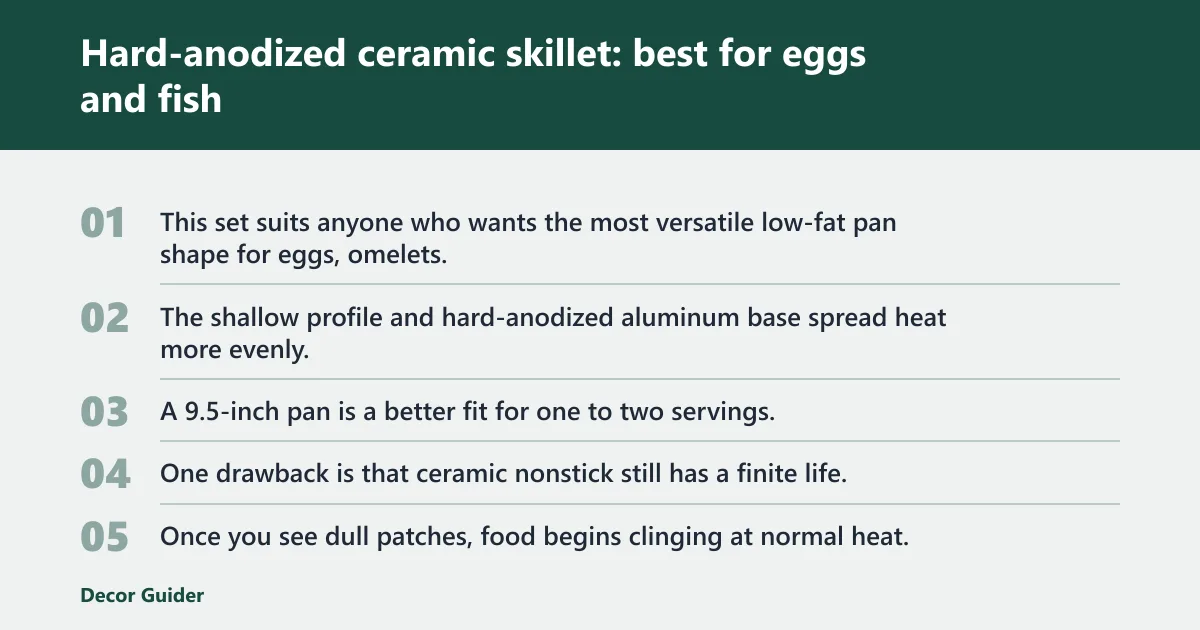
This set suits anyone who wants the most versatile low-fat pan shape for eggs, omelets, fillets, pancakes, and fast vegetables. The shallow profile and hard-anodized aluminum base spread heat more evenly, which matters when you are cooking with only a thin film of oil.
The main advantage is control. A 9.5-inch pan is a better fit for one to two servings, while an 11-inch pan gives more room for four eggs, a couple of fish portions, or a larger pancake without crowding.
One drawback is that ceramic nonstick still has a finite life. Once you see dull patches, food begins clinging at normal heat, or the surface needs more oil than it used to, the coating is telling you it is wearing out.
Deep ceramic sauté pan: best for vegetables, stir-fries, and sauce-heavy meals
- Quick Cleaning Technology saves time after cooking
- Stay-Cool handles remain comfortable on stovetops
- PFAS-free non-toxic ceramic interior
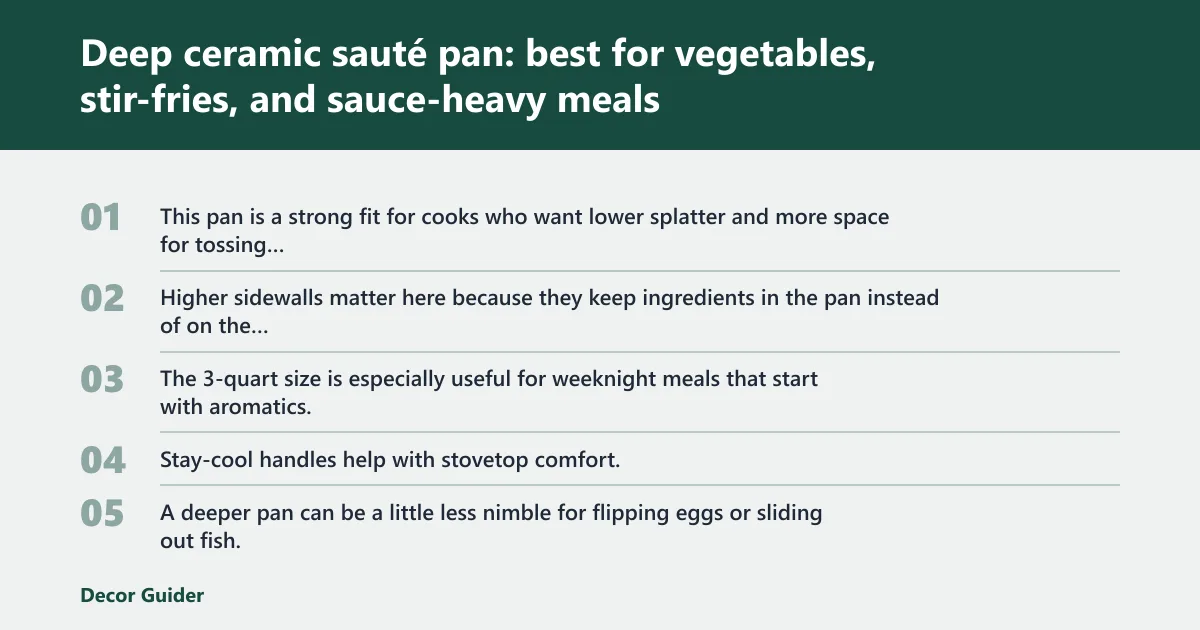
This pan is a strong fit for cooks who want lower splatter and more space for tossing vegetables, finishing sauces, or simmering one-pan meals with less oil. Higher sidewalls matter here because they keep ingredients in the pan instead of on the stove.
The 3-quart size is especially useful for weeknight meals that start with aromatics, move into vegetables, and end with a light sauce. Stay-cool handles help with stovetop comfort, and the lid gives you more control when steaming or reducing.
The tradeoff is weight and access. A deeper pan can be a little less nimble for flipping eggs or sliding out fish, so it is not the first pick for shallow-pan jobs.
Ceramic saucepan: best for sauces, grains, and reheating
A ceramic saucepan is the right choice when low-fat cooking is about liquid contact rather than searing. It beats a skillet for small-batch sauces, oatmeal, rice, grains, and reheating because the taller sides reduce evaporation and help you stir without splashing.
For single servings, a small saucepan is usually the practical minimum. For batch prep, a larger saucepan gives more room before simmering liquid climbs toward the rim.
Check the handle angle and the lid fit before buying. A snug lid and a handle that stays manageable on the stovetop matter more here than on a skillet, because simmering and reheating often mean longer contact with heat.
What is the best ceramic cookware for low-fat cooking?
The best ceramic cookware for low-fat cooking is a hard-anodized ceramic nonstick skillet or sauté pan with even heating, a flat base, and shallow or medium-high sides depending on the food. For eggs and fish, a skillet is the better first buy. For vegetables and saucy meals, a sauté pan usually gives better control.
That answer changes by use case. The goal is not one pan for everything; it is the pan shape that lets you use less oil without fighting the food.
Best shape by food type
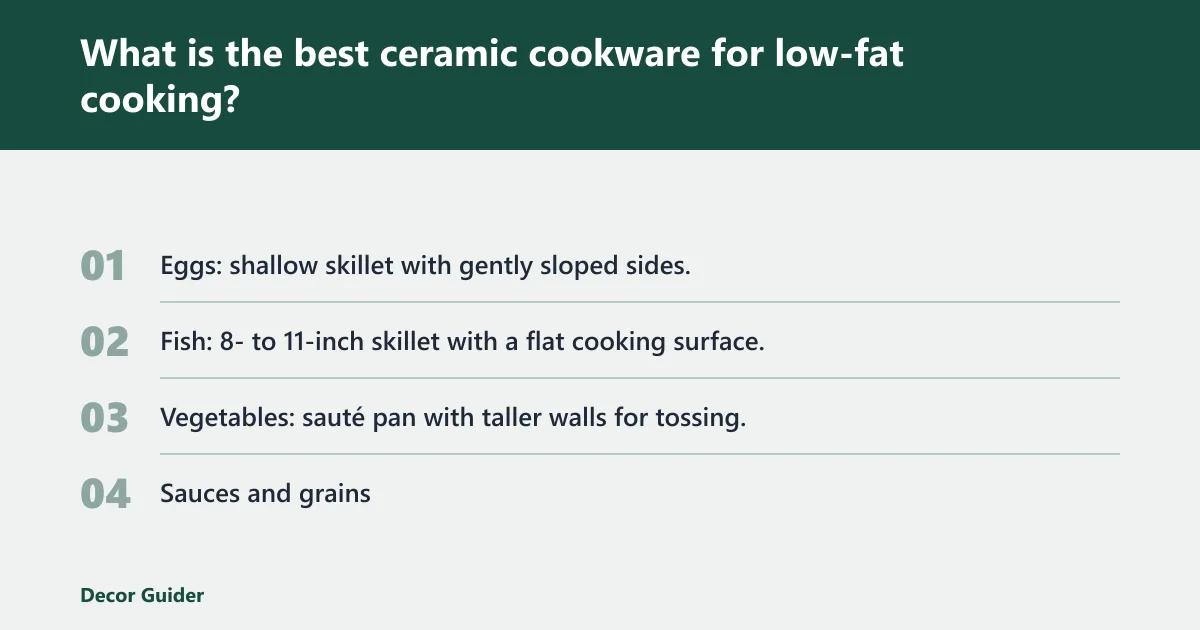
- Eggs: shallow skillet with gently sloped sides.
- Fish: 8- to 11-inch skillet with a flat cooking surface.
- Vegetables: sauté pan with taller walls for tossing.
- Sauces and grains: saucepan with a narrower base and lid.
Is ceramic cookware really nonstick enough to cook with less oil?
Yes, ceramic nonstick can support lower-oil cooking, but it is not oil-free or permanent. Fresh ceramic coatings usually release eggs, fish, and vegetables well with a small amount of oil or spray, though performance depends on heat control, food moisture, and how much the coating has worn.
What matters is realistic use, not marketing language. Beginners often need a light coating of oil, especially for eggs or delicate fish. As the coating ages, release usually declines first at the edges, then across the whole surface.
Suppose you are cooking two eggs in a 10-inch skillet. A thin wipe of oil often works better than a puddle, but if the pan is overheated or scratched, the eggs may still stick and tear.
Does ceramic cookware work for eggs and delicate foods without butter?
Ceramic cookware can be a good option for eggs, omelets, crepes, and delicate fish when you want to reduce butter. A good skillet with a flat base and gentle side slope helps you slide a spatula under the food before it sets too firmly, which is the main release advantage.
Eggs ask the most from the coating because they show sticking fast. Fish follows close behind, especially skinless fillets. If the pan is too large for the portion, the oil spreads thin and release can become inconsistent.
A common first-timer mistake is using high heat because the food looks like it is not browning fast enough. That can shorten coating life and make proteins grip harder, which defeats the low-fat goal.
How long does ceramic nonstick last compared with other cookware?
Ceramic nonstick usually has a shorter useful life than stainless steel, cast iron, or hard-anodized cookware without a nonstick layer. Its release layer eventually loses slickness, even with careful care, so the practical lifespan is measured by performance decline rather than a fixed number on a box.
Replacement signs are easy to spot: food starts sticking at normal heat, the surface looks cloudy or uneven, or you need more oil than you used to for the same recipe. Those are not cosmetic issues; they mean the pan is no longer reliable for low-fat cooking.
True ceramic, ceramic-coated, and hybrid nonstick constructions also age differently. True ceramic can take higher heat but often gets less slick over time; ceramic-coated pans are common in everyday cookware and usually rely on an aluminum body for performance.
Is ceramic cookware safe for high heat cooking?
Ceramic cookware can handle moderate-to-high heat better than many cooks expect, but the coating still has limits. Many manufacturers list an oven-safe maximum, often in the mid-range of common oven temperatures, and lids, knobs, and handles may have lower limits than the pan body.
High stovetop heat is a separate issue. Even when a pan is oven-rated, repeated scorching on the burner can shorten coating life and make sticking appear sooner. Use the lowest heat that does the job.
Check the label for the exact temperature, and read the lid details too. A glass lid may be rated lower than the pan, and a silicone handle wrap can change the limit.
What should I look for when buying ceramic cookware for healthier cooking?
Look for a pan shape that matches the food, then verify the base, handle, and oven rating. For healthier low-oil cooking, the most useful setup is an aluminum or hard-anodized aluminum base, a ceramic nonstick coating, and a size that prevents overcrowding so you do not need extra fat to keep food moving.
Induction compatibility needs label verification. The pan must have a magnetic base, and the product should say induction-ready or induction-compatible; a ceramic coating alone does not make that true.
Also check handle construction. Stainless steel handles are common because they are oven-safe and use rivets for stability, but they can transfer heat from the pan body, so grip comfort still matters.
- Choose the shape first: skillet, sauté pan, or saucepan.
- Check the base material: aluminum or hard-anodized aluminum heats more evenly than heavier, slower metals for many low-fat tasks.
- Verify the oven-safe maximum in degrees Fahrenheit.
- Confirm whether the lid and handle share that rating.
- Look for induction wording on the label if you cook on an induction stove.
- Plan to use silicone or wooden utensils to limit surface wear.
Can ceramic cookware go in the oven and dishwasher?
Sometimes, yes, but only if the label says so. Oven-safe ratings can vary widely, and the lid or handle may set a lower limit than the pan itself. Dishwasher-safe claims are common, but hand washing is usually the better choice if you want the coating to stay slick longer.
Dishwasher heat and detergents can dull some ceramic surfaces over time. That does not mean the pan is unsafe; it means the release surface may age faster, which matters most when you are cooking with very little oil.
If the product says dishwasher-safe, that is permission, not a durability guarantee.
Which ceramic cookware is best for everyday low-oil meals?
For everyday low-oil meals, a skillet is the most versatile first buy, a sauté pan is the best second buy, and a saucepan fills the gap for sauces and grains. If you cook eggs, fish, and quick vegetables most often, start with the skillet. If you cook wetter dishes more often, choose the sauté pan first.
Choose based on the food you repeat most, not the pan size that sounds most complete. A 10- or 11-inch skillet covers more weekday cooking than a large set you rarely pull out.
If your meals are split between eggs and vegetables, a skillet plus a sauté pan is the most practical low-fat pairing. If you are mostly reheating grains or making light sauces, the saucepan matters more than a second skillet.
Which one should you buy?
Choose the GreenPan skillet set if your low-fat meals center on eggs, omelets, and fish, and you want hard-anodized construction with induction compatibility. Choose the Calphalon sauté pan if you cook more vegetables, stir-fries, and saucy dishes and want a lid plus higher sidewalls. Choose the Tramontina 12-inch frying pan if you need more surface area for batch cooking and do not need a covered pan.
If you are buying only one piece, start with the skillet. It handles the widest range of low-oil meals with the least compromise. If you already own a skillet that works well, the sauté pan is the smarter upgrade for splatter control and one-pan dinners.
A common first-timer mistake is buying a large set because it looks complete, then using only one pan. For low-fat cooking, that usually means a 9.5- to 11-inch skillet or a 3-quart sauté pan gets the most actual use.
Low-fat cooking decision table
| Food | Best ceramic cookware shape | Minimum useful size | Typical oil need | Red-flag failure signs |
|---|---|---|---|---|
| Eggs and omelets | Skillet | 8 to 10 inches | Thin wipe or light teaspoon amount | Edges stick, whites tear, surface looks dull at normal heat |
| Fish fillets | Skillet | 10 to 11 inches | Light film | Skin adheres, fillet breaks when lifted, dark spots appear |
| Vegetables | Sauté pan | 3 quart or larger | 1 to 2 teaspoons for a batch | Sticking at the center, hot spots, uneven browning |
| Sauces and grains | Saucepan | 1.5 to 2 quarts for small batches | Little to none, depending on recipe | Milk or starch clings, simmer rings, coating feels rough |
| Reheating leftovers | Saucepan or sauté pan | 2 to 3 quarts | Usually a small splash of fat or broth | Food grabs the bottom, browned patches form too fast |
| Pancakes and crepes | Skillet | 10 inches | Very light coating | Batter tears, release slows, spots remain after cleaning |
How to choose ceramic cookware for low-fat cooking
Start with the pan shape, because shape controls how much oil you need to keep food moving. A skillet is best for eggs and fish, a sauté pan is better for vegetables and splash-prone meals, and a saucepan is the right tool for sauces, grains, and reheating.
Then check the base material. Aluminum cookware bases heat quickly and stay relatively light, which helps with even cooking and easier handling. Hard-anodized aluminum adds surface durability and is common in better ceramic pans because it helps resist warping and everyday wear.
Next, verify the support details. Stainless steel handles are common for oven use, but they can transfer heat; riveted construction usually signals better long-term stability. Check the oven-safe maximum in Fahrenheit, the lid limit, and whether the product explicitly says induction-compatible.
Finish with care limits. Use silicone or wooden utensils, avoid abrasive scrubbers, and do not assume the coating will last forever. Once release drops at normal heat, the pan has crossed from useful to frustrating for low-fat cooking.
Frequently asked questions
What is the best ceramic cookware for low-fat cooking?
The best ceramic cookware for low-fat cooking is usually a hard-anodized ceramic nonstick skillet or sauté pan with an aluminum base. That combination gives you even heating, practical release with little oil, and the shape control needed for eggs, fish, vegetables, and light sauces.
Is ceramic cookware really nonstick enough to cook with less oil?
Yes, but only when the coating is in good condition and the heat is controlled. Ceramic nonstick can handle eggs, fish, and vegetables with a small amount of oil, yet it is not a permanent surface. As the coating ages, you may need more fat for the same result.
Does ceramic cookware work for eggs and delicate foods without butter?
It can, especially in a skillet with shallow sides and a flat base. Butter is not required if the pan is in good shape, though a small amount of oil often helps with margin for error. If eggs stick at normal heat, the coating is likely wearing out or the pan is too hot.
How long does ceramic nonstick last compared with other cookware?
Ceramic nonstick usually wears out sooner than stainless steel, cast iron, or nonstick-free hard-anodized cookware. The useful life depends on heat, utensils, washing method, and how often you cook high-stick foods. The main sign to replace it is performance loss, not a calendar date.
Is ceramic cookware safe for high heat cooking?
It can be safe within the maker’s stated limits, but high stovetop heat still shortens coating life. Many ceramic pans are oven-safe to a specific Fahrenheit rating, while lids and handles may have lower limits. Check the label before putting any ceramic pan in the oven.
Can ceramic cookware go in the oven and dishwasher?
Sometimes, yes. Look for the exact oven-safe and dishwasher-safe statements on the label, and check whether the lid and handle share the same rating. Dishwasher cleaning is convenient, but hand washing is usually gentler on the ceramic surface over time.
Products related to this article
Sponsored / affiliate links. As an Amazon Associate I earn from qualifying purchases. I may earn additional commission from eligible campaigns.
 Ipetboom Heavy Duty Secure Lock for Glass Doors and Drawers, Stainless Steel Cabinet Lock Kit with Sturdy Structure and Efficient Use, for Home and Office Security
 Non Slip Area Rug Gripper 3x5 Feet, Rug Gripper for Hardwood Floors, Laminate, Vinyl, Stone & Tile, Anti Slip Area Rug Pad for Under Rugs