3 Best Budget Cookware for Safer Home Cooking (2026): we compared
For most budget home cooks, 18/10 stainless steel is the safest low-cost cookware buy; if you want the longest life for the least money, bare cast iron is the next best pick, and cheap nonstick carries the highest failure risk. Cheap pans can warp, scratch, or shed coating quickly, which means faster replacement and more chance of food contact with worn surfaces. This guide compares budget cookware materials and set types by safety, lifespan, and true cost per year.
Quick comparison
| Product | Badge | Best for | Price | ||
|---|---|---|---|---|---|
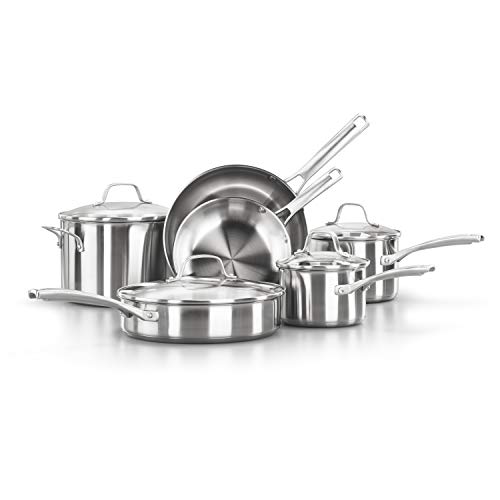 |
Calphalon Classic Stainless Steel Cookware Set, 10-Piece,Calphalon | Our pick | Stainless steel with aluminum base | $126.34
Price as of 7 Oct 2026
|
View |
 |
Lodge Chef Collection 10 Inch Pre-Seasoned Cast IronLodge | Budget pick | Pre-seasoned cast iron skillet | $29.90
Price as of 7 Oct 2026
|
View |
 |
Cuisinart Chef’s Classic Stainless Steel Pots and Pans Set,Cuisinart | Also great | Stainless steel with aluminum base | $118.99
Price as of 7 Oct 2026
|
View |
 |
8 Cup Large Glass Measuring Cup – Kitchen Mixing Bowl,Le’raze | Pair with it | 8-cup borosilicate glass measuring cup | $28.49
Price as of 7 Oct 2026
|
View |
Stainless steel is usually the best budget safety pick because it has no coating to wear away and it handles higher heat well. Ceramic nonstick and titanium-reinforced nonstick are convenience buys: they clean up faster, but their surfaces need gentler use and usually wear out sooner.
📊 CNET’s top budget cookware set is the Tramontina Tri-Ply 8-piece cookware set. Source: Best Cookware Sets Available in 2026.
How we chose
The ranking below puts failure risk first, then lifespan, then price. That means coating stability, warp resistance, and how often a buyer will likely replace the pan matter more than the sticker price alone.
We also weighed claim clarity. If a product says PFAS-free, PTFE-free, or PFOA-free, that claim matters only on the exact item page, not across a whole brand line.
Set value mattered too. A large budget set can look cheap per piece and still be poor value if half the pieces crowd a cabinet or duplicate functions.
Finally, we considered cooking style. Eggs, sautéing, searing, and batch cooking do not need the same surface or heat tolerance.
Budget safety decision table

| Material | Upfront cost | Coating risk | Maintenance burden | Likely replacement frequency | Best buy / avoid |
|---|---|---|---|---|---|
| Stainless steel | Low to mid | Low; no coating to wear away | Medium; needs heat control and some oil | Low | Buy for sautéing, searing, soups, and everyday mixed cooking |
| Cast iron | Low | Low; no coating at all when bare | Medium; seasoning and drying matter | Very low | Buy for searing, oven use, and long-life budget cooking |
| Ceramic nonstick | Low to mid | Medium; release can fade with rough care | Medium to high; low-to-medium heat only | Medium to high | Buy for eggs and sticky foods if cleanup speed matters most |
| Titanium-reinforced nonstick | Low to mid | Medium; still a nonstick surface | Medium; gentle utensils and moderate heat help | Medium to high | Buy as a starter-set convenience option, not a forever pan |
| Induction-ready sets | Varies | Depends on the surface material | Depends on the surface material | Depends on build quality | Buy only if a magnetic base matches your cooktop needs |
Cooking style guidance
Eggs: ceramic nonstick or titanium-reinforced nonstick is the easier buy if you want fast release with less scrubbing.
Sautéing: stainless steel is the better long-term choice because it tolerates heat and repeated use with fewer coating worries.
Searing: stainless steel and cast iron are the safer budget choices because they handle higher heat better than coated pans.
Batch cooking: stainless steel usually wins because it can move from stovetop to oven more easily and does not rely on a fragile coating.
Stainless steel: best for everyday cooking
- Encapsulated base for quick, even heating
- Cool-grip handles for safe stovetop handling
- Includes measurement markings for precision
Cuisinart’s Chef’s Classic stainless steel set is for budget cooks who want one set to cover most jobs without coating concerns. Based on the spec sheet and review patterns, stainless steel is the safer everyday pick because there is no nonstick layer to wear off, and the aluminum base helps the pan heat more evenly.
It stands out for mixed-use cooking. Stainless steel handles higher heat, browning, and simmering better than budget coated pans, and Cuisinart’s cool-grip handles and measurement markings make it practical for a small household.
The drawback is the learning curve. Stainless steel asks for more heat control and a little oil, and that can frustrate cooks who want eggs to slide around with almost no effort.
Cast iron skillet: best for the longest life on a tight budget
- Superior heat retention for even searing
- Ergonomic handles and pour spouts for ease
- Made in the USA with durable, non-toxic material
Lodge’s 10-inch pre-seasoned skillet is the best ultra-budget pick for cooks who want bare metal and very low failure risk. CNET describes the Lodge Seasoned 7-piece bundle as cast iron cookware and says it is budget friendly; Kitchnfam also calls a Lodge 10.25-inch skillet around $30 safe cookware, with no coating at all.
It stands out because cast iron can handle high heat. That matters for searing, oven finishing, and rough everyday use where a coated pan might wear out faster.
The drawback is care and weight. It needs drying, seasoning, and a bit more handling discipline, and it is not the easiest choice for anyone who wants light cookware or instant nonstick behavior.
Calphalon stainless steel set: best for a safer all-around starter set
- Even heat distribution for consistent cooking
- Stay-cool handles for safer stovetop use
- Oven-safe up to 450°F for versatile cooking
Calphalon’s Classic stainless steel set is a solid pick for cooks who want a broader starter bundle and still want to avoid coating risk. Based on the spec sheet and review patterns, the impact-bonded aluminum base should help with more even heating, which matters when budget pans often fail by hot spots and uneven cooking.
It stands out for practical day-to-day use. Stay-cool handles and oven safety make it easier to move from stovetop to oven, and that flexibility matters more than a big piece count on paper.
The drawback is price versus footprint. A 10-piece set can crowd a small cabinet, and stainless still asks the cook to manage heat, preheat, and a little oil for the best results.
Glass measuring cup: best for prep, not cooking
- Heat-resistant for hot and cold ingredients
- Clear measurement markings for accuracy
- Ergonomic handle and anti-drip pour spout
Le’raze’s 8-cup glass measuring cup is for cooks who want safer prep gear rather than another pot or pan. It is not cookware in the frying-and-sautéing sense, but it can be useful in a budget kitchen because borosilicate glass handles hot and cold ingredients and avoids coating questions altogether.
It stands out for accuracy and convenience. Clear markings and a pour spout make it easier to portion liquids, batters, and sauces without grabbing a separate bowl.
The drawback is obvious: it does not replace a pan. Glass is also less useful for direct stovetop cooking than stainless steel or cast iron, so it should be treated as a prep tool, not part of the main cookware decision.
What is the safest budget cookware for everyday cooking?

For everyday cooking, stainless steel is the safest budget choice for most households because it avoids coating wear and handles a wide range of heat levels. Bare cast iron is the next best low-cost option if you can handle the weight and maintenance. Cheap nonstick is easiest to use, but it is usually the weakest on lifespan.
That matters because budget failures are often mechanical, not dramatic. Thin pans warp, coatings scratch, and weak handles loosen long before the cook is ready to replace the whole set.
Is stainless steel safer than nonstick on a budget?
Usually, yes. Stainless steel has no coating to peel or scratch, so the safety question is mostly about cooking technique and food sticking, not surface breakdown. Budget nonstick may be convenient, but it is more likely to lose performance first and force a replacement sooner.
That does not make stainless steel magically better for every meal. It is simply less dependent on a fragile surface layer, which is why it is the better safety-per-dollar choice for many families.
What non-toxic cookware can I buy cheaply?
The cheapest practical options are bare cast iron and stainless steel, because neither relies on a nonstick coating for release. If a buyer wants coated cookware, ceramic nonstick is often marketed as PFAS-free or PTFE-free, but the exact claim must be checked on the product page and the finish still wears with use.
Kitchnfam’s note that ceramic-coated budget sets often sit around $40–90 is useful here, but low price does not mean long service life. The real question is whether the pan will still perform after months of heat, washing, and utensil contact.
Are ceramic nonstick pans safer than PTFE pans?
Ceramic nonstick is often sold as PFAS-free, PTFE-free, PFOA-free, or PFOS-free, which can make it easier to shop for buyers who want to avoid those coating terms. That said, “safer” is not permanent; ceramic release can fade faster if the pan is heated hard or scrubbed rough.
PTFE is the traditional nonstick coating term, and it should be checked carefully on the exact listing. PFOA was phased out in U.S. cookware production starting around 2013, but that does not mean every current nonstick product is built or labeled the same way.
What should I avoid when buying cheap cookware?
Avoid thin pans that warp, vague safety claims, oversized sets with filler pieces, and any nonstick product that does not clearly identify its coating. Cheap cookware is most likely to fail through poor heat control, weak construction, or a coating that wears faster than the buyer expects.
Also watch the set size. Bigger is not better if the extra pieces crowd cabinets or duplicate the same job three times over. A smaller, better-built set is usually the smarter budget move.
Is induction-compatible cookware safer or just more versatile?
Induction-ready cookware is mainly about compatibility, not safety. A magnetic base is required for induction cooktops, but that feature does not make the pan coating-free or longer lasting by itself. It simply means the pan can work on induction, gas, and electric households more easily.
That makes induction readiness useful as a filter, especially in mixed-stove homes. It is worth paying attention to, but it should not outrank surface material, warp resistance, or coating clarity.
How do I choose budget cookware that will not warp or peel?
Choose a thicker pan, a clear base construction, and a surface that matches your cooking habits. Stainless steel and cast iron are the safest bets for avoiding peel problems because they do not depend on a fragile nonstick layer, while coated pans need more careful heat and utensil use.
- Check whether the product lists PTFE, PFAS, PFOA, or PFOS claims on the exact page.
- Look for a magnetic base if you need induction compatibility.
- Skip sets with too many pieces you will never use.
- Prefer stainless steel or cast iron if you cook at higher heat.
- Choose ceramic or titanium-reinforced nonstick only if easy cleanup matters more than long life.
What is the best budget cookware set for a small kitchen?
For a small kitchen, the best budget set is usually a compact stainless steel set rather than a huge mixed bundle. Smaller collections are easier to store, easier to use, and less likely to include filler pieces that look helpful but get ignored.
If cabinet space is tight, a few good pieces beat a dozen mediocre ones. A stainless skillet, a small saucepan, and one stockpot cover more real cooking than a crowded budget set with too many duplicates.
Which one should you buy
For a small kitchen, choose stainless steel first. It gives the best safety-per-dollar balance, lasts longer than cheap coated pans, and does not ask you to baby the surface.
For a family on a tight budget, buy bare cast iron if you can handle the weight, or stainless steel if you want easier daily use. Both reduce replacement risk far better than bargain nonstick.
If you cook eggs and quick dinners most nights, ceramic nonstick or titanium-reinforced nonstick is the convenience pick. Just treat it as a shorter-life tool and check the coating claims on the exact listing.
If you want the longest life under $100, prioritize a stainless steel skillet plus one cast iron piece, not a large cheap set. The CNET-picked Tramontina Tri-Ply 8-piece set is a good reference point for budget stainless, while the Lodge cast iron bundle points in the right direction for pure lifespan. Made In’s CeramiClad 7-piece set shows how ceramic can be marketed as PFAS, PTFE, PFOA, lead, and cadmium free, but that still does not change the shorter wear cycle of a coated surface.
Skip giant starter bundles unless every piece earns its place in your cabinet. Piece count is not the same as usefulness.
Frequently asked questions
What is the safest budget cookware for everyday cooking?
Stainless steel is the safest budget choice for most everyday cooking because it has no coating to wear away and it handles a wide range of heat. Bare cast iron is also very safe from a surface-wear standpoint, but it is heavier and asks for more maintenance. Cheap coated pans fail faster.
Is stainless steel safer than nonstick on a budget?
In most budget buying decisions, yes. Stainless steel avoids coating breakdown, so the surface stays the same even after repeated use. Nonstick is easier to clean, but budget versions are more likely to scratch, lose release, and need replacement sooner, which makes the true cost higher over time.
What non-toxic cookware can I buy cheaply?
Cheap options that avoid coating concerns include bare cast iron and stainless steel. If you want a coated option, ceramic nonstick is often sold with PFAS-free or PTFE-free claims, but those claims must be checked on the exact product page. Cheap does not mean permanently safe or maintenance-free.
Are ceramic nonstick pans safer than PTFE pans?
Ceramic nonstick is often marketed as free of PFAS, PTFE, PFOA, and PFOS, so it may fit buyers who want to avoid those materials. But the finish is still a coated surface that can wear with rough cleaning, high heat, or metal utensils, so safety and longevity are separate questions.
What should I avoid when buying cheap cookware?
Avoid very thin pans, vague coating claims, and oversized sets with pieces you will not use. Also avoid cheap nonstick that does not clearly state what the coating is, because the buyer should know whether the product is PTFE-based, ceramic-coated, or coating-free. Failure usually starts with weak construction.
Is induction-compatible cookware safer or just more versatile?
Mostly more versatile. Induction-ready cookware needs a magnetic base, which makes it usable on induction cooktops and often on gas and electric stoves too. That feature does not make the pan safer by itself. Safety still depends on the surface material, coating quality, and how the pan holds up over time.
Products related to this article
Sponsored / affiliate links. As an Amazon Associate I earn from qualifying purchases. I may earn additional commission from eligible campaigns.
 Golden Home Essentials XXXL Heavy Duty Couch Support for Sagging Cushions - 30in x 68in Extra Wide Sofa Cushion Board - 0.4in Saggy Cushion for Seat Support
 Ipetboom Heavy Duty Secure Lock for Glass Doors and Drawers, Stainless Steel Cabinet Lock Kit with Sturdy Structure and Efficient Use, for Home and Office Security