Hard Anodized vs Ceramic Nonstick Cookware
Hard Anodized cookware is the better buy for most home cooks, while Ceramic Nonstick Cookware fits low-to-moderate heat and easy cleanup. Pick ceramic if you plan to replace pans sooner. Get the choice wrong, and you end up with peeling coatings, stuck food, and cookware that wears out early. This guide compares hard anodized vs ceramic nonstick by safety, durability, care, and which cooking habits suit each one.
| Decision factor | Hard Anodized | Ceramic Nonstick Cookware | Winner |
|---|---|---|---|
| Durability and wear | Hard anodized aluminum body with a nonstick coating often holds up better in daily use; some sets are built for stronger wear resistance. | PTFE-free coating category that usually wears faster than PTFE-based nonstick and often needs earlier replacement. | Hard Anodized |
| Heat tolerance | Many sets allow moderate to high oven use, but the limit depends on the specific set and lid. | Some sets tolerate very high oven temperatures, with examples reaching 600°F, though the coating still needs careful heat habits. | Ceramic Nonstick Cookware |
| Induction fit | Some hard anodized sets work on induction, others do not; the base design decides it. | Most ceramic nonstick sets also depend on the base material, so induction support is not automatic. | Tie |
| Ease of care | Some sets are dishwasher safe, but handwashing often helps the finish last longer. | Usually easy to wipe clean, but the coating can lose release performance sooner if treated roughly. | Tie |
| Eggs and delicate foods | Works well when the coating is intact and heat stays controlled. | Often the better feel for eggs, fish, and other delicate foods when the pan is new and used on gentle heat. | Ceramic Nonstick Cookware |
| Safety labels and marketing | May use PTFE nonstick on the surface; safety depends on avoiding overheating and following the exact product limits. | Often PTFE-free and marketed as safer-looking, but shorter coating life can change the real-world tradeoff. | Tie |
What the coating actually is: base vs finish
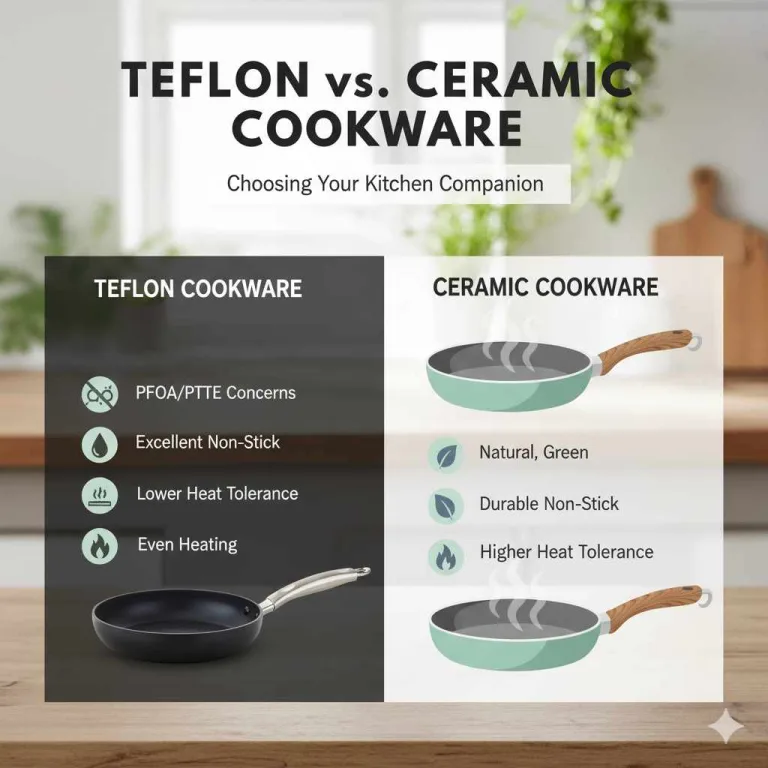
The main split is not the pan body alone. Hard anodized refers to the aluminum base treatment, while the nonstick layer can still be PTFE-based or another coating; ceramic nonstick is a coating category, usually sold for PTFE-free positioning. The better choice depends on which problem bothers you more, coating wear or replacing a pan sooner.
Business Insider describes hard-anodized cookware as strong, durable, and even-heating. Greatist says ceramic coatings are less durable than PTFE-based nonstick, which matters because the coating is the part that does the sticking and the flaking.
What each surface actually
Hard anodized aluminum is the base material or body of the pan, not the nonstick finish itself. That distinction matters because a hard anodized pan can still use a PTFE coating, and a ceramic coating can sit on a different base entirely.
Ceramic nonstick is commonly described as a PTFE-free coating category. It is often sold as a cleaner-sounding option for people who want to avoid traditional PTFE, but it is not a promise of longer life.
Why safety and lifespan pull in different directions
PTFE is the traditional nonstick polymer, also known as Teflon. The same source notes that PTFE-based coating can release harmful fumes above 500 degrees, so overheating is the key failure case to avoid.
PFOA is a chemical historically used in Teflon manufacturing, and many modern cookware claims are PFOA-free. Greatist also says ceramic cookware does not contain toxic chemicals such as PFOA, but that point does not erase the shorter wear life of many ceramic coatings.
Cookware decision matrix
This matrix weights the way you actually cook. If your pan sees daily eggs, occasional oven use, or a dishwasher cycle, the better answer can change quickly.
| Buyer scenario | Hard Anodized | Ceramic Nonstick Cookware | Recommendation | Why |
|---|---|---|---|---|
| Eggs daily | Good | Better | Ceramic Nonstick Cookware | Fresh ceramic release is often excellent for eggs and other delicate foods on gentle heat. |
| Induction cooktop | Better | Maybe | Hard Anodized | Some hard anodized sets are induction-safe, and base construction decides the fit. |
| Oven finishing | Better | Better | Depends on the exact set | Oven-safe limits vary widely, with examples at 400°F, 500°F, and 600°F. |
| Dishwasher use | Better | Worse | Hard Anodized | Some hard anodized sets are dishwasher safe, though handwashing still helps the finish last longer. |
| Metal-utensil habit | Better | Worse | Hard Anodized | Some hard anodized sets claim metal-utensil safety, but nonmetal tools still protect the coating best. |
| Low-heat cooking | Better | Better | Tie | Both work well when heat stays moderate and the pan is not overheated. |
| Maximum durability | Better | Worse | Hard Anodized | Ceramic coatings usually wear out faster, so hard anodized often stretches replacement time. |
| Safety-first preference | Maybe | Better | Ceramic Nonstick Cookware | PTFE-free positioning will matter more to buyers who want to avoid traditional PTFE. |
Suppose you fry two eggs every morning in a 10-inch skillet and rinse it by hand while it is still warm. Ceramic may feel better at first because release is excellent, but the same habit also exposes the coating to frequent wear. Hard anodized is the safer long-term buy if you want that routine to keep working year after year.
A common first-timer mistake is treating every “nonstick” pan as the same. A hard anodized pan with a PTFE coating can tolerate one set of rules, while a ceramic-coated pan may need a gentler replacement plan because the surface usually gives up release sooner.
How do the coatings compare side by side?
Ceramic nonstick and PTFE-based nonstick do the same job at the start: they help food release and make cleanup easier. The difference is how quickly that performance fades, especially under repeated heat and scrubbing.
PTFE-free ceramic nonstick versus PTFE-based nonstick
Ceramic nonstick is often marketed as safer than traditional PTFE because it is PTFE-free. That label matters to some buyers, but Greatist says ceramic coatings are less durable than PTFE-based nonstick, so the cleaner label can come with shorter service life.
Hard anodized cookware may use PTFE on top of the anodized aluminum base. That means the pan body can be tough while the cooking surface still has the same basic nonstick limits as other PTFE coatings.
Scratch resistance and coating wear
Scratch resistance is not only about knives and forks. It also includes the kind of wear that comes from stacking pans, using high heat, or cleaning with harsh pads.
Some hard anodized sets claim metal-utensil safety, but that claim should not be treated as a free pass. For longer life, wood, silicone, or plastic tools usually make more sense for both coatings.
Food release for eggs, fish, and low-starch foods
Both surfaces are common on skillets and cookware sets used for eggs and fish. Ceramic often wins on first-use slickness for delicate foods, while hard anodized tends to win when the pan has to keep performing after many more cycles.
The real test is not whether food releases on day one. It is whether it still releases after heat swings, cleaning cycles, and regular use.
Is hard anodized cookware safer than ceramic nonstick?
Safety is not a simple yes-or-no answer here. Ceramic nonstick is PTFE-free and does not contain PFOA according to Greatist, while PTFE-based coatings can release harmful fumes above 500 degrees if overheated. Hard anodized cookware can be safe too, but only if you respect its exact coating type and temperature limits.
PTFE, Teflon, and overheating limits
PTFE is the traditional nonstick polymer also known as Teflon. The concern is not everyday low-heat cooking; it is the overheating scenario, especially above 500°F, where fumes become a problem.
That matters because hard anodized does not automatically mean PTFE-free. You need to check the coating, not just the exterior finish.
PFOA-free claims and what they do not mean
PFOA is tied to older Teflon manufacturing, and many modern cookware products say PFOA-free. That claim is useful, but it does not tell you whether the pan uses PTFE or whether the coating will last longer.
Ceramic cookware is often sold as free of toxic chemicals such as PFOA. That still leaves durability, cleaning habits, and heat control as the real decision points.
Why coating failure matters more than marketing labels
A coating that wears out fast can become a worse day-to-day choice than a coating with stricter care needs. Once the surface degrades, food release gets worse, cleanup gets harder, and you replace the pan sooner.
Safety claims matter most when they match the way you cook. If you keep heat low and do not abuse the pan, both categories can fit ordinary home use.
Does ceramic nonstick last as long as hard anodized cookware?
Usually, no. Ceramic nonstick tends to wear faster than PTFE-based nonstick in everyday use, and hard anodized cookware often gives you a longer useful life because the base is more durable and the finish tends to hold up better under normal kitchen wear.
Ceramic nonstick wear patterns
Ceramic-coated pans often start with strong release, then lose that slick feel sooner than many buyers expect. Heat abuse, dishwashing, and rough tools can speed that change.
That is why ceramic works best for people who are comfortable treating pans as consumables rather than long-term gear.
Hard anodized durability with different coatings
Hard anodized aluminum itself is durable because the surface is treated through an electrochemical process. Cookware Advisor describes one hard-anodized line as having a hard anodized aluminum exterior with a pure aluminum core, which is a reminder that the body and the cooking surface are separate decisions.
The same source says some hard-anodized sets are dishwasher safe, but that does not mean the coating will last forever. It only means the product can tolerate that cleaning method better than some others.
Replacement cost over time
The cheaper pan is not always the cheaper choice. If ceramic needs replacing sooner, the total cost can climb faster than a more durable hard anodized set with a longer service life.
That makes replacement tolerance part of the buy. If you prefer to keep one skillet in rotation for a long time, hard anodized usually makes more sense.
Can you use them on your stove and in the oven?
Yes, but only within the exact product limits. Induction compatibility depends on the base and construction, while oven-safe temperature depends on the set, the coating, the handles, and especially the lid material.
Induction compatibility depends on the base
Some hard anodized sets are induction-safe and others are not. T-fal’s hard-anodized set is not induction safe, while Cookware Advisor says a Cuisinart hard-anodized set is not induction compatible.
That means you must check the bottom construction before buying. The anodized surface alone does not decide cooktop fit.
Oven-safe temperature limits by set
Oven-safe temperature is not a single number for all cookware. Business Insider’s top ceramic-coated set is oven-safe to 600°F, T-fal’s hard-anodized set has an oven-safe temperature of 400°F, and Cookware Advisor lists a Cuisinart hard-anodized set up to 500°F.
Those differences are large enough to matter. If you finish food under high heat, the lowest-rated component in the set controls the real limit.
Glass lid limits versus pan limits
Lids often set the ceiling. A pan body may tolerate more heat than the glass lid or handle, so the full set can have a lower practical limit than the marketing headline.
Check the entire package. A 600°F pan with a lower-limiting lid is still limited by the weakest part.
Cleaning and care: what protects the finish?
The finish lasts longer when you treat it gently. That usually means moderate heat, nonabrasive cleaning, and avoiding habits that cause surface wear before the pan has paid for itself.
Dishwasher safety claims
The same source notes some hard-anodized sets are dishwasher safe. That claim is useful, but it does not mean the dishwasher is the best choice for coating life.
For ceramic nonstick, handwashing is still the safer default when you want the coating to keep its release longer.
Handwashing for longer coating life
Handwashing protects both types better than repeated machine cycles in many kitchens. It reduces exposure to harsh detergent, bumping, and high heat drying.
- Let the pan cool before washing.
- Use a soft sponge or cloth.
- Skip abrasive powders and steel scrubbers.
- Dry it fully before stacking.
Metal utensil claims versus best practice
Some hard anodized sets claim metal-utensil safety. That claim should be read as damage-resistant, not damage-proof.
For the longest finish life, use wood, silicone, or plastic tools on both coatings. That is the simplest way to slow wear without changing your cooking style.
Choose Hard Anodized if… / Choose Ceramic Nonstick Cookware if…
Choose Hard Anodized if you want a pan that is more likely to survive daily use, you cook on induction and have confirmed compatibility, or you prefer a dishwasher-safe option without expecting perfect coating life forever. It is also the better pick if you replace cookware less often.
Choose Ceramic Nonstick Cookware if your priority is PTFE-free positioning, you cook mostly on low to moderate heat, or you want the slickest feel for eggs and fish and are fine replacing the pan sooner. It fits lighter-duty cooking and a shorter ownership cycle.
Skip both if you regularly sear at high heat, abuse pans with metal tools, or want one pan to do everything for years without close care. A different cookware type will suit that kind of use better.


Frequently asked questions
Ceramic nonstick vs hard anodized
Ceramic nonstick is a coating category, while hard anodized is an aluminum body treatment that can carry different coatings on top. If you want the longer-lasting option, hard anodized usually wins. If you want PTFE-free positioning and lighter-duty cooking, ceramic is the more obvious fit.
Which is better hard anodized or nonstick?
Hard anodized is better for most home cooks because it tends to last longer and handle more abuse. Ceramic nonstick is better only when you value PTFE-free marketing, gentle heat, and short-term food release more than lifespan. The better answer depends on how soon you are willing to replace the pan.
Can hard anodized cookware go in the oven?
Often yes, but the exact limit depends on the specific set and lid. Examples in the sources include 400°F and 500°F for hard anodized sets, while some ceramic-coated sets reach 600°F. Check the lid and handle, not only the pan body.
Is hard anodized cookware induction compatible?
Sometimes. Induction compatibility depends on the base construction, and some hard anodized sets are induction-safe while others are not. T-fal’s hard-anodized set is not induction safe, and Cookware Advisor says one Cuisinart hard-anodized set is not induction compatible.
Products related to this article
Sponsored / affiliate links. As an Amazon Associate I earn from qualifying purchases. I may earn additional commission from eligible campaigns.