TV Stand Drawer Problems: Why They Stick or Won’t Close
Start by matching the symptom: a drawer that sticks, sags, rubs, falls out, or will not close usually points to either the slides, the alignment, or the cabinet frame. Fix loose hardware before replacing parts. Ignoring it can strip screws, chip the drawer, and crack the cabinet opening. This guide walks you through a symptom-first failure tree so you can isolate the problem and choose the right fix.
Why is the drawer not closing?


A drawer that will not close all the way usually has one of three problems: debris or friction in the slides, a drawer that is out of square, or a cabinet opening that is twisted. Start with the symptom you see at the front, then check whether the resistance changes when you lift, press, or push from one side.
Stuck halfway versus fully jammed
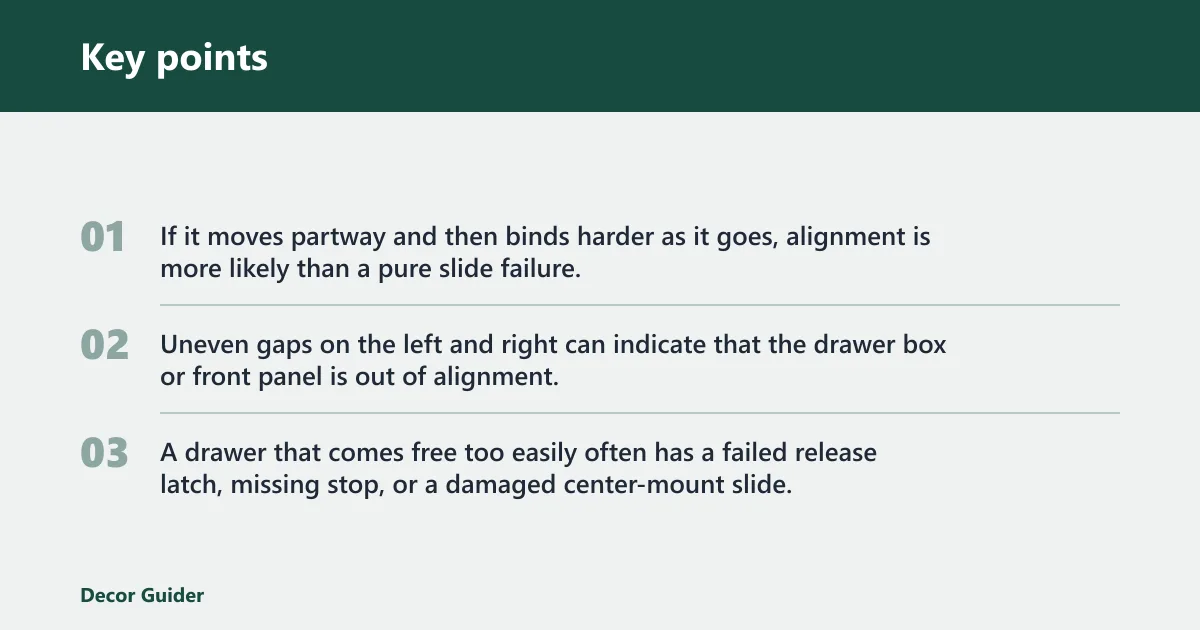
If the drawer stops at the same point every time, it may point to bent rails, a hidden obstruction, or a failed soft-close mechanism. If it moves partway and then binds harder as it goes, alignment is more likely than a pure slide failure.
Crooked closing versus rubbing
Uneven gaps on the left and right can indicate that the drawer box or front panel is out of alignment. A rubbing sound on one side, especially near the back, often points to a slide mounted too low, too high, or at a slight angle.
Loose fit versus falling out
A drawer that feels loose but stays in place may have worn rollers, bent ball-bearing members, or stripped mounting screws. A drawer that comes free too easily often has a failed release latch, missing stop, or a damaged center-mount slide.
Drawer troubleshooting matrix
This matrix helps you separate slide failure from alignment, drawer-box damage, and cabinet problems before you replace parts. Check the symptom first, then do the quick test, because the same sticking drawer can come from dust, a warped rail, or a rack in the TV stand frame.
| Symptom | Likely cause | Quick test | Fix | When to replace hardware |
|---|---|---|---|---|
| Stops halfway | Debris in track, bent rail, soft-close unit binding | Pull the drawer out and run it by hand without load | Clean tracks; clear grit; test again | Replace if the rail is bent or the soft-close unit will not reset |
| Rubs on one side | Out-of-square drawer or uneven slide mounting | Check side gaps with a level and visual gap check | Realign the slide and square the front | Replace only if the mounting holes are too damaged to hold screws |
| Sags at the front | Bottom panel sag, loose joinery, overloaded contents | Lift the front edge while closing | Tighten joinery and reduce load | Replace if the drawer box is cracked or the bottom is warped badly |
| Falls out | Broken stop, failed release latch, missing catch | Open fully and inspect the end stop or latch | Reset or repair the stop hardware | Replace if the stop or release feature is broken beyond repair |
| Closes crooked | Cabinet carcass rack or twist | Measure the opening diagonals and check with a level | Shim, retighten, or unload the unit | Replace slides only after the frame is square enough to support them |
| Sticks with weight inside | Slide load rating too low for the contents | Remove media gear, cables, or heavy items and retest | Reduce load and redistribute weight | Replace with a higher-load slide set if the current rating is too low |
| Grinds or scrapes | Dry dust, grit, or damaged rollers | Look for visible debris and rough travel | Clean and apply dry silicone or paraffin lightly | Replace if rollers are cracked or ball bearings are missing |
| Opens by itself | Cabinet tilt, front-heavy load, soft-close fault | Check level front-to-back and side-to-side | Level the stand and rebalance the drawer load | Replace if the soft-close slide no longer holds shut |
| Front panel shifts | Loose wood screws or stripped pilot holes | Try snugging the mounting screws by hand | Repair the holes and reinstall with correct screws | Replace only if the slide bracket or front attachment is cracked |
What are the most common failure points?
Many drawer problems on TV stands come from three places: the slide hardware, the drawer box, or the cabinet carcass. A tight slide can still bind if the frame is twisted, and a square drawer can still rub if one side of the opening is lower than the other.
Drawer slides and rail damage
Drawer slides come in side-mount and center-mount styles, and they may use ball bearings or rollers. Common failures include bent rails, loose screws, grit in the track, and soft-close parts that no longer damp the last few inches. Check the stated load rating if the drawer holds game consoles, receivers, or other heavy items.
Drawer box and front-panel issues
The drawer box can fail even when the slides are fine. Look for loose joinery, cracked corners, a bottom panel that sags, or swelling from moisture near a window, vent, or humid room. A front panel that is loose or twisted can make the drawer look misaligned even when the slide travel is correct.
Cabinet carcass rack or twist
The cabinet carcass is the outer frame of the TV stand. If it has rack or twist, the drawer opening will not stay square, which leads to rubbing and uneven closing. Check screw tightness at the case joints, especially where shelves, stretchers, or back panels anchor the frame.
How do you check alignment and level?
Check the level first. A bubble level or smartphone level can show whether the cabinet leans, and simple gap checks can show whether the drawer is square in the opening. Many “sticking” drawers are really tilt problems.
Using a bubble level or smartphone level
Place the level on the top of the TV stand from front to back, then side to side. If the cabinet tilts, the drawer may drift, bind, or close unevenly under its own weight. A small tilt can be enough to make a center-mount slide feel rough.
Front-to-back square and side-to-side gaps
Close the drawer slowly and watch both side gaps. They should stay close to even from front to back, and the front panel should not lean to one side. If one gap narrows while the other opens, the slide is likely mounted unevenly or the drawer box is racked.
Signs of rubbing from tilt or uneven mounting
Rubbing marks on one edge, shiny wear on a rail, or a drawer that slides better when lifted by hand all point to misalignment. Suppose a 16-inch drawer closes smoothly when empty but binds once a set-top box is inside; that often means the cabinet is slightly low on one side, not that the slides are broken.
Can you fix the slides without replacing them?
Yes, if the rails are straight and the hardware is intact. Clean dust and grit first, then check screw tightness and only then add lubricant. Dry silicone or paraffin-based options are often a better choice than oil on dusty tracks because they reduce friction without holding as much dirt.
Cleaning dust and grit from tracks
- Remove the drawer. Pull it straight out if the slide design allows, or release the latch if the side-mount hardware has one. Keep the drawer level so you do not bend the rail while removing it.
- Vacuum the track. Clear loose dust, crumbs, and cable debris from both rails and the drawer box. A narrow nozzle helps reach the back of center-mount tracks and the lower channel on roller slides.
- Wipe the contact points. Use a dry cloth to remove the fine grit that a vacuum misses. Do not soak the track, because moisture can swell wood parts and make the drawer bind again.
Using dry silicone or paraffin sparingly
Apply a thin film only to the moving contact points after the track is clean. Too much lubricant can attract dust, especially near media cabinets where vents and cables collect debris. Avoid oil on dusty tracks unless the hardware maker specifically allows it.
Tightening loose screws and correcting bent rails
Loose screws let slides shift out of parallel, which creates rub marks and uneven travel. Tighten the mounting screws first, then inspect the rail for a bend, twist, or crushed spot. If the rail is visibly warped, lubrication will not solve the bind.
How do you repair loose mounts and stripped holes?
Loose mounting points are common when a TV stand drawer has been moved, overloaded, or opened hard. Repair the hole before you reinstall the slide, because a screw that spins in wood will not hold alignment for long. Match screw length and gauge to the original hardware whenever possible.
- Check the pilot holes. Remove the screw and inspect the hole for crushed wood fibers or stripped threads. A good pilot hole should let the screw bite without wobble.
- Choose the right screw. Use the same gauge and a length that will grip solid wood without punching through the visible panel. Many slide and front-mount screws are short, so length matching matters more than brute force.
- Repair the stripped hole. Fill it with a wood plug, dowel, or hardwood shims and glue if the area is accessible, then re-drill a pilot hole after the filler sets. For a renter-friendly fix, a removable wood filler or larger screw may work if the panel thickness allows it.
- Move the mounting point. If the original location is badly damaged, shift the bracket slightly to fresh wood. Keep the slide parallel and preserve the mounting screw spacing so the drawer still tracks straight.
Picture a drawer front that sags on the right and leaves a wider gap at the top. If the right-side screws pull out when the drawer is opened, the problem is often the mounting point, not the slide itself. Repairing the holes usually beats replacing the whole hardware set.
When should you replace the drawer hardware?
Replace hardware when the slide is bent, the roller is broken, the ball bearings are missing, or the soft-close mechanism no longer works after cleaning and tightening. Also replace it when the length, mounting style, or load rating no longer matches the drawer. A partial fix will not help if the new part cannot fit the old pattern.
Matching slide type, length, and mounting style
Check whether the existing hardware is side-mount or center-mount, and measure the slide length from end to end. Compare the mounting screw spacing and bracket shape before buying replacements, because a good-looking slide can still be incompatible with the cabinet.
Checking load rating and soft-close behavior
Many drawers in TV stands hold heavier items than a bedroom nightstand drawer. If the old hardware feels weak under the load, choose a slide with a higher rating and the same travel length. For soft-close units, make sure the replacement matches the closing behavior you want, since some slides only close by gravity or spring tension.
Using a hinges and glides hardware kit
A hardware kit can be a good option when the old parts are no longer standard or the brackets are mixed. Check the included screw spacing, slide length, and mounting style before you start. If the cabinet opening is damaged enough that no standard slide fits squarely, replacement of the whole drawer assembly may be the cleaner choice.
What tools do you need to repair a TV stand drawer?
You usually need only basic hand tools, but the right ones make diagnosis faster. A screwdriver set, a bubble level or smartphone level, a flashlight, a vacuum or brush, and a tape measure cover most checks. A drill with the correct bit helps if you must remake pilot holes.
Recommended tools for diagnosis and repair
- Phillips and flathead screwdrivers
- Bubble level or smartphone level
- Tape measure
- Flashlight for track inspection
- Vacuum, brush, or compressed air for debris
- Drill and drill bits for pilot holes
- Wood glue, dowels, or hardwood plugs for stripped holes
- Dry silicone or paraffin lubricant
Renter-friendly fixes that avoid permanent damage
For rentals, start with cleaning, tightening, and leveling before any repair that changes the cabinet. Use removable shims under the stand, keep new screw holes to a minimum, and avoid cutting or permanently altering the carcass unless the unit is already beyond a simple fix.
Frequently asked questions
Why is my TV stand drawer not closing properly?
It usually means the drawer is binding on the slides, sitting out of square, or fighting a twisted cabinet opening. Check whether the resistance appears at the same point every time. If the drawer closes better when lifted slightly, alignment or cabinet level is often the real issue.
How do I fix a TV stand drawer that sticks?
Remove the drawer, clean the tracks, and check for bent rails or loose screws. Then test the empty drawer by hand before adding lubricant. If the drawer still sticks after cleaning and tightening, the slide type, mounting angle, or load rating may be the problem.
What should I do if a TV stand drawer keeps falling out?
Inspect the stop, latch, or end catch on the slides first. A missing or broken stop can let the drawer travel too far and drop free. If the slide is a center-mount style, check that the rail is fully engaged and that the front mounting screws are secure.
How do I realign a drawer on a TV console?
Start by checking the cabinet with a level, then measure the side gaps and the opening diagonals. Loosen the slide screws slightly, square the drawer in the opening, and retighten while holding position. If the carcass is racked, correct the frame before adjusting the drawer again.
Why does my drawer slide get stuck halfway?
Halfway binding often points to debris, a bent rail, or a soft-close mechanism that is not resetting. If the drawer moves freely when empty but jams with items inside, the load may exceed the slide rating or the cabinet may be tilted enough to create drag.
Can I replace the drawer slides on a TV stand?
Yes, if you match the slide type, length, mounting style, and screw spacing. Side-mount and center-mount hardware are not interchangeable in every case. Measure the old slides carefully before buying replacements, and check whether the new set can handle the drawer’s load.
Products related to this article
Sponsored / affiliate links. As an Amazon Associate I earn from qualifying purchases. I may earn additional commission from eligible campaigns.