TV Stand vs Floating Shelf
Choose a floating shelf only when its rated load exceeds the combined TV and device weight, the wall accepts the anchor type, and you have a clean wiring plan. Otherwise, a floor TV stand is the safer choice. Skip those checks and you invite sagging shelves, visible cords, or a mount that fails under load. This guide compares weight limits, wall types, storage, cable routing, and rental limits so you can choose the right setup.
| Factor | TV stand | floating shelf | Winner |
|---|---|---|---|
| Installation | No wall attachment; usually assembled and placed on the floor | Mounted to studs with anchors, leveling, and wiring planning | TV stand |
| Storage | Usually offers drawers, shelves, or cabinet doors | Often one or two tiers, with less enclosed storage | TV stand |
| Cable concealment | Good if the back panel and openings are designed well | Best only when wall routing or hidden outlets are available | floating shelf |
| Renter-friendliness | Easy to move and remove; no wall damage required | Usually requires drilling and patching later | TV stand |
| Open floor space | Takes floor footprint | Keeps the floor open under the TV | floating shelf |
| Long-term safety | Stable when matched to TV width and used with anti-tip strap | Depends on studs, anchors, load rating, and installation quality | TV stand |
How weight limits and wall studs shape the setup
The choice comes down to load and daily use. A TV stand sits on the floor, usually offers more storage, and asks less of the wall; a floating shelf opens floor space but depends on stud placement, rated load, and cable planning.
If the TV, soundbar, game console, and streaming box together push the shelf near its limit, the wall-mounted option is a poor fit. If you need a setup you can change later, the floor model is usually simpler and safer.
What each option actually
A TV stand is a freestanding console that sits on the floor. It does not need wall attachment beyond an anti-tip strap, and it often includes drawers, open shelves, or closed cabinets for remotes, media boxes, and consoles.
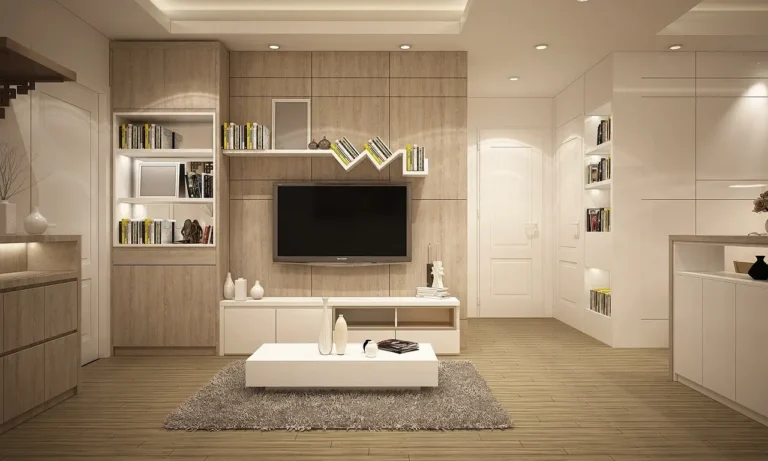
A floating shelf is wall-mounted to studs and appears to hover above the floor. It can include open tiers or a slim cabinet, but the storage volume is usually tighter than a comparable floor unit.
Why the wall changes the decision
Wall studs are the mounting reference for secure installation. Without solid stud access, a floating unit becomes harder to place safely, especially if the wall is uneven, the outlet lands in an awkward spot, or the shelf depth leaves little room for device weight.
A floor console avoids that problem. That is why it stays the safer default when the wall structure is unknown or the installation needs to be reversible.
How much weight and load can the wall take?
A floating shelf only belongs in the plan if the wall can support the full load: the TV, the shelf itself, and anything sitting on it. Studs, anchors, shelf depth, and device weight matter together, and if any one is weak, the setup is a bad fit.
Wall studs and mounting reference
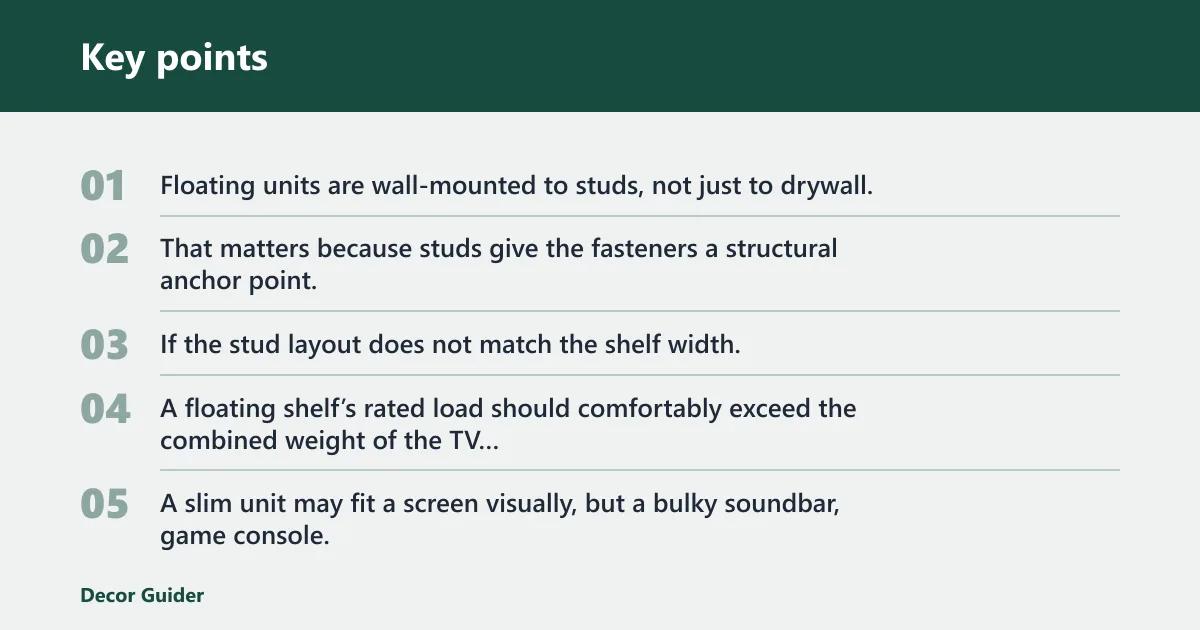
Floating units are wall-mounted to studs, not just to drywall. That matters because studs give the fasteners a structural anchor point, which is the basis for long-term safety on a load-bearing installation.
If the stud layout does not match the shelf width, or if only one usable stud is available where you need the unit, a floor stand is usually the cleaner answer.
TV weight, shelf depth, and device load
A floating shelf’s rated load should comfortably exceed the combined weight of the TV and everything it supports. A slim unit may fit a screen visually, but a bulky soundbar, game console, and cable box can push the total into unsafe territory even when the screen size seems reasonable.
Say your 65-inch TV fits the width, but the setup also needs a soundbar and two consoles. A floating shelf with shallow depth and limited shelf space can become awkward fast, while a TV stand gives you more room to separate and support the devices.
When a floating unit stops being a safe choice
Stop and choose a stand if the wall is weak, the stud access is poor, or the shelf’s hardware does not clearly support the intended load. The same applies when the installation would rely on awkward anchors, because neat cord hiding is never worth a compromised mount.
Professional installation for a floating TV shelf may add $100-300, and that cost still does not solve a bad wall layout. If the structure and the wiring plan do not cooperate, avoid the wall mount entirely.
Storage and cable management
Storage and wiring often decide the outcome more than appearance does. A TV stand usually wins on enclosed storage, while a floating shelf can win on cable concealment only when the wall plan is already sorted out.
Drawers, open shelves, and closed cabinets
A freestanding TV stand typically gives you more places to hide daily clutter. Drawers and cabinet doors help with remotes, controllers, media cases, and small accessories, while open shelves work for streaming boxes and game consoles that need airflow.
Floating shelves often provide only one or two tiers, so the layout can get crowded quickly. A floating TV cabinet improves storage, but it still usually trails a comparable floor console for total volume.
Wire holes, cable channels, and external covers
Some floating consoles include wire holes or cable routing channels, which makes a clean look easier to achieve. A product example lists several pre-drilled wire holes, open shelves, and a flip-down door, which suggests the usual trade-off: some cable help and limited storage.
If in-wall routing is not possible, external cable covers are the fallback. They are more visible than hidden wiring, but they are also simpler, cheaper, and less invasive than opening the wall.
In-wall outlet behind the TV: when it helps and when it adds work
An in-wall power outlet behind the TV improves the look because the cord drop disappears. It also adds work, since the outlet location, wiring path, and wall access all need to line up with the shelf and the TV bracket.
Do not treat this as a small add-on. If the outlet sits above a baseboard in an awkward place, or the wall construction is not friendly to retrofit work, the project becomes more complicated than a floor stand with visible but tidy cable management.
Is a floating shelf renter-friendly?
Usually no, at least not by default. A floating shelf normally requires drilling into the wall, which can conflict with lease rules, force patching later, and make reversal harder than simply removing a freestanding TV stand.
No-drill and low-damage alternatives
For renters, the safer alternatives are a TV stand with no wall attachment, a console-height piece that can be anchored only if the lease allows it, or temporary cable covers that run along the wall surface. Those options keep the room organized without committing to a permanent mount.
If you need a cleaner look but cannot drill, start with a floor unit that is a few inches wider than the screen and has cable cutouts or rear openings. That gives you a good balance of control and reversibility.
Lease rules, patching, and reversibility
Lease rules matter more than style. Even a small floating shelf can require patching, repainting, and a deposit conversation later, especially if the wall finish is delicate or the stud layout forces multiple holes.
Picture a studio apartment under 200 square feet with a lease that forbids wall mounting. In that case, a compact TV stand solves the storage and cable problem with no drilling and no restoration work at move-out.
When a freestanding stand is the safer rental choice
Choose the stand if the building is old, the wall is uneven, the outlet placement is awkward, or the lease is strict about holes. You keep more flexibility, and you avoid discovering mid-project that the wall will not support the layout you wanted.
TV stand sizes, room size, and layout
Size has to match both the TV and the room. A good rule is that the console should be a few inches wider than the TV, which helps stability and avoids a cramped look at the edges.
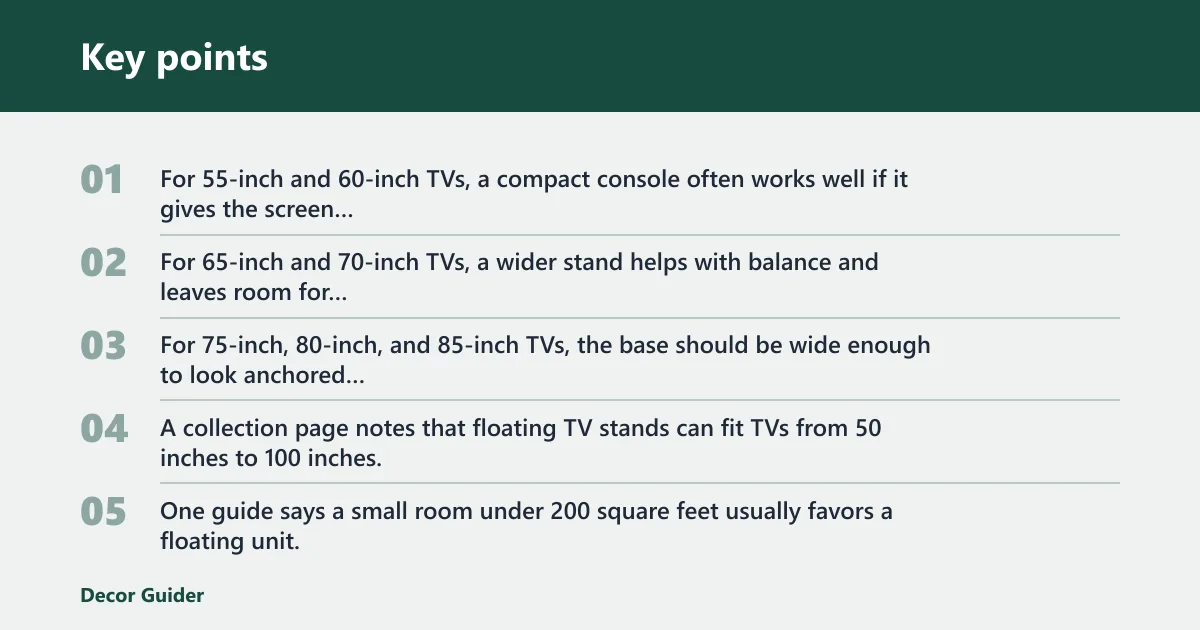
55-inch to 85-inch fit examples
For 55-inch and 60-inch TVs, a compact console often works well if it gives the screen some side clearance. For 65-inch and 70-inch TVs, a wider stand helps with balance and leaves room for accessories.
For 75-inch, 80-inch, and 85-inch TVs, the base should be wide enough to look anchored rather than top-heavy. Floating TV stands can fit TVs from 50 inches to 100 inches, but width, depth, and load still matter more than the screen-size label alone.
Small apartments, studios, and rooms under 200 square feet
A small room under 200 square feet usually favors a floating unit. That makes sense when every square foot matters and you want the floor to stay open under the screen.
Even there, the wall still has to cooperate. If the studs are awkward or the wall cannot take the anchor type, the room size does not override the mounting problem.
Corner placement, baseboard outlets, and uneven walls
Corner layouts can complicate both choices, but they are especially tricky for wall-mounted shelves because the stud pattern and cable path may not line up with the corner angle. Baseboard outlets can also force visible cable runs unless you plan the route carefully.
Uneven wall construction is another failure case. If the surface bows, the shelf may not sit flush, and that can create both visual and structural problems.
Floating TV shelf decision matrix
This matrix helps you compare four common setups on the criteria that matter most. Use it as a quick filter before you worry about finish color or style.
| Criteria | Freestanding TV stand | floating shelf | Floating TV cabinet | Wall-mounted shelf with hidden outlet |
|---|---|---|---|---|
| Floor-space savings | 2 | 5 | 4 | 5 |
| Storage volume | 5 | 2 | 4 | 3 |
| Cable concealment | 3 | 3 | 4 | 5 |
| Renter-friendliness | 5 | 1 | 1 | 1 |
| Installation difficulty | 5 | 2 | 2 | 1 |
| Adjustability | 5 | 2 | 2 | 1 |
| Long-term safety | 5 | 3 | 3 | 3 |
How to read the results
Higher is better for the setup that naturally performs well in that category. The scores show why the floor unit is the safer general pick: it is easier to install, easier to change later, and less dependent on the wall.
The wall-mounted options earn their place only when open floor space and a cleaner visual line matter enough to justify the extra work and constraints. The hidden-outlet version improves the cable result, but it also adds the most installation effort.
- Check TV weight. Add the TV, soundbar, and any devices that will rest on the unit.
- Check stud access. Confirm that the shelf location lines up with secure mounting points.
- Check wiring. Decide whether you can use an in-wall outlet or must rely on surface cable covers.
- Check the lease or wall rules. If drilling is restricted, default to a freestanding stand.
- Check storage needs. If you need drawers or closed cabinets, the floor unit usually wins.
Choose TV stand if… / Choose floating shelf if…
Choose a TV stand if you want the safer default, need more storage, cannot drill, or expect to rearrange the room later. It also fits better when the wall is uncertain, the stud layout is awkward, or the setup includes heavier components and more cables.
Choose a floating shelf if the wall has clear stud access, the total load is well within the shelf rating, and you have a real cable plan. It works best in small rooms where open floor space matters, or in layouts where hidden wiring and minimal storage needs line up cleanly.
Choose a floating TV cabinet if you want a middle ground: some wall-mounted visual lightness with a bit more enclosed storage than a bare shelf. Choose a wall-mounted shelf with a hidden outlet only when you can accept the extra work of retrofitting power and routing cables inside the wall.
Material and build quality
Solid wood and plywood usually hold up better than particle board or MDF when the unit needs to carry heavier gear or tolerate repeated movement. A solid wood TV stand can suit larger rooms above 300 square feet, while lighter materials may be fine for smaller setups if the load stays modest.
For surface durability, scratch-resistant veneer finishes and waterproof veneer finishes help with everyday wear. They do not replace structural strength, but they do make a finish easier to maintain in homes where remotes, consoles, and cleaning wipes see regular use.
If a floating unit is the plan, material quality matters even more because wall-mounted loads leave less margin for weak construction. A strong frame, good fasteners, and clear load ratings matter more than the minimalist look.
Frequently asked questions
Floating shelf vs tv stand
Use the floating shelf when the wall, load, and wiring plan all check out. Use the TV stand when you need easier installation, more storage, or a reversible setup. The deciding factors are weight, stud access, and how much equipment you need to hide.
Can a tv sit on a floating shelf?
Yes, if the shelf is designed and rated to support the TV’s weight plus any devices placed with it. The shelf must be mounted to studs, and the depth has to suit the TV base. If the load rating is unclear, pick a TV stand instead.
Is a floating TV shelf renter-friendly?
Usually not, because it often requires drilling into the wall and later patching. Renters should check lease rules first. If drilling is not allowed or the wall is unknown, a freestanding TV stand is the simpler and safer option.
How much storage does a floating TV stand have compared with a regular TV stand?
A floating TV stand usually has less storage than a regular TV stand, often just one or two tiers or a slim cabinet layout. A floor console typically gives you more drawers, shelves, and closed storage for remotes, consoles, and cable boxes.
Do I need an electrician for a floating TV shelf?
Not always, but you may need one if you want an in-wall outlet behind the TV or if the wiring needs to be moved. Surface cable covers do not usually require electrical work. If the outlet is not where you need it, the project becomes more involved.
What size TV stand should I get for my TV?
Pick a stand that is a few inches wider than your TV. That gives the setup a better visual balance and helps with stability. For 55-inch through 85-inch TVs, check both width and depth, not just the screen-size label.
Can I hide cables behind a floating TV shelf?
Yes, but the result depends on the wiring plan. Wire holes, cable channels, and an in-wall outlet can hide cords well, while surface cable covers are the fallback. If the wall cannot support that plan, a TV stand may give you a cleaner overall result with less work.
Products related to this article
Sponsored / affiliate links. As an Amazon Associate I earn from qualifying purchases. I may earn additional commission from eligible campaigns.