Corner TV Stand vs Long TV Stand: Which Fits Best?
Pick a corner TV stand if your usable corner depth is around 24 inches or more and wall length is tight; pick a long TV stand if you have roughly 5 feet or more of clear wall and need more storage. Choose the wrong shape and you waste floor space, block outlets, or leave the screen sitting at an odd angle for the sofa. This guide compares fit, layout, storage, and cable access so you can choose the better stand for your room.
Corner TV stand vs long TV stand: the fit question in one line


The difference is placement and footprint, not looks. A corner TV stand is built to sit into a room corner and is usually triangular or wedge-shaped, while a long TV stand is a rectangular unit made to sit flat against a wall.
That shape choice changes how the room works around it. A corner unit can free up wall space in a small room, while a long stand usually gives you more surface area and storage. Measure the room first, then match the shape to the floor plan.
| Decision factor | Corner TV Stand | Long TV Stand | Winner |
|---|---|---|---|
| Space efficiency | Fits snugly into room corners; often frees wall space | Uses a full wall run and can leave dead space if forced into a corner | Corner TV Stand |
| Storage capacity | Usually moderate storage; smaller shelves and cabinets | Usually more surface area, shelves, and drawer capacity | Long TV Stand |
| Viewing angle flexibility | Can point the screen toward seating in angled layouts | Best when seating faces forward on a long wall | Depends on room |
| Cable access | Harder in a tight corner, especially near outlets | Usually easier against a flat wall | Long TV Stand |
| Walkway clearance | Often better in tight or odd-shaped rooms | Better in rooms with a clear wall and enough depth | Depends on layout |
Space efficiency
Corner TV stands win when wall length is short or furniture has to stay out of a traffic path. A regular rectangular stand placed near a corner can leave a hard-to-clean triangular gap behind it, which wastes floor space and collects dust.
Long TV stands win when the room has an open wall and the stand can sit flat without pinching a walkway. In those rooms, the extra width is useful, not a drawback.
Storage and device capacity
Long TV stands often offer more practical storage for game consoles, media boxes, soundbars, and decor. The wider footprint gives you more shelf span, more cabinet volume, and more room to separate heat-producing devices.
Corner stands can still work well if the load is light to moderate. They are enough for a few components and accessories, but they are rarely the best answer for a full media stack.
According to Corner TV Stand vs. Standard TV Stand: Choosing the Right Fit — Many corner stands support TVs from 40" up to 65" or more.
How room shape changes the answer
Room shape drives the decision more than TV size does. Small living rooms, awkward alcoves, and angled seating often favor a corner unit, while long walls and open-plan rooms usually favor a rectangular stand.
Small living rooms and tight walkways
In a small room, a corner TV stand often works better because it keeps the floor path open. It can also preserve more usable wall length for a chair, lamp, or storage cabinet.
If the sofa and doorway already compete for space, a long stand can create a pinch point. That is where a “space-saving” choice turns into a traffic problem.
Long walls and open-plan rooms
A long TV stand makes more sense when you have a clear wall and the seating faces forward. The screen sits on a cleaner axis, and the furniture reads as one straight run instead of a diagonal solution.
This is also the easier layout for decorating around devices, since cables and accessories can follow the wall instead of crossing a corner.
Odd corners, alcoves, and angled seating
Corner units do their best work in irregular rooms. If the seating angle is already offset, the corner placement can correct the sightline without forcing every chair to turn sharply.
In alcoves, though, check the usable depth carefully. A unit may “fit” on paper and still block a door swing or leave no room for cables.

Which setup gives you better storage?
Long TV stands usually give better storage because they have more width for shelves, cabinets, and drawers. Corner units can store essentials, but they usually top out at moderate capacity and tighter compartment sizes.
Shelves, cabinets, and drawers by use case
If you need space for a soundbar, a console, a streaming box, controllers, and a few decor items, the long stand is usually the cleaner answer. The extra width lets you separate gear so heat and cable runs are easier to manage.
If you only need a media box or two, a corner TV stand can be enough. It is a fit-first solution, not a storage-first solution.
Where a long TV stand usually wins
A long stand wins when storage is doing real work, not just holding a TV. It is better for families with multiple consoles, shared accessories, or closed storage needs behind cabinet doors.
It also gives you more top surface for decor without crowding the screen edge.
Where a corner TV stand is enough
A corner stand is sufficient when the setup is light and the room is short on wall space. It keeps essentials in reach without demanding a full wall run.
That makes it a practical fit for guest rooms, compact apartments, and awkward family rooms.
How do viewing angles differ?
Corner placement can improve viewing when the seating is already angled toward the corner. Wall placement works best when the sofa faces forward and the screen can sit square to the main seating line.
When corner placement points the screen well
A corner TV stand helps when the main seat is off-center or when two seating zones share the room. The diagonal placement can aim the screen more naturally at the sofa without moving the furniture as much.
That helps in rooms where a straight wall setup would force neck turns or a skewed viewing line.
When a wall-based long stand gives a cleaner sightline
If the seating is already centered, a long stand usually gives the cleaner picture. The TV sits square to the room, and viewers do less compensation with their necks and shoulders.
That matters in larger living rooms, where a corner angle can feel slightly off even if the unit fits.
Wide rooms and off-center sofas
Wide rooms can expose the weak side of a corner setup. The screen may look aimed correctly from one chair and less correct from another.
In those cases, a long stand often pairs better with a centered seating plan, while a corner stand works only if the furniture is already arranged around the angle.
Can a corner TV stand hold a 65-inch TV?
Often yes, but the answer depends on the model and the TV’s actual dimensions, not the diagonal label alone. Many corner stands support TVs from 40″ up to 65″ or more, but the real check is width, base depth, and stand footprint.
Why screen width and stand footprint matter more than inches on the box
A 65″ diagonal TV’s width can vary, so measure exact dimensions before buying. Two TVs with the same diagonal can have different feet spacing and a different base shape, which changes whether the stand feels stable or cramped.
The stand also needs enough depth so the feet or pedestal do not hang too close to the front edge.
TV base depth, feet spacing, and overhang checks
Check the base depth first. Then check the spacing between the feet or the pedestal footprint. If the feet sit wider than the shelf or the base projects too far forward, the TV may fit poorly even if the screen size seems correct.
That is why a 65″ label alone is never enough.
When the answer depends on the model, not the size label
Some corner stands have broad enough top surfaces for a larger set, while others are designed for smaller footprints. Material and frame layout matter too, because a light MDF unit and a heavier wood or metal frame do not behave the same under load.
Always compare the stand’s top dimensions to the TV’s actual footprint.
How to measure before you buy

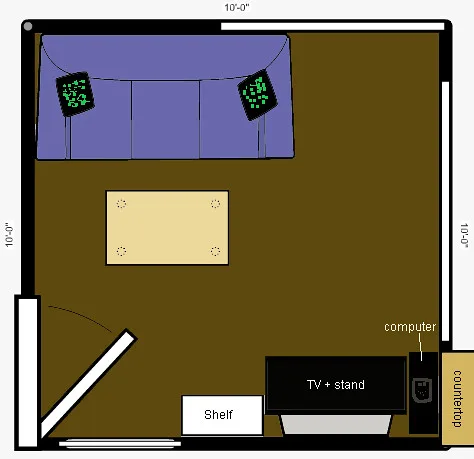
Measure the room like a fit problem. Start with corner depth, wall length, walkway clearance, seat distance, and the TV’s width and base depth. Then check outlet location and cable routing before you order anything.
- Measure usable corner depth from the corner to the nearest obstruction.
- Measure clear wall length if you are considering a long TV stand.
- Measure walkway clearance so doors and paths stay open.
- Measure TV width, base depth, and feet spacing.
- Check seat distance and the main viewing angle.
- Find outlet position and plan cable access before setup.
- Check whether the room needs no-drill or renter-friendly placement.
Corner depth, wall length, and walkway clearance
The first fail point is usually floor space, not the TV. A corner unit needs enough usable depth to sit fully inside the corner, while a long stand needs enough clear wall to avoid jutting into the room.
Walkway clearance matters because even a well-sized stand becomes a problem if it narrows the route between seating and a doorway.
Seat distance and screen position
Set the TV where the main seat can view it without a forced angle. Corner placement can help in offset layouts, but it can also push the screen too far off-axis if the sofa is centered on a different wall.
If the seat position is fixed, measure to that point first and choose the stand shape second.
Cable routes, outlet location, and base clearance
Cable access is harder in a tight corner than against a flat wall. That makes outlet position a real deciding factor, especially where cords would have to bend around the back of the unit or cross a walkway.
No-drill renters should pay close attention here. A shape that avoids wall mounting, drilled anchors, or messy cord paths may matter more than storage capacity.
Decision matrix: corner TV stand vs long TV stand
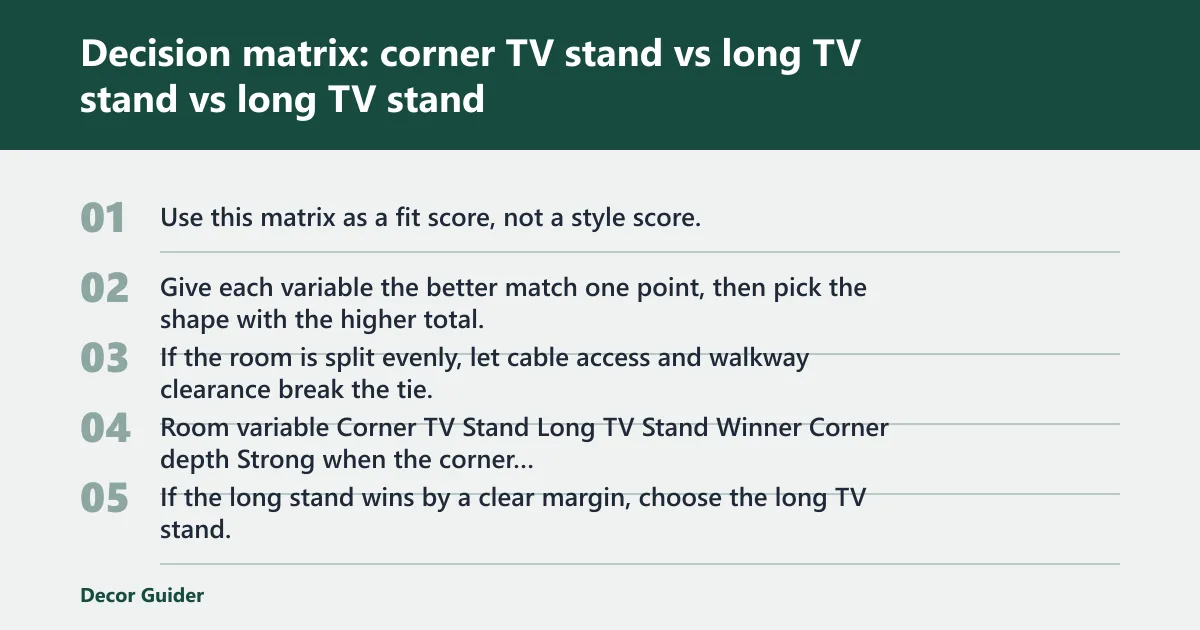
Use this matrix as a fit score, not a style score. Give each variable the better match one point, then pick the shape with the higher total. If the room is split evenly, let cable access and walkway clearance break the tie.
| Room variable | Corner TV Stand | Long TV Stand | Winner |
|---|---|---|---|
| Corner depth | Strong when the corner is usable and unobstructed | Weak when it must sit diagonally near the corner | Corner TV Stand |
| Wall length | Needs less wall | Better when a long clear wall is available | Long TV Stand |
| Seating angle | Better for angled or offset seating | Better for forward-facing seating | Depends |
| Storage load | Moderate storage | Higher storage for consoles, soundbars, and accessories | Long TV Stand |
| Cable access | Tighter near corner outlets | Easier along a flat wall | Long TV Stand |
| Walkway clearance | Often better in compact or odd rooms | Better when the wall run does not cut into traffic flow | Depends |
| TV base depth | Must match a more limited top footprint | Usually easier to match wider bases | Long TV Stand |
| Renter constraints | Useful when floor placement has to do the work without wall drilling | Also renter-friendly, but can become bulky in tight rentals | Corner TV Stand |
Simple pick rule
If the corner setup wins by a clear margin, choose the corner TV stand. If the long stand wins by a clear margin, choose the long TV stand. If the score is tied, pick the shape that keeps cable access and walkway clearance easiest, because those are the failures people notice first.
Failure cases to watch
A long stand in a corner can leave dead space behind it and create a cord path that is annoying to clean. A corner stand in a wide room can look squeezed, reduce storage, and make the TV sit at an awkward angle for the main sofa.
Neither choice works well if it blocks a door swing, outlet, or main route through the room.
Choose Corner TV Stand if… / Choose Long TV Stand if…
Choose a corner TV stand if the room is tight, the usable corner depth is enough, the seating is angled or offset, and renter-friendly placement matters more than maximum storage. Choose a long TV stand if you have a clear wall, heavier storage needs, a forward-facing sofa, and enough room to keep cables and walking paths simple.
Corner TV stand fit signals
Pick the corner shape when wall length is short, the room is irregular, or a regular stand would create dead space in the corner. It also makes sense when you want to keep wall area open for other furniture.
Materials matter here too. Wood and metal usually feel sturdier over time, while MDF can be fine in lighter setups if scuff resistance is acceptable and moisture exposure is low.
Long TV stand fit signals
Pick the long shape when storage is doing real work and the wall can take the footprint. It is often the better answer for consoles, soundbars, and closed storage because the cabinet span is easier to use.
Glass can look lighter, but it shows smudges and edge wear faster. In busy family rooms, wood or metal often holds up better than glass or basic MDF.
When a regular TV stand in a corner is the wrong compromise
A regular stand pushed into a corner is the wrong move when the triangular gap becomes dead space, the cords become hard to manage, or the TV ends up misaligned with seating. If the stand has to be “made to work,” the room is usually telling you to choose the true corner shape instead.
Frequently asked questions
Is a corner TV stand better than a long TV stand for a small living room?
Usually yes, if the room is short on wall space and traffic lanes are tight. A corner TV stand can free up valuable wall space and reduce clutter in the middle of the room, while a long TV stand may feel bulky if it blocks the main walkway.
How do I know if a long TV stand will fit in a corner?
Check whether the full rectangular footprint can sit flat without blocking a doorway, outlet, or path. If it has to angle into the room, you may create dead space behind it and lose the main benefit of the longer shape.
Which option gives better storage: corner TV stand or long TV stand?
A long TV stand usually gives better storage because it has more width for shelves, cabinets, and drawers. A corner TV stand can still handle a few devices and accessories, but it is usually the lighter storage choice.
When does a long TV stand make more sense than a corner stand?
A long TV stand makes more sense when the room has a clear wall, the sofa faces forward, and the storage load is heavy. It is also easier for cable access and usually better when you want a cleaner, more direct viewing line.
What room layouts work best for corner TV stands?
Corner TV stands work best in small rooms, odd-shaped spaces, alcoves, and layouts where seating is slightly offset. They also help when you need to keep a walkway open and do not have enough wall length for a full rectangular stand.
How do viewing angles differ between corner and long TV stands?
A corner stand can aim the screen toward seating in angled layouts, which helps in rooms where the sofa is not centered. A long TV stand usually gives the cleanest view when the seating faces forward and the TV can sit square to the main line of sight.
Can I place a regular TV stand in the corner instead?
You can, but it often creates a triangular gap behind the stand and can complicate cable routing. If the fit is tight, a true corner TV stand usually works better because it is made to sit snugly into the corner instead of being forced there.
What measurements should I check before buying either style?
Measure usable corner depth, clear wall length, walkway clearance, TV width, TV base depth, seat distance, and outlet position. Those numbers tell you far more than diagonal screen size alone, and they usually decide whether the stand fits cleanly or turns into a layout problem.
Products related to this article
Sponsored / affiliate links. As an Amazon Associate I earn from qualifying purchases. I may earn additional commission from eligible campaigns.