TV Stand vs Corner TV Cabinet
A TV stand usually works best on a flat wall, while a corner TV cabinet is the better choice when you need to free up wall space in a tight room or angle the screen into a corner. Pick the wrong one and you can crowd a walkway, end up with poor viewing angles, or waste storage space. This guide compares footprint, viewing angle, and usable storage so you can pick the right fit for your room.
| Decision factor | TV stand | Corner TV cabinet | Winner |
|---|---|---|---|
| Footprint on the floor | Uses more wall width, but usually leaves a simple rectangular footprint | Uses less wall width, but projects into the room from the corner | corner TV cabinet |
| TV fit margin | Easier to match wider TV bases and wider top surfaces | Base width and corner depth can be limiting on larger sets | TV stand |
| Viewing flexibility | Better for straight-on seating and wider seating zones | Better when the main seat is already angled toward a corner | tie |
| Usable storage | Often offers more shelf width and broader cabinet spans | Can store the same kinds of items, but usually with less horizontal space | TV stand |
| Cable access and outlet routing | Usually easier to route cables along a flat wall | Can be awkward if outlets sit behind the corner or at the wrong angle | TV stand |
Footprint trade-offs between flat wall and corner setups
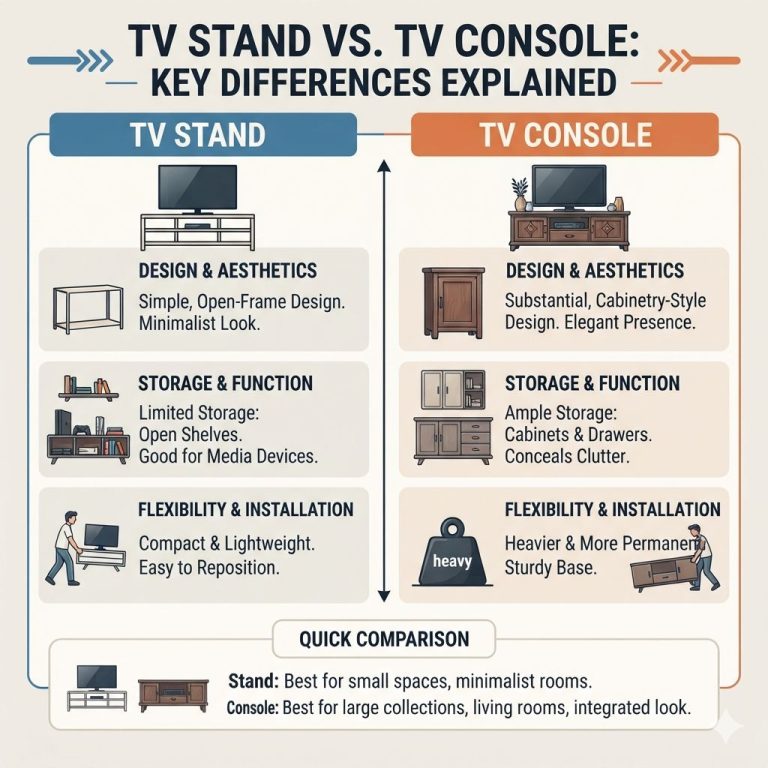
The practical difference is placement and shape. A TV stand is made for a flat wall and usually spreads width across it, while a corner TV cabinet uses an angled or triangular footprint that trades wall width for corner depth. That trade affects open floor space, cable routing, and the largest TV base that can sit on top.
What each piece is built to do
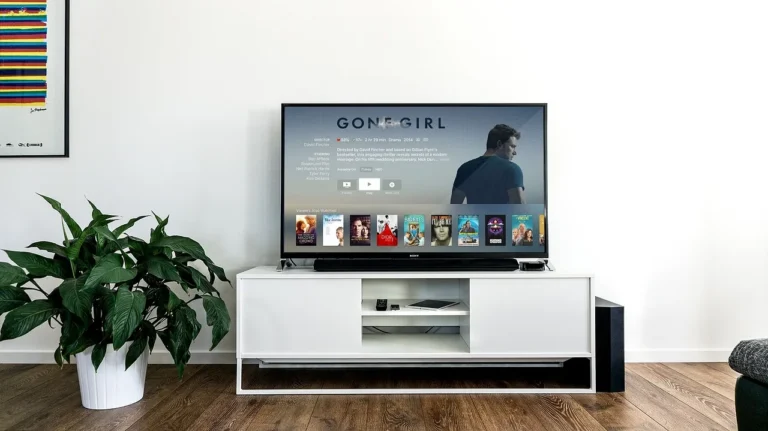
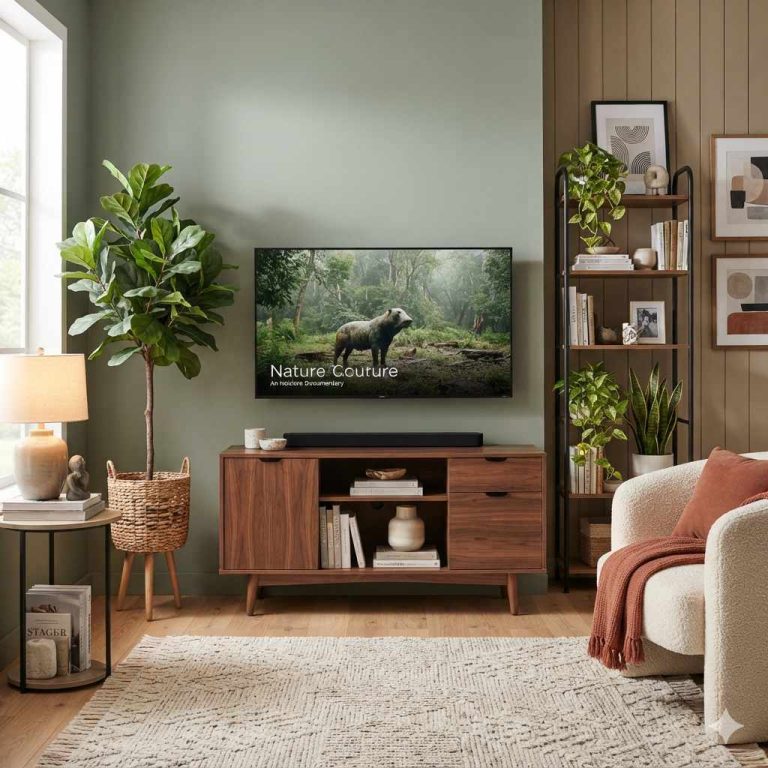
A TV stand usually gives you a wider top surface, wider shelves, and simpler access to devices. A corner TV cabinet is built to tuck into the angle of two walls, which can make a tight room feel less crowded. The trade-off is that the usable top surface often narrows as you move toward the back corners.
How footprint changes with placement
The footprint is not just width or depth; it is the actual floor area the furniture occupies. A flat-wall stand may be 60 inches wide and 16 to 20 inches deep, while a corner unit may present a smaller front width but extend 20 to 30 inches from the corner along each wall line, depending on design. That can free up wall width, but it does not always reduce the total floor area the unit occupies, so corner depth is the number to watch, not just the listed width.
The core trade-off: width versus corner depth
The trade-off is simple. A TV stand gives you width for larger TV bases, larger components, and wider storage bays. A corner TV cabinet gives you a smaller wall footprint and can improve traffic flow in narrow rooms, but it can limit screen width, shelf width, and access to devices if the corner is tight.
TV stand vs corner TV cabinet table
Use the table below as a practical comparison guide based on the footprint and fit checks discussed in this section, not as a universal sizing rule.
| Room width | Corner depth | TV base width | Device stack depth | Recommended furniture type |
|---|---|---|---|---|
| 8 ft | 24 in or less | Up to 28 in | Up to 14 in | corner TV cabinet |
| 9 ft | 24 to 28 in | 28 to 34 in | Up to 16 in | corner TV cabinet |
| 10 ft | 28 to 32 in | 34 to 40 in | Up to 16 in | TV stand |
| 10 ft or wider | 32 in or more | 40 in or more | 16 in or more | TV stand |
These ranges are practical buying guides, not universal rules. The real check is whether the cabinet clears walking space, supports the TV base, and leaves room for device ventilation. If the room is wide enough for a flat-wall stand without blocking a door, outlet, or walkway, the stand usually wins on fit.
How to measure your TV and room
Measure the TV base, not only the diagonal. Screen size in inches tells you the panel diagonal, but the base width and support footprint tell you whether the set actually sits safely on top. A 65-inch TV can have a base that is far narrower than the screen, or one that spreads close to the edges of the stand.
Measure the TV base, not only the diagonal
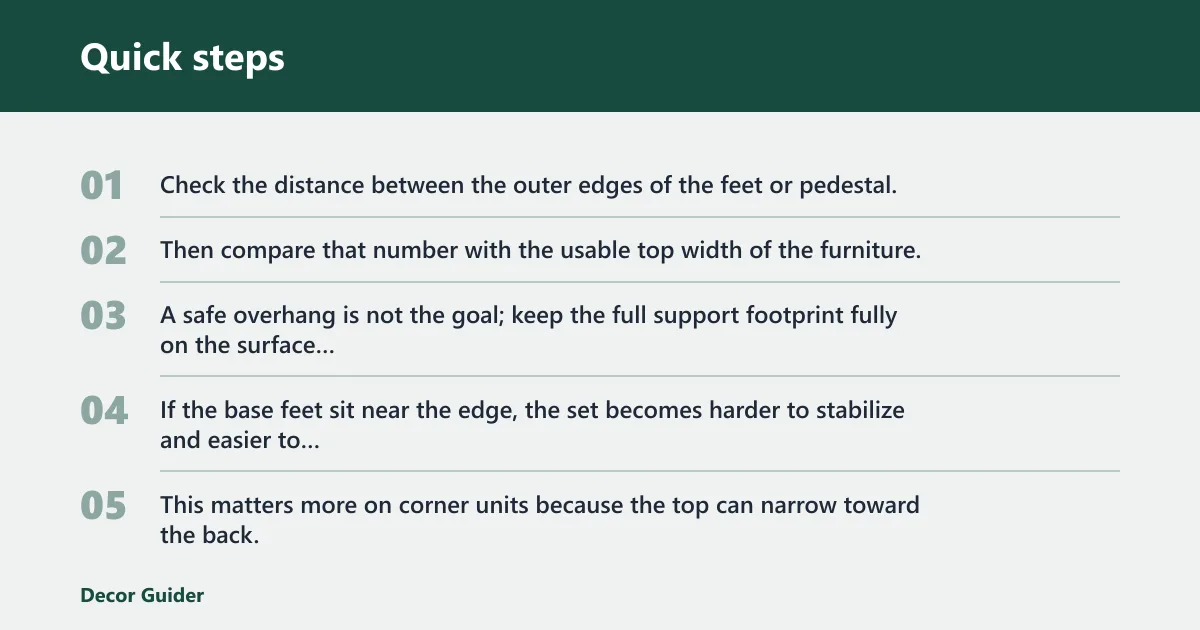
Check the distance between the outer edges of the feet or pedestal. Then compare that number with the usable top width of the furniture, leaving margin on both sides. A safe overhang is not the goal; keep the full support footprint fully on the surface whenever possible.
Check support footprint and safe overhang
If the base feet sit near the edge, the set becomes harder to stabilize and easier to bump. This matters more on corner units because the top can narrow toward the back. A stand with a wider top surface gives more room for a centered placement and a cleaner load path.
Map walking clearance and outlet access
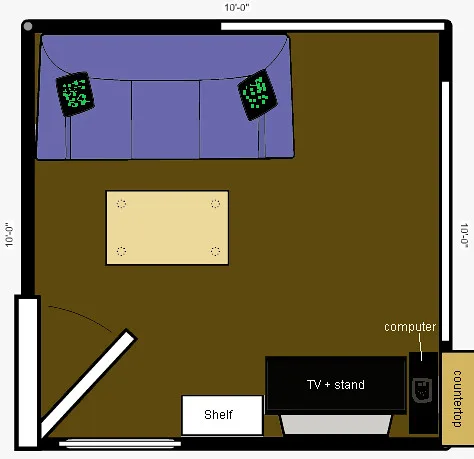
Measure the path people use around the furniture. Leave enough clearance so doors, drawers, and walking routes do not collide with the cabinet corner. Also note outlet height and location; a corner unit can block plugs or force tight cable bends if the wall outlet lands behind the angled back.
Say your room is 9 feet wide and your TV feet span 30 inches. A corner cabinet with about 26 inches of corner depth may fit the room, but if the top narrows to about 28 inches at the front edge, the TV feet may sit too close to the sides. In that case, the room may allow a corner cabinet while the TV itself still pushes you toward a wider stand.
Viewing angle and cable path
A corner placement can improve sightlines when the main sofa already faces diagonally across the room. It can also reduce the amount of wall blocked by furniture. But angled placement is not always better; if the seating is straight-on, the corner can push the screen off-axis and make one seat feel better than the rest.
When a corner placement improves sightlines
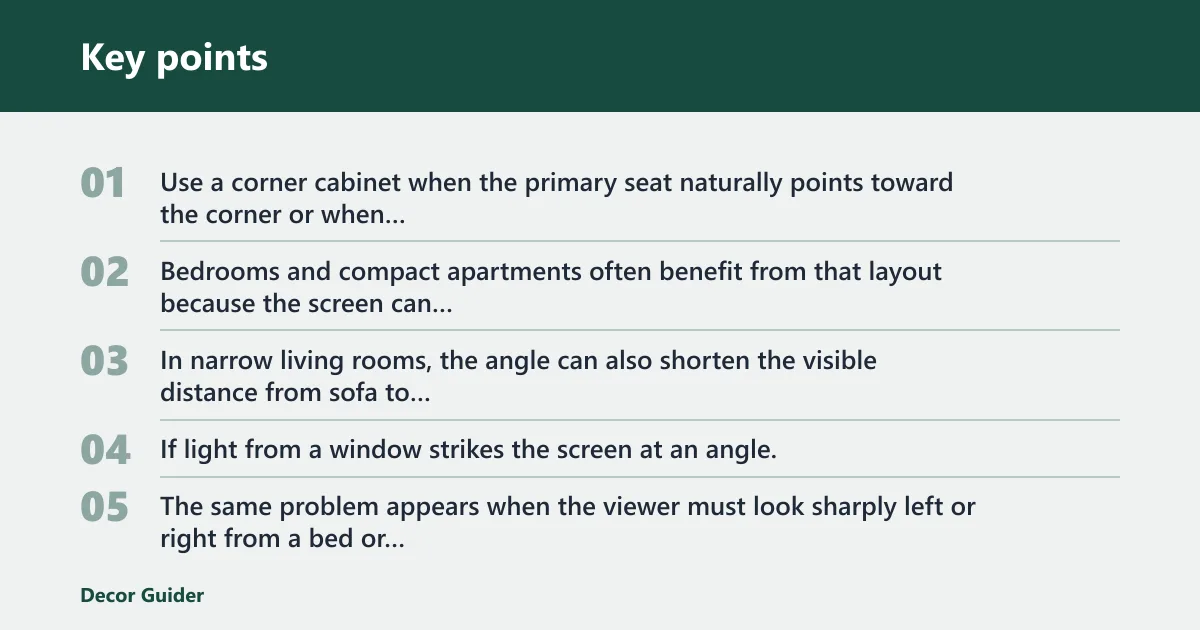
Use a corner cabinet when the primary seat naturally points toward the corner or when the room has two entry paths and a corner keeps the center open. Bedrooms and compact apartments often benefit from that layout because the screen can sit out of the traffic line. In narrow living rooms, the angle can also shorten the visible distance from sofa to screen.
When angled placement creates glare or discomfort
If light from a window strikes the screen at an angle, the corner can increase glare rather than reduce it. The same problem appears when the viewer must look sharply left or right from a bed or sofa. In those cases, a flat-wall stand often gives a more direct sightline and a more comfortable head position.
Planning cable runs to power and devices
Check where the power outlet, antenna coax, and device cables enter the wall. A flat-wall stand usually lets you route cords straight down the back and hide them behind the unit. A corner cabinet may require a longer cable path or a cutout on the back panel, which matters if the outlet sits behind one wall rather than centered in the corner.
A common beginner mistake is buying for the TV and forgetting the console stack. A 14-inch-deep game console, a soundbar, and a streaming box can fit on paper, but a corner cabinet with a shallow back shelf may leave no room for airflow or for a plug that sticks out of the rear panel.
Storage and ventilation compared
Storage should be judged by usable shelf width, not by the number of doors. TV stands usually give you more linear shelf space for consoles, receivers, and accessories. Corner TV cabinets can still hold devices, but the angled frame often cuts into the largest shelf areas and makes the back corners less usable.
Open shelves for receivers and consoles
Open shelves are the easiest way to keep consoles and receivers cool. They also make remote signals and front-panel access simpler. If you use a receiver, a game console, and a streaming box together, look for a shelf opening that leaves space behind the devices for cables and air movement.
Closed doors for hidden storage
Closed cabinets hide remotes, discs, controllers, and power strips. That is useful in a bedroom or apartment where visible clutter is harder to ignore. The trade-off is heat and signal blockage, so closed sections are best for low-heat items, not for electronics that run warm.
Drawers, airflow, and heat buildup
Drawers help with small accessories, but they do not solve ventilation. A drawer below the TV can be useful for cables and manuals, while a closed lower compartment can hold less sensitive items. For active devices, leave airflow space above and behind the unit; a cabinet that seals tightly around a console is a poor match.
Weight capacity and material strength
Load rating matters as much as footprint. Check the top-shelf load rating for the TV itself and the shelf load rating for devices below. The combined weight of the TV and accessories should stay well under the listed limit, and heavier materials generally resist flex better than thin boards or light frames.
Top-shelf load rating
The top shelf carries the TV, so that rating deserves the most attention. If a cabinet lists separate shelf limits, use the top limit for the screen and the lower shelf limits for components. Do not assume that a larger cabinet automatically means a stronger one; the frame design matters.
Shelf load rating
Receiver shelves, center shelves, and drawer bases often carry different loads from the top. That matters when you place a soundbar, console, or speaker on the lower levels. If the shelf flexes, the cabinet can vibrate more, and cable strain can increase.
How material choice affects stability
Solid wood and thick engineered panels usually handle load better than thin particleboard with a tall, narrow frame. Metal brackets, center supports, and back panels also affect side-to-side stiffness. A corner unit can feel stable only if the back geometry is braced well enough to resist wobble on uneven floors.
Choose TV stand if… / Choose corner TV cabinet if…
Pick a TV stand when width, device clearance, and easier cable routing matter more than saving every inch of floor space. Pick a corner TV cabinet when the room is narrow, the seating already angles toward a corner, or you need to keep a central walkway open. A wall-mounted TV bracket is the better call when you need the floor clear and the TV plus devices are light enough for the mounting system.
Choose TV stand if…
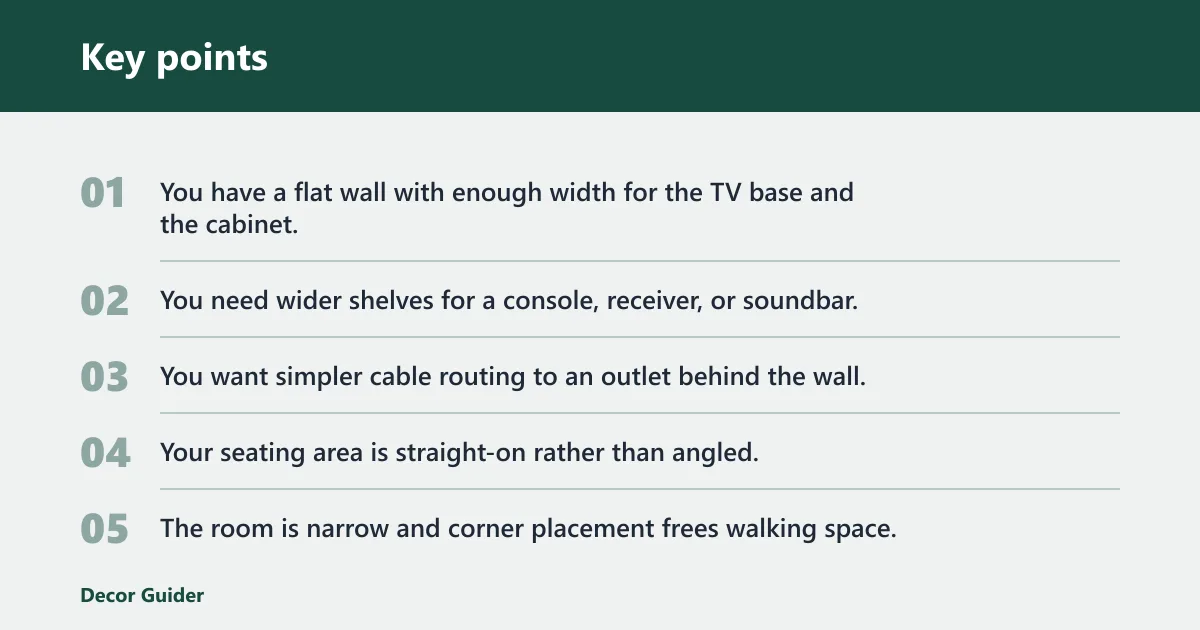
- You have a flat wall with enough width for the TV base and the cabinet.
- You need wider shelves for a console, receiver, or soundbar.
- You want simpler cable routing to an outlet behind the wall.
- Your seating area is straight-on rather than angled.
Choose corner TV cabinet if…
- The room is narrow and corner placement frees walking space.
- The TV base width fits within the cabinet’s usable top width.
- Your main seat naturally faces the corner or sits diagonally across the room.
- You can keep device ventilation and outlet access clear.
Suppose a bedroom has a 6-foot bed centered on one wall, with the only free floor area in the corner near a closet door. A corner cabinet can keep the path open, but only if the door swing, outlet location, and TV base width all clear the corner footprint. If the set needs a wide top shelf, a flat stand may still be the safer fit for clearances and stability.


Frequently asked questions
What is the difference between a TV stand and a corner TV cabinet?
A TV stand is designed for flat-wall placement and usually offers more width for the TV base and devices. A corner TV cabinet is shaped to sit in the angle between two walls, which saves wall width but can reduce shelf width and change how cables, outlets, and viewing angles line up.
Is a corner TV cabinet better for small rooms?
Often yes, but only when the room’s layout supports it. A corner cabinet can free up wall length and walking space in a small room, yet it may fit poorly if the TV base is wide, the outlet is awkwardly placed, or the angled screen creates glare from a window.
Can a corner TV stand hold a large TV safely?
Only if the TV base width, top-shelf width, and load rating all support it. Screen diagonal alone does not prove fit. A large TV can sit safely on a corner unit when the feet land fully on the surface and the cabinet’s top and shelf ratings cover the combined weight.
How do I know if my TV fits a corner cabinet?
Measure the distance between the TV feet or pedestal edges, then compare that to the cabinet’s usable top width. Also check depth at the point where the feet will sit, because a corner unit can narrow toward the back. Leave room for cables, ventilation, and any overhang near the front edge.
Do corner TV cabinets offer less storage than regular TV stands?
Usually they offer less usable horizontal storage, though the total storage depends on shelves, doors, and drawers. A corner cabinet can still store media gear, but its angled shape often reduces shelf width and makes back corners less practical. Ventilation and cable access can also be tighter.
Should I choose a wall-mounted shelf or a corner TV cabinet?
Choose a wall-mounted shelf when you want the floor completely clear and the TV plus devices are light enough for a mounted setup. Choose a corner TV cabinet when you need freestanding storage, want easier relocation, or need to avoid drilling into the wall. The better choice depends on weight, outlet access, and room layout.
What measurements matter when buying a corner TV cabinet?
Focus on corner depth, front width, TV base width, shelf depth for devices, and the cabinet’s load ratings. Also measure door swing, outlet position, and walking clearance. Those numbers tell you more than TV size alone, because the screen diagonal does not show how the set actually sits on the cabinet.
Are corner TV cabinets good for bedrooms or apartments?
Yes, especially when floor space is tight and the furniture has to stay out of the main walking path. They work well in bedrooms and apartments where a corner can hold the screen without blocking a doorway or dresser. Just check glare, outlet access, and device ventilation before buying.
Products related to this article
Sponsored / affiliate links. As an Amazon Associate I earn from qualifying purchases. I may earn additional commission from eligible campaigns.