TV Stand Door Problems: Causes, Fixes, and Checks
Start by matching the failure to the fix: if the door sticks, the cabinet is out of level or the hinge is misaligned; if it sags, tighten or replace the hinge; if it pops open, adjust the latch or strike. Using the wrong fix can leave the door rubbing, stress screws, and damage the cabinet side. This guide shows how to diagnose TV stand door problems, then correct hinge alignment, leveling, or broken hardware.
What you’ll need
- Phillips screwdriver
- Square-drive or cam-driver bit, if your screws use it
- Small bubble level
- Shims for leveling the stand
- Wood glue and wooden toothpicks or dowel filler for minor strip-out
- Replacement hinges or mounting screws that match your cabinet hardware
- Flashlight for checking rub points and rear cutouts
- Painter’s tape for marking contact spots
- Soft cloth or moving blanket for tempered glass doors
For tempered glass doors, support the panel with two hands and set it on a padded surface before removing hardware. Glass doors add hinge load, and over-tightening can chip the mounting point or crack the panel.
Why won’t the door close?
Most closing failures come from a simple mismatch between the door, hinge, and cabinet opening. Start with the contact point, then check hinge screws, then check the stand itself. If the cabinet is leaning, hinge adjustment alone will not solve the problem.
Check door swing clearance
- Open the door fully and watch where it stops or drags.
- Look for shelf interference, a center support, or a nearby door edge.
- Check the open center console and rear wire-management holes for cords that are pinched into the swing path.
- Mark the rub point with painter’s tape, then close the door again.
Picture a four-door glass TV stand with three interior shelves and an open center console. One door may close cleanly while the next catches on a shelf edge or a cord routed through the back panel opening. That points to a clearance problem, not a hinge defect.
Inspect the hinges and screws
- Tighten every visible hinge screw before making any adjustment.
- Use the side-to-side screw to center the gap.
- Use the depth screw to move the door in or out until it sits flush.
- Use the height adjustment, if present, only after the door is square in the opening.
- Check for bent hinge arms, stripped holes, or a loose mounting plate.
If the screw spins without biting, stop and repair the hole first. In particleboard and MDF, repeated tightening strips the anchor point quickly.
How do you fix a sagging TV stand door?
A sagging door usually means the hinge is loose, the mounting screws have shifted, or the screw holes in the cabinet side are failing. Re-center the door with the hinge adjustments first. If the hardware cannot hold position, repair the hole or replace the hinge before the panel starts tearing out.
Re-center the door
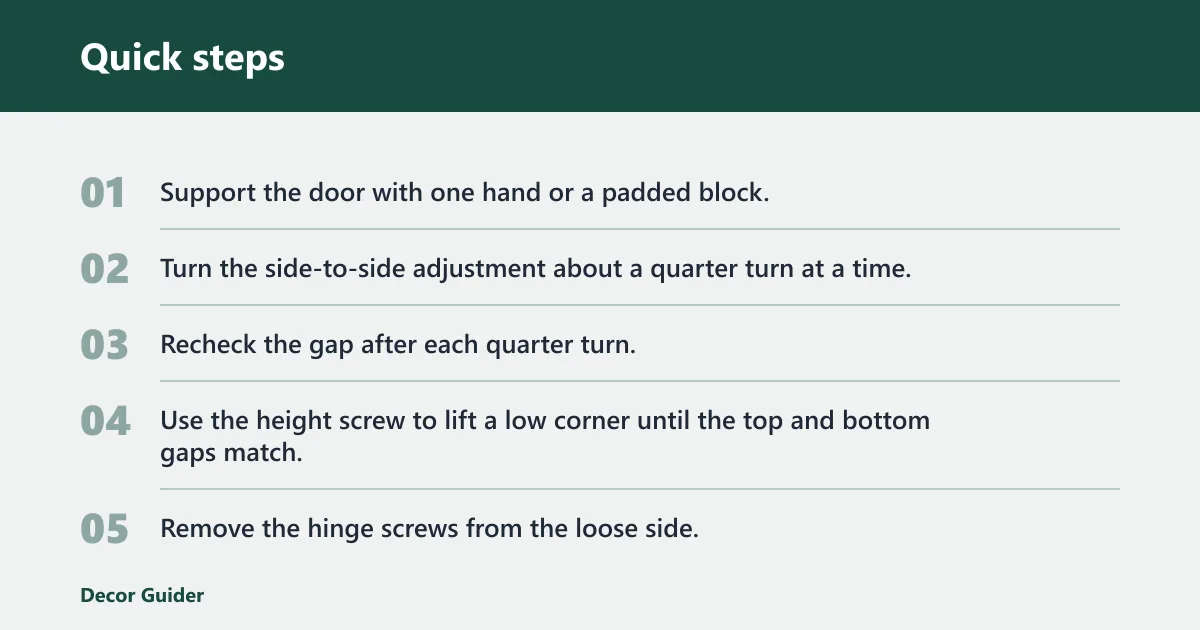
- Support the door with one hand or a padded block.
- Turn the side-to-side adjustment about a quarter turn at a time.
- Recheck the gap after each quarter turn.
- Use the height screw to lift a low corner until the top and bottom gaps match.
Suppose the top corner of a door drags while the bottom corner sits wide open. A quarter turn on the height adjustment often corrects the diagonal gap better than forcing the door against the frame.
Decide whether the holes need repair
- Remove the hinge screws from the loose side.
- Inspect the hole for powdery fiber, cracking, or a widened opening.
- Pack the hole with wood glue and toothpicks for a light repair, then reinstall after the glue sets.
- Replace the hinge plate or side panel if the board crumbles again after a brief test fit.
On particleboard or MDF, a screw hole that strips twice is usually beyond a simple fix. At that point, the cabinet carcass needs a stronger anchor point or replacement part.
What causes TV stand doors to rub the frame?
Rubbing usually comes from a swing-clearance conflict, not from the hinge alone. The door may be too tall for the opening, the stand may be sitting unevenly, or a shelf, center divider, or rear cord path may be stealing space from the swing. Check the cabinet before you chase hinge settings.
Test the cabinet level first
- Place a level across the top of the stand from left to right.
- Check the front edge and the side-to-side slope separately.
- Shim the low corner or adjust the legs, then retest the door.
- Only after the stand sits level should you fine-tune the hinge.
Even a slight floor slope can pull the door into the frame. If the stand moves when the door opens, the frame can twist enough to create a new rub point.
Check the contact zone
- Open the door slowly and listen for contact.
- Look for shelf corners, adjacent door edges, or a center console lip that blocks the swing.
- Inspect rear wire-management holes for cords that press against the back edge of the door.
- Reroute cords so they do not cross the swing path.
Back-panel openings are useful, but they can also pinch cords if the cable sits too close to the hinge side. Keep the routing path away from the door arc.
TV stand door matrix
| Symptom | Likely cause | Quick test | Fix | Tools needed | Replace vs repair threshold |
|---|---|---|---|---|---|
| Sticky door | Frame rub, uneven floor, humidity swelling | Open and close with the stand leveled; check the marked rub spot | Level the stand, then adjust hinge depth or side-to-side position | Level, screwdriver, shims | Repair if the panel is sound; replace if the edge is swollen or crushed |
| Sagging door | Loose screws, worn hinge, stripped hole | Lift the door by hand; if the gap changes, the support is failing | Tighten screws, then reset height; repair stripped holes | Screwdriver, filler, wood glue | Replace the hinge if it will not hold position after tightening |
| Rubbing door | Swing clearance conflict, shelf interference, misaligned hinge | Open slowly and watch the contact point | Move shelves or cords, then adjust depth and side-to-side gap | Flashlight, screwdriver, tape | Replace the door only if it is warped or damaged at the edge |
| Door pops open | Latch or strike misaligned, hinge tension too low | Push the door closed with light pressure and see if it stays shut | Adjust the strike, then retest the close alignment | Screwdriver | Replace the latch or hinge if the catch no longer engages |
| Soft-close failure | Damper worn out, hinge arm bent, screw loosened | Close the door by hand and watch for a sudden drop or slam | Tighten the hinge, then replace the soft-close hinge if damping is gone | Screwdriver, replacement hinge | Replace when the slow-close mechanism no longer resists the final swing |
| Split screw holes | Particleboard or MDF strip-out, repeated over-tightening | Remove the screw and check for loose fiber or cracking | Rebuild the hole or move to a new anchor point | Glue, filler, screwdriver | Replace the side panel if the hole will not hold after repair |
When should you repair or replace hardware?
Repair the hardware when the hinge is straight, the screws are only loose, and the cabinet side still holds an anchor. Replace the hardware when the soft-close hinge no longer controls the final movement, the arm is bent, or the mounting plate pulls free after tightening. Damaged MDF and particleboard often set the limit.
Use this threshold
- Repair a stripped hole if the surrounding board is still firm and the screw can bite after filler or glue repair.
- Replace the hinge if the soft-close mechanism fails, the door drops, or the adjustment range is already maxed out.
- Replace the door if tempered glass is chipped, cracked, or under uneven hinge load.
- Replace the side panel if repeated repairs leave the screw hole soft, enlarged, or split.
Do not keep tightening a failing hinge into particleboard or MDF. That usually enlarges the hole and makes the next repair harder.
Common mistakes
- Overtightening screws into particleboard or MDF, which strips the anchor point.
- Using hinge adjustments to fix a crooked stand instead of leveling the cabinet first.
- Ignoring shelf interference or cord routing near the rear cutouts.
- Forcing a tempered glass door into alignment without supporting the panel.
- Assuming every soft-close hinge has an adjustable damper; many only allow position adjustment.
Prevention is simple: level the stand during setup, keep cords out of the swing path, and recheck hinge screws after the first few days of use. On a stand with four swing-open glass doors, three compartments, three interior shelves, wire-management holes in the back, and soft-close hinges, a small shift in the cabinet can change how every door closes.
Frequently asked questions
Why are my TV stand doors not closing properly?
Most often, the door is hitting the frame, the cabinet is out of level, or the hinge has shifted. Start with the rub point, then tighten the hinge screws, then check the stand with a level. If the cabinet is square but the door still binds, the hinge or door edge is likely worn.
Why do soft-close TV stand doors stop working?
The slow-close mechanism can wear out, the hinge arm can bend, or the mounting screws can loosen enough to change the damping path. Check whether the door slams only at the end of travel. If yes, replace the soft-close hinge; if the hinge is only loose, retighten it first.
How do I realign cabinet doors on a TV stand?
Use the hinge adjustments in order: side-to-side for gap centering, depth for flush fit, and height for top-and-bottom alignment. Make each change about a quarter turn at a time and retest after each change. If the cabinet is not level, shim the low side before fine-tuning the door.
When should I replace TV stand hinges instead of repairing them?
Replace the hinge when the soft-close action fails, the arm is bent, or the screw holes no longer hold after a proper repair. On particleboard and MDF, repeated strip-out is a strong sign that replacement hardware or a new anchor point is the better fix than another tightening cycle.
Products related to this article
Sponsored / affiliate links. As an Amazon Associate I earn from qualifying purchases. I may earn additional commission from eligible campaigns.