TV Stand vs Credenza: Which Fits Your Space Best?
Choose a credenza for a low-interaction, furniture-first wall, and choose a TV stand if you need frequent access to devices, ports, and airflow. Pick the wrong one, and you can block vents, make cable changes a hassle, or end up with storage that does not fit your setup. This guide compares TV stand vs credenza by size, storage, cooling, mounting options, and the spaces where each works best.
| Decision factor | TV stand | credenza | Winner |
|---|---|---|---|
| Primary purpose | Built around television use, with equipment-focused storage | Primarily a storage piece with a long, low profile | TV stand |
| Device access | Usually easier access to ports, shelves, and components | Often more closed off, especially with doors or drawers | TV stand |
| Cooling and airflow | More likely to support cable paths and ventilation | Can limit airflow when fronts and backs are enclosed | TV stand |
| Furniture-first look | More media-forward in appearance | Often reads as general furniture first | credenza |
| Closed storage | May mix open and closed sections | Often stronger at hiding electronics and clutter | credenza |
TV stand vs credenza at a glance
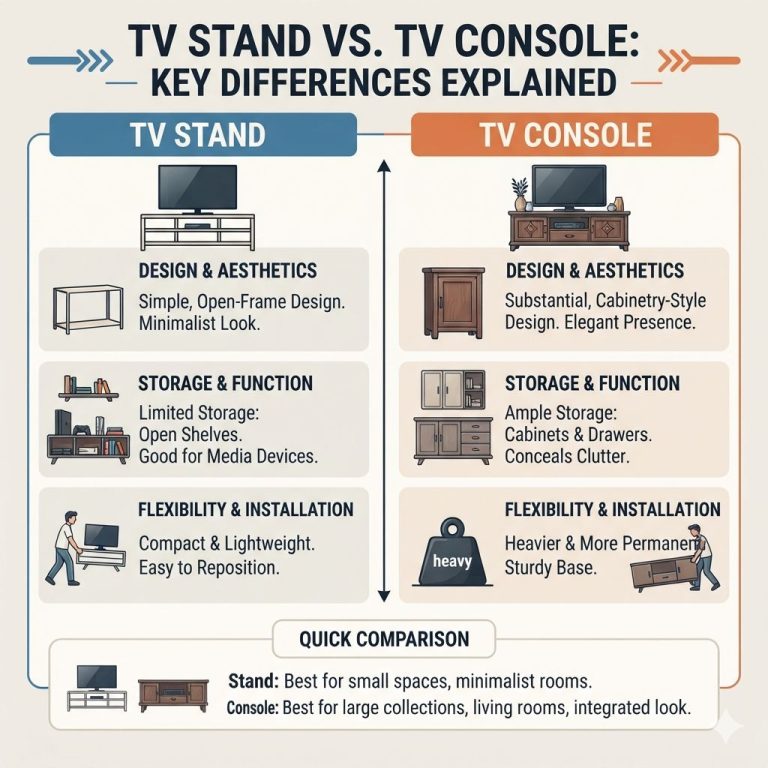
The short version is simple: a TV stand is built for a television and the gear that usually comes with it, while a credenza is mainly a storage piece that can work under a TV when the dimensions, stability, and access fit. If you swap devices often, the TV stand usually wins. If the wall should read as furniture first, the credenza usually fits better.
What each piece is built to do
A TV stand or media console is designed around a television, so the layout usually favors cable access, ventilation, and equipment storage. A credenza is primarily a storage piece, often with doors or drawers, and it can sit under a TV only when width, depth, height, and weight capacity work together.
That difference matters in daily use. One piece supports media gear first, and the other supports storage first.
Core trade-offs: access, storage, and look
Choose the TV stand when you need to reach ports, power strips, receivers, or streaming boxes often. Choose the credenza when the wall should feel calmer and the equipment stays mostly put. The trade-off is access versus concealment.
Hernest’s split between concealed and open storage captures the practical divide well. Open shelves make cabling and cooling easier. Closed fronts hide clutter, but they can also make heat and cable swaps harder.
Can a credenza be used as a TV stand?
Yes, a credenza can be used as a TV stand when the width, height, depth, stability, and cable access all fit the TV and the equipment below it. The label alone is not enough. A credenza works best when the television is not being moved or reworked often, and the wall needs to look like furniture first.
When a credenza works well under a TV
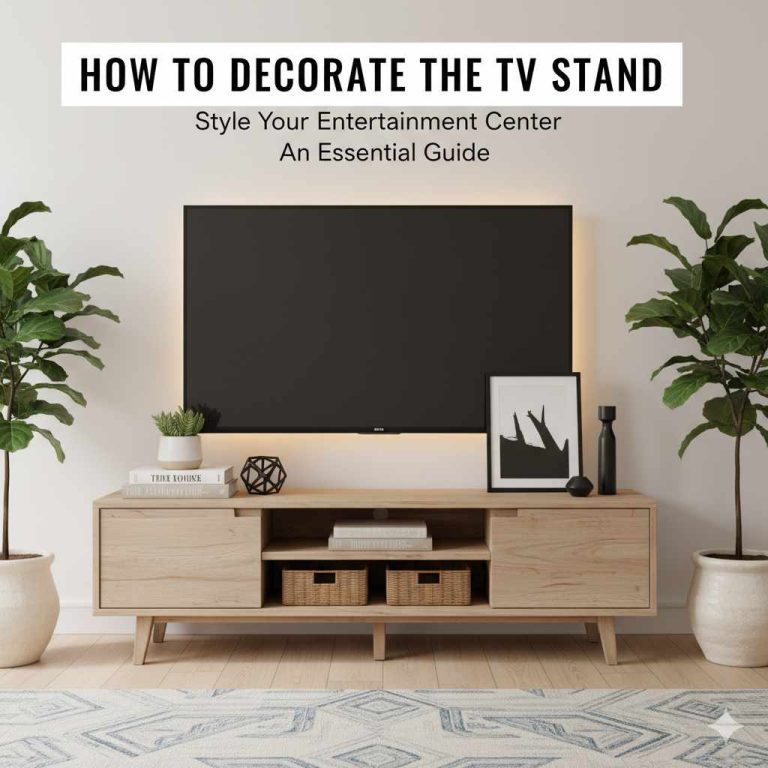
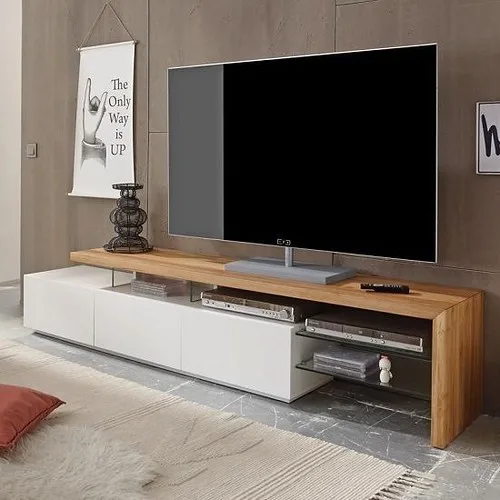
A credenza can be a good fit in a living room or mixed dining-living space when the TV is wall-mounted and the cabinet mainly holds a soundbar, a streamer, or a few remotes. A broader base can help the wall feel grounded, and AURA notes that a credenza can change the feel of a TV wall while creating a broader base.
Suppose your TV around 55 inches is mounted above a low credenza about 72 inches wide with one open shelf for a soundbar. If the back has cord access and the top stays clear of heat-producing gear, that setup can work well.
When a credenza creates problems
A credenza becomes a weak choice when you need frequent access to HDMI ports, game consoles, or an AV receiver. Closed doors can trap heat, and solid backs can make cable changes annoying. It is also a poor pick if the TV or gear makes the top feel crowded or unstable.
A common first-timer mistake is placing a heavy television on a narrow credenza because the finish looks right. If the top surface is shallow or the cabinet is light for the load, the setup can feel top-heavy and awkward fast.
What is the right size for a TV stand?
The right size comes down to width, depth, height, overhang margin, and stability. The stand should be wide enough to support the TV or the mounting base, deep enough for components, and low enough for comfortable seated viewing. It also needs enough weight capacity for the set and the gear beneath it.
Width, depth, and overhang checks
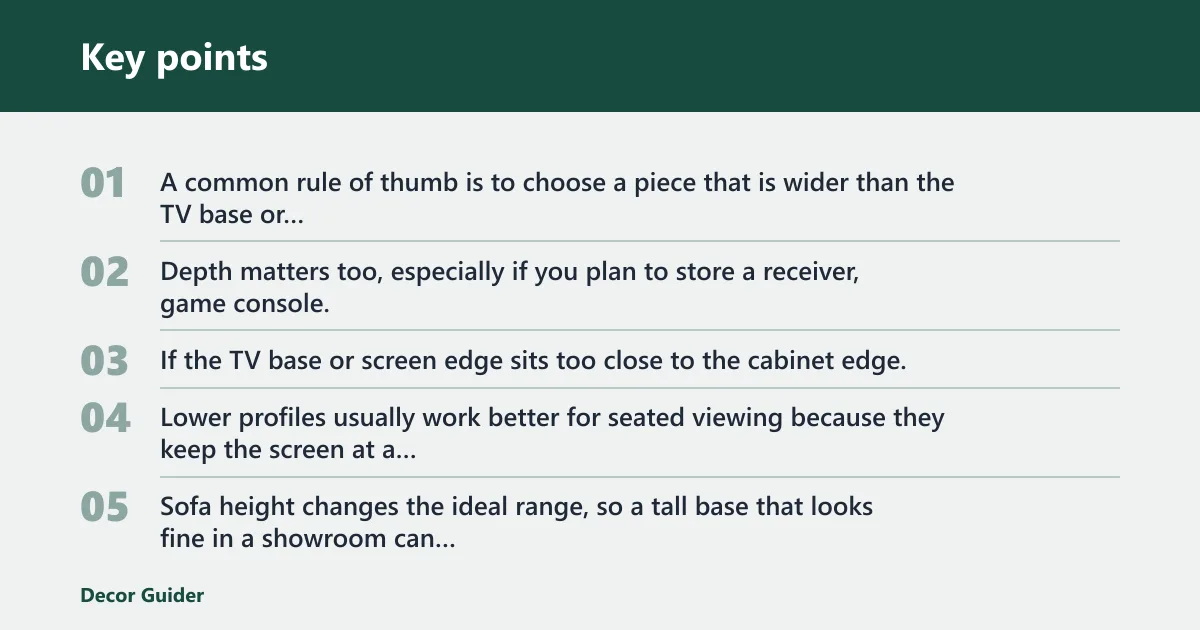
Check the stand width before buying. A common rule of thumb is to choose a piece that is wider than the TV base or wall-mounted screen area, with room on both sides so the setup does not look cramped or tip-prone. Depth matters too, especially if you plan to store a receiver, game console, or larger soundbar.
Also check TV overhang margin. If the TV base or screen edge sits too close to the cabinet edge, the setup can look unstable and be harder to bump safely around daily traffic.
Height and viewing comfort
Lower profiles usually work better for seated viewing because they keep the screen at a more natural eye line. Sofa height changes the ideal range, so a tall base that looks fine in a showroom can feel awkward in a room with low seating. A media console can be listed in many ways, but the practical question is whether the screen lands comfortably for the main seat.
Weight capacity and stability
Check stability and weight capacity before placing a television on any cabinet. That includes the TV itself, not only the stand. If the cabinet rocks, flexes, or feels light in relation to the load, it is the wrong match even if the dimensions look right on paper.
Weight and balance matter more than the product name. A credenza can work, but only if the structure can support the setup without wobble or a top-heavy feel.
Cable access and ventilation
Cable access and ventilation are where TV stand vs credenza often separates in daily life. Rear cutouts, open-back sections, and easy cord paths make a setup easier to maintain, especially when you use a console, receiver, and streaming box together. Closed storage can hide clutter, but it can also make the whole stack harder to cool and service.
Rear cutouts, open backs, and cord paths
A TV stand usually gives you more predictable cable routing because the design often assumes devices will be connected and reconnected. Open-back shelving and rear cutouts can make it easier to thread power cords, HDMI cables, and Ethernet lines without dragging the cabinet away from the wall.
That matters for renter setups too. If you may move the furniture later, easier cord access saves time and reduces the chance of pinched cables.
Why enclosed storage can be a problem
Closed-door storage can look cleaner, but it may create heat pockets around electronics. Receivers and game consoles need room to shed heat, and streaming boxes can be harder to reach when they sit behind solid fronts. If you need to swap cables often, a credenza may become frustrating quickly.
Picture a family room where a console and router both live behind two solid doors. The wall looks tidy, but every time a cable needs to be changed, the whole setup becomes harder to use.
Choose TV stand if… / Choose credenza if…
Choose a TV stand when the equipment matters more than the furniture face. Choose a credenza when the room should read as storage furniture first and the TV gear stays relatively simple. The right answer depends on how often you touch the setup, not on the label alone.
Choose TV stand if…
- You use a gaming console, AV receiver, or soundbar and need easy access to ports.
- You expect to swap cables or devices often.
- You want better airflow for electronics.
- You prefer open shelves or mixed storage over fully closed fronts.
Choose credenza if…
- The TV is wall-mounted and the cabinet mostly supports decor or a small soundbar.
- You want a furniture-first wall with less visible equipment.
- You rarely reach behind the setup.
- You can verify width, depth, stability, and weight capacity before buying.


Sideboard, buffet, and media console: what they mean
These terms are not interchangeable. A sideboard is storage furniture that often sits on higher legs than a credenza and can work under a TV if the dimensions fit. A buffet is usually dining-room storage with a counter-height surface, so it is often not the first choice for media use. A media console may be listed as a TV stand in some shops and often mixes open and closed storage with cord access.
How a sideboard differs from a credenza
A sideboard often has a lighter stance with more visible legs. A credenza is usually lower and longer, with a stronger furniture wall presence. Either can work under a TV, but the practical decision still comes back to height, stability, and the ease of routing cables.
Why a buffet is usually a separate case
A buffet is built around dining-room storage, not media gear. Its counter-height top can put a television too high for relaxed seated viewing, and its internal layout often favors serving pieces rather than electronics. That makes it a poor default pick for a TV wall.
Where media console fits in product listings
Media console is the broadest label in this group. Some listings use it for a TV stand, some use it for a cabinet with more storage, and some mix open shelves with closed compartments. Use the specs, not the name, to decide whether the piece fits your TV and your equipment.
TV stand decision matrix
This matrix shows the better pick by common room and gear setup. It also names the measurement checks that matter most and the failure risk if you choose the wrong piece. Use it as a quick filter before you compare finishes.
| Buying scenario | Better choice | Must-check measurements | Main failure risk |
|---|---|---|---|
| Wall-mounted TV above a low cabinet | credenza | Width, depth, TV overhang margin, stability | Cabinet looks right but blocks cable access |
| Gaming setup with console and controllers | TV stand | Depth, rear cutouts, shelf height, ventilation | Heat buildup and awkward cable swaps |
| Soundbar under the screen | TV stand | Width, open shelf height, cable path, viewing height | Soundbar blocks sensor line or overhangs the edge |
| Kids’ room with limited gear | TV stand | Stability, height, weight capacity | Top-heavy setup is easier to bump |
| Renter setup with frequent moves | TV stand | Weight, assembly, cord access, width | Closed cabinet is hard to move and reroute |
| Dining-living combo room | credenza | Height, depth, door clearance, stability | Piece reads too much like office storage |
| AV receiver and multiple boxes | TV stand | Shelf height, ventilation, rear access, depth | Receiver runs hot behind solid doors |
| Minimal gear, mostly streaming | credenza | Weight capacity, width, cable hole placement | Cables become hidden but hard to service later |
| Long wall with a low sofa | TV stand | Height, width, TV overhang margin | Screen lands too high for comfortable viewing |
| Formal living room that still needs a TV | credenza | Width, stability, cable access, finish durability | Media gear is too visible for the room style |
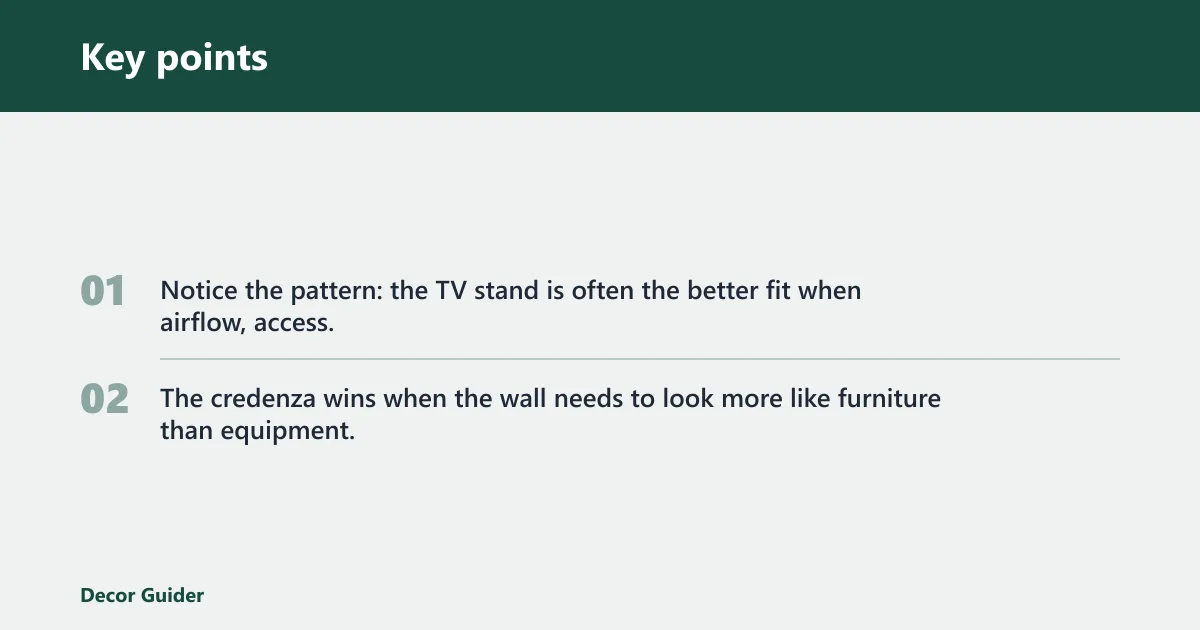
Notice the pattern: the TV stand is often the better fit when airflow, access, or device changes matter most. The credenza wins when the wall needs to look more like furniture than equipment, and the TV side of the setup stays quiet.
Frequently asked questions
What is the difference between a TV stand and a credenza?
A TV stand is built around television use, with lower viewing height, cable routing, ventilation, and equipment-focused storage. A credenza is mainly a storage piece that can work under a TV when the dimensions and stability fit. In practice, the TV stand is the easier pick for gear-heavy setups.
Can I use a credenza as a TV stand?
Yes, if the credenza is wide enough, deep enough, and stable enough for the TV and any devices you plan to store. The key checks are width, height, weight capacity, cable access, and ventilation. If those do not work, the label does not matter.
Can you put a TV on a credenza?
You can put a TV on a credenza only when the top surface and structure can support the load safely. Check the cabinet’s stability, the TV’s base footprint, and the overhang margin before you place anything. If the TV feels cramped or top-heavy, choose a different piece.
What is a TV credenza?
A TV credenza is a credenza used under a television, usually because the piece is low, long, and attractive enough to work as living-room furniture. It is not a separate category so much as a use case. The fit still depends on ventilation, cable access, and support.
Can you use a sideboard as a TV stand?
Yes, a sideboard can work as a TV stand if the height, depth, and stability suit the screen and the room. Sideboards often sit on higher legs than a credenza, so the viewing height and visual weight may feel different. Check measurements before deciding.
How wide should a TV stand be compared to the TV?
A TV stand should be wide enough to support the TV base or mounting footprint with room to spare on both sides. That extra width helps the setup feel balanced and gives you a margin against bumps. The safest choice is the one that fits the actual TV dimensions, not just the screen size label.
How tall should a media console be for comfortable viewing?
A lower profile usually works better for seated viewing because it keeps the screen closer to a natural eye line from the sofa. Sofa height, screen size, and wall mounting all affect the ideal range. If the cabinet pushes the screen too high, the setup will feel less comfortable quickly.
Is a TV stand considered furniture?
Yes. A TV stand is furniture, and a media console is furniture too, even when the design is built around cables and devices. The practical difference is how much the piece prioritizes equipment access versus a storage-first look. That is what should guide your choice.
Tv console vs credenza
A tv console is often used as another listing name for a TV stand or media console, while a credenza is usually a storage-first cabinet. If the piece has open backs, rear cutouts, and easy shelf access, it is closer to a tv console. If it hides gear behind doors, it behaves more like a credenza.
Tv console vs sideboard
A tv console is usually more media-focused, while a sideboard is general storage that may or may not suit a television. A sideboard can still work under a TV if the height and depth fit the room. The decision should turn on cable access, stability, and viewing height rather than the listing title.
Can I use a credenza as a tv stand: yes, as long?
Yes, as long as the credenza meets the size and support needs of the TV and the devices you plan to place on it. Check width, height, depth, stability, weight capacity, cable access, and ventilation before buying. If any of those are weak, a TV stand is usually the safer choice.
Products related to this article
Sponsored / affiliate links. As an Amazon Associate I earn from qualifying purchases. I may earn additional commission from eligible campaigns.