Best Pantry Storage for Cookware Lids and Racks: we compared
The best pantry storage for cookware lids is a rack matched to pantry depth, lid diameter, and how often each lid gets used: choose vertical or door-style storage for daily lids, and deep-drawer dividers for oversized or rarely used ones. A poor fit wastes shelf room, scuffs lids, and turns one missing cover into a cabinet mess. This guide breaks down which lid rack style works best for shallow pantries, deep shelves, and drawers.
Quick comparison
| Product | Badge | Best for | Price | ||
|---|---|---|---|---|---|
 |
2 PACK Kitchen Cabinet Organizer for Food Contanier Lid,AntStep | Our pick | 2-pack · clear · adjustable dividers | $25.99
Price as of 5 Oct 2026
|
View |
 |
Z ZICOME 8-Slots Bamboo Wooden Dish Rack Stand Pot LidZ ZICOME | Budget pick | 8 slots · bamboo · flat stand | $11.99
Price as of 5 Oct 2026
|
View |
 |
HOMESTEAD Under Cabinet Spice Rack Organizer, Pull Down 2HOMESTEAD | Upgrade pick | Pull-down · 2 tier · 10 lb capacity | $44.99
Price as of 5 Oct 2026
|
View |
 |
Housolution Pot and Pan Lid Organizer Holder Storage Rack,Housolution | Also great | 14 dividers · expandable · heavy-duty iron | $21.99
Price as of 5 Oct 2026
|
View |
Most kitchens do best with one rack style chosen for access pattern, not a single organizer bought on impulse. I look first at shelf depth, lid size, and how you reach the lids, because those decide whether storage feels orderly or annoying in daily use.
Kitchen storage pages from The Container Store group cookware, pantry organizers, drawer organizers, clear bins, drawers, turntables, and custom pantry spaces under the same broader kitchen umbrella. That is useful for general order, but lid storage needs tighter fit rules than a broad category page gives.
How we chose
This guide is built around fit first. A lid rack has to match pantry depth, lid diameter, and front clearance before style matters.
Protection came next. Glass lids need chip control, metal lids need spacing, and nonstick or stainless sets need less rubbing and fewer hard contact points.
Access came after that. Daily lids need fast grab-and-go storage; backup lids can sit deeper or lower.
Flexibility also counted. Modular or expandable organizers make more sense for mixed cookware sets, odd lid sizes, and pantry systems that may change later.
Vertical lid rack: best for shallow pantry shelves
A vertical lid rack is the cleanest answer for shallow pantry shelves when the lids are used often and you want them upright, visible, and easy to grab. It works by lid diameter, so slot spacing matters more than the brand name.
The Z ZICOME bamboo stand is a practical fit for this use case because natural bamboo is kinder to lids than bare metal, and the simple open layout makes each lid easy to see. Based on the spec sheet and owner feedback, the tradeoff is obvious: this style is not for very deep or heavily mixed lid collections that need finer adjustment.
For this rack style, check for a non-slip base or divider support. Without it, upright lids can tip, especially when the rack sits on a slick pantry shelf or when the lid handles are tall and top-heavy.
What to check before buying
- Pantry shelf depth measured in inches, with room left at the front so fingers can slide in without scraping the lid edge.
- Lid diameter grouping: small lids need tighter slots, while medium and large lids need wider spacing.
- Base stability, especially if the rack sits in a cabinet cubby or on a smooth shelf.
- Handle height, because tall handles can keep a lid from sitting squarely in the slot.
Pull-out pantry organizer: best for deep shelves
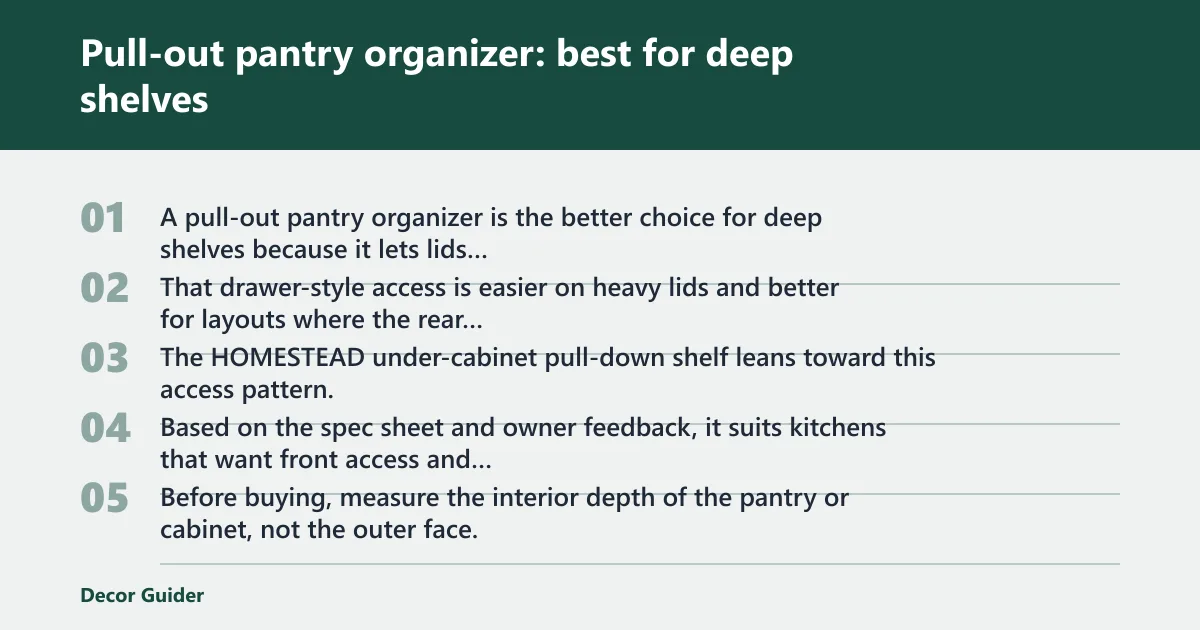
A pull-out pantry organizer is the better choice for deep shelves because it lets lids come out from the front instead of hiding in a stack at the back. That drawer-style access is easier on heavy lids and better for layouts where the rear of the pantry is hard to reach.
The HOMESTEAD under-cabinet pull-down shelf leans toward this access pattern. Based on the spec sheet and owner feedback, it suits kitchens that want front access and a compact footprint, but it is not a dedicated lid rack, so mixed cookware storage needs more attention to spacing and the weight of the items inside.
Before buying, measure the interior depth of the pantry or cabinet, not the outer face. The organizer needs enough travel space to move without hitting the door frame, and it still needs a little room at the front so lid handles do not knock into the edge on the way out.
Why deep shelves change the decision
Deep shelves hide lids fast. A stack in the back turns into a search problem, and the lid you need most often becomes the hardest one to reach. Pull-out formats fix that by moving the whole group forward in one motion.
They also reduce lid-on-lid rubbing. That matters for glass lids and polished stainless pieces, which can chip or scratch when they are dragged across hard edges.
Cabinet shelf divider: best for upper cabinets and cubbies
A cabinet shelf divider is best when the storage zone is narrow, upright, and broken into cubbies or upper-cabinet lanes. It creates separate standing channels so lids do not lean into each other and tip as soon as the door opens.
This style is the most useful answer for people with mixed lid sizes and short cabinet depth. Adjustable width matters more than a fixed rack when the cabinet opening changes from bay to bay or when the lids include both shallow and tall handles.
When this style wins
- Upper cabinets with limited depth.
- Pantry cubbies that need upright lanes instead of one open slot.
- Mixed cookware sets where one rack opening would be too narrow for large lids.
For glass lids, this style helps by separating edges before they touch. For metal lids, it reduces metal-on-metal contact. For stainless sets, the divider spacing can cut down on handle stress by keeping heavier lids from leaning on each other.
Pot and lid organizer: best for matching cookware sets
A pot and lid organizer is the best choice when the pots and lids belong together and the pantry or cabinet has enough room for both. It stores cookware by size, which helps when matching lids to pans is the bigger headache than storing the lids themselves.
The Housolution rack is the strongest option here because its adjustable dividers and expandable format fit changing cookware sets better than fixed lid-only racks. Based on the spec sheet and owner feedback, the drawback is that it can take more room than a simple lid stand, so it is a poorer fit for very shallow pantry shelves.
This style makes the most sense when the set includes cast iron, stainless, and a few oversized lids that do not sit neatly in a narrow rack. It is also useful when the kitchen wants one storage zone instead of separate lid and pan solutions.
When combined storage saves space
Combined storage works when the same organizer can hold the base pot and the matching lid without forcing either piece to stack too tightly. That reduces scattered storage, especially in smaller kitchens where every vertical inch counts.
It does not work as well for odd lid collections, warped lids, or pieces with oversized knobs that prevent clean nesting.
What size lid rack do I need for my cabinet?
The right lid rack size depends first on lid diameter and then on cabinet depth. Measure the widest lids you own, group them into small, medium, and large sizes, and then check whether the rack slots leave enough room for the handles without forcing the lids to lean or bind.
Use this fit checklist before you buy
| Pantry depth | Lid diameter range | Lid material | Access pattern | Best organizer type | Buy? |
|---|---|---|---|---|---|
| Shallow, under about 12 inches | Small to medium lids | Glass or lightweight metal | Daily grab-and-go | Vertical lid rack | Yes, if the base has non-slip support |
| Deep, about 12 inches or more | Medium to large lids | Glass, stainless, mixed lids | Front access from a full shelf | Pull-out pantry organizer | Yes, if the interior depth is measured first |
| Narrow cubbies or upper cabinets | Small to medium lids | Metal or glass | Occasional access | Cabinet shelf divider | Yes, if width is adjustable |
| Mixed-depth pantry or cookware zone | Medium to extra-large lids | Stainless, cast iron adjacent, or mixed materials | Store pots and lids together | Pot and lid organizer | Yes, if the set stays in one zone |
Simple buying filter
- Yes if the pantry shelf depth leaves finger clearance at the front.
- Yes if your lids fall into one main diameter group with only a small mix of outliers.
- Yes if the material can sit without chipping, scratching, or wobbling.
- No if the rack must hold warped lids, tall handles, and oversized pieces in the same narrow lane.
Can I store pot lids with pots and pans in the same organizer?
Yes, but only when the organizer is built for it. Pot and lid combinations work best in expandable racks or divided systems that keep the lid from scraping the pot body. If the cookware set is mixed or heavy, a single-purpose lid rack usually gives better control.
When combined storage is smart
Store pots and lids together if the set is used often, the pieces are similar in size, and the organizer can separate them without metal-on-metal contact. That setup is efficient for pantry corners, utility shelves, and larger cabinets.
Skip combined storage if the lids are mostly glass, the handles are tall, or the pot bodies are so heavy that the rack gets pulled out of alignment.
What is the best lid storage for small kitchens?
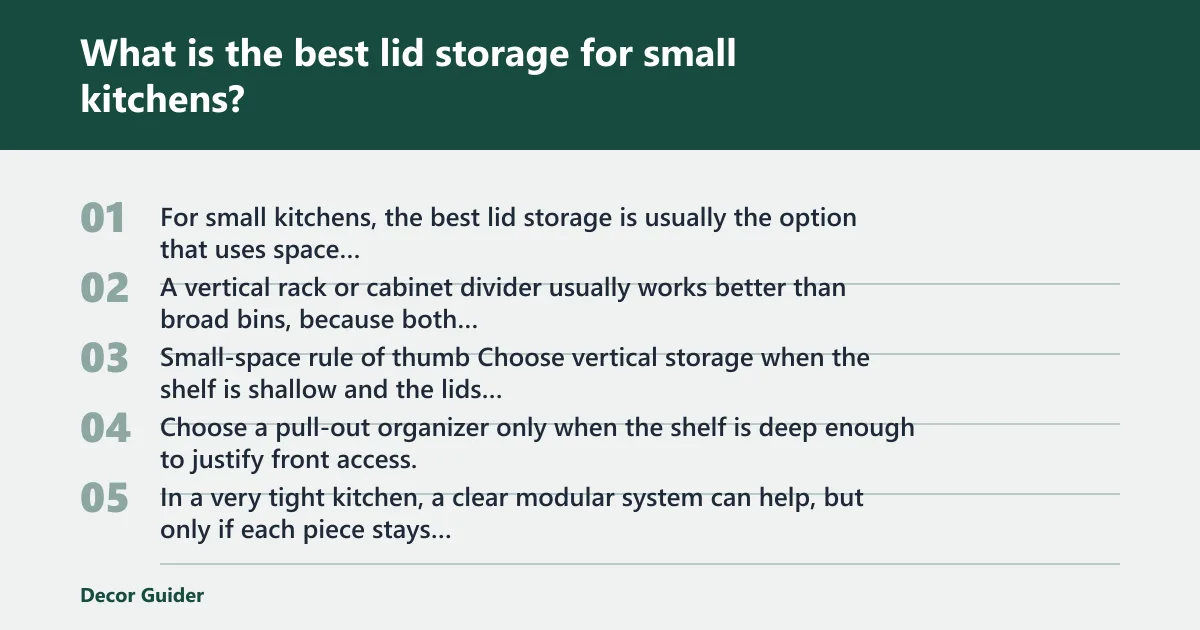
For small kitchens, the best lid storage is usually the option that uses space efficiently while keeping the lids easy to reach. A vertical rack or cabinet divider usually works better than broad bins, because both keep lids upright and visible without forcing extra stacking.
Small-space rule of thumb
Choose vertical storage when the shelf is shallow and the lids are used often. Choose a pull-out organizer only when the shelf is deep enough to justify front access. In a very tight kitchen, a clear modular system can help, but only if each piece stays easy to identify and replace.
Organizer brand collections can make sense here, especially premium pantry systems with clear bins and drawers. The Container Store’s kitchen storage categories include cookware and accessories, pantry organizers, drawer organizers, custom pantry spaces, clear bins and drawers, and turntables, which tells you the brand is built around modular kitchen storage rather than one fixed lid solution. That matters when a reader wants pieces that can be rearranged later.
How do I keep lids from scratching each other in storage?
Keep lids from scratching by separating hard edges, limiting movement, and avoiding loose stacks. Glass lids need the most care, because chips usually happen at contact points, while metal lids scratch when they slide against each other. Padding, dividers, and upright lanes all help.
Practical protection steps
- Separate lids by diameter so large lids do not press against small ones.
- Use a rack with dividers or slots instead of one open bin.
- Keep glass lids away from heavy metal lids if the organizer allows it.
- Choose organizers with non-slip pads or base support when the shelf is slick.
- Avoid stacking lids with tall handles where they can twist and rub.
How do I stop lids from sliding around in a pantry shelf?
Stop lids from sliding by giving them a fixed lane and a stable base. Non-slip pads, divider support, and an organizer that matches the shelf depth all matter. If the rack is too short or too wide, lids move when the pantry door opens and shuts.
What usually goes wrong
The most common failure case is a rack sized for the wrong shelf depth. The second is mixed lid sizes in the same slot, which leaves smaller lids loose and larger lids forced at an angle. Warped lids also slide badly because they no longer sit flat.
If a pantry shelf is deep, a pull-out organizer is usually better than a free-standing rack. If the shelf is shallow, the answer is usually better support, not more accessories.
Are pantry lid racks better than drawer dividers?
Pantry lid racks are better for upright visibility and quick access. Drawer dividers are better when the lids live in a deep drawer and need to stay low, separated, and protected from tipping. The better choice depends on access pattern, not on one style being universally superior.
How to choose between them
Use pantry racks for lids you grab often, especially in shallow shelves and upper cabinets. Use drawer dividers for backup lids, large lids, or sets that would otherwise rattle around in a deep drawer. For many kitchens, the best answer is one of each.
Which one should you buy
Buy the vertical lid rack if your pantry shelf is shallow, your lids are mostly small to medium, and you want fast access. Buy the pull-out pantry organizer if the shelf is deep and you are tired of reaching behind stacked cookware. Buy the cabinet shelf divider if the lids live in upper cabinets or cubbies and need upright lanes. Buy the pot and lid organizer if you want the cookware and lids stored together in one expandable zone.
Best pick by pantry depth
Shallow shelves point to the Z ZICOME bamboo stand. Deep shelves point to a pull-out format like the HOMESTEAD shelf. Narrow cabinet cubbies point to an adjustable divider system. Mixed cookware sets point to the Housolution expandable rack.
Best pick by lid count and diameter mix
Few lids with similar sizes fit best in a simple vertical rack. Mixed small, medium, and large lids need adjustability. Warped lids and oversized handles are a sign to avoid tight slot spacing and move toward a wider, more flexible organizer.
Best pick by budget and access frequency
If budget is tight and the lids are used daily, a basic vertical stand usually gives the best return. If access is frequent and the shelf is deep, spend more on front-access storage. If the set is large and changing, modular or expandable organizer brand collections make more sense than a fixed rack.
Frequently asked questions
What is the best way to store cookware lids in a pantry?
The best way is to match the organizer to pantry depth, lid diameter, and how often the lids are used. Vertical racks work well for daily lids in shallow spaces. Deep shelves do better with pull-out organizers. If the lids are mixed or oversized, adjustable dividers usually give the most control.
Should pot lids be stored vertically or horizontally?
Vertical storage is usually better because it keeps lids visible, easier to grab, and less likely to rub against each other. Horizontal storage makes sense for very heavy lids, bulky pieces, or drawer layouts where the lids need to lie flat. The key is choosing the orientation that fits the space without forcing the lids to shift.
What size lid rack do I need for my cabinet?
Measure the cabinet depth in inches, then compare it to the largest lid diameter you plan to store. Leave room for the handle and a little finger clearance at the front. Small and medium lids usually fit standard slots, while large lids need wider spacing and a rack with more stable support.
How do I keep lids from scratching each other in storage?
Separate them by size, keep hard edges from touching, and avoid loose stacking. Glass lids need the most protection from chips, while metal lids scratch when they slide. Racks with dividers, non-slip bases, or upright lanes reduce movement and keep lids from banging together during daily use.
Can I store pot lids with pots and pans in the same organizer?
Yes, if the organizer is designed for mixed cookware and the pieces fit without pressure. Expandable racks are useful for matched sets, especially when the pots and lids stay in one zone. It is a poorer choice for warped lids, tall handles, or heavy cookware that can throw the rack off balance.
What is the best lid storage for small kitchens?
In a small kitchen, the best lid storage usually saves depth and keeps the lids visible. Vertical racks and cabinet dividers are often better than wide bins because they reduce wasted space. If the shelf is deep enough, a pull-out organizer can work, but only when access from the front truly helps.
Products related to this article
Sponsored / affiliate links. As an Amazon Associate I earn from qualifying purchases. I may earn additional commission from eligible campaigns.