Best Cookware Protectors for Stackable Storage: we compared
The best cookware protectors for stackable storage are felt pads for most mixed cabinets. They stay thin, fit common pan sizes, and usually cost less per piece than silicone. Pick the wrong protector, and cabinets end up with scratched pans, chipped nonstick, and lids that stick together. I sort these by failure mode, so the pad matches how your pots and pans actually stack.
Quick comparison
| Product | Badge | Best for | Price | ||
|---|---|---|---|---|---|
 |
All-Clad Premium Cookware Protectors: Pot and PanAll-Clad | Our pick | 3-piece · Black/Grey · Soft Polyester | $16.99
Price as of 7 Oct 2026
|
View |
 |
Anolon Advanced Home Hard Anodized Nonstick Cookware Set,Anolon | Pair with it | 9-piece · Hard Anodized · Nonstick | $249.00
Price as of 7 Oct 2026
|
View |
 |
T-fal Premium Pot, Pan Cookware Protectors (6-Pack) forT-Fal | Also great | 6-pack · 14", 16", 18" · Polyester | $21.99
Price as of 7 Oct 2026
|
View |
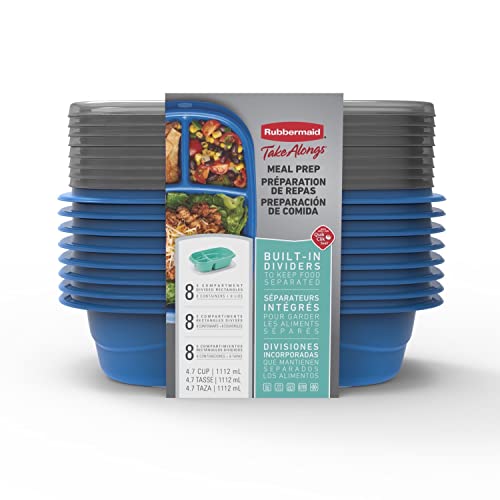 |
Rubbermaid Food Storage & Prep Containers w/Dividers, 4.7Rubbermaid | Pair with it | 8-piece · 4.7-cup · Divided | $23.98
Price as of 7 Oct 2026
|
View |
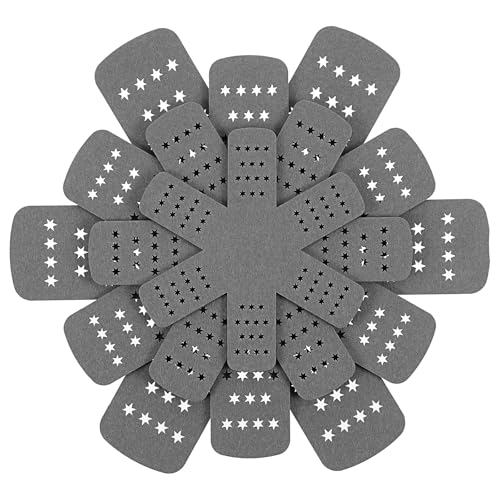 |
Elegaperma 8pcs Pan Liners for Stacking,Pot and PanElegaperma | Budget pick | 8-piece · 4 Sizes · Polyester Fiber | $6.69
Price as of 7 Oct 2026
|
View |
For most home cabinets, I start with felt. Silicone fits better when heavy pieces, hot lids, or repeated compression are the main problem.
📊 BOYAN protectors have a 4.8-star average from 13,284 verified reviews. Source: 8 Best Pan Protector Sets for Stacking Cookware (September 2026….
How we chose
The comparison below is built around four things that actually cause cabinet damage: thickness under load, rim coverage, slip control, and how well the protector fits daily stack-and-grab use.
We also weighed washability, size range, and whether a set makes sense for a mixed collection of nonstick, stainless steel, and cast iron.
Felt pan protectors: best for most stackable cabinets
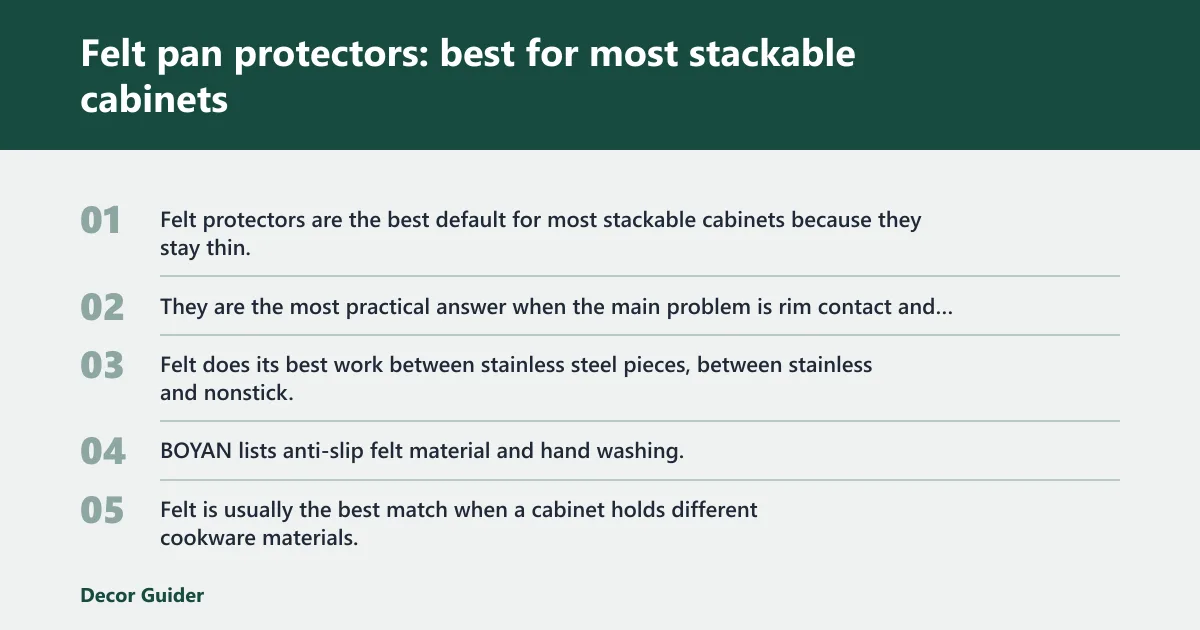
Felt protectors are the best default for most stackable cabinets because they stay thin, work across mixed cookware, and keep the stack low enough that pans still slide in and out without turning the cabinet into a wobbling pile. They are the most practical answer when the main problem is rim contact and metal-on-metal scuffing.
Felt does its best work between stainless steel pieces, between stainless and nonstick, and under lighter lids or bakeware. BOYAN lists anti-slip felt material and hand washing, which fits the typical cabinet use case better than a bulky pad that is hard to flatten inside a crowded shelf.
Why thin felt works well for mixed cookware
Felt is usually the best match when a cabinet holds different cookware materials. It cushions contact points without adding much height, so a stack of skillets, saucepans, and lids still nests cleanly. That matters in cabinets where the top pan gets used every day.
BOYAN’s 12-piece set in 3 sizes is a good example of the format that works for mixed storage, while VANWYCHEN’s 12-piece set in 3 sizes shows the same idea at a larger size spread, including 10, 14, and 15 inches.
Where felt falls short
Felt is not the strongest answer when the failure mode is compression. Heavy cast iron can flatten softer pads over time, especially if the same stack gets opened and closed all week. Felt also loses ground if the cabinet shelf is slick and the pans slide sideways before the pad can do its job.
It can also trap moisture if cookware is put away damp. That is less about the material itself and more about poor storage habits, but the failure still matters because the pad sits in the wettest part of the stack.
Best size range for 8- to 15-inch pans
For most cabinets, size the protector to the pan body, not only the marketing label. An 8-inch protector works for small saucepans and compact skillets; 10-inch and 12-inch pads cover the most common home pans; 14-inch and 15-inch sizes are better for wide skillets and larger sauté pans.
When the pan has a flared rim or a rolled edge, size up if the protector would otherwise stop on the flat base and leave the contact edge exposed. That is where edge wear starts.
Silicone pan protectors: best for heavier stacks
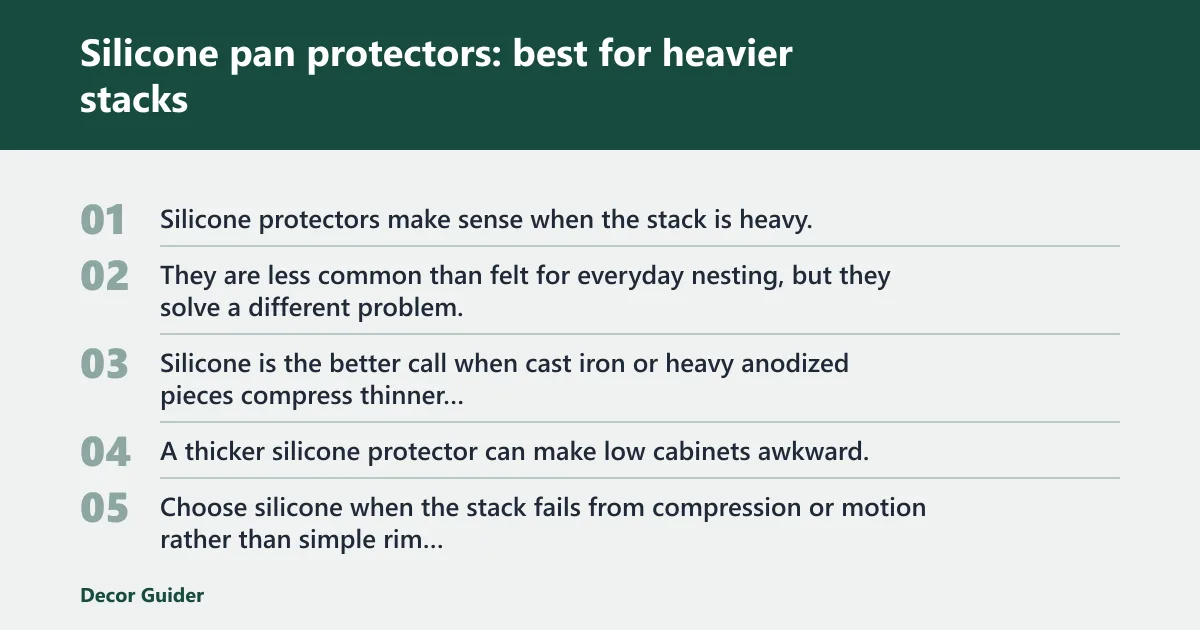
Silicone protectors make sense when the stack is heavy, the cabinet gets hot cookware more often, or you want a grippier separator that resists sliding better than plain felt. They are less common than felt for everyday nesting, but they solve a different problem.
Silicone is the better call when cast iron or heavy anodized pieces compress thinner pads too much. The tradeoff is bulk. A thicker silicone protector can make low cabinets awkward, and oversized pans may stop nesting cleanly if the pad is too stiff.
When silicone makes sense over felt
Choose silicone when the stack fails from compression or motion rather than simple rim rubbing. If a pan shifts every time the cabinet door opens, the grippier surface can help. If the cookware is hot more often, silicone also tolerates that use better than felt in some designs.
BYKITCHEN’s set of 6 uses a larger and thicker design, which points to this heavier-duty use case. The drawback is obvious: more thickness can help with cushioning, but it can also make stacking feel awkward in shallow cabinets.
Heat resistance and cleanup
Silicone is easier to wipe clean and usually handles incidental warmth better, which matters if a lid or pan goes into storage before cooling fully. Felt is more forgiving in low-profile stacks, but it needs more care if spills or condensation get into the pile.
That said, heat resistance is not the same as a license to store hot cookware. Any protector can be stressed if steam gets trapped between pans and no airflow reaches the stack.
Tradeoffs in bulk and fit
The downside of silicone is bulk. In a cabinet that already feels tight, a thicker pad can make the stack taller, not safer. It may also interfere with lids or wide rims, especially on cookware that already sits high.
For most households, silicone is a narrow answer: better for heavy pieces, less efficient for daily nesting.
Star-shaped protectors: best for extra edge coverage
Star-shaped protectors are useful when the problem is side-wall contact, not just flat-bottom rubbing. The extra points extend beyond the pan edge, so they catch rim scuffs and help slow movement when pans are pulled from a stack.
That shape matters most for shallow pans, lids, and wide-rim skillets where a round pad leaves exposed edge zones. The shape does not fix everything, but it reduces the common failure where the protector stays centered while the cookware shifts around it.
Why the shape helps with side-wall contact
A round pad mainly protects the center contact area. A star-shaped pad reaches farther up the sides, so the edge of one pan is less likely to scrape the side of the one beneath it. That extra coverage is especially useful in cabinets where pieces are lifted one-handed.
Best cookware shapes for this design
Star shapes are a strong choice for shallow frying pans, wider skillets, and mixed lid stacks. They are less necessary for deep saucepans with straight sides and limited lateral movement.
They are also a good fit when you store glass lids with cookware, since lid edges can chip if they rub the rim of a neighboring pan.
What size protector do you need?
The right size is the protector that covers the pan’s contact zone, not just its label size. Match the pad to the cookware body diameter, then size up when a wide rim, rolled lip, or flared wall would otherwise leave metal exposed at the edge.
For most home stacks, 8-inch pads fit compact saucepans and small skillets, 10-inch fits the standard daily pan, 12-inch suits larger everyday skillets, and 14- to 15-inch pads are better for oversized sauté pans and wide shallow pieces. If the pan diameter and rim diameter differ, use the larger contact area as the guide.
How rim shape changes the fit
A straight-sided pan can use a pad close to its listed size. A wide-rim skillet needs more coverage because the metal that touches another pan is not always the same as the cooking surface size.
If the rim flares outward, the edge is the first wear point. That is where a slightly larger protector pays off.
When to size up for cast iron or wide-skirt cookware
Size up when the cookware is heavy, because compression reduces pad height under load. Size up again if the pan has a broad skirt or thick lip that shifts the balance of the stack. Cast iron is the clearest case: a pad that looks fine on the shelf can flatten too much once weight is added.
Cookware protector selection matrix
| Cookware type | Cabinet access | Stack height | Scratch risk | Best material | Suggested size | Suggested thickness |
|---|---|---|---|---|---|---|
| Nonstick | Daily | Low to medium | High | Soft felt with anti-slip surface | Match pan body; often 10, 12, or 14 inches | Thin to medium, about 2–4 mm |
| Stainless steel | Daily or weekly | Medium | Medium | General-purpose felt | 10 to 15 inches, depending on skillet width | Medium, enough to block metal-on-metal contact |
| Cast iron | Weekly or occasional | Low to medium | High from compression and abrasion | Thicker felt or silicone | Usually size up one step if the rim is wide | Thicker than daily felt, with better crush resistance |
| Glass lids | Occasional | Low | High at the edge | Star-shaped felt | One size up if lid edge overhangs | Thin to medium |
| Bakeware | Occasional | Medium | Medium | Felt or silicone | Large enough to cover the base footprint | Medium |
Yes/no checklist for mixed cookware collections
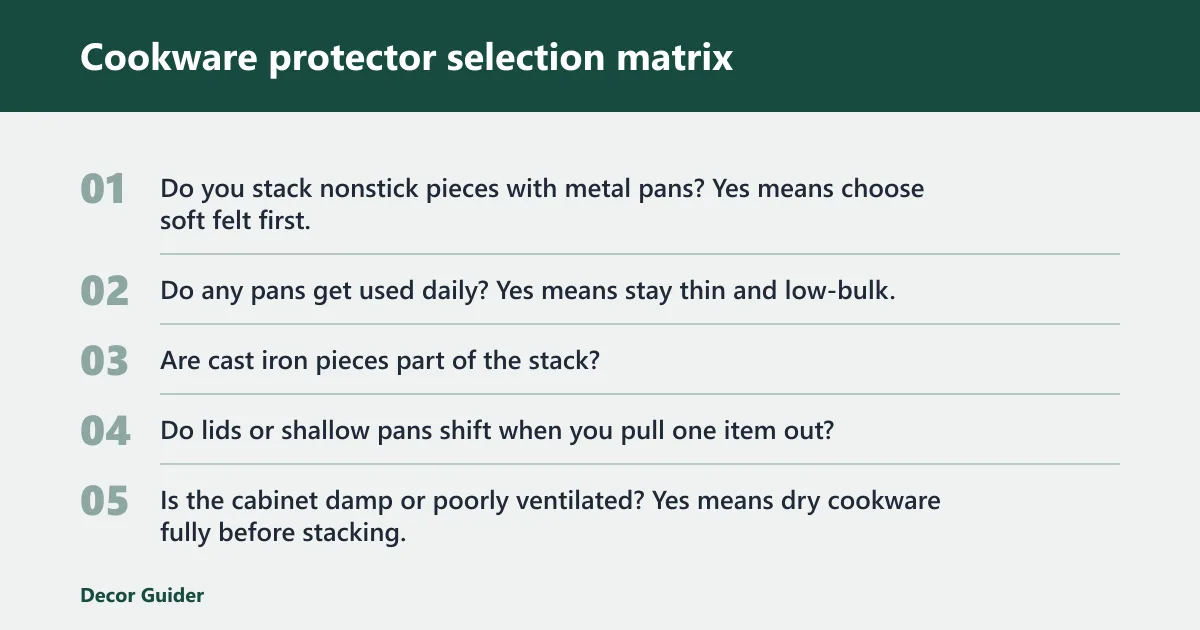
- Do you stack nonstick pieces with metal pans? Yes means choose soft felt first.
- Do any pans get used daily? Yes means stay thin and low-bulk.
- Are cast iron pieces part of the stack? Yes means move up in thickness or choose silicone for the heaviest pieces.
- Do lids or shallow pans shift when you pull one item out? Yes means look at star-shaped pads.
- Is the cabinet damp or poorly ventilated? Yes means dry cookware fully before stacking.
- Do you have a tight shelf height? Yes means avoid oversized padding that makes the stack awkward.
All-Clad Premium Cookware Protectors: best for cast iron compatibility
This 3-piece set is aimed at cooks who store cast iron, steel, or glass in the same cabinet and want a thicker, flexible polyester option. Based on the spec sheet and owner feedback, it fits the heavy-duty end of the protector market better than thin everyday pads.
The main strength is straightforward: All-Clad is described as cast iron compatible, so it makes sense when compression is the failure mode. The drawback is the set size. A 3-piece pack works for a few key pieces, but it is not the best fit for a full mixed stack.
T-Fal Premium Pot, Pan Cookware Protectors: best for larger stacks
T-Fal’s 6-pack suits households that need a simple separator for larger pans and repeat-use cabinets. Its polyester build is a practical middle ground when the goal is preventing scratches on stacked pots, pans, and stoneware without moving into bulky specialty pads.
The obvious advantage is count: six pieces give more coverage than a small starter set, and the larger formats are useful for bigger cookware. The drawback is fit flexibility. With only the listed larger sizes, it is less adaptable for compact saucepans or a cabinet full of mixed 8-inch and 10-inch pieces.
Elegaperma Pan Liners: best for mixed small-to-medium pans
This 8-piece set is a compact option for mixed cabinets that need several sizes without buying a large bundle. The four listed sizes, from 6 to 12 inches, are useful for smaller skillets, lids, and everyday pans that do not need heavy-duty cushioning.
The drawback is coverage. It is more limited for larger pans, and the lighter build is better for scratch prevention than for heavy cast iron compression. That makes it a good fit for light to medium stacks, not the toughest cabinet loads.
Which one should you buy?
If your cabinet is mostly nonstick or mixed stainless steel, start with felt. It stays low-profile, fits more cookware sizes, and is the safest default for daily stackable storage. BOYAN is a strong example of the felt approach because it uses anti-slip felt, comes in 12 pieces, and includes 3 sizes.
If your cabinet holds cast iron or unusually heavy pans, move toward thicker protection. All-Clad is the clearest match among the listed options for cast iron compatible storage, while BYKITCHEN’s larger and thicker design points in the same direction for heavier stacks.
If space is tight, avoid oversized bulk. Thin felt is usually the better answer because it protects without making the stack awkward. If you need a bigger set for a deep cabinet, a 12-piece bundle usually makes more sense than a 3-piece pack, especially when you store multiple skillets, lids, and saucepans together.
If you want the fewest pieces per purchase, buy for the number of contact points rather than the number of pans. A full set often needs separate pads for the most-used skillet, the next-largest pan, a saucepan, and one or two lids. That is why sets of 6, 12, or more are easier to live with than single-size pads.
How many cookware protectors do you need for a full set?
Most households need more protectors than they think, because every contact point in a stack needs its own separator. For a small kitchen with three to five regularly stacked pieces, a 6-pack is usually enough. For a full mixed set, a 12-piece bundle is the safer starting point.
If you store 8-, 10-, 12-, and 14-inch pans together, count the actual stacks, not the total pan count. One cabinet can burn through several pads if you keep cast iron, nonstick, and lids in the same pile.
When larger sets make sense
Larger sets make sense when the collection is mixed or when the household uses the cabinet every day. BOYAN’s 12-piece set, VANWYCHEN’s 12-piece set, and T-Fal’s 6-pack all fit different versions of that need. The right choice depends less on brand and more on how many stacks you need to separate.
For occasional use, smaller sets are fine. For daily use, buy extra. Running short is how pans end up stacked bare.
Frequently asked questions
What are the best cookware protectors for stackable storage?
Felt protectors are the best default for most stackable storage because they stay thin, work with mixed cookware, and reduce metal-on-metal rubbing without making the cabinet bulky. Silicone is better when weight and compression are the main issues, especially with heavier pans or repeated shifting.
Do pan protectors really stop scratches on nonstick cookware?
Yes, when the protector covers the actual contact point and the pans are stored dry. Nonstick is the most scratch-sensitive cookware type, so soft felt with anti-slip texture is the best general choice. Protectors cannot stop damage if pans rub around inside the stack or if moisture gets trapped.
What size pan protector do I need for my pots and pans?
Match the protector to the pan body, then size up if the rim is wide or flared. Common home sizes are 8, 10, 12, 14, and 15 inches. For cast iron or wide-skirt cookware, a slightly larger pad often protects the true edge better than a tight fit.
Are felt or silicone cookware protectors better?
Felt is better for most cabinets because it stays lower profile and works well across mixed materials. Silicone is better for heavier stacks, more slip resistance, and some heat tolerance. If the problem is compression, silicone wins. If the problem is fitting a crowded cabinet, felt usually wins.
How many cookware protectors do I need for a full set?
A small stack may need only 3 to 6 protectors, but a full mixed set often needs 12 or more. Count every place where one piece touches another. If you store different pan sizes, lids, and one or two heavy pieces, buying extra is usually safer than buying a bare-minimum pack.
How thick should a pan protector be?
For daily nesting, 2–4 mm is the practical range because it cushions contact without making stacks awkward. Heavier pans need thicker protection, especially cast iron. Thicker is not automatically better, though. In a tight cabinet, too much bulk can cause more storage problems than it solves.
Products related to this article
Sponsored / affiliate links. As an Amazon Associate I earn from qualifying purchases. I may earn additional commission from eligible campaigns.