Cookware Protector Set Cost: How Much to Pay for Sets
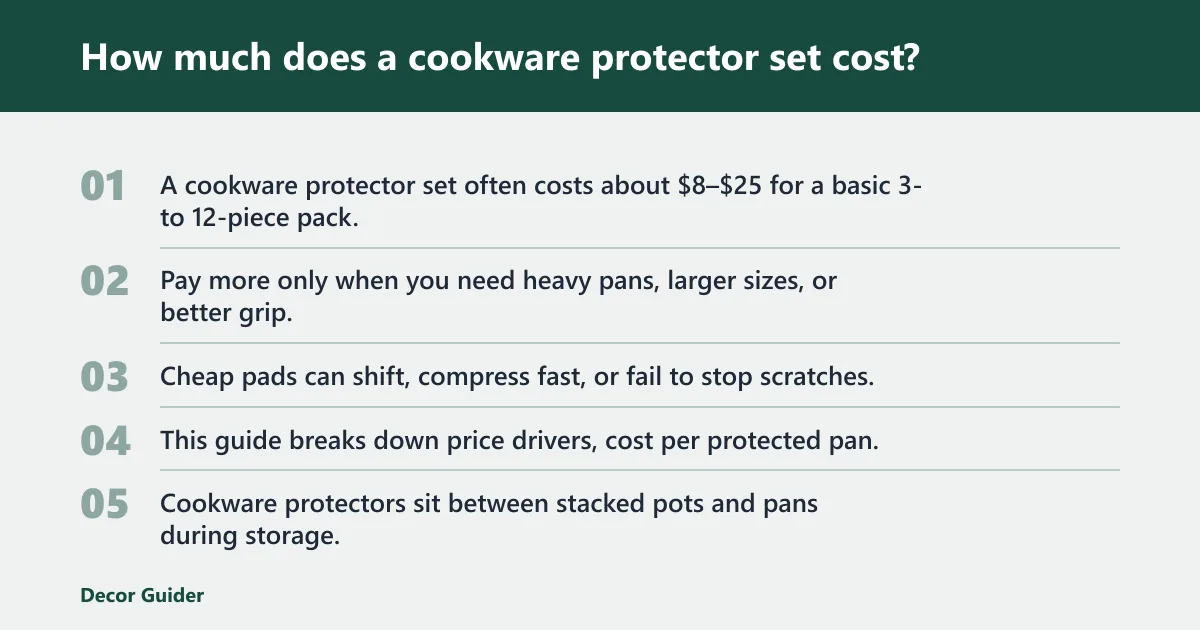
A cookware protector set often costs about $8–$25 for a basic 3- to 12-piece pack, and roughly $25–$60 for thicker felt or silicone sets. Pay more only when you need heavy pans, larger sizes, or better grip. Cheap pads can shift, compress fast, or fail to stop scratches, which shortens the life of nonstick, enamel, and cast-iron finishes. This guide breaks down price drivers, cost per protected pan, and when a low-cost set is enough.
Cookware protectors sit between stacked pots and pans during storage. That thin barrier keeps hard surfaces from rubbing together, which matters for ceramic-coated, aluminum, cast iron, and stainless steel cookware. A soft pad costs far less than replacing a scratched pan, but the cheapest set is not always the best buy for a mixed collection.
How much does a cookware protector set cost?


Why prices rise with size, thickness, and package count
Price usually rises for three reasons: more pieces in the pack, larger diameters, and thicker material. A low-cost set may cover only a few pans and use a thinner felt pad, while a branded set may include larger protectors, denser material, or a warranty. Those differences change how much protection you get per pan.
One competitor says simple cookware protectors can cost less than $5, while another stated market range for pan protectors is $10 to $25. That gap matters because the sticker price alone does not tell you how many pans the set can cover, or whether the sizes will fit your storage stack.
📊 Consumer Reports says cookware sets can include five to 15 pieces. Source: 9 Best Cookware Sets of 2026, Expert Tested and Reviewed.
What is the average price of pan protectors?
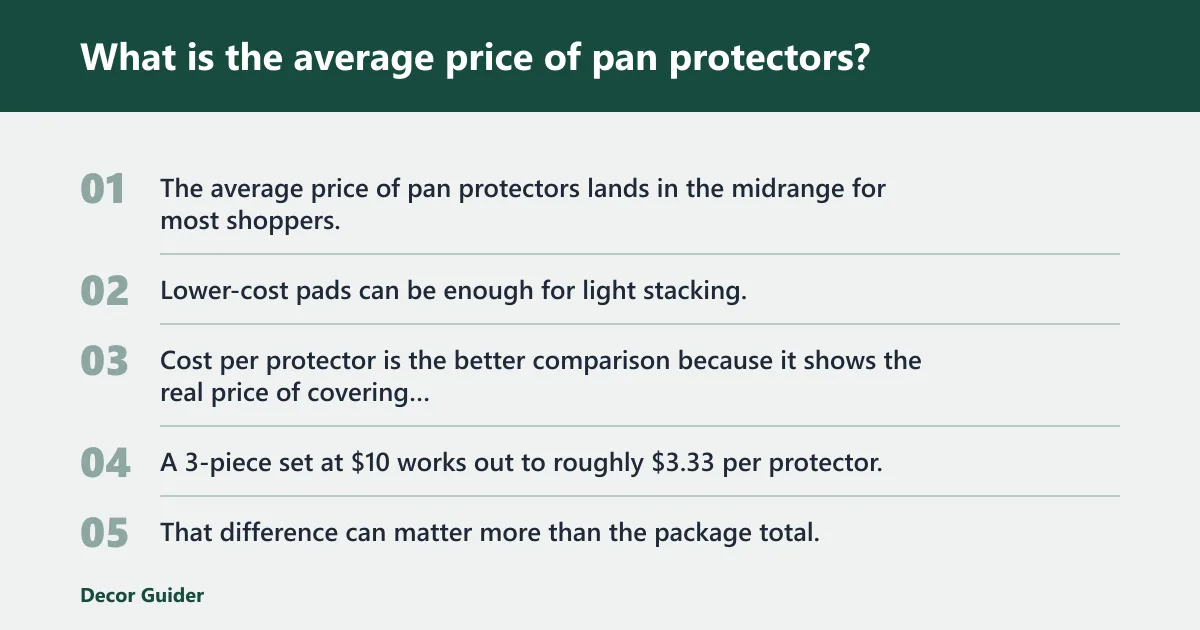
The average price of pan protectors lands in the midrange for most shoppers, around the $10 to $25 market band cited by competitor pages. Lower-cost pads can be enough for light stacking, while thicker or branded sets often cost more because they include larger sizes, denser material, or fewer fit compromises.
What you actually pay per protected pan
Cost per protector is the better comparison because it shows the real price of covering each pan. A 3-piece set at $10 works out to roughly $3.33 per protector, while a 12-piece set at $24 works out to around $2 per protector. That difference can matter more than the package total.
| Price band | Common set size | Estimated cost per protector | Best for |
|---|---|---|---|
| Less than $5 | 3-piece starter set | About $1.67 or less | Light stacks, a few small pans, short-term storage |
| $10–$15 | 3- to 6-piece set | About $1.67–$5.00 | Everyday nesting of nonstick, stainless steel, or aluminum cookware |
| $15–$25 | 6- to 12-piece set | About $2.08–$4.17 | Mixed diameters, deeper stacks, better size coverage |
| $25–$60 | Thicker felt or silicone multipack | About $2.50–$10.00 | Heavier cookware, larger pans, tighter fit, more grip |
Those figures are a practical comparison, not a universal rule. A lower set price can still be the better buy if the protectors fit your pans cleanly and you only need a few pads. A larger multipack makes more sense when you store multiple nested stacks or have several pan diameters.
When a lower set price is still the better buy
Suppose you store two 10-inch nonstick skillets and one 12-inch sauté pan. A small set with the right diameter may cost less overall than a larger multipack you will not fully use. In that case, fit beats quantity. Paying for extra pads does not help if they never touch a pan.
By contrast, a household with a full stock pot, a Dutch oven, and several frying pans may need more protectors to keep every contact point covered. In that case, a larger pack with mixed sizes is often the lower-cost choice per protected pan.
What materials are worth paying for?
Soft polyester felt or silicone is recommended as protector material. Polyester felt is the common budget choice for scratch prevention, while silicone is useful when you want a softer contact layer with more grip. The right material depends on the pan finish, the weight of the stack, and how often you move the cookware.
Polyester felt protectors for general scratch prevention
Polyester felt protectors are common because they are soft, light, and usually inexpensive. They suit everyday storage between nested pots and pans, especially for nonstick, aluminum, and stainless steel cookware. Competitor guidance also points to hand-wash only care for felt styles, which is worth checking before you buy.
Felt can be enough for many kitchens. It is often the least expensive path to basic surface protection, so it works well when your main goal is preventing contact marks rather than padding heavy stacks.
Silicone protectors and when a soft contact layer matters
Silicone protectors are also listed as a suitable material. A soft silicone layer can be useful for heavier cookware or for users who want a grippier surface between pans. That extra grip may help the stack stay aligned, which matters when you are pulling pans in and out of a crowded cabinet.
Silicone often costs more than simple felt. That is not wasted money by default. It can be worth paying for if you store cast iron, heavier enamel pieces, or larger pans that press harder against the stack.
What sizes do cookware protector sets come in?
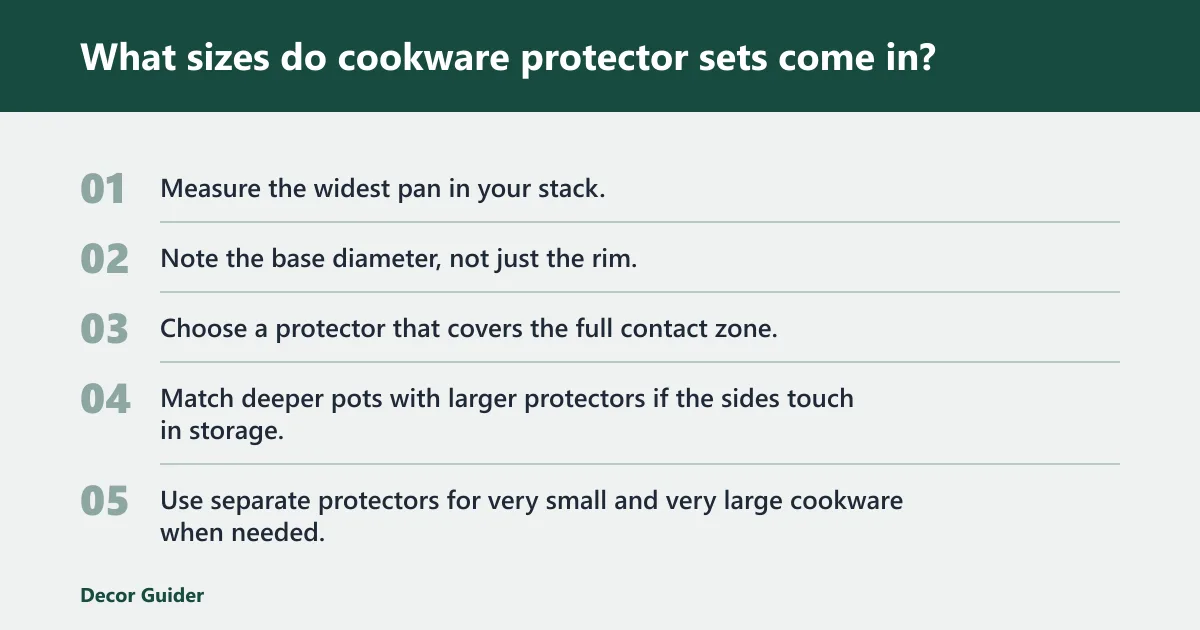
Cookware protector sets commonly come in mixed diameters, with larger options made for bigger pans and smaller options for everyday skillets. Range Kleen sells a 3-piece set in 14-inch, 16-inch, and 18-inch sizes, while All-Clad’s 3-piece set fits 4- to 6-quart cookware sets up to 14 inches.
How 14-inch, 16-inch, and 18-inch options fit nested cookware
Size matters because protectors should sit flat under the pan base and cover the contact area without bunching. A 14-inch protector is a better match for many standard pans, while 16-inch and 18-inch options are useful for larger skillets, stock pots, and wide Dutch ovens.
A common first-timer mistake is choosing a low-priced cookware protector set that only fits a single skillet, then needing to buy another set for the stockpot and Dutch oven. That can leave gaps under larger cookware or create extra material that folds and shifts under smaller pans. Mixed sets are usually the safer pick for mixed cookware collections.
Choosing a size for mixed pot and pan diameters
- Measure the widest pan in your stack.
- Note the base diameter, not just the rim.
- Choose a protector that covers the full contact zone.
- Match deeper pots with larger protectors if the sides touch in storage.
- Use separate protectors for very small and very large cookware when needed.
Depth matters too. Two pans with the same top diameter may still need different protection if one has taller sides or a flared rim. If the stack leans, the protector can slide away from the point of contact. A better size match keeps the layer where it belongs.
Are cookware protectors worth buying for stackable storage?
Yes, cookware protectors are usually worth buying if you stack pots and pans, because they add a low-cost barrier between surfaces and reduce contact damage. They are especially useful when you store ceramic-coated, aluminum, cast iron, or stainless steel cookware together in tight cabinets.
Best fit for ceramic-coated, aluminum, cast iron, and stainless steel cookware
Ceramic-coated cookware benefits from padding because surface wear can show quickly. Aluminum and stainless steel can pick up scuffs from repeated contact. Cast iron is less about visible scratching and more about keeping pieces from rubbing against seasoning or enamel surfaces nearby.
Protectors can save cookware surfaces from rust and corrosion, but they do not stop every kind of damage. They reduce rubbing and surface contact. They do not fix chips, dents, or poor storage conditions that leave cookware damp.
When protectors cost less than replacing scratched cookware
A small pack of protectors is usually far cheaper than replacing a scratched nonstick pan or an enamel piece with visible wear. For most home cooks, the better comparison is not protector price versus nothing. It is protector price versus the cost of shortening a pan’s usable life.
Picture a 12-inch nonstick sauté pan stacked under a heavy Dutch oven with no pad in between. The finish can pick up marks fast, and the contact point often shows first. A protector is a small purchase that helps avoid that kind of wear during storage.
What brands make cookware protectors?
Common brands include All-Clad and Range Kleen. All-Clad offers a 3-piece cookware protector set made of polyester, and it fits 4- to 6-quart cookware sets up to 14 inches. Range Kleen also sells a 3-piece set and includes 14-inch, 16-inch, and 18-inch sizes.
All-Clad Textiles cookware protectors
All-Clad Textiles cookware protectors are a polyester 3-piece set. The stated fit for 4- to 6-quart cookware sets up to 14 inches makes them a straightforward choice for medium-size pots and pans. That clear sizing can simplify shopping if your collection is fairly standard.
Range Kleen cookware protectors
Range Kleen’s cookware protector set covers a wider size spread with 14-inch, 16-inch, and 18-inch options. It also comes with a one-year warranty. That kind of package may suit larger collections or kitchens that store both everyday pans and bigger stock pots.
| Example brand | Set size | Material | Size notes | Value cue |
|---|---|---|---|---|
| All-Clad Textiles | 3-piece | Polyester | Fits 4- to 6-quart cookware sets up to 14 inches | Good for standard medium cookware |
| Range Kleen | 3-piece | Protector material not specified in the sourced facts | 14-inch, 16-inch, and 18-inch sizes | Better for mixed diameters and larger pieces |
How do I choose the right protector size for my pots and pans?
Choose the protector size by matching the pan’s base diameter and stack depth, not just the top rim. The safest choice is a protector that covers the contact area under the pan without folding or hanging far over the edge. Mixed collections usually need more than one size.
Stack fit, diameter, and depth profile
Start with the widest pan you store. Then check whether the base is flat enough for the protector to sit evenly. If a pot has a narrow base and flared sides, a large round pad may waste material at the edges. If the base is wide, a small pad may leave contact points exposed.
Consumer Reports notes cookware sets can include five to 15 pieces, and a 12-piece set may count lids as pieces. That is why protector sizing should be based on the cookware you actually need to stack, not just the number printed on the box.
How should you care for cookware protectors?
Wipe protectors with a damp cloth unless the product guidance says something different. They are not safe in a dishwasher or washing machine, and competitor guidance also says some polyester felt protectors are hand-wash only. Check the package before cleaning to avoid shrinking or misshaping the pad.
Wipe-clean care versus hand-wash guidance
For routine care, a damp cloth is the safest general choice. That works well for dust, light residue, or crumbs that collect in storage. If the protector picks up grease or food residue, follow the care note on the package rather than assuming all felt or silicone pads can be machine cleaned.
Do not treat all protectors the same. A felt pad may need gentle hand washing, while a silicone version may have different care limits. The label matters more than the material name alone.
Frequently asked questions
How much does a cookware protector set cost?
A cookware protector set usually costs less than $5 at the low end for simple protectors, while the broader market range cited by competitors is $10 to $25. Thicker felt or silicone sets can cost more, especially when you pay for larger sizes, more pieces, or branded packaging.
What is the average price of pan protectors?
The average price of pan protectors is commonly in the $10 to $25 range. That band is broad because set size, thickness, and diameter all change the cost. A 3-piece set can look cheap on the shelf but cost more per protector than a larger multipack.
Are cookware protectors worth buying for stackable storage?
Yes, especially if you stack ceramic-coated, aluminum, cast iron, or stainless steel cookware. Protectors are a low-cost way to reduce contact damage between nested pans. They are most useful when you store cookware in tight cabinets and move the stack often.
What sizes do cookware protector sets come in?
Cookware protector sets commonly come in 14-inch, 16-inch, and 18-inch sizes, and some sets are sized for cookware up to 14 inches. The right size depends on the pan’s base diameter and depth profile. Mixed collections usually need more than one protector size.
What material is best for pan protectors, felt or silicone?
Polyester felt is the common budget pick for general scratch prevention, while silicone is a good option when you want a softer contact layer with more grip. Felt is often enough for everyday storage. Silicone can be worth paying for when cookware is heavier or more tightly stacked.
How many protectors are usually included in a set?
Many cookware protector sets come as 3-piece packs, including examples from All-Clad and Range Kleen. Larger multipacks are also common. The best number depends on how many pans you stack and whether your cookware collection includes multiple diameters or a few oversized pieces.
Products related to this article
Sponsored / affiliate links. As an Amazon Associate I earn from qualifying purchases. I may earn additional commission from eligible campaigns.