Nonstick Pan Repair Kit Cost: How Much You Should Pay
A nonstick pan repair kit often costs in the low tens of dollars; if repair plus shipping starts to approach half the price of a new pan, replacement is usually the smarter buy. Ignoring flaking, warped, or deeply scratched coatings can waste money on a fix that won’t hold, and leave you with poor food release and harder cleanup. This guide breaks down kit prices, what they can realistically fix, and the damage levels where repair stops making financial sense.
This guide is part of our Cast iron skillet care guide series.
How much does a nonstick pan repair kit cost?
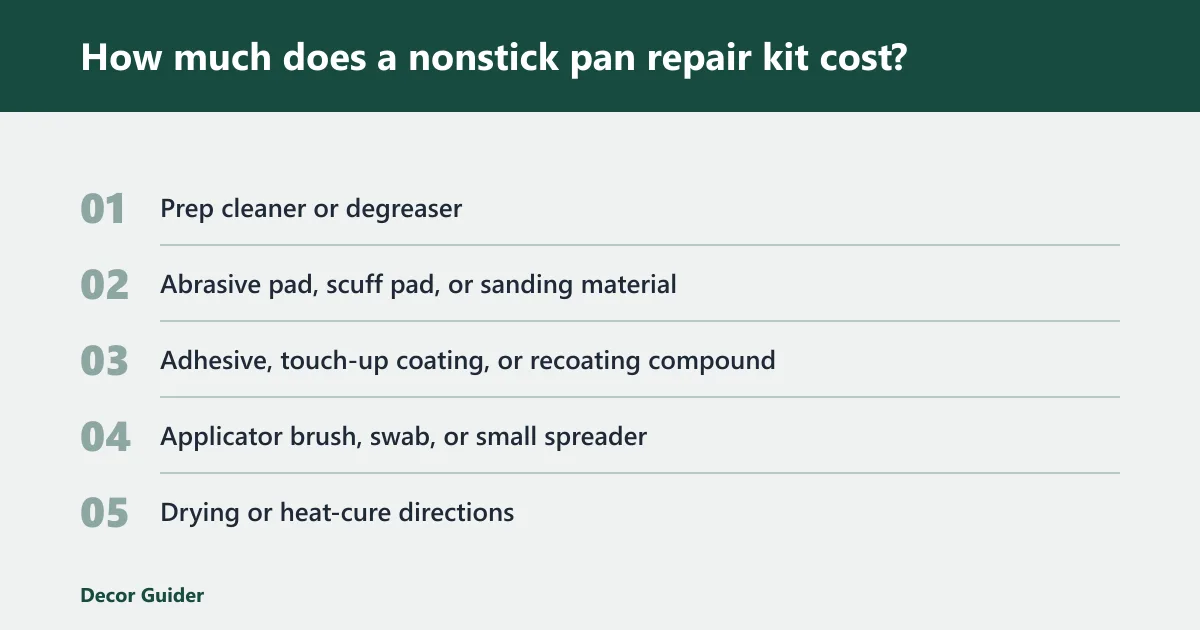


A nonstick pan repair kit usually falls in the $10 to $30 range, with the final price shaped by coating material, included prep items, and whether the kit needs heat curing or a long drying step. The true cost rises once you count shipping, surface prep, and the time the pan stays out of use.
What changes the price
Basic kits are simple. They may include a cleaner or degreaser, a scuff pad, a small amount of coating or adhesive material, and an applicator. More complete kits add masking tape, sanding pads, or curing directions that call for an oven or a long air-dry period.
Price rises when the kit is made for a specific coating type. A PTFE-based surface, which is the chemistry behind many modern nonstick pans and is better known by the Teflon name, may need different prep than a ceramic nonstick surface. Compatibility matters more than a glossy package.
What is usually included in the box
- Prep cleaner or degreaser
- Abrasive pad, scuff pad, or sanding material
- Adhesive, touch-up coating, or recoating compound
- Applicator brush, swab, or small spreader
- Drying or heat-cure directions
The box may also include gloves, wipes, or surface-protection sheets. Good Housekeeping says some cookware comes with protectors to prevent scratching in storage, and that idea matters here too: the repair only helps if the pan stops taking new damage during storage and use.
Hidden costs: prep time, drying time, and heat-cure steps
The hidden cost is labor time. A repair can take under an hour of hands-on prep, but curing or drying can stretch into several hours or a full day. During that time, the pan is out of service, and the finish may still not match factory performance.
A common first-timer mistake is to treat the repair as instant. It is not. If the directions call for heat cure, that may require an oven-safe pan and strict temperature control. If the pan cannot tolerate the cure step, the kit loses value immediately.
📊 Nonstick coatings can lose performance if overheated beyond about 260°C. Source: Non-stick surface.
What can a repair kit actually fix?
A repair kit can sometimes slow cosmetic wear, but it cannot restore a badly worn cooking surface to original condition. Minor scratching may be manageable if the coating still releases food and the base metal is not exposed. Peeling, flaking, and warping are different problems, and repair value drops fast.
Scratch-only wear versus coating failure
Scratch-only wear is the best-case repair scenario. If the surface still looks intact and food release remains mostly normal, a kit may buy limited extra time. That is very different from a pan that has lost its release layer and needs more oil for eggs or fish than a nonstick pan should.
Once the coating starts to flake, the pan moves from “maybe repairable” to “usually replace.” Exposed base metal, bubbling, or peeling means the finish is failing structurally. At that point, a touch-up product may cover the symptom, not the problem.
Why warped pans are usually a replacement case
Warping is not a coating problem. It is a shape problem, usually tied to heat stress, thin construction, or repeated thermal shock. A repair kit cannot flatten the base or restore even contact with a burner.
That matters because a warped pan cooks unevenly. Eggs slide to one side, oil pools in the low spot, and heating becomes less predictable. Even a low-priced repair kit is wasted if the pan no longer sits flat.
Hypothetical examples
Say your 10-inch pan has a few gray marks from a metal whisk, but water still beads and eggs release with a little oil. That is the kind of cosmetic wear where prep and touch-up may be worth considering, especially if the pan was expensive.
Suppose a 12-inch skillet has flakes around the center and rough patches near the rim. That pan has crossed into coating failure. A kit may hide the damage for a short time, but it will not solve the release problem or restore a stable cooking surface.
Is it cheaper to repair a nonstick pan or replace it?
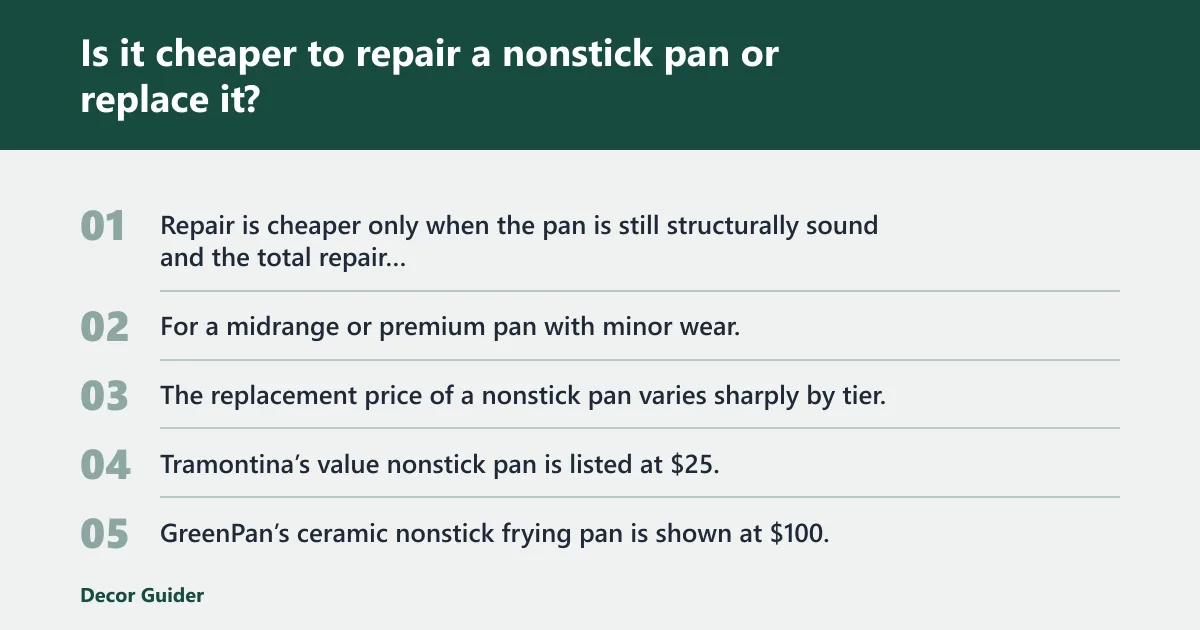
Repair is cheaper only when the pan is still structurally sound and the total repair cost stays well below the price of a comparable replacement. For low-cost pans, replacement usually wins. For a midrange or premium pan with minor wear, repair can make sense if the coating is still performing.
Budget, midrange, and premium replacement price bands
The replacement price of a nonstick pan varies sharply by tier. Tramontina’s value nonstick pan is listed at $25. GreenPan’s ceramic nonstick frying pan is shown at $100. The Made In Ceramiclad pan costs $139. Those three prices show how wide the gap can be.
Set pricing changes the math again. Good Housekeeping lists a T-fal 12-piece nonstick set at $110, while Food Network says one T-fal set includes a 10.25-inch griddle. A set may look cheap per piece, but replacing one pan inside a set is rarely as simple as buying that one pan alone.
Single pan versus set replacement costs
If the damaged pan is part of a matched set, replacement may force a choice: buy a single like-for-like pan or replace the whole set for consistent handles, lids, and coatings. That decision often pushes repair farther down the list for lower-priced sets.
For a premium single pan, the repair case is stronger. A $10 to $30 repair kit on a $100 to $139 pan is easier to justify than the same kit on a $25 pan. The price ceiling is simple: once repair plus shipping approaches half the cost of a comparable new pan, replacement is usually smarter.
Repair-vs-replace cost table by damage type
| Damage type | Repair kit cost | Labor/time cost | Replacement threshold |
|---|---|---|---|
| Scratch-only | $10 to $20 | 30 to 60 minutes plus drying | Repair can make sense if the pan costs $60 or more |
| Flaking coating | $15 to $30 | 1 to 2 hours plus cure time | Replace if a comparable pan costs under $100 or if flaking is visible |
| Warped pan | $10 to $30, but usually not useful | 1 to 2 hours wasted in most cases | Replace regardless of price if the base no longer sits flat |
This table is the practical cutoff: scratch-only wear may justify a low-cost kit on a better pan, but flaking and warping almost always push the decision toward replacement. The worse the damage, the less value the repair has.
What affects coating durability after repair or replacement?
Coating durability depends on heat, utensils, cleaning method, and the pan’s construction. Nonstick coatings can lose performance if overheated beyond about 260°C. If the coating has already been stressed by heat and metal tools, a repair has less chance of lasting.
Heat limit and low-to-medium heat use
Most nonstick cookware works best at low to medium heat. High heat shortens coating life, and oven use depends on the pan’s rating. The GreenPan Valencia Pro is oven-safe up to 600°F, while Food Network says Made In’s ceramic nonstick pan is oven safe to 550°F. Those figures matter if a repair kit requires heat cure.
Match the cure step to the pan’s oven-safe rating. A repair that needs heat the pan cannot safely handle is not a repair option at all.
Metal utensil risk and scratch resistance
Metal utensils can cut a soft coating, even when the damage looks minor at first. That is true for PTFE-based surfaces and for ceramic nonstick interiors. The scratch resistance of a repaired surface is usually lower than the original factory finish, so the margin for abuse gets even smaller.
Use of silicone, wood, or nylon tools is not a luxury here. It is part of whether the repair pays back at all.
Dishwasher sensitivity and expected lifespan
Dishwasher use is usually tied to a shorter nonstick lifespan, and repaired coatings are usually more sensitive than new ones. A repaired finish may last only if care stays gentle, heat stays moderate, and the pan is cleaned by hand with nonabrasive tools.
That is why “how long will it last?” is a money question, not only a performance question. If a repair buys only a few weeks of decent release, the effective cost per month can exceed the cost of replacement.
Do pan materials change the repair decision?
Yes. The body material affects whether the pan is worth fixing and whether the surface can take a repair process. Aluminum bodies are common because they heat quickly and keep weight down. Stainless steel exteriors often appear in clad pans. Ceramic nonstick and PTFE-based surfaces each fail in different ways.
Aluminum body with nonstick interior
An aluminum pan with a PTFE or ceramic interior is common in budget and midrange cookware. The body is usually not the problem; the coating is. If the base is straight and the interior damage is limited, repair may buy time on a pan that still heats evenly.
Stainless steel exterior and bonded layers
Bonded or clad pans with stainless steel outside are often more expensive, so replacement costs are higher. That can improve the repair case for minor wear. But if the pan has separated layers, warping, or severe loss of release, the higher price does not rescue the repair value.
Ceramic nonstick versus PTFE-based coatings
Modern nonstick pans often use PTFE, better known as Teflon. Ceramic nonstick is a different surface type, often marketed as a less chemical-heavy option. Neither is immune to heat or abrasion, and neither becomes truly “like new” after a home repair.
GreenPan’s ceramic nonstick frying pan is shown at $100, which places ceramic in a range where repair may seem tempting. But if the surface is already losing release, the repair kit still has to beat the value of a new pan, not just the value of the coating material.
When should you stop repairing and buy a new pan?
Stop repairing when the pan is warped, the coating is peeling, or the total cost of repair gets close to half the cost of a comparable new pan. Age matters too. If the pan sees daily use and the coating has already broken down from heat or utensils, replacement usually gives better value.
Age of the pan and frequency of use
Budget cookware may need replacement after a few years, especially with regular use. A pan used for eggs every morning will age faster than one used occasionally. The more often it is heated and washed, the less likely a repair will hold for long.
Loss of food release performance
Food release is the core job of a nonstick pan. If eggs stick even after proper preheating and a small amount of fat, the surface has likely moved past practical repair. Once cleanup takes effort again, the original reason for keeping nonstick cookware is gone.
Food safety and value cutoff
Visible flaking, deep peeling, or exposed base metal raises concern beyond convenience. At that stage, the pan is no longer just inconvenient; it is poor value. Repair also makes little sense if the pan costs less than the time and materials needed to restore it.
A clear rule is useful: repair only when the pan is structurally sound, the surface damage is limited, and the total repair cost stays well below 50% of a comparable replacement. For a $25 pan, that cutoff is very low. For a $100-plus pan, the math is more forgiving.
Frequently asked questions
How much does a nonstick pan repair kit cost?
A nonstick pan repair kit usually costs $10 to $30. The total can rise with shipping, extra prep supplies, or a kit made for a specific surface type. If the pan is low-cost, that price can be too close to replacement to make sense.
Is it cheaper to repair a nonstick pan or replace it?
It is cheaper to repair only when the pan is still in good shape and the repair cost stays well below the cost of a comparable new pan. For a $25 pan, replacement usually wins. For a $100 to $139 pan with minor wear, repair may be worth trying.
What comes in a nonstick pan repair kit?
Most kits include a cleaner or degreaser, an abrasive pad or scuffing tool, some form of coating or adhesive material, an applicator, and drying or heat-cure directions. Some also include gloves or surface-protection items for prep and storage.
Can you fix a scratched nonstick coating at home?
You can sometimes improve the look of minor scratches at home, but you usually cannot restore factory performance. If the surface still releases food and the scratch is only cosmetic, a kit may be worth considering. If the coating is peeling or flaking, home repair is a poor bet.
How long does a repaired nonstick coating last?
A repaired nonstick coating usually lasts less time than the original factory finish. Lifespan depends on heat, utensil choice, cleaning method, and whether the pan is used at low to medium heat. If release performance drops again quickly, replacement is the better value.
When should I stop repairing and buy a new pan?
Stop repairing when the pan is warped, flaking, or losing release over the whole cooking surface. Also stop if the repair cost plus shipping reaches about half the price of a comparable new pan. At that point, replacement is the more sensible choice.
Products related to this article
Sponsored / affiliate links. As an Amazon Associate I earn from qualifying purchases. I may earn additional commission from eligible campaigns.
 NMOWYBPY Wood Scratch Repair Paint Pen for Floor, Table, Chair & Door, Dry Water Furniture Touching Up Markers, Core Hardware Restores, 1Pc
 Linen Canvas Repair Tape, 4 x 63 in Dark Gray Waterproof Self-Adhesive Patch for Outdoor Gear, Durable and Weatherproof Fabric Tape for Boat Covers, Tents, Sofas, Sun Shades, Awnings and Lounge Chairs