Stainless Steel Scrubber vs Copper Scrubber
Use copper scrubbers on bare stainless steel or cast iron for heavy carbon. Stainless steel scrubbers are tougher, but both can damage nonstick, enamel, aluminum, and copper cookware if the finish is thin or coated. The safer choice depends on the pan surface, the residue, and the scrubber’s actual material.
Decision factors and comparisons between scrubber types
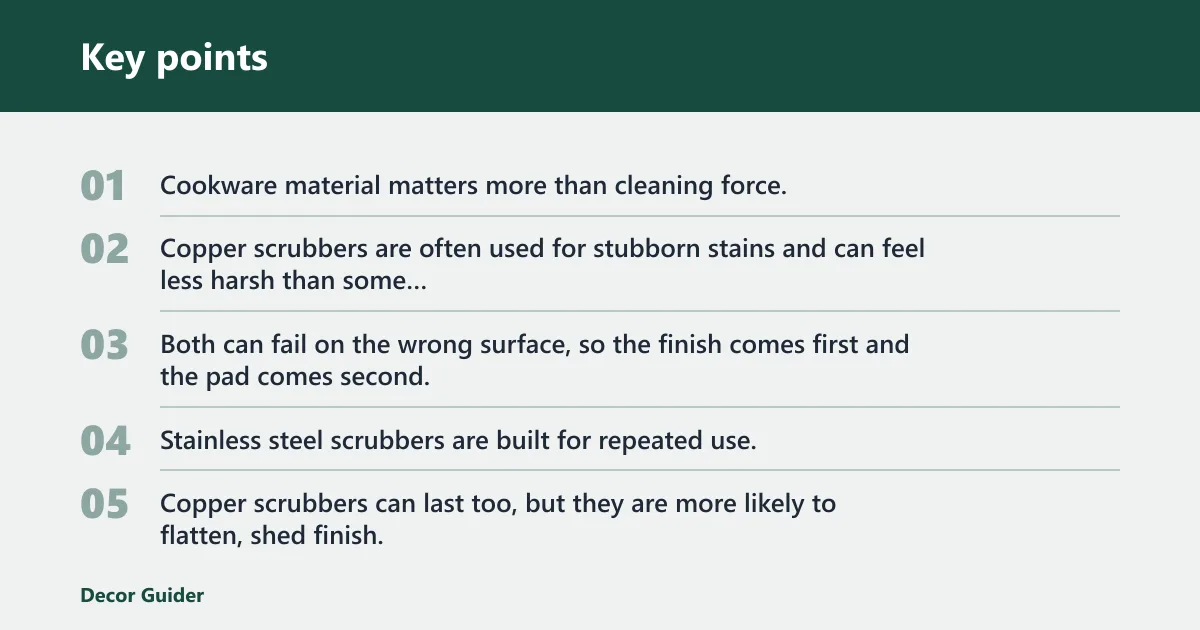
Cookware material matters more than cleaning force. Copper scrubbers are often used for stubborn stains and can feel less harsh than some steel meshes, while steel scrubbers are usually more durable. Both can fail on the wrong surface, so the finish comes first and the pad comes second.
| Decision factor | Steel Scrubber | Copper Scrubber | Winner |
|---|---|---|---|
| Durability | Very durable; commonly rated excellent for durability | Good, but typically wears faster and needs more care | Steel Scrubber |
| Stain removal | Strong on baked-on residue | Commonly rated excellent for stain removal | Copper Scrubber |
| Corrosion behavior | Stainless steel resists rust and corrosion well, but abrasion can change the finish and expose embedded residue on some surfaces | Can react with acidic cleaners like vinegar | Steel Scrubber |
| Surface scratch risk | High on delicate coatings and polished finishes | Still risky on delicate coatings, but often felt as a gentler metal pad | Tie |
| Maintenance | Easy to clean; dries well | Needs regular cleaning and drying | Steel Scrubber |
| Best fit | Bare stainless steel, cast iron, tough metal surfaces | Stainless steel cookware with stubborn carbon, when the pad is verified as real copper | Tie |
| Safe on polished stainless | Use only with caution; finish marking is the main risk | Use only with caution; can still dull a mirror finish | Tie |
| Safe on nonstick or enamel | No | No | Neither |
| Best alternative tool | Nylon pad, soft sponge, or nonabrasive cleaner | Nylon pad, soft sponge, or nonabrasive cleaner | Soft tool |
Durability
Stainless steel scrubbers are built for repeated use, and that matters when you clean pans with stuck-on grease or soot. Copper scrubbers can last too, but they are more likely to flatten, shed finish, or show wear faster if they stay wet or are used on rough residue.
Stain removal
Copper scrubbers are often described as better at removing stubborn stains and grime. That makes them useful for carbon marks on bare cookware. The trade-off is simple: stronger stain removal does not mean safe use on every surface, especially coatings or polished finishes.
Corrosion and cleanup
Stainless steel is generally corrosion-resistant, which is why it is common in cookware. Copper can react with acidic cleaners such as vinegar or citrus and can dull or darken over time. That makes copper more dependent on drying, rinsing, and avoiding harsh acidic soaks.
Scratch risk
Both materials can scratch delicate surfaces. Nonstick coatings are especially sensitive, and enamel can dull or chip if the edge is aggressive. The safer choice depends on the pan finish and the cleaning job, not on package language or marketing claims.
Best-fit use cases
Steel scrubbers fit tough, bare surfaces where durability matters more than a soft touch. Copper scrubbers make more sense when you want metal-on-metal cleaning with a slightly gentler feel and you have confirmed the cookware can take it. On coated cookware, neither is the right default.
Copper scrubber vs stainless steel scrubber
Copper scrubbers are often made from copper fibers or copper-plated strands, and some blends may use a core metal with a copper finish. Stainless steel scrubbers are made from stainless steel wire or mesh. The build changes how they wear, how they react to moisture, and how much residue they can leave behind.
Copper also has antimicrobial claims associated with copper surfaces, but that does not make it automatically safe for cookware finishes. Stainless steel is usually easier to rinse, dry, and store, while copper needs more attention to confirm it is real copper rather than a plated imitation.
Material makeup
A copper scrubber may be solid copper, plated, or blended with another metal. That matters because a plated pad can shed coating over time. A stainless steel scrubber is usually a wire mesh made for rough cleaning and repeated reuse, though the exact weave and wire thickness affect how abrasive it feels.
Corrosion, oxidation, and residue transfer
Copper can oxidize and change color. That patina is normal, but acidic cleaners such as vinegar or citrus can accelerate the reaction and leave the pad looking dull sooner. Stainless steel is less reactive, so the bigger risk is usually finish wear or residue transfer from the pad, not the metal corroding in normal use.
Noise, feel, and maintenance
Stainless steel scrubbers can be noisy on glass or ceramic. Copper often feels a bit softer in hand, but it still needs regular cleaning and drying. If you leave either pad damp, grime can build up and the pad can start to drag instead of scrub, which reduces cleaning efficiency.
Cookware-safe scrubber decision table
This table focuses on safety by cookware type, not cleaning strength alone. If a surface is scratch-sensitive, the safest scrubber is usually no metal scrubber at all. Use the “avoid” column as the hard stop.
| Cookware material | Recommended scrubber | Safe? | Why | Failure mode | Best alternative tool |
|---|---|---|---|---|---|
| Polished stainless steel cookware | Steel Scrubber or Copper Scrubber only for stubborn carbon on bare steel | Conditional | Can handle more abrasion than coated pans, but the finish shows marks easily | Dulling, scratching, visible streaks, residue haze | Nylon pad, soft sponge, or stainless-safe cleaner |
| Brushed stainless steel cookware | Steel Scrubber for heavy residue; Copper Scrubber for lighter metal-on-metal cleaning | Conditional | More forgiving than polished steel, but the grain can still show wear | Directional scratching, finish flattening, residue transfer | Nylon pad or nonabrasive cleanser |
| Seasoned cast iron | Steel Scrubber for stuck carbon; soft brush for routine care | Conditional | Seasoning can be preserved if the cleaning is targeted and brief | Seasoning removal if the scrub is too aggressive | Brush, chainmail-safe cleaner, or hot water and a scraper |
| Bare cast iron | Steel Scrubber for heavy buildup | Yes | Bare iron is the most abrasion-tolerant cast-iron surface | Surface roughening if over-scrubbed | Stiff brush or coarse salt scrub |
| Enameled cast iron | Soft sponge or nonabrasive pad | No for metal scrubbers | Enamel can dull, scratch, or chip when abraded | Chipping, dull spots, visible marks | Nonabrasive sponge and mild detergent |
| Anodized aluminum | Soft sponge or nonabrasive pad | Usually no for metal scrubbers | The anodized layer can be marred, and darkening may be permanent | Surface marring, loss of uniform color, premature wear | Soft sponge, nylon pad, or aluminum-safe cleaner |
| Copper cookware | Soft cloth, nonabrasive pad, or copper-safe polish | Usually no for metal scrubbers | Metal pads can scratch the finish or alter the patina | Scratches, uneven shine, finish loss | Microfiber cloth or copper polish |
| Nonstick cookware | Soft sponge or nylon pad | No | Nonstick coatings scratch very easily and lose performance once damaged | Coating wear, peeling, shortened pan life | Soft sponge and mild dish soap |
Stainless steel cookware
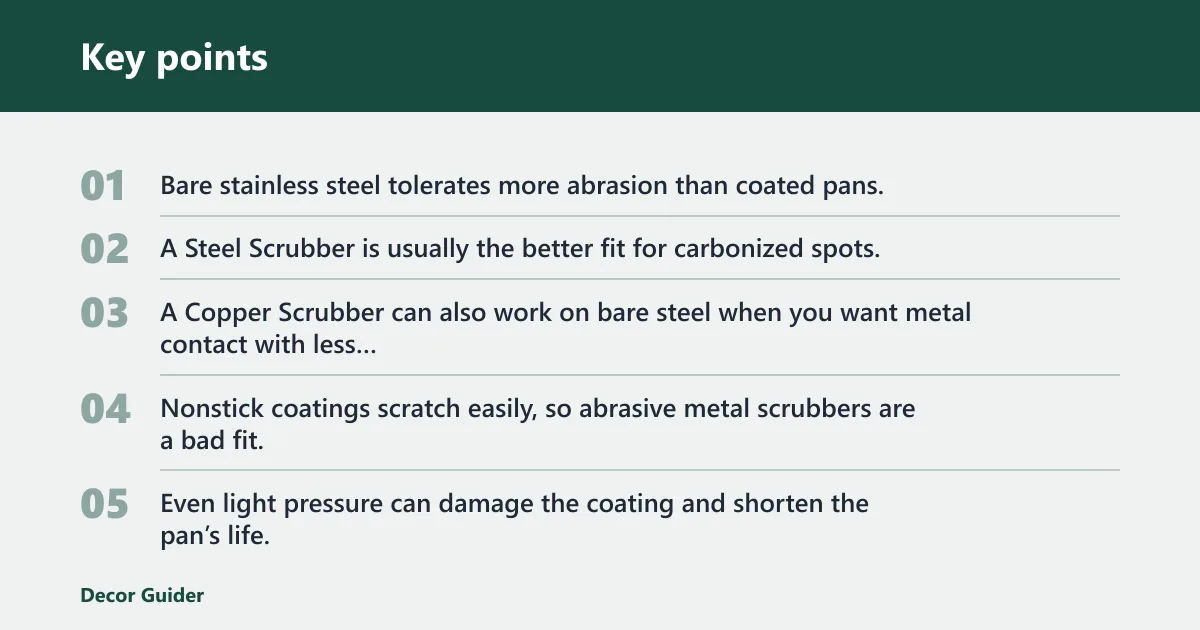
Bare stainless steel tolerates more abrasion than coated pans, so this is the most flexible category. A Steel Scrubber is usually the better fit for carbonized spots. A Copper Scrubber can also work on bare steel when you want metal contact with less harsh feel, but polished finishes need caution.
Nonstick cookware
Nonstick coatings scratch easily, so abrasive metal scrubbers are a bad fit. Even light pressure can damage the coating and shorten the pan’s life. Use a soft sponge, microfiber cloth, or nylon pad with a mild detergent instead. Once the coating is scratched, the problem usually gets worse.
Cast iron cookware
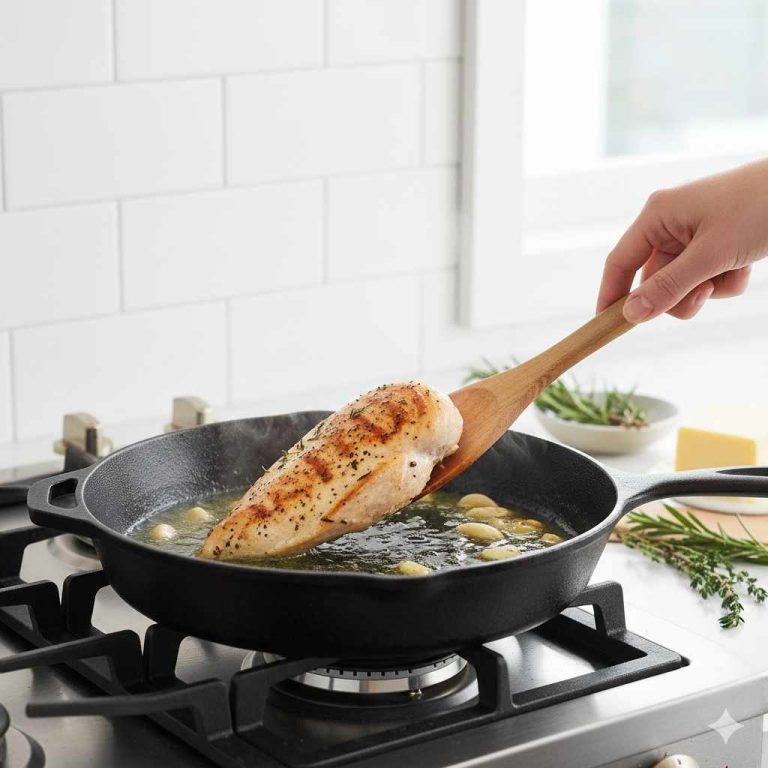
Cast iron changes the equation because seasoning is part of the cooking surface. A bare, stripped pan can take more abrasion, but a seasoned pan should be cleaned in a way that protects that layer. Use metal scrubbers only when removing stuck residue on bare iron or when the seasoning needs to be repaired anyway.
Enameled cookware
Enameled surfaces are hard but not scratch-proof. A metal scrubber can leave marks, dull the finish, or chip a weak spot. For everyday cleaning, a soft pad is the safer choice. If the enamel is already chipped, avoid abrasive tools even more closely because exposed spots can worsen.
What kind of scrubber to use on stainless steel
For stainless steel pots and pans, start with the least abrasive tool that will remove the residue. Use a Copper Scrubber or Steel Scrubber only on bare stainless steel when the stain is stubborn and the finish can take metal contact. If the pan is brushed, polished, or coated, step down to a softer pad.
Heavy carbon, browned oil, and baked-on fond are the main reasons to reach for a metal pad on stainless steel. If the spot is cosmetic, a soft cleaner and a nylon pad are safer. For routine cleanup, there is usually no need to start with metal.
When a copper scrubber is acceptable
A Copper Scrubber is acceptable on bare stainless steel when you want strong stain removal with a less aggressive feel than some steel meshes. That still assumes the pad is real copper or a genuine copper blend, not a plated imitation that may shed. Use light pressure and rinse the pan well.
When a stainless steel scrubber is the better fit
A Steel Scrubber is the better fit when you need maximum durability and you are cleaning tough, bare surfaces. It is also the more practical choice if you clean often and want a pad that is easy to rinse and dry. For rough pan bottoms or grill-like residue, steel usually lasts longer.
When to switch to a softer tool
Switch to a softer tool when the finish is polished, the cookware is coated, or you see any visible scratch marks from prior use. If the residue comes off with a soak or a paste, stop before you reach for metal. The goal is cleaning, not thinning the surface.
Can I use a copper scrubber on stainless steel?
Yes, a Copper Scrubber can be used on bare stainless steel cookware in some situations, especially for stubborn stains or cooked-on grease. The catch is that the pan must be able to tolerate abrasion, and you should avoid acidic cleaners at the same time because copper can react with vinegar or citrus.
Use caution on brushed or mirror-finish steel. If the pad leaves streaks, gray residue, or visible dulling, stop and switch to a softer method. That symptom usually matters more than the pad’s marketing description.
Safe scenarios for stainless steel pots and pans
Common safe uses include removing browned bits from a stainless sauté pan, cleaning a stockpot with baked-on residue, or scrubbing a pan bottom that has heat discoloration. These are bare-metal jobs. A light touch reduces the chance of finish damage and keeps the grain or polish intact.
Failure cases: scratching, residue, and finish damage
The main failure mode is scratching. A second risk is residue transfer, which can leave a metallic streak or haze on the pan. On fine finishes, repeated use can change the look of the steel even if the cookware still functions, so stop once the stain lifts.
Acidic cleaner interactions with copper
Acidic cleaners such as vinegar and citrus can react with copper. That can speed oxidation and change the pad’s surface appearance. If you have already soaked the pan in an acidic cleaner, rinse thoroughly before using a copper pad, and do not leave the pad damp afterward.
How do I tell if a copper scrubber is real copper?
A true copper scrubber should not behave like plain steel in a magnet test, and it should show wear in a way that matches copper or a copper blend. If the pad is strongly magnetic, it may be plated steel or a mixed-metal product rather than solid copper. That matters for wear and residue risk.
Visual wear cues help too. Look for flaking, gray underlayer exposure, or a finish that rubs off quickly at the contact points. Those signs suggest plating loss rather than stable copper fiber, especially if the outer color changes unevenly after a few uses.
- Hold a magnet to the pad. Strong attraction points to steel under the coating.
- Inspect high-wear edges. Flaking or a different color beneath the surface suggests plating.
- Check the color after repeated rinsing. Uneven fading can mean a coated product, not solid copper.
- Look for oxidation. A copper patina can darken or dull over time; that change is normal, but it should not reveal a different base metal.
- Rinse and dry it fully. Persistent dampness speeds dulling and residue buildup.
Magnet test for plated or mixed-metal scrubbers
The magnet test is the fastest screening tool. If the pad grabs strongly, it is likely not solid copper. A weak or absent magnetic pull does not prove purity, but it is a useful first filter before you trust the product on cookware or assume copper-only performance.
Visual wear cues that suggest plating or coating loss
Plating loss often shows up as patchy color, rough spots, or a bright inner layer where the outer finish has worn away. If that happens early, the scrubber may not be what the package implied. Replace it if the coating is shedding into your sink or pan.
Simple signs of oxidation and patina
Copper patina usually looks darker, duller, or slightly brown-green depending on exposure. That change is normal and does not automatically mean the pad is unsafe in routine use. It does mean the scrubber needs more drying and closer attention after acidic or wet cleaning jobs.
Choose Steel Scrubber if… / Choose Copper Scrubber if…
Choose Steel Scrubber if you need the tougher, longer-lasting option for bare stainless steel or cast iron, if you clean hard carbon often, or if you want the easier pad to rinse and dry. Choose Copper Scrubber if you want strong stain removal on bare stainless steel, prefer a less aggressive-feeling metal pad, and can confirm the product is genuine rather than plated.
Do not use either scrubber on nonstick or other scratch-sensitive coatings. If the cookware has an enamel layer, a nonabrasive pad is the safer choice. If the pad leaves marks, residue, or a metallic smell on the pan, switch tools immediately.

Frequently asked questions
Stainless steel scrubber vs copper coated scrubber
A stainless steel scrubber is usually the more durable option, while a copper coated scrubber may feel gentler and remove stains well. The coated version can wear down, though, and the copper layer may not be the whole story. If the surface is delicate, neither is a safe default.
Copper vs stainless steel scrubber
Copper is usually favored for stain removal, and stainless steel is usually favored for durability and easy cleanup. That split matters less than the cookware surface. Bare stainless steel and cast iron can take more abrasion; nonstick, enamel, and many copper finishes generally cannot.
What kind of scrubber to use on stainless steel: on bare stainless steel, either
On bare stainless steel, either Copper Scrubber or Steel Scrubber can work for stubborn residue. Use the softer-acting option first if the finish is polished, and move up only if the stain remains. For routine cleaning, a sponge or nylon pad is often enough.
Will a scrubber scratch nonstick pans?
Yes. Metal scrubbers can scratch nonstick pans because the coating is easy to damage. Once scratched, the surface can wear faster and lose its easy-release finish. A soft sponge and mild soap are the safer route for that cookware, even when the mess is baked on.
Are copper scrubbers antimicrobial?
Copper scrubbers are described as having natural antimicrobial properties. That claim does not make them safe for every cookware surface, and it does not remove the need to dry and clean the pad. Antimicrobial action is about microbes on the material, not scratch safety on a pan.
Is stainless steel scrubber safe for cookware?
A stainless steel scrubber is safe for some cookware and unsafe for others. It is a reasonable choice for bare stainless steel and some cast iron cleaning jobs, but it can damage nonstick, enamel, aluminum, and copper cookware. Surface type decides safety first, and finish condition decides how much risk is acceptable.
Products related to this article
Sponsored / affiliate links. As an Amazon Associate I earn from qualifying purchases. I may earn additional commission from eligible campaigns.