Best Rust Removers for Cookware: Based on Specs and Reviews
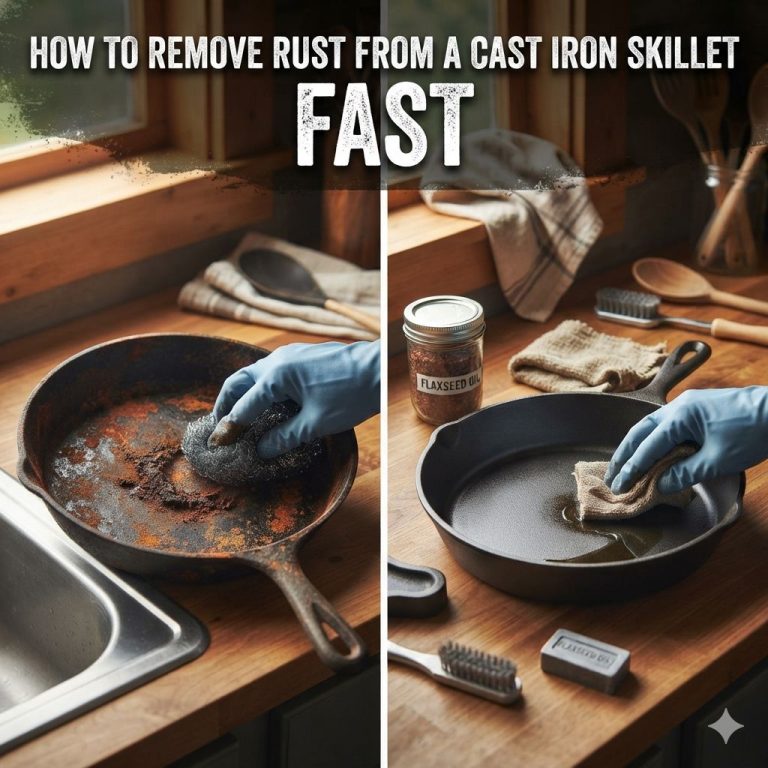
For bare stainless, cast iron, and carbon-steel cookware, start with a food-safe oxalic-acid cleaner or a baking-soda paste; stop if rust is deep pitting, flaking coating, or rust under enamel. The wrong product can strip seasoning, damage nonstick or enamel, and leave pits that hold moisture and spread corrosion. This guide compares cookware-safe removers, what they work on, and when to replace the pan.
Quick comparison
| Product | Badge | Best for | Price | ||
|---|---|---|---|---|---|
 |
Bar Keepers Friend Powder Cleanser, 12 oz x 2, MultipurposeBar Keepers Friend | Our pick | 12 oz x 2 powder · multipurpose cleaner | $16.74
Price as of 22 Oct 2026
|
View |
 |
White Ox 64 oz Rust RemoverWHITE – OX | Also great | $39.95
Price as of 22 Oct 2026
|
View | |
 |
Viva Doria 100% Pure Citric Acid, Food Grade, Fine Grain, 2Viva Doria | Also great | $9.99
Price as of 22 Oct 2026
|
View | |
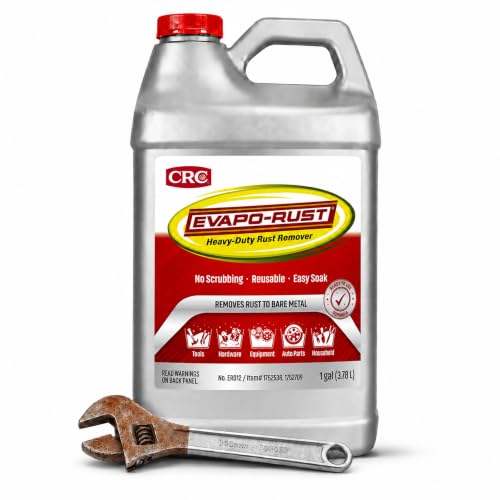 |
CRC Evapo-Rust Heavy Duty Rust Remover, 1 Gallon Bottle |Evapo-Rust | Also great | 1 gallon bottle · water-based rust remover | $29.89
Price as of 22 Oct 2026
|
View |
The trade-off is plain: stronger removers clear heavier rust faster, while gentler cleaners are easier to use on cookware surfaces that also need to stay food-contact safe. Your best pick depends on the pan material, how deep the rust goes, and whether the finish can tolerate abrasion or soaking.
Rust forms when iron meets water and oxygen. Commercial rust removers work by wetting the spot, dissolving the oxide layer, or stripping it away, and they come as sprays, gels, liquids, or powders. For cookware, residue, seasoning loss, and coating damage matter just as much as the chemistry.
| Option | Best use | Cookware caution |
|---|---|---|
| Evapo-Rust | Heavy rust on bare cast iron or carbon steel | Follow the label and rinse thoroughly before any food use |
| Bar Keepers Friend Soft Cleanser | Light to moderate rust stains on stainless steel or enamel | Test first on polished or coated surfaces |
| Rust eraser | Small rust blooms and edge spots | Can scratch or strip finish if pressed hard |
| Vinegar or baking soda | Mild spot treatment or paste cleaning | Too weak for deep rust, too aggressive for long soaks on some finishes |
Popular Mechanics named Evapo-Rust Best Overall in its roundup. Good Housekeeping’s best overall pick was Iron OUT Rust Stain Remover Powder, while its best value pick was CLR Calcium Lime & Rust Remover. Those rankings help set expectations, but cookware needs a stricter filter than sinks, tubs, or general household stains.
How we chose
The shortlist centers on cookware material compatibility, rust severity, residue concerns, cleanup steps after treatment, and whether a product is better left off food-contact surfaces. A remover that works on tile or laundry is not automatically a sound choice for a pan.
One more filter matters: published label language. NSF approval or a kitchen-safe claim only counts if the label or maker says it, and small-area testing comes before any full treatment on a pan with a finish that could react.
We compared products that fit four practical jobs: heavy rust removal, light rust and stain cleanup, spot abrasion, and general household rust stain control. That leaves room for alternatives such as citric acid, Bon Ami, and manufacturer-specific care products without pretending they are all interchangeable.
Evapo-Rust: best for heavy rust on bare metal
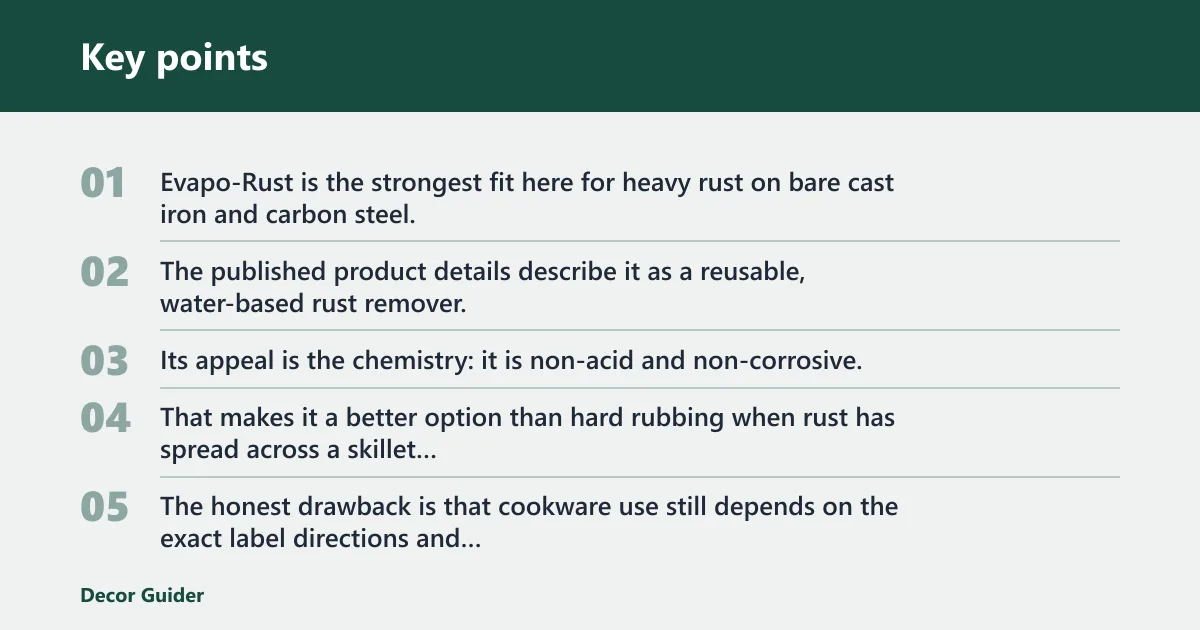
- Explicitly safe for cast iron cookware
- Non-corrosive, water-based formula
- Reusable — rust floats away from metal
Evapo-Rust is the strongest fit here for heavy rust on bare cast iron and carbon steel, especially when the rust is more than a surface bloom. The published product details describe it as a reusable, water-based rust remover, and the pros list it as explicitly safe for cast iron cookware.
Its appeal is the chemistry: it is non-acid and non-corrosive, so it is less likely than an abrasive scrub to gouge a cooking surface. That makes it a better option than hard rubbing when rust has spread across a skillet interior or along a carbon-steel rim.
The honest drawback is that cookware use still depends on the exact label directions and the cleanup afterward. Any soak that reaches seams, rivets, or hidden joints needs careful rinsing and full drying, and seasoning must be restored on bare iron or carbon steel after the rust is gone.
When it fits
Choose it when a cast-iron skillet, griddle, or carbon-steel pan has broad orange film, but the metal is still structurally sound. It is also a strong option when the surface needs a heavier rust removal step before re-seasoning.
Do not treat it as a default for enamel, nonstick coatings, or pans with visible coating failure. If the rust sits under a damaged coating or the surface is flaking, replacement is the safer move, not a longer soak.
Use and cleanup
A common safe workflow is to soak only long enough for the rust to lift, then rinse, dry completely, and oil the metal. For cast iron, drying after washing should be immediate, followed by a thin oil application to help block moisture.
After rust removal, re-seasoning is the next step if the pan is bare cast iron or carbon steel. If the pan still beads water unevenly, the surface likely needs another drying and oiling pass before it goes back into service.
Bar Keepers Friend Soft Cleanser: best for light rust and stains
- Removes rust stains from cookware
- Works on stainless steel, aluminum, copper & more
- Trusted by professionals since 1882
Bar Keepers Friend Soft Cleanser is the better fit for light to moderate rust stains on many kitchen surfaces, especially stainless steel and enamel. Its product details and long-standing kitchen reputation point to rust and stain removal with a polishing action, which suits orange marks that have not eaten into the metal.
This is the product to consider when the issue looks like discoloration on the outside of a pan or a faint bloom on stainless steel, not deep corrosion. It can also help when mineral staining and rust overlap, which is common around rivets, rims, and lids.
The drawback is abrasion. On polished finishes, brushed stainless, or coatings the label excludes, too much scrubbing can leave dull patches or scratch the surface. Small-area testing matters here.
Best use on stainless steel and enamel
On stainless steel, use a small amount, work in a short pass, and stop once the rust stain lifts. On enamel, use only if the label allows the surface and the stain is light, because some enamel glazes mark more easily than plain steel.
For cookware, the goal is stain removal, not heavy sanding. If a gentle pass does not clear the rust after brief contact, switch methods rather than pressing harder and risking finish damage.
How much scrubbing is enough?
Enough is usually the point where the stain lightens in one or two short passes. If the mark remains after modest pressure, that suggests either deeper rust or a surface that needs a different approach, such as a soak on bare metal or a rust eraser on a tiny spot.
Do not keep scrubbing polished cookware in a single place. That can create a visible dull spot even when the rust is gone.
Rust eraser: best for spot scrubbing
A rust eraser is an abrasive physical remover, not a chemical soak. It makes sense for small rust blooms, edge specks, or a spot on a pan where a liquid remover would be awkward or where you want tighter control over the contact area.
The trade-off is clear: the same grit that removes oxidation can also remove finish. On stainless steel it can leave micro-scratches; on carbon steel or cast iron it can strip seasoning if used too hard or too long.
MTC Kitchen sells the Naniwa Rust Eraser A-904 #400 and lists it at $9.00, while describing it as not a typical rust remover. That framing is useful for cookware: it is a spot tool, not a soak substitute.
Best use on small rust blooms
Use a rust eraser when the damage is localized and you need a controlled touch-up. It is especially useful on bare steel edges, a small orange crescent near a rim, or a single rust bloom after a pan has dried unevenly.
Keep pressure light and check the surface often. If the spot is not moving after a few passes, the rust may be deeper than it looks, and a soak or replacement decision is safer.
Cookware rust decision table
This table separates surface fixes from cookware that is too pitted, coated, or corroded to save. The same rust remover can be a good fit on one pan and a bad fit on another, depending on the material and the damage depth.
| Cookware material | Rust severity | Safe remover type | Soak time | Scrub tool | Rinse and dry steps | When to re-season or discard |
|---|---|---|---|---|---|---|
| Cast iron | Surface bloom or orange film | Evapo-Rust, baking soda paste, rust eraser | Short soak only, or 10 to 20 minutes for paste contact | Non-scratch sponge or rust eraser | Rinse well, dry immediately, heat-dry, then wipe with a thin oil film | Re-season after any bare-metal cleaning; discard if pitting is deep or the iron is flaking |
| Carbon steel | Light to moderate rust | Evapo-Rust, baking soda paste, rust eraser | Brief soak or spot treatment only | Soft nylon pad or rust eraser | Rinse, dry completely, warm the pan, and oil lightly | Re-season after cleaning; discard if corrosion has created holes or severe roughness |
| Stainless steel | Rust stain or light bloom | Bar Keepers Friend Soft Cleanser, citric acid, rust eraser | Short contact time, usually a few minutes at most for paste use | Soft cloth or non-scratch pad | Rinse thoroughly and dry to prevent return stains | No seasoning needed; discard only if pitting is structural or deep corrosion has spread |
| Enameled cookware | Surface stain near chip-free enamel | Soft cleanser approved for enamel, citric acid, manufacturer-specific care product | Very short contact, then rinse | Soft sponge only | Rinse completely, dry with a towel, and inspect for chips | Discard or replace if rust is under damaged enamel or the coating is chipped through |
| Nonstick-coated pans | Any visible rust under or through coating | Usually none; use only label-approved gentle cleaning for the surrounding area | Not recommended | Soft cloth only | Rinse, dry, and inspect the coating edge closely | Discard if rust is under the coating, if it is flaking, or if the surface is peeling |
Picture a 10-inch cast-iron skillet with orange specks on the cooking surface after air-drying overnight. That is a fixable surface bloom. Now picture the same skillet with rough pits that catch a fingernail. That is a different problem, and no cleaner can restore missing metal.
Say your stainless sauté pan has rust around two rivets after being stored damp in a cabinet. That is a stain-and-residue job, not a seasoning job, so a short stain remover pass and complete drying matter more than oiling.
Can you use vinegar or baking soda on rusty pans?
Yes, but only in the right place and with the right expectation. Vinegar can help with spot rust on bare metal, while baking soda works best as a mild paste for light rust or discoloration. Neither is a fix for deep pitting, and long soaking can be too aggressive for some cookware.
Vinegar for spot treatment versus soak use
Vinegar is a common DIY option because it can loosen surface rust, but it is better for short, targeted treatment than for long immersion on assembled cookware with seams and rivets. A brief spot application is safer than soaking a pan for extended periods, especially on cast iron and carbon steel.
After vinegar use, rinse well and dry immediately. If the metal is bare iron or carbon steel, oil it at once and re-season if the surface was stripped.
Baking soda for mild rust and paste use
Baking soda is gentler, which makes it a good first pass for very light rust or for a paste on a small stained area. It is less effective than a dedicated remover on heavy rust, but it is often enough for faint orange marks and light cleanup.
When the paste stops changing the stain after a short effort, stop there. More rubbing may do more damage than the rust itself.
When DIY methods stop being worth it
Stop with DIY methods if the rust stays after a few short passes, if the surface is pitted, or if the cookware has a coating that is already lifting. At that point, the problem is no longer simple oxidation on the surface.
Good Housekeeping notes that bleach can set rust stains, so bleach is not the answer here. If the goal is cookware, not laundry or tile, keep the method food-contact focused and avoid adding new residue problems.
Which one should you buy?
Choose by material first, then by rust depth. For cast iron and carbon steel with heavy rust, Evapo-Rust is the strongest match among the products here. For stainless steel and enamel with light staining, Bar Keepers Friend Soft Cleanser is the more practical first pick.
If the rust is a tiny spot on a finished surface, a rust eraser is often the cleanest fix because it stays local. If you are dealing with household rust stains on sinks or tile rather than cookware, CLR or Iron OUT may fit that job better, but that does not make them default cookware choices.
Citric acid is a reasonable comparison option for some bare-metal cleanup, and manufacturer-specific care products can be the safer route for specialty pans because the maker has already limited the surface list. Bon Ami can also help with mild scrubbing jobs, but it is still an abrasive, so it belongs in the gentle-cleaning bucket, not the heavy-rust bucket.
Replace the pan when rust sits under enamel, when nonstick is peeling, when pitting is deep enough to trap food, or when the metal has flaked. A pan that cannot be cleaned smooth is usually not worth saving for kitchen use.
Frequently asked questions
How to remove rust from pans
Start by matching the remover to the pan material. Use a rust-safe cleaner or paste on the affected area, keep contact time short, then rinse, dry, and restore protection if the pan is bare cast iron or carbon steel. If the rust has caused pitting or coating failure, replacement is the safer choice.
What to put on cast iron to prevent rust
Put on a very thin layer of oil after drying. Cast iron should be dried immediately after washing, then warmed briefly so the last moisture leaves the surface. Regular seasoning maintenance matters more than any single cleaner because oil helps block air and water from reaching the iron.
Which rust remover is safe for cookware and food-contact surfaces?
Only products whose label or manufacturer clearly supports kitchen use should be treated as food-contact safe. For bare metal cookware, that often means a cleaner with a clear rinse requirement and a finish that can be fully dried afterward. If the label is vague, keep it off the cooking surface.
What rust remover works on cast iron without damaging seasoning?
A very gentle approach is safest for seasoning, but any true rust removal can affect the surface. For light spots, use the mildest method that works, then dry, oil, and re-season as needed. If the seasoning has already failed in patches, a full re-season is usually better than spot repair.
Products related to this article
Sponsored / affiliate links. As an Amazon Associate I earn from qualifying purchases. I may earn additional commission from eligible campaigns.