Best Storage Rack for Cast Iron Cookware: We Compared
The best storage rack for cast iron cookware is a steel, wall-anchored or cabinet-mounted organizer with one shelf per skillet, and a common rule of thumb is about 12 inches of clearance for 12-inch pans, with a lid slot if you store lids together. If the rack is too small, it can tip, bend, or chip enamel under cast-iron weight, and poor spacing makes pans hard to lift. This guide compares rack types by pan count, skillet diameter, lid storage, and cabinet or counter fit so you can choose safely.
Quick comparison
| Product | Badge | Best for | Price | ||
|---|---|---|---|---|---|
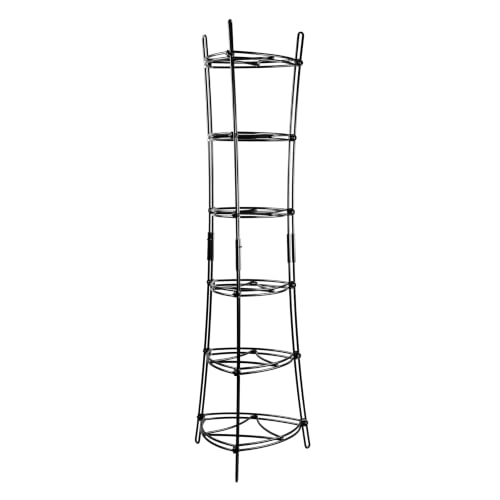 |
Lodge Cookware Storage Tower 6-Tier Storage Rack, MatteLodge | Our pick | 6-Tier · Matte Black · Vertical | $129.90
Price as of 17 Oct 2026
|
View |
 |
Housolution 6 Tier Cast Iron Pot Organizer Pan RackHousolution | Upgrade pick | 6-Tier · Carbon Steel · 264 Lbs | $99.99
Price as of 17 Oct 2026
|
View |
 |
Cuisinel Pan Organizer Rack for Cast Iron Skillets, 12.2",Cuisinel | Budget pick | 5-Tier · 12.2 inch · 70 Lbs | $29.99
Price as of 17 Oct 2026
|
View |
 |
RedCall Universal Knife Block Without Knives – 14 SlotRedCall | Also great | $27.99
Price as of 17 Oct 2026
|
View | |
 |
XILYZMO Stainless Steel Pot Rack Organizers, 11-TierXILYZMO | Also great | $890.49
Price as of 17 Oct 2026
|
View |
Use the comparison table to match the rack to your layout first, then check load rating and spacing. That order matters more than tier count alone when you store heavy skillets, griddles, and lids together.
How we chose
We compared the listed products by load rating, tier layout, storage orientation, and fit for cast iron failure points such as tipping, handle interference, and scratched seasoning. We also weighed cabinet height, shelf depth, and whether a rack can hold mixed cookware without forcing pans into each other.
Scratch control matters most for seasoned and enameled cast iron. The safer default is a steel frame with stable feet, enough spacing for handles, and a finish that cuts metal-on-metal contact.
Say your 12-inch skillet stores with its helper handle and a lid. A rack that looks fine for lighter pans can still fail if the handle catches the next tier and the front edge shifts forward when you lift one piece out.
Cast iron storage decision table
| Skillet count | Skillet diameter | Lid or Dutch oven storage | Cabinet height | Safest rack type | Load-capacity checklist | Do not buy if… |
|---|---|---|---|---|---|---|
| 2 to 3 skillets | 8 to 10 inches | No lids, or lids stored elsewhere | Standard cabinet | 5-tier pan organizer rack with vertical use | Check total load rating, stable feet, and one bay per pan | Do not buy if the tiers are too close for the handle to clear, or the base slides when you pull one pan out |
| 3 to 5 skillets | 10 to 12 inches | Lids stored in one slot or separate section | Tall cabinet or pantry shelf | All-steel organizer with wider spacing | Check per-shelf support, not just total capacity; heavier pans belong on lower tiers | Do not buy if the frame flexes, the side rails bow, or the front tips when a 12-inch pan is removed |
| Mixed set with griddle and Dutch oven | 10 to 12 inches and larger | Yes, lids and enameled pieces together | Tall pantry or floor-level cabinet | Extra-large 5-tier rack or 8-tier adjustable layout | Check depth for handles, room for lids, and whether the lower tier carries the heaviest piece | Do not buy if lid rims scrape the shelf or the organizer only looks tall but lacks lateral stability |
| Small set for fast access | 8 to 10 inches | No lids in the rack | Under-cabinet storage or short shelf | Countertop rack with compact footprint | Check anti-tip placement and enough depth for the handle | Do not buy if the rack sits near a sink, wobbles on the counter, or blocks cabinet doors |
| Brand-matched cast iron set | Mostly 10 to 12 inches | Some lids, some bare skillets | Cabinet or pantry | Lodge cookware organizer benchmark option | Check tier spacing, steel build, and whether the lowest tier takes the heaviest pan | Do not buy if your set includes oversized pieces that exceed the rack’s spacing or balance |
How to read the table
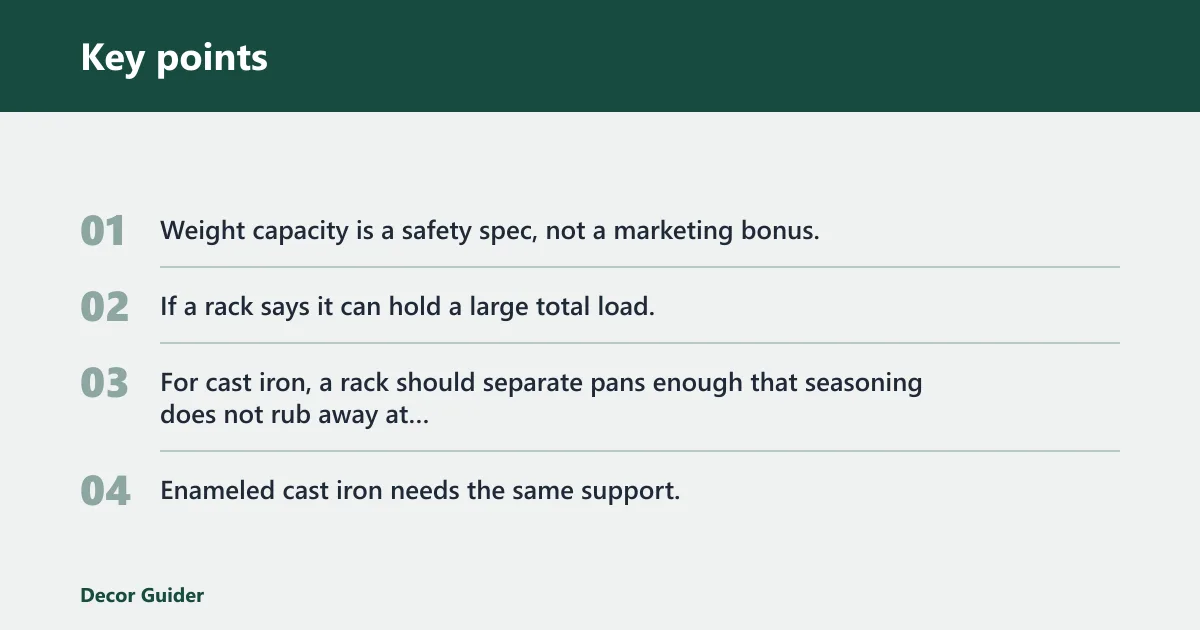
Weight capacity is a safety spec, not a marketing bonus. If a rack says it can hold a large total load, you still need enough room per shelf for the skillet diameter and handle shape.
For cast iron, a rack should separate pans enough that seasoning does not rub away at contact points. Enameled cast iron needs the same support, but it is more sensitive to chipping where rims or lids collide.
What is the best storage rack for cast iron cookware?
The best storage rack for cast iron cookware is a steel organizer with stable support, enough tier spacing for 10- to 12-inch pans, and a layout that keeps handles from colliding. For most homes, that means a vertical all-steel rack or a silicone-coated organizer if scratch control matters more than raw capacity.
Top pick by use case
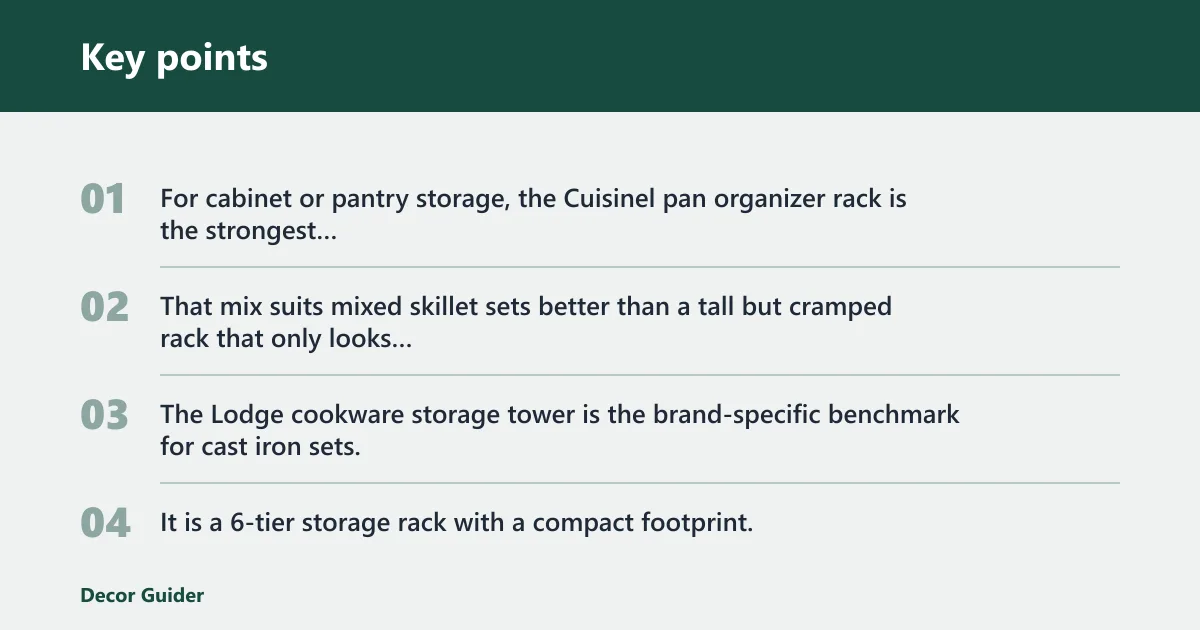
For cabinet or pantry storage, the Cuisinel pan organizer rack is the strongest general-purpose fit because it works vertically or horizontally, is sized at 12.2 inches, and is listed to hold 70 lbs. That mix suits mixed skillet sets better than a tall but cramped rack that only looks sturdy.
The Lodge cookware storage tower is the brand-specific benchmark for cast iron sets. It is a 6-tier storage rack with a compact footprint, but its value depends on whether your cabinet height and pan widths match the tier spacing.
Cuisinel pan organizer rack: best for flexible cabinet storage
- Fits inside cabinets
- Heavy-duty metal construction
- Vertical or horizontal mounting
This is the best fit for shoppers who want one rack that can work inside a cabinet or on a shelf, with vertical or horizontal placement. The 5-tier format and 70 lb rating make it easier to separate cast iron skillets, griddles, and lids without forcing a tight stack.
What stands out is the mix of cabinet fit and flexibility. That matters when you need one organizer for both seasoned skillets and heavier enameled pieces, because the layout can reduce handle interference and help pans dry with airflow between them.
The drawback is size discipline. A 12.2-inch organizer still needs real clearance for handles, and a 5-tier rack is not enough if you expect it to carry oversized Dutch ovens or a deep mixed set without checking shelf depth first.
Lodge cookware storage tower: best for brand-matched cast iron sets
- Brand authority for cast iron care
- Sturdy all-steel construction
- Compact, space-saving multi-tier design
This is the clearest brand-specific choice for cast iron care. Its 6-tier vertical design and all-steel construction fit Lodge skillets, lids, and accessories in a compact footprint, which makes it a strong benchmark if you already store mostly Lodge cookware.
It suits home cooks who want a dedicated tower for seasoned skillets and a few lids rather than a mixed pan wall. The tier count helps separate pieces so seasoning does not rub, and the vertical format saves room in narrow cabinets or pantry zones.
The main drawback is that brand-matched convenience does not remove the need to measure. If your cabinet is short or your pans are wider than the gap between tiers, the tower can still be too tight for easy removal.
Housolution 6 tier cast iron pot organizer: best for heavy loads
- High 264-lbs capacity
- Reinforced curved support plates
- Includes 6 S-hook accessories
This is the strongest capacity-focused option in the list. Its 264 lb advertised capacity and reinforced curved support plates make it the clearest pick when you need a freestanding rack for a large cast iron set with heavier Dutch ovens or multiple skillets.
It works best in pantries, on floors, or in deeper utility spaces where a taller organizer can sit without crowding a sink or stove. The six tiers and included S-hook accessories make it more useful for mixed cookware than a bare tower.
The drawback is footprint and scale. A high-capacity rack can still be a poor fit for a short cabinet or a narrow counter, and a very large organizer is only safe if the floor or shelf beneath it is level and stable.
XILYZMO stainless steel pot rack organizer: best for very large sets
This is the largest-format option in the group and suits a large pantry or utility kitchen more than a normal cabinet. The 11-tier layout gives you more separation than most cast iron racks, which can help with mixed skillets, lids, and bigger cookware pieces.
It is the option to consider when tier count matters more than compactness. If your storage problem is a high-volume set rather than a single cabinet, an extra-tall steel organizer can keep pieces upright and easier to sort by size.
The drawback is obvious: this is far more rack than many kitchens need, and the price is high. It is also not a practical choice for short cabinets, so measure height and walking clearance before you consider it.
RedCall knife block: best for nothing in this category
This product is not a cast iron storage solution. A wooden knife block belongs on a countertop for knives, not for heavy skillets, lids, or Dutch ovens, so it does not meet the safety or spacing needs in this guide.
The only honest takeaway is that it should be excluded from a cast iron shortlist. Its slot layout, material, and purpose do not address handle interference, weight support, or scratch-safe separation.
The drawback is complete mismatch. It is not a rack for cast iron cookware, and it should not be used as one.
Which rack fits your kitchen?
The right rack depends on where the weight sits. Cabinets need height and depth checks. Counters need a small footprint and anti-tip placement. Pantries can handle taller steel towers if the floor is level and the load stays low enough for safe access.
Cabinets
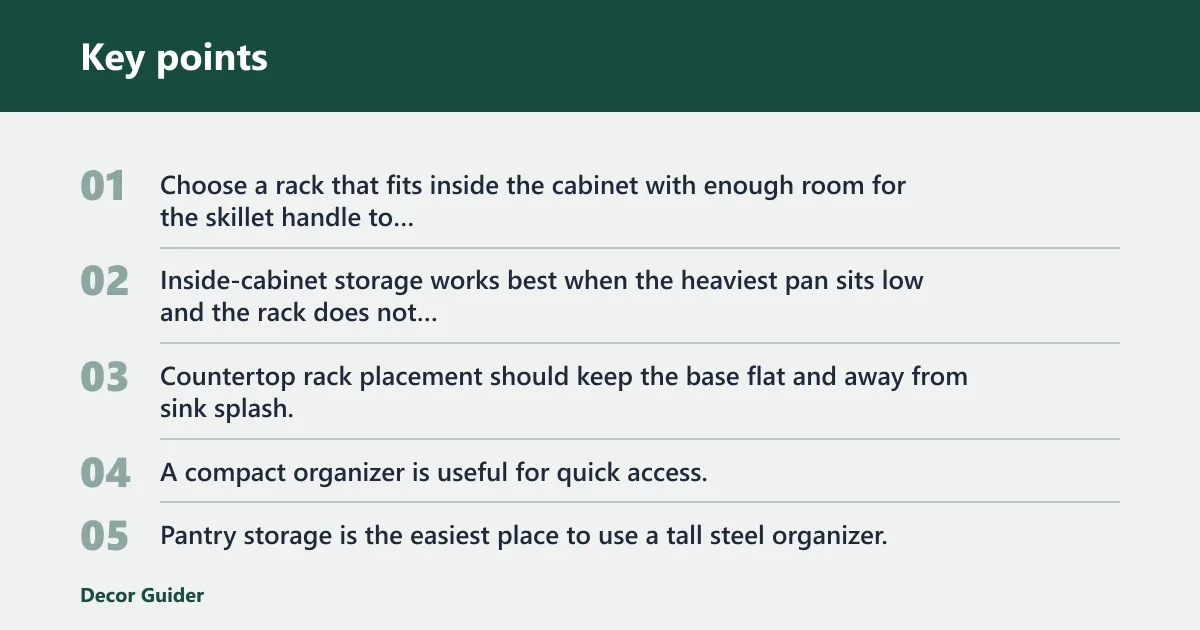
Choose a rack that fits inside the cabinet with enough room for the skillet handle to clear the front rail. Inside-cabinet storage works best when the heaviest pan sits low and the rack does not shift when you slide one skillet out.
Counters
Countertop rack placement should keep the base flat and away from sink splash. A compact organizer is useful for quick access, but the footprint must be wide enough that a cast iron pan does not pull the rack forward as you lift it.
Pantries
Pantry storage is the easiest place to use a tall steel organizer. That is where larger tier counts and wider spacing help most, especially if you keep lids, griddles, and Dutch ovens in the same zone.
Under-cabinet storage
Under-cabinet storage needs the strictest height check. Measure cabinet height, shelf depth, and handle clearance before you buy, because a rack that fits the pans can still fail if the handle hits the shelf above it.
A common first-timer mistake is to choose a rack by shelf count alone, overlooking whether it can safely support heavy cast iron skillets and Dutch ovens. Say you have four skillets, including one 12-inch pan with a long handle and a lid. The rack may look large enough on paper, but the handle can block removal unless the tier spacing is generous.
Silicone-coated rack: best for scratch control
A silicone-coated organizer is the better choice when your main concern is scratched seasoning or metal-on-metal scuffing. The coating adds grip inside cabinets and can reduce sliding when you store seasoned cast iron close together.
When coating matters
Choose silicone-coated steel when your cabinets are narrow, your pans are tight together, or you move cookware often. One listed organizer supports up to 50 lbs of cookware, and the coating is useful when small shifts can otherwise rub the finish.
When steel is enough
All-steel organizers are the safer default for heavy sets when the frame, welds, and feet are stable. If your pans sit widely apart, or if you store mostly larger pieces on lower tiers, plain steel can be the better structural choice.
Silicone is not a substitute for fit. If the rack is too short, too shallow, or too light for the set, coating alone will not prevent tipping or handle collisions.
All-steel organizer: best for heavy sets
An all-steel cookware organizer is the best default when you store multiple cast iron pieces and want long-term durability. Steel frames are better suited to the weight of skillets, griddles, and Dutch ovens than lightweight organizers with narrow rails.
When to choose vertical storage
Choose vertical storage when cabinet depth is limited or when you need fast access to several pans. A 5-tier or 6-tier rack can keep each skillet separate so you do not have to unstack heavy cookware to reach the one underneath.
What load specs to check
Check total capacity, but also check how the tiers are built. One pick supports up to 60 lb for heavy cookware, another silicone-coated organizer supports up to 50 lbs, and one rack is advertised with a 120 lb capacity. Those figures are only useful if the spacing and base stability match your cookware.
Tier count affects spacing as much as capacity. A 5-tier organizer can be enough for a modest set, while an 8-tier adjustable layout gives more room for lids and mixed sizes, but only if the frame does not flex under the load.
Which one should you buy?
If you have 2 to 3 skillets and mostly need easy cabinet access, start with the Cuisinel pan organizer rack. Its 5-tier layout, 12.2-inch size, and 70 lb rating make it the most balanced choice for a typical home set.
If you store a mixed cast iron set with a Dutch oven, lids, and several heavier skillets, choose the Housolution 6 tier organizer. The higher capacity is the point here, and the six-tier format gives more room for larger pieces.
If scratch control is your main issue in a tight cabinet, a silicone-coated rack is the better path. If you want a dedicated cast iron brand match, the Lodge cookware storage tower is the strongest branded option in the group.
For very large collections, the XILYZMO 11-tier organizer is the space-maximizing choice, but it is only sensible if you have the height and floor space to support it. The RedCall knife block should be skipped entirely for this job.
Frequently asked questions
How do you store cast iron cookware without scratching it?
Store cast iron with one shelf per pan or a rack that keeps rims and handles from touching. Silicone-coated rails help in tight cabinets, but the real protection comes from spacing, stable support, and avoiding nested storage while the pans are still damp.
How do you store a cast iron pan so it dries properly?
Dry it fully before racking it. Wipe away visible water, then place the pan where air can move around the cooking surface and underside; do not stack it tightly with lids or another skillet until all moisture is gone, or rust can form in the contact points.
What size rack do I need for cast iron skillets and lids?
Use a rack that leaves enough room for your largest skillet, usually a 10- to 12-inch pan, plus handle clearance. If lids stay with the pans, choose a model with a dedicated slot or wider tier spacing so the lid rim does not scrape the shelf.
Can a pan organizer hold heavy cast iron safely?
Yes, if the organizer is built for it. Check total load capacity, but also check the frame, feet, and shelf spacing, because a high number on the box does not help if the rack wobbles, bends, or tips when you remove a heavy skillet.
Should cast iron pans be stored vertically or horizontally?
Vertical storage is usually safer for heavy cast iron because it reduces stacked weight and improves access. Horizontal storage can work for short sets or in wider cabinets, but it is more likely to trap moisture and makes the lower pans harder to lift.
What is the difference between cast iron cookware storage ideas and a cast iron pan rack?
Storage ideas are the broader methods, such as stacking, wall hanging, pantry shelving, or cabinet inserts. A cast iron pan rack is the physical organizer that applies those ideas in one structure, usually with tier count, spacing, and load limits already built in.
How many pans can one cast iron storage rack hold?
Most consumer racks are built around 5-tier or 6-tier layouts, though larger adjustable units may offer more. The real limit depends on skillet thickness, lid storage, and handle length, so a rack that looks large may still only fit a few cast iron pieces safely.
Cast iron vs iron cookware
For storage, both need sturdy support, but cast iron pieces are usually the heavier and bulkier category home cooks worry about. That means you should size the rack for the heaviest skillet or Dutch oven in the group, not for the lightest piece.
Products related to this article
Sponsored / affiliate links. As an Amazon Associate I earn from qualifying purchases. I may earn additional commission from eligible campaigns.