Oven Cleaner vs Degreaser for Baked-On Grease
Use a degreaser for fresh to moderate grease on intact oven surfaces; switch to oven cleaner when grease is baked hard, dark, or carbonized, or after careful degreaser passes fail. Appliance labels and manuals should control the final choice, especially on self-cleaning interiors and specialty finishes. Self-cleaning oven care, oven rack cleaning, burnt grease removal, and safe cleaner comparisons are closely related when you need a broader cleaning plan.
Oven cleaner vs degreaser at a glance
| Decision factor | Oven Cleaner | Degreaser for Baked-On Grease | Winner |
|---|---|---|---|
| Grease type | Baked-on grease, spills, and carbon deposits | Grease and oil on fresher residue | Oven Cleaner |
| Surface fit | Better on oven interiors, oven bottoms, doors, racks, and broiler pans when the label allows it | Better on broader kitchen surfaces such as stovetops, range hoods, microwaves, burner grates, and drip pans | Degreaser for Baked-On Grease |
| Cleaning strength | Stronger chemistry for heavy, burnt-on residue | Typically less harsh | Oven Cleaner |
| Timing flexibility | Can be a 30-second spot clean, a standard wait around 1 hour 15 minutes, or an overnight deep clean with some formulas | May need longer contact time on stubborn stains | Oven Cleaner |
| Risk of overreach | Higher if used on the wrong finish or a self-cleaning interior | Lower on more kitchen-safe surfaces, but may stall on heavy carbon | Degreaser for Baked-On Grease |
Grease type
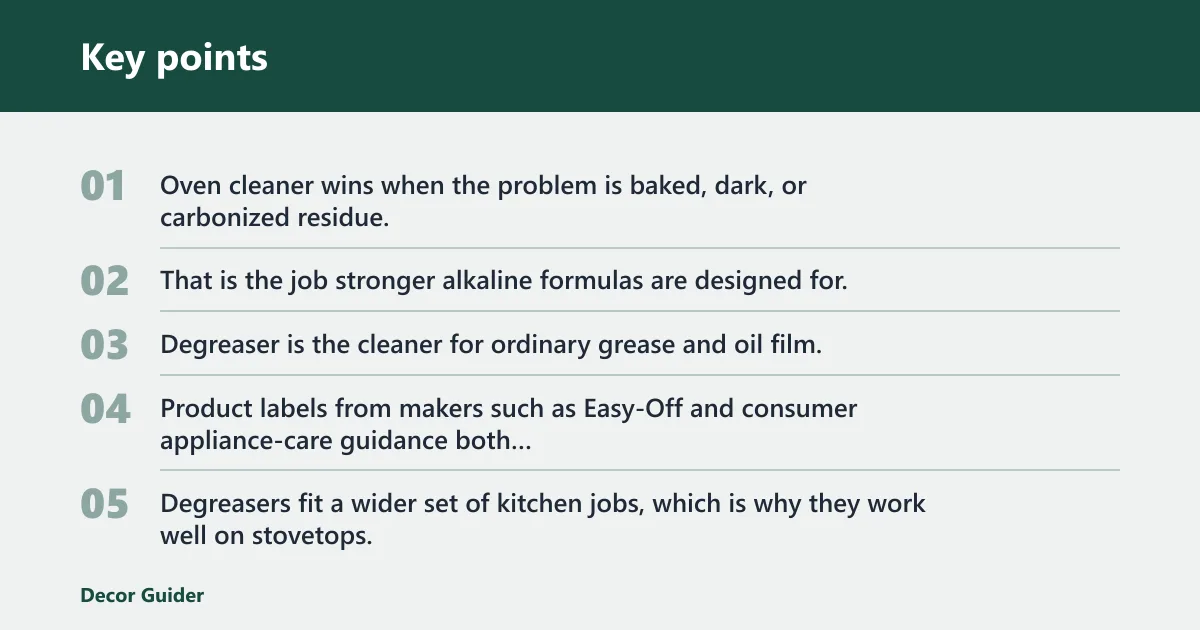
Oven cleaner wins when the problem is baked, dark, or carbonized residue. That is the job stronger alkaline formulas are designed for, including products built for heavy-duty oven soil. Degreaser is the cleaner for ordinary grease and oil film, especially when the deposit is still soft enough to lift without aggressive soaking. Product labels from makers such as Easy-Off and consumer appliance-care guidance both point to using the least aggressive cleaner that still matches the soil level.
Surface fit
Degreasers fit a wider set of kitchen jobs, which is why they work well on stovetops, range hoods, microwaves, burner grates, and drip pans. Oven cleaner is more targeted. Use it where the label allows contact with oven interiors, doors, racks, or pans, especially where the buildup is heavy enough to call for stronger chemistry. Always defer to the appliance manual for coated interiors, self-cleaning models, and any finish the cleaner label excludes.
Cleaning strength
Oven cleaner is commonly made with stronger alkaline chemistry, often including sodium hydroxide or potassium hydroxide. Those ingredients help break down baked fats and oils, which is useful on burnt residue but also makes some formulas caustic. A degreaser is typically less harsh, which makes it easier to use on more finishes and on everyday kitchen grease where heavy-duty chemistry is not necessary. Avoid treating any cleaner as universally safe; label restrictions are part of the product’s safety guidance.
Timing flexibility
Oven cleaner has the wider timing range. Easy-Off Fume Free Oven Cleaner is positioned for 30-second spot cleaning, 1 hour 15 minutes for standard cleaning, and overnight for deep-cleaning on approved surfaces. Degreasers can work well, but stubborn residue may need repeated contact time instead of one short pass. Use the dwell time printed on the bottle you have, since formulas and instructions vary by product.
Risk of overreach
The safer product is not always the stronger one. A degreaser is less likely to attack a broader kitchen surface, while an oven cleaner can be too aggressive for the wrong finish. On self-cleaning ovens, the appliance manual comes first because some chemical cleaners do not belong there at all. When the label and manual disagree, the manual wins.
How bad is the grease?
Start with the deposit, not the label. Fresh splatter and a light film usually respond to a degreaser. Sticky residue may still need a stronger cleaner, especially if it survives a careful second pass. Hard, blackened carbon calls for oven cleaner or a stop-and-escalate decision instead of endless scrubbing. That approach matches common appliance-care guidance: use the mildest effective cleaner first, then step up only when the residue and surface allow it.
Light film and fresh splatter
Light grease is usually the degreaser zone. If the residue wipes off with a normal kitchen cleaner after a short dwell time, there is no reason to jump straight to a caustic oven product. This is the right place for a gentler formula and a microfiber cloth or non-scratch pad, especially on finishes that can scratch or dull.
Stuck-on grease and sticky residue
Sticky residue is the gray area. A kitchen degreaser may still work, but expect longer contact time and a second wipe. If the surface stays tacky, turns streaky, or leaves a brown film behind, stop repeating the same cleaner and move up to oven cleaner if the surface allows it. That keeps you from over-scrubbing while the residue is still in a stage that can be lifted chemically.
Hard carbon and burnt deposits
Hard, dark, burnt-on residue is where oven cleaner earns its place. Degreasers are not always intended for heavy oven carbon, and they can stall on black deposits that cling to enamel or the oven bottom. If the grime smokes slightly when the oven warms or stays crusted after two passes, treat it as carbon buildup. At that point, follow the stronger product’s label or switch to a manufacturer-approved method.
Which oven surface are you cleaning?
Surface type can matter as much as grease severity. Oven bottoms, walls, doors, racks, broiler pans, and coatings do not all tolerate the same chemistry. Glass needs a different touch from enamel, and self-cleaning interiors need special caution because some cleaners are not allowed there at all. The best cleaner is the one that matches both the mess and the material.
Oven bottom and walls
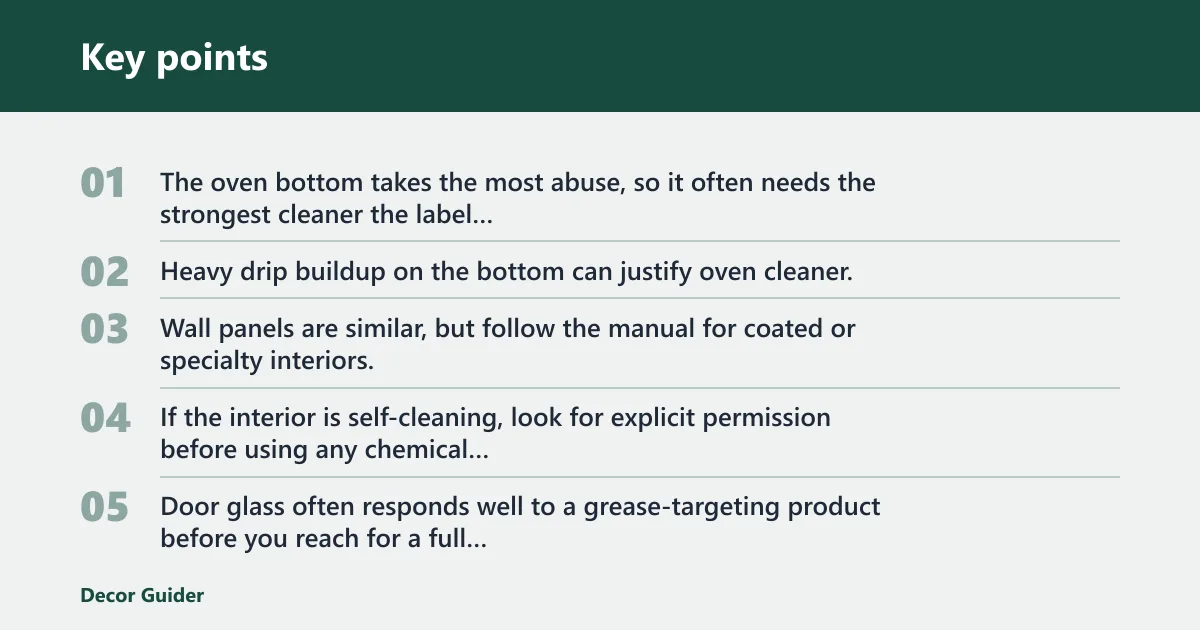
The oven bottom takes the most abuse, so it often needs the strongest cleaner the label permits. Heavy drip buildup on the bottom can justify oven cleaner, especially if a degreaser leaves a brown haze or requires repeated scrubbing. Wall panels are similar, but follow the manual for coated or specialty interiors. If the interior is self-cleaning, look for explicit permission before using any chemical cleaner.
Oven door glass and interior window
Door glass often responds well to a grease-targeting product before you reach for a full oven cleaner. A product such as Dawn Platinum Powerwash is positioned for greasy spots and baked-on residue on targeted kitchen soil, which makes it a reasonable choice for the glass itself when the label allows it. It is not a whole-oven solution, and it should not replace a product intended for heavy carbon on oven interiors.
Racks, broiler pans, enamel, and self-cleaning interiors
Racks and broiler pans can usually handle stronger treatment than a delicate finish, but always check the label. Enamel can be damaged by the wrong chemistry or by leaving a strong cleaner on too long, so porcelain enamel deserves a gentler approach unless the product explicitly permits stronger use. Self-cleaning interiors are the biggest caution point because manufacturer recommendations control, and warranty concerns can apply. If the manual says to avoid chemical cleaners, do not test that limit.
Material-specific decision guide
| Surface/material | Best fit | Avoid or use with caution | Notes |
|---|---|---|---|
| Porcelain enamel | Mild degreaser first; oven cleaner only if the label and manual allow it | Avoid prolonged dwell with strong caustic cleaners unless approved | Porcelain enamel can dull or discolor if the wrong chemistry sits too long |
| Tempered door glass | Kitchen degreaser or glass-safe grease remover | Avoid abrasive pads and any cleaner not meant for glass | Check for streaking and rinse/wipe fully to avoid film |
| Bare aluminum | Cleaner only if the product label explicitly says aluminum-safe | Avoid strong alkaline oven cleaner and long contact time | Aluminum can darken or pit with caustic products |
| Chrome racks | Oven cleaner only if approved; otherwise a rack-safe cleaner | Avoid harsh soak times that can affect the finish | Follow rack-cleaning guidance and the rack manufacturer’s instructions |
| Broiler pans | Heavy-duty oven cleaner when the label permits | Avoid use on coated or specialty pans unless approved | Broiler pans often tolerate stronger cleaning than decorative surfaces |
| Self-cleaning coatings | Only the method the appliance manual allows | Avoid guessing, spot testing, or assuming the label overrides the manual | Manufacturer instructions control compatibility and warranty risk |
Oven cleaner decision matrix
This matrix ties the cleaner to the amount of grease, the oven part, and the warning signs that mean a degreaser has stopped being enough. If the first pass leaves film, smoke, or carbon, move up one step only if the surface and manual allow it. Do not keep repeating the same mild cleaner on blackened buildup. For related guidance, see safe cleaner comparisons and burnt grease removal.
| Grease severity | Oven surface | Recommended cleaner type | Dwell time | Failure signs that mean escalate |
|---|---|---|---|---|
| Light film, fresh splatter | Oven door glass, enamel side wall, removable rack | Degreaser for Baked-On Grease | Short contact time per label, then wipe | Streaking, greasy film remains, or spots return after drying |
| Moderate sticky residue | Oven bottom, interior window, broiler pan | Degreaser for Baked-On Grease first; oven cleaner if the label allows | Longer dwell time than a quick wipe; repeat once if needed | Brown haze, tacky residue, or two passes with no real change |
| Heavy baked-on grease | Oven bottom, walls, racks, broiler pans | Oven Cleaner | 30 seconds for spot cleaning, 1 hour 15 minutes for standard cleaning, overnight for deep-cleaning | Black carbon remains, smoke on warm-up, or a second treatment is still needed |
| Carbonized buildup | Interior areas only if the manual permits chemical cleaners | Oven Cleaner | Standard or overnight dwell depending on the label | Finish dulling, persistent crust, or any sign the product should not be on that surface |
Light film and fresh splatter: for fresh residue, a degreaser
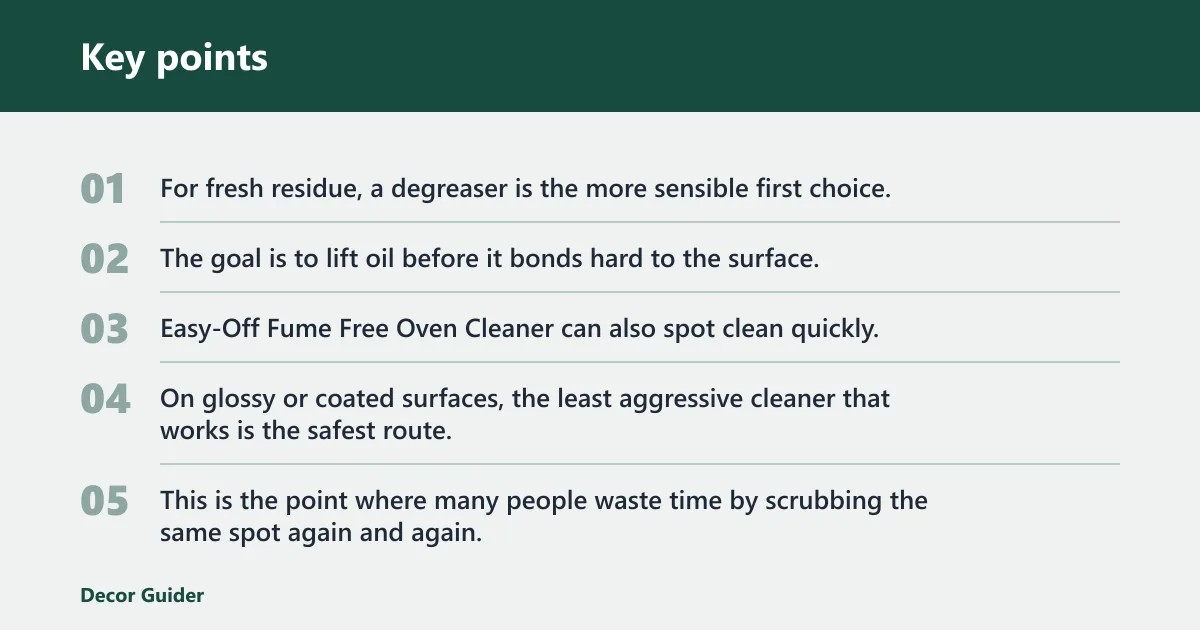
For fresh residue, a degreaser is the more sensible first choice. The goal is to lift oil before it bonds hard to the surface. Easy-Off Fume Free Oven Cleaner can also spot clean quickly, but using that strength on a light job is usually more than you need. On glossy or coated surfaces, the least aggressive cleaner that works is the safest route.
Moderate sticky residue
This is the point where many people waste time by scrubbing the same spot again and again. Try one degreaser pass, then reassess. If the residue is still brown, sticky, or streaked, the problem has moved past everyday kitchen grease. That is when a label-approved oven cleaner can save effort, provided the surface tolerates it.
Heavy baked-on grease
Heavy buildup belongs to oven cleaner. A heavy-duty oven cleaner is often positioned for baked-on messes, and Easy-Off Heavy-Duty Oven Cleaner is the kind of product aimed at that level of soil. That is the right category when a degreaser usually loses because the deposit is no longer just grease; it has become bonded residue. Use only on surfaces the bottle and appliance manual permit.
Carbonized buildup
Carbonized buildup is the clearest sign to stop treating the oven like a simple greasy surface. Oven cleaners are designed for that job, including some formulas sold for self-cleaning ovens, but the appliance manual still controls. If the label or manual rules it out, switch methods instead of forcing it. Never assume a product marketed for ovens is automatically safe for every oven finish.
Choose Oven Cleaner if… / Choose Degreaser for Baked-On Grease if…
Oven Cleaner is the right pick for heavy, burnt-on messes on oven interiors that the label allows. Degreaser for Baked-On Grease is the right pick for everyday kitchen grease, lighter oven splatter, and surfaces that benefit from a milder formula. If the first pass fails twice, move from degreaser to oven cleaner only when the surface is compatible and the manual does not say otherwise. For a broader product-choice view, compare options in safe cleaner comparisons.
Choose oven cleaner if…
- The grease is dark, baked hard, or carbonized.
- The oven bottom or broiler pan has crusted buildup that a degreaser leaves behind.
- You need a short spot clean, a standard dwell, or an overnight deep clean depending on the label.
- The product label permits use on that surface, including some self-cleaning oven models.
Choose degreaser for baked-On grease if…
- The residue is fresh, light, or only moderately sticky.
- You are cleaning oven glass, a door panel, or a broader kitchen surface.
- You want a milder cleaner with lower risk on more surfaces.
- You are trying to remove everyday grease before it turns into hard carbon.

How long should you leave it on?
Dwell time should match the soil level. Easy-Off Fume Free Oven Cleaner gives a clear time ladder: 30 seconds for spot cleaning, 1 hour 15 minutes for standard cleaning, and overnight for deep-cleaning. Degreasers may need longer contact time on stubborn stains, but they are not a substitute for stronger chemistry when the residue is carbonized. Use the label on the specific product you bought, because timing instructions can differ by formula and surface.
30-second spot cleaning
Use a short dwell for isolated spots, not for a whole greasy oven. That is where Easy-Off Fume Free Oven Cleaner is positioned. If the spot lifts and wipes away cleanly, stop there and avoid overexposure to the finish. Spot-clean claims are meant for limited patches, not heavy crust across the entire cavity.
Standard dwell times around one hour
Standard cleaning makes sense when the grime is spread out but not fully blackened. Product directions for Easy-Off Fume Free Oven Cleaner list 1 hour 15 minutes for standard cleaning. Some appliance-care references describe longer waits for deep cleaning, so follow the label that comes with the product in hand rather than a generic timing rule. If the residue is still present after the instructed dwell, reassess surface compatibility before repeating.
Overnight cleaning for severe buildup
Overnight dwell is for severe buildup when the label allows it. It is a practical way to avoid endless scrubbing, especially on the oven bottom or a stubborn rack. If residue is still present in the morning, do one more treatment only if the surface and instructions allow it. When the surface is coated, aluminum, or self-cleaning, a longer dwell is not automatically safer.
What should you avoid on a self-cleaning oven?
Do not assume every chemical cleaner is safe for a self-cleaning oven. Some oven cleaners are marketed for those interiors, but the manufacturer’s guidance comes first because compatibility varies and warranty concerns can apply. If the manual limits chemical use, stop there and use the approved method instead. Self-cleaning modes and self-cleaning coatings are designed to be picky about chemistry.
Manufacturer instructions and warranty concerns
Read the appliance manual before applying any strong cleaner to a self-cleaning interior. That matters even if the product bottle mentions self-cleaning ovens. The oven maker’s instructions control surface compatibility, heat-cycle safety, and any warranty issue. Manufacturer guidance is the most reliable source for whether an alkaline cleaner is acceptable on that exact model.
Chemical cleaner compatibility limits
Self-cleaning interiors can have coatings or finishes that react badly to strong alkaline cleaners. Sodium hydroxide and potassium hydroxide are effective on grease, but they are also part of why some oven cleaners are caustic. If the manual limits alkaline cleaners, do not test that boundary on a hidden spot. That applies equally to hidden corners, trims, and any coated panel inside the cavity.
When to stop and switch methods
Stop if you see dulling, streaking, smoke, or residue that does not move after the allowed dwell time. On a self-cleaning oven, that is the point to switch to the method the manufacturer allows. A gentler cleaner on a safe surface is better than a stronger cleaner on the wrong one. If you are unsure, use the appliance’s approved cleaning cycle or a manual-approved wipe-down method instead.
Frequently asked questions
How do you clean baked on oven grease?
Start with the least aggressive cleaner that matches the soil. Use a degreaser for fresh to moderate grease, then move to oven cleaner if the residue is dark, hard, or carbonized. Read the product label and the appliance manual, wear gloves, ventilate the room, and stop if the surface is not compatible. For oven-safe methods and what to avoid on specialty finishes, see safe cleaner comparisons.
How do you clean grease in oven without scrubbing forever?
Let the cleaner do more of the work. Use the dwell time the label gives you, then wipe and reassess instead of scrubbing dry residue. Easy-Off Fume Free Oven Cleaner has short, standard, and overnight timing options, which helps reduce repeated elbow grease on stubborn spots. When the residue is still bonded after the allowed dwell, move to a stronger label-approved method rather than grinding at the same patch.
How do you remove baked on oven grease from the oven bottom?
The oven bottom often needs the strongest allowed option because it tends to get the heaviest drip buildup. If a degreaser still leaves a brown film after about two passes, switch to oven cleaner if the label permits it. Stop immediately if the finish dulls or the manual says not to use chemicals there. For more targeted tips, see burnt grease removal.
What works best on heavy, burnt-on oven grime?
Oven cleaner is the stronger match for heavy, burnt-on grime. It is designed for baked-on grease, spills, and carbon deposits, which is why heavy-duty oven cleaners are aimed at those messes. Degreasers are better kept for lighter kitchen grease and less severe residue. If the oven has a self-cleaning coating, check the manual before using any caustic cleaner.
Can you use a kitchen degreaser on baked-on oven grease?
Yes, but only when the residue is still light to moderate and the surface is suitable. A product like Method Heavy Duty Degreaser is intended for grease on stovetops, range hoods, microwaves, burner grates, and drip pans. If the oven soil is black carbon, it may not be enough. In that case, step up to a label-approved oven cleaner instead of repeating the same mild pass.
What should you avoid when cleaning a self-cleaning oven?
Avoid assuming any strong cleaner is safe just because it says “oven” on the label. Check the manual first, because some self-cleaning interiors have limits on chemical use. If the appliance maker prohibits it, do not force oven cleaner onto the surface, and do not rely on repeated degreaser passes either. When in doubt, use the cleaning method the manufacturer explicitly approves.
Sources
- Easy-Off Fume Free Oven Cleaner product directions and label instructions for spot cleaning, standard cleaning, and deep-clean timing.
- Easy-Off Heavy-Duty Oven Cleaner product positioning and label instructions for heavy baked-on oven messes.
- Manufacturer owner’s manuals and care instructions for self-cleaning ovens, enamel interiors, racks, and specialty finishes.
- General appliance-care guidance from reputable consumer cleaning sources on using the least aggressive effective cleaner and following label directions.
- Good Housekeeping product and cleaning guidance on grease-removal products and safe use on kitchen surfaces.
- Dawn Platinum Powerwash product guidance for greasy spots and baked-on residue on appropriate kitchen surfaces.
- Method Heavy Duty Degreaser product guidance for stovetops, range hoods, microwaves, burner grates, and drip pans.
- Bar Keepers Friend Powder Cleanser product guidance and material-compatibility notes for cookware and surfaces where abrasive powder cleaners are appropriate or should be avoided.
Products related to this article
Sponsored / affiliate links. As an Amazon Associate I earn from qualifying purchases. I may earn additional commission from eligible campaigns.