Bar Keepers Friend Cookware Cleaner Review
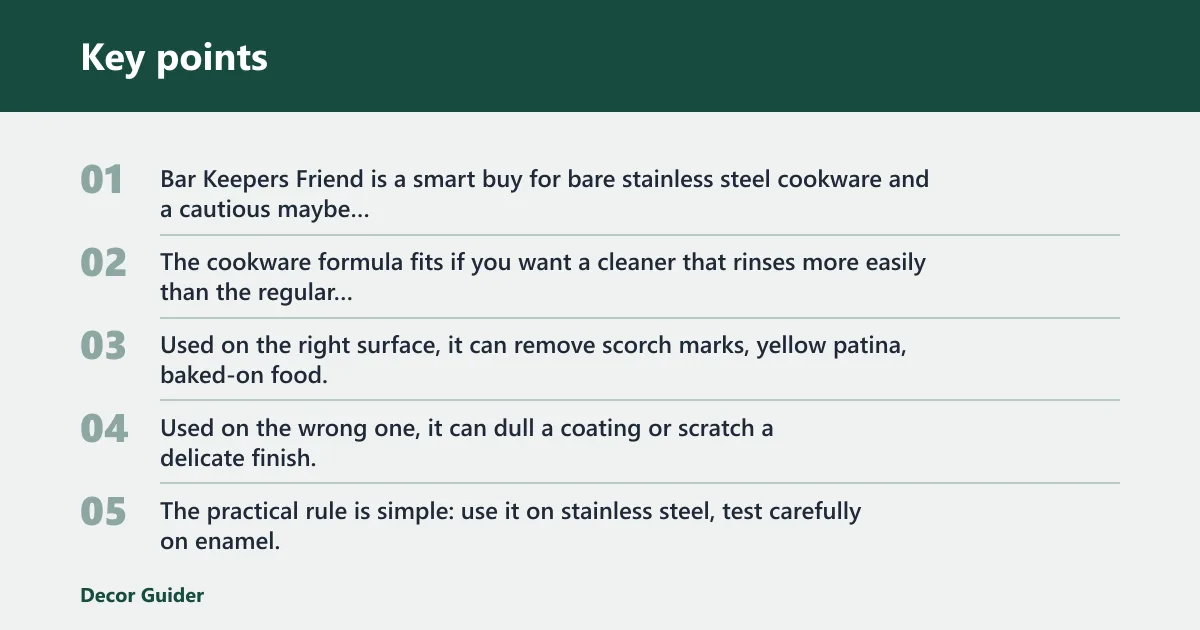
Bar Keepers Friend is a smart buy for bare stainless steel cookware and a cautious maybe for intact enamel, but it is the wrong tool for nonstick and damaged finishes. The cookware formula fits if you want a cleaner that rinses more easily than the regular powder and targets cooked-on residue without turning to a harsh degreaser.
Verdict

- Oxalic acid cleans baked-on stains on cookware
- Non-scratching formula safe for ceramic and glass tops
- Polishes stainless steel and aluminum to a streak-free shine
Used on the right surface, it can remove scorch marks, yellow patina, baked-on food, light rust, and mineral buildup. Used on the wrong one, it can dull a coating or scratch a delicate finish. The practical rule is simple: use it on stainless steel, test carefully on enamel, and skip it on nonstick or anything chipped, crazed, or already fragile.
Specs at a glance
| Spec | Cookware cleanser & polish | Why it matters |
|---|---|---|
| Form | Powder cleanser | Gives you controlled abrasion for cookware cleanup. |
| Active ingredients | Glass Oxide Abrasive, Oxalic Acid, Surfactant | Combines scouring action with acid-based stain removal. |
| Designed for | Stainless steel, glass, ceramic cookware | Best fit is hard, nonporous cookware surfaces. |
| Also claimed for | Enameled cast iron cookware | Use carefully and keep contact short. |
| Stated rinse window | Rinse within 1 minute | That limit matters most on sensitive cookware. |
| Difficult-stain option | Paste left up to 1 minute | Gives a little more dwell time without crossing the stated limit. |
| Formula difference | 50% more grease-cutting power than Powder Cleanser | Useful when grease film is part of the problem. |
Who it
This cleaner fits cooks who need a reset on stainless steel pans, stock pots, and cookware bottoms that have turned dull, yellowed, or marked by scorch spots. It also fits people who want a dedicated cookware formula rather than a general kitchen powder.
It is a poor fit for nonstick pans, ceramic-coated nonstick, chipped enamel, crazed glaze, and any finish you would rather preserve than scrub. If a pan already sheds coating, has a scratch-prone surface, or feels delicate to the touch, choose a non-abrasive cleaner first.
Best fit: stainless steel cookware
Stainless steel is the strongest match because BKF is especially good on tough chores and helps restore the metal’s shine. That includes interiors, cooking surfaces, and pan bottoms with heat staining. Wirecutter specifically notes that it restored a stainless steel pan to a shiny silver color.
Use with caution: enamel and coated surfaces
Intact enamel can usually tolerate careful use, but the contact time needs to stay short and the scrubbing light. The moment the finish is chipped, crazed, or roughened, the cleaner becomes a riskier choice. That is the point to stop and switch to a non-abrasive method.
Poor fit: nonstick and delicate finishes
Nonstick cookware needs caution because the surface itself is sensitive, and heavy abrasive scrubbing is a bad match. That warning applies even more strongly to ceramic-coated nonstick, which many shoppers mistake for true ceramic cookware. If the coating is thin or already worn, skip BKF.
What works
BKF is a powder cleanser sold as a cookware cleaner and polish, and the cookware formula is designed for stains that cling to metal after cooking: baked-on food, discoloration, grease film, and some mineral marks. The company says the cookware version has 50% more grease-cutting power than Powder Cleanser.
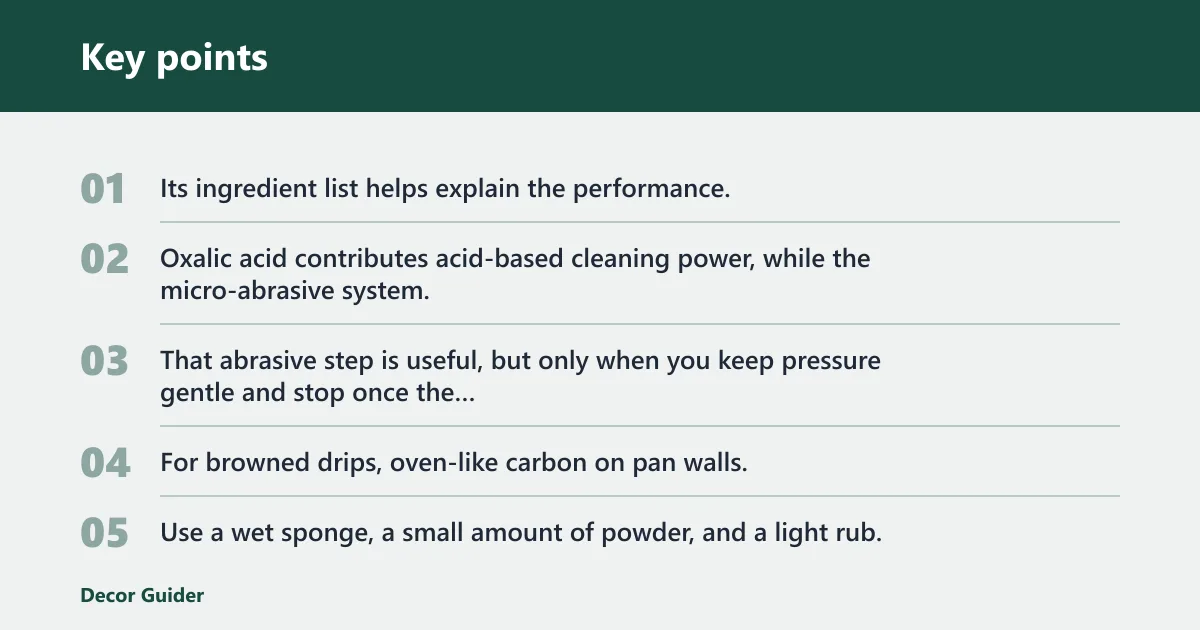
Its ingredient list helps explain the performance. Oxalic acid contributes acid-based cleaning power, while the micro-abrasive system, including Glass Oxide Abrasive, adds scouring action to lift residue. That abrasive step is useful, but only when you keep pressure gentle and stop once the stain releases.
Baked-on food on stainless steel
For browned drips, oven-like carbon on pan walls, or a ring left after simmering pasta sauce, stainless steel is the best target. Use a wet sponge, a small amount of powder, and a light rub. If the residue is still stubborn, a short paste dwell can help.
Scorch marks and yellowing
Yellow patina on stainless steel and light scorch marks on the base are classic BKF jobs. These marks are cosmetic, but they make good pans look old. A brief application can pull back the shine without needing a full soak or a harsh degreaser.
Grease, rust, and mineral buildup
The cookware formula is meant to cut grease, and its oxalic acid content also helps with some calcium and mineral buildup. It can help with light rust on suitable metal surfaces too. For a pan bottom with stuck mineral film and smoke staining, that combination is often more practical than soap alone.
Say your stainless skillet has a brown ring around the cooking zone and a dull bottom after a week of searing. BKF is the right kind of tool for that job, because the stain is on a hard surface and the fix is mostly about lifting discoloration, not preserving a fragile coating.
Suppose a soup pot has a pale mineral haze after repeated hard-water boils. A short, careful application can help, but if the deposit feels gritty or thick enough that you are pressing hard, that is the point to stop and use a soak or a descaler meant for mineral removal.
What does not?
BKF is not the right choice for every pan that looks dirty. If the surface is nonstick, chipped, crazed, or already losing its top layer, abrasion is the problem, not the cure. A cleaner with more bite can make the damage show faster.
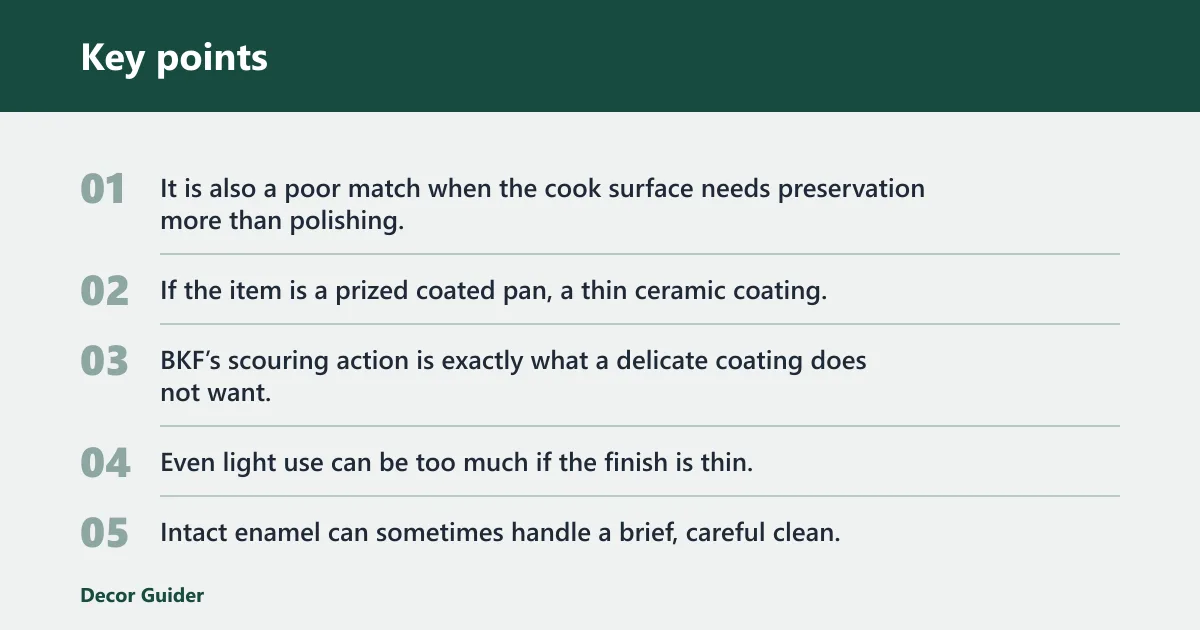
It is also a poor match when the cook surface needs preservation more than polishing. If the item is a prized coated pan, a thin ceramic coating, or any finish that already looks matte in the worn areas, start with a soft cleanser and stop before scrubbing begins.
Nonstick and other scratch-sensitive coatings
Nonstick pans are the clearest no. BKF’s scouring action is exactly what a delicate coating does not want. Even light use can be too much if the finish is thin, and heavy scrubbing is out of bounds.
Chipped or crazed enamel
Intact enamel can sometimes handle a brief, careful clean, but damage changes the decision. Chipped or crazed enamel has weak points where residue collects and the surface is easier to mark. That is where BKF becomes more likely to dull the finish than improve it.
When a non-abrasive cleaner is safer
Choose a non-abrasive method when the pan only needs deodorizing, light grease removal, or a soak to loosen food. Baking soda paste, warm soapy water, or a soft cleanser is a better first move if you are unsure about the coating or the enamel condition.
Pros and cons
Pros
- Works well on stainless steel cookware, including bottoms and interiors.
- Targets baked-on food, grease, discoloration, and light rust.
- The cookware formula is designed for easier use on pots and pans.
- Rinses within a short window, which helps limit residue on cookware.
Cons
- The 1-minute contact limit leaves little room for careless use.
- It is too abrasive for nonstick and other delicate coatings.
- Enamel needs close attention, especially if it is chipped or crazed.
- Some cookware finishes may dull if the cleaner sits too long or is rubbed too hard.
Cookware safety matrix
| Material | Safe/unsafe | Maximum contact time | Scrub intensity | Recommended tool | Stop-sign warning |
|---|---|---|---|---|---|
| Bare stainless steel | Safe | Up to 1 minute | Light to moderate | Wet sponge or soft cloth | Stop if the finish starts to haze or you feel grit resisting pressure. |
| Stainless steel cookware bottoms | Safe | Up to 1 minute | Light to moderate | Wet sponge or soft cloth | Stop if only heavy black carbon remains after a short pass. |
| Intact enameled cast iron | Cautious use | No more than 1 minute | Very light | Soft cloth or wet sponge | Stop if the enamel is chipped, crazed, or dulling under the cloth. |
| Nonstick cookware | Unsafe for heavy scrubbing | Spot test only, then brief contact if at all | Very light | Soft cloth | Stop if the coating is thin, worn, or already scratched. |
| Ceramic-coated nonstick | Use caution | Spot test only | Very light | Soft cloth | Stop if the surface is glossy, painted-looking, or easily marked. |
| Damaged enamel or crazed glaze | Unsafe | Do not use | None | Non-abrasive cleaner instead | Stop immediately if chips, cracks, or rough lines are present. |
Alternatives
BKF is not the only path to a cleaner pan. If the stain is light, the coating is fragile, or the cookware is already in good shape, a softer method often makes more sense. The cleaner should fit the surface, not the other way around.
The Bar Keepers Friend Cooktop Cleaner and Cookware Cleanser & Polish bundle is the more flexible pick if you want both a liquid for smooth surfaces and the cookware polish for pans. Based on the published product details, it fits users who want BKF’s oxalic-acid cleaning power in a two-product setup. The drawback is obvious: you are paying for a bundle, and the liquid is not the same thing as a gentle all-purpose pan wash.

Zep Heavy-Duty Oven and Grill Cleaner is better suited to very heavy grease on grates, burners, and drip pans than to cookware you care about preserving. That makes it a niche alternative, not a direct substitute for BKF on pans. It can be too aggressive for cookware finishes, so treat it as a separate job-specific cleaner rather than a universal backup.
When a soft cleanser is better
If the issue is a thin grease film, light browning, or day-to-day cleanup, a soft cleanser is usually enough. BKF is a better fit when residue has bonded to the surface or the pan has visible discoloration that soap will not shift.
When soaking or baking soda is the safer first step
For cookware with delicate coatings or a stain that is mostly food residue, a soak is the safer first move. Baking soda paste can handle mild discoloration without the same scratch risk. If that works, you never needed a more aggressive cleaner.
Should you buy it?
Buy Bar Keepers Friend Cookware Cleanser & Polish if you clean stainless steel often, want help with scorch marks and yellowing, and prefer a cookware-specific formula with a short rinse window. It is also a reasonable choice if you want the company’s stated 50% more grease-cutting power over the standard powder cleanser.
Skip it if most of your pans are nonstick or coated, if your enamel is damaged, or if you want one cleaner that can be scrubbed hard without judgment. The right decision here depends less on brand and more on finish. Stainless steel: yes. Intact enamel: maybe, carefully. Nonstick: no.
Frequently asked questions
Is Bar Keepers Friend safe on cookware?
It is safe on bare stainless steel cookware and can be used carefully on intact enamel, but it is not a good choice for nonstick or damaged finishes. The key limit is surface condition: hard, nonporous cookware can handle it better than coatings that scratch, chip, or wear through.
Is it safe to use Bar Keepers Friend on cookware?
Yes, on the right cookware and with the right timing. The company says to rinse within 1 minute, and that limit matters most on enamel and other sensitive finishes. If the pan is coated, crazed, or already worn, a non-abrasive cleaner is the safer choice.
How do you use Bar Keepers Friend on stainless steel pans?
Wet the pan, sprinkle on a small amount of powder, and rub with a wet sponge or soft cloth. Keep the pressure light, let the cleaner work briefly, then rinse thoroughly and dry. For difficult stains, you can make a paste and keep it on the surface for up to 1 minute.
Can Bar Keepers Friend remove burnt-on food from pots and pans?
Yes, especially on stainless steel pots and pans with baked-on residue. It is designed for tough cleanup, and the abrasive plus oxalic acid combination can lift cooked-on film and discoloration. If the buildup is thick or carbonized, expect to repeat a gentle pass rather than scrub harder.
Can Bar Keepers Friend damage enameled cookware?
It can, if you let it sit too long or scrub too hard. Wirecutter cautions that it should not stay on enameled cast iron for more than a minute. Chipped or crazed enamel is a harder stop, because the surface is already compromised and more likely to dull or mark.
What should you not use Bar Keepers Friend on?
Do not use it on nonstick cookware, damaged enamel, or finishes that scratch easily. Avoid mixing it with bleach or ammonia, and do not treat ceramic-coated nonstick as if it were true ceramic. If you are uncertain, test an inconspicuous spot first and stop at the first sign of dulling.
Products related to this article
Sponsored / affiliate links. As an Amazon Associate I earn from qualifying purchases. I may earn additional commission from eligible campaigns.