Bar Keepers Friend vs Baking Soda
Use Bar Keepers Friend for stubborn brown heat tint, mineral film, and stuck-on spots on stainless steel; choose baking soda for lighter grime, odor, and safer routine cleaning. Using the wrong one can scratch polished finishes, leave haze, or waste time on stains that need a mild acid instead of an alkali. This guide compares stain type, finish goal, and risk level so you can pick the cleaner that fits your pan.
When each cleaner works best
| Decision factor | Bar Keepers Friend | Baking Soda | Winner |
|---|---|---|---|
| Tough browned-on residue | More effective on the toughest stains and works well on stainless steel when used briefly. | Works on lighter buildup, but tougher spots usually need more scrubbing. | Bar Keepers Friend |
| Heat tint and yellow patina | Removes patina more completely and can bring back a brighter silver look. | May lighten grime, but often leaves a duller finish. | Bar Keepers Friend |
| Rust and mineral deposits | Targets rust and mineral film more directly because of its oxalic acid content. (Wikipedia) | Can help with light soil, but is not the stronger choice for oxidation or mineral film. | Bar Keepers Friend |
| Routine cleaning and hand comfort | Needs gloves and prompt rinsing or wiping within about a minute. | Milder for routine cleanup, though it can dry out hands and still benefits from gloves. | Baking Soda |
| Risk to finish if overworked | Can dull a polished surface if you scrub too hard or leave it on too long. | Usually gentler, but repeated heavy scrubbing can still mar a brushed finish. | Baking Soda |
Tough browned-on residue
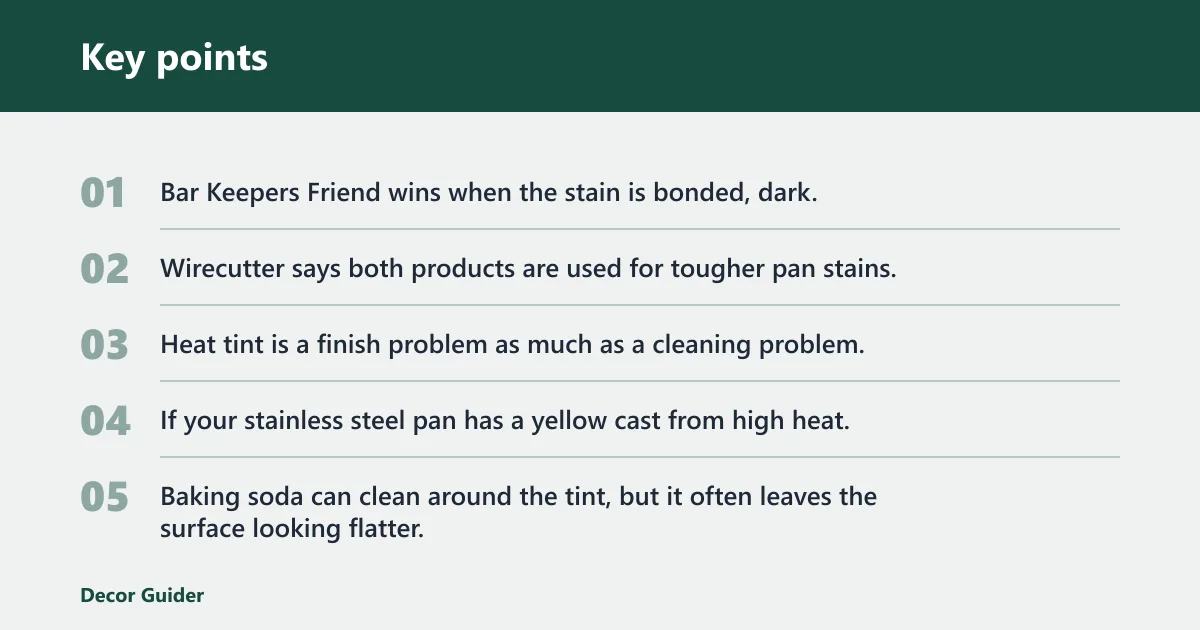
Bar Keepers Friend wins when the stain is bonded, dark, or stubborn enough that a mild alkali keeps stalling out. Wirecutter says both products are used for tougher pan stains, but BKF is more effective on the hardest ones, while baking soda often needs more scrubbing.
Heat tint and yellow patina
Heat tint is a finish problem as much as a cleaning problem. If your stainless steel pan has a yellow cast from high heat, BKF is the better fit because it removes patina more completely and can restore a brighter silver look. Baking soda can clean around the tint, but it often leaves the surface looking flatter.
Rust and mineral deposits
Rust spots and mineral film are where BKF has the clearer edge. Its oxalic acid helps lift oxidation and mineral deposits, and Wirecutter notes that it can remove rust. Baking soda is useful for many household jobs, but it is not the stronger choice for those deposits on cookware.
Routine cleaning and hand comfort
Baking soda fits better when you want a gentler touch for everyday cleanup. It is a mild abrasive cleaner and works well as a slurry or paste for grime, odor, and ordinary residue, though it can dry out hands and may still require gloves if you clean often.
Risk to finish if overworked
Both cleaners can hurt a finish if you scrub too hard, but the risk shows up differently. BKF is stronger and should not linger on the pan, while baking soda is gentler yet still can leave brushed stainless looking tired if you keep attacking the same spot with a worn pad.
How do the cleaners differ in strength and ingredients?
Bar Keepers Friend is a mildly abrasive cleaner with oxalic acid, while baking soda is sodium bicarbonate and also mildly abrasive. That chemical difference matters: BKF is often better suited to oxidation, rust, and baked-on stains, while baking soda is often better for lighter soil and routine cleaning.
Oxalic acid versus sodium bicarbonate
Oxalic acid is the ingredient that gives BKF its cleaning edge on rust and mineral deposits, but it can irritate skin. Baking soda works more as a gentle scrub in paste or slurry form, so it is less aggressive on the surface but also less forceful on hard stains.
Gloves, scrubbing, and contact time
Gloves are a good idea with both cleaners, and latex-free options make sense if your skin reacts easily. BKF should be wiped or rinsed off within about a minute, while baking soda often needs more scrubbing and may take about 15 to 30 minutes or longer for stubborn cookware stains.
Can you use baking soda instead of Bar Keepers Friend?
Yes, if the problem is light grime, odor, or routine cleanup on stainless steel, baking soda is often enough. It is also worth trying first because many kitchens already have it, but it usually falls short on heat tint, rust, and mineral deposits where BKF does more of the work.
When baking soda is enough
Choose baking soda when the pan has a thin grease film, light discoloration, or leftover food smell. A paste or slurry with a fresh scrubby side can handle that kind of job without pushing hard on the finish.
When baking soda usually falls short
Suppose a sauté pan has a brown ring around the base after high heat and a chalky line from hard water. Baking soda may loosen some surface grime, but it often will not erase the heat tint or mineral film the way BKF can.
Can Bar Keepers Friend and vinegar be used together?
For cookware, that is usually a poor shortcut. Vinegar is useful for some mineral cleanup, but pairing it with BKF does not make a better all-purpose pan cleaner, and it can distract from the real need: use the right cleaner for the stain, then rinse thoroughly.
Why the combo is a poor fit for cookware
BKF already uses oxalic acid, so adding vinegar does not turn it into a more effective stainless steel rescue step. If your goal is to remove heat tint, rust, or mineral deposits, it is better to use BKF by itself on the stain and avoid piling on extra acids.
A safer sequence for mineral deposits
If mineral film is the issue, start with a targeted cleaner and a short contact time, then rinse and dry the pan fully. If marks remain after a normal pass, switch methods rather than mixing cleaners on the surface.
Bar Keepers Friend vs Baking Soda decision table
This table maps common cookware problems to the cleaner that fits the stain type, finish goal, and risk level. It separates grime removal from shine recovery and from patina preservation, because those are not the same job.
| Cookware problem | Best cleaner | Recommended application | Expected finish result | When to stop and switch methods |
|---|---|---|---|---|
| Grease film and greasy residue | Baking Soda | Make a paste with water and scrub gently with a fresh unworn scrubby side. | Cleaner surface with a more neutral, less aggressive finish. | Stop if oily haze remains after ordinary scrubbing and move to BKF. |
| Burnt-on stains and scorch marks | Bar Keepers Friend | Use a small amount, scrub lightly, then wipe or rinse off within about a minute. | Better stain removal and a brighter silver look. | Stop if the mark is still brown after a short pass; do not keep rubbing harder. |
| Heat tint and yellow patina | Bar Keepers Friend | Apply as directed, work over the tinted area, and rinse promptly. | More complete patina removal and a cleaner stainless appearance. | Stop if you want to preserve the patina instead of removing it. |
| Rust spots and mineral deposits | Bar Keepers Friend | Target the spot directly with a damp cloth or pad, then rinse fully. | Less rust, less mineral film, and a more even sheen. | Stop if the spot does not change after a short application; do not escalate to steel wool. |
| Light odor after cooking eggs or fish | Baking Soda | Use a paste or slurry, then wash and dry as usual. | Neutralized smell with minimal surface change. | Stop if the issue is visual staining rather than odor; switch to BKF for visible discoloration. |
| Brushed stainless with a dull patch | Baking Soda | Use gentle pressure and a fresh scrub pad to avoid crossing the grain too hard. | Light cleaning with lower risk of over-polishing. | Stop if the patch is actually oxidation or patina, which BKF handles better. |
| Polished stainless with minor haze | Baking Soda | Work a thin paste and keep the scrubbing light. | May clear mild haze while protecting the gloss better than a stronger acid cleaner. | Stop if the haze is heat tint; switch to BKF for a stronger reset. |
| Cookware you want to keep aged-looking | Baking Soda | Clean only the grime, then rinse and dry without chasing a bright finish. | Less change to the natural patina. | Stop if you start removing the finish you meant to keep. |
Grease film and greasy residue
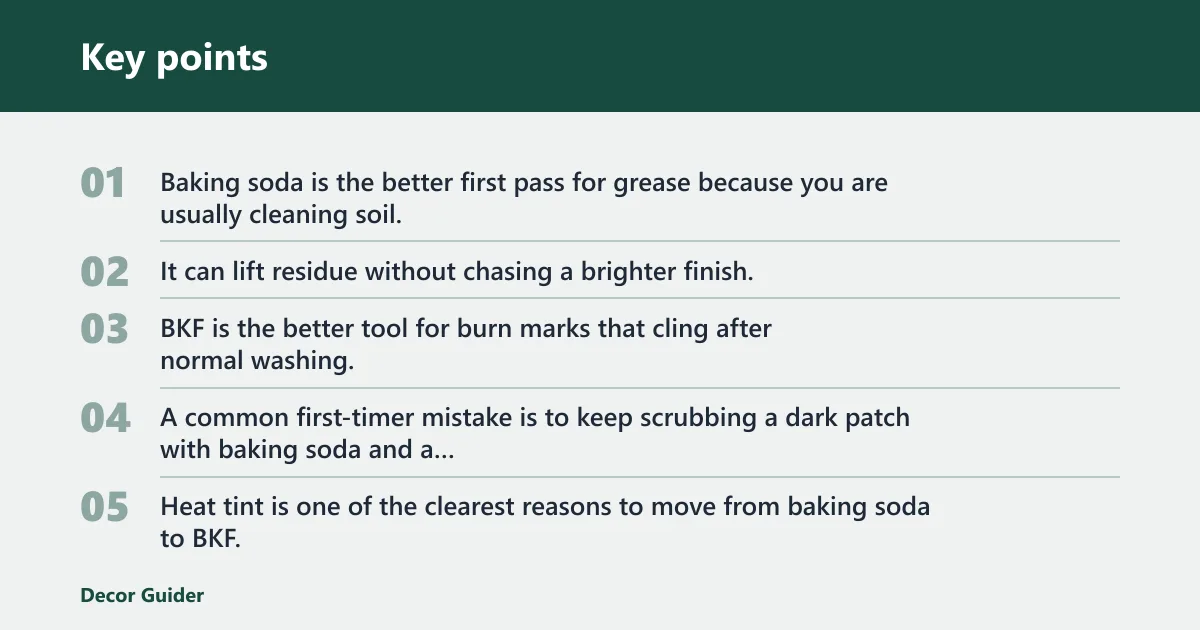
Baking soda is the better first pass for grease because you are usually cleaning soil, not restoring metal. It can lift residue without chasing a brighter finish, which matters if the pan is already in decent shape.
Burnt-on stains and scorch marks
BKF is the better tool for burn marks that cling after normal washing. A common first-timer mistake is to keep scrubbing a dark patch with baking soda and a worn pad, which can waste time and still leave the stain in place.
Heat tint and yellow patina: heat tint is one
Heat tint is one of the clearest reasons to move from baking soda to BKF. If the goal is to remove a yellowed layer and restore a brighter silver look on stainless steel, BKF is the cleaner that actually addresses that finish change.
Rust spots and mineral deposits
BKF is the right pick for rust and mineral film because the stain is chemical as much as physical. Baking soda may reduce surface grime around the spot, but it is not the better match when oxidation or hard-water residue is the real problem.
What tools matter with each cleaner
A fresh scouring pad works better with baking soda than a tired one, because the abrasive grain does the work without extra pressure. Wirecutter references a green Scotch-Brite pad for this kind of cleaning, and steel wool should be avoided on cookware because it is too harsh for many finishes.
Choose Bar Keepers Friend if… / Choose Baking Soda if…
Choose Bar Keepers Friend if the pan has brown heat tint, rust, mineral film, or a dull patina you want removed more completely. Choose Baking Soda if the job is lighter grime, odor, or routine cleaning, or if you want a gentler pass that is less likely to change the finish.

- Choose Bar Keepers Friend if the stain is stubborn and dark.
- Choose Bar Keepers Friend if you want to restore a brighter silver look on stainless steel.
- Choose Bar Keepers Friend if rust or mineral deposits are visible.
- Choose Baking Soda if the issue is light grease or everyday residue.
- Choose Baking Soda if you want a milder cleaner for routine hand washing cleanup.
- Choose Baking Soda if you want to preserve more of the existing patina.


Frequently asked questions
Is Bar Keepers Friend the same as baking soda?
No. Bar Keepers Friend is a mildly abrasive cleaner that uses oxalic acid, while baking soda is sodium bicarbonate. They overlap on simple cleanup, but they do not perform the same way on heat tint, rust, or mineral deposits.
Bar Keepers Friend vs baking soda for stainless steel
For stainless steel, BKF is the stronger choice for tough stains, patina, and rust. Baking soda is the gentler option for everyday grime, but Wirecutter says it needs more scrubbing on tougher spots and does not fully restore the bright silver look.
Bar Keepers Friend vs baking soda and vinegar
For cookware, baking soda plus vinegar is not a practical upgrade over using the right cleaner on its own. The combo can neutralize itself in part and does not solve the separate problems of burnt-on residue, oxidation, or patina as well as BKF does.
Can Bar Keepers Friend be used with vinegar?
It is better not to treat vinegar as a booster for BKF on cookware. BKF already contains oxalic acid, so the cleaner should be used by itself, then wiped or rinsed promptly. If mineral deposits remain, use a separate cleanup step rather than mixing products.
Bar Keepers Friend powder vs baking soda
Powder form does not make the products equal. BKF powder is still the stronger cleaner for rust, heat tint, and tough stains, while baking soda powder is mainly useful as a mild abrasive that works best when made into a paste or slurry.
Products related to this article
Sponsored / affiliate links. As an Amazon Associate I earn from qualifying purchases. I may earn additional commission from eligible campaigns.