Cookware Material Care Chart for Clean, Dry Storage
A cookware material care chart should match each surface to its own cleaning, drying, storage, and rescue method; if a pan is warped, rusted through, or has peeling nonstick, replace it. Wrong care shortens lifespan, invites rust, strips seasoning, and can send coating flakes into food. This guide focuses on stainless steel, cast iron, carbon steel, hard-anodized aluminum, PTFE nonstick, and ceramic nonstick.
Care matrix


The point of a cookware material care chart is simple: cleaning method, tool choice, drying, and storage all change by material. Stainless steel often takes more scrubbing and usually tolerates dishwashers better than coated pans. Cast iron and carbon steel generally need seasoning care. Nonstick usually needs gentler tools, lower heat, and earlier replacement once the coating starts to fail.
| Material | Cleaning method | Safe tools | Forbidden products | Drying method | Re-seasoning or re-conditioning | Common failure signs | Replacement triggers |
|---|---|---|---|---|---|---|---|
| Stainless steel | Hot water, dish soap, and a nylon scrubber for stuck food; soak briefly if needed. | Soft sponge, nylon scrubber, pan scraper, microfiber cloth. | Steel wool on polished surfaces, chlorine bleach, harsh oven cleaner. | Dry immediately to reduce water spots and mineral film. | No seasoning; a polish or vinegar rinse can help with haze or spotting. | Rainbow heat tint, white spotting, burnt-on residue, fine scratches, dull polish. | Deep warping, cracked handle welds, severe pitting, or loose rivets. |
| Cast iron | Warm water, a small amount of soap if needed, then scrub lightly and rinse fast. | Nylon brush, chainmail scrubber, pan scraper, paper towel, light cooking oil. | Long soaks, dishwasher use, soaking with acidic foods, abrasive pads. | Heat on the stove or in the oven until fully dry, then wipe with a thin oil layer. | Yes, when seasoning looks dry, patchy, or stripped after cleaning or acid use. | Rust, rough patches, dull gray surface, sticky spots, food sticking more than usual. | Cracks, large broken edges, or rust that has eaten through the surface. |
| Carbon steel | Rinse soon after cooking; clean with warm water and mild soap, then dry fast. | Soft sponge, nylon scrubber, pan scraper, towel, a thin coat of oil. | Long acid baths, soaking, steel wool, dishwasher cycles. | Dry on heat, then wipe with oil to slow rust. | Yes, when the surface turns patchy, dry, or loses its dark seasoning. | Rust specks, pale patches, sticky seasoning, discoloration after acidic sauces. | Deep rust that returns after cleaning, warping, or a cracked handle. |
| Hard-anodized aluminum | Hard-anodized aluminum should usually be hand-washed with warm water and mild soap; avoid heavy scouring. | Soft sponge, nylon scrubber, microfiber cloth, wooden or silicone utensil. | Abrasive pads, steel wool, harsh powders, chlorinated cleaners. | Dry with a towel to limit spotting and dull film. | No seasoning; surface care is about protecting the anodized finish. | Scratches, dull gray streaks, pitting, uneven cleaning, damaged nonstick topcoat if present. | Severe gouges, warped base, flaking coating on a coated model. |
| PTFE nonstick | PTFE nonstick should usually be cooled first, then washed by hand with mild soap and a soft sponge. | Soft sponge, silicone spatula, wood spoon, nylon scrubber for light residue. | Metal utensils, aerosol sprays, high heat, abrasive pads, oven cleaner. | Air-dry or towel-dry; do not stack while damp. | No seasoning; coating wear is not fixed by oil or heat. | Reduced release, flaking, scratches, sticky patches, discoloration after overheating. | Any peeling, blistering, or loss of release across cooking areas. |
| Ceramic nonstick | Low-heat residue should be washed gently after cooling; hand washing is safest. | Soft sponge, wooden spoon, silicone spatula, nylon scrubber, pan scraper. | Aerosol sprays, abrasive pads, steel wool, very high heat, harsh cleaners. | Towel-dry fully before storage. | No seasoning; some residue can be reduced, but worn release does not come back. | Loss of slickness, brown film, uneven release, micro-scratches, faster sticking over time. | Widespread sticking, exposed base, peeling topcoat, or a warped pan bottom. |
How to read the material matrix
The cleaning column tells you how much force the surface can take. The safe tools column shows what can touch the pan without cutting the surface. The forbidden products column matters because the wrong cleaner can do damage that looks like staining at first and then becomes permanent wear.
The drying column matters just as much. Water left on stainless steel can spot. Water left on cast iron or carbon steel can rust. The re-seasoning column applies to seasoned metals, while nonstick sections focus on when the coating has aged past repair.
Quick rules before you wash a pan
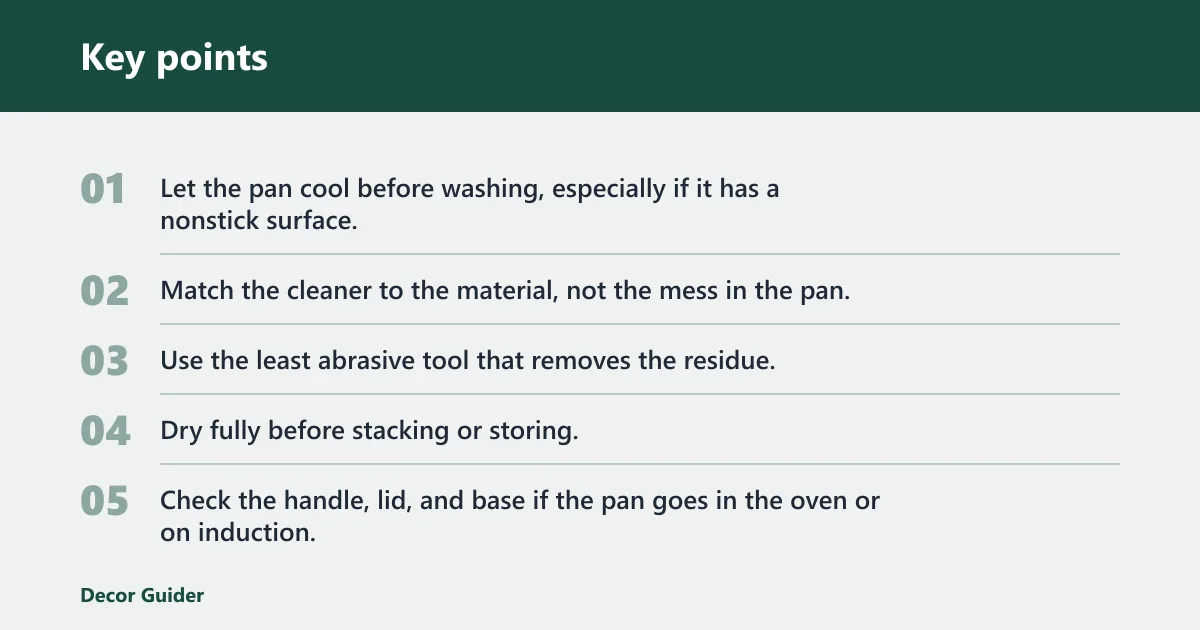
- Let the pan cool before washing, especially if it has a nonstick surface.
- Match the cleaner to the material, not the mess in the pan.
- Use the least abrasive tool that removes the residue.
- Dry fully before stacking or storing.
- Check the handle, lid, and base if the pan goes in the oven or on induction.
📊 Consumer Reports shows Caraway Ceramic-Coated Non-Stick cookware at 14 pieces. Source: Cookware Ratings & Reviews.
How should you care for each cookware material?
Use the same care habit every time: clean with the mildest tool that works, dry fully, and store so the surface does not rub against hard edges. Material matters because stainless steel, cast iron, carbon steel, hard-anodized aluminum, PTFE nonstick, and ceramic nonstick all fail in different ways.
Stainless steel care
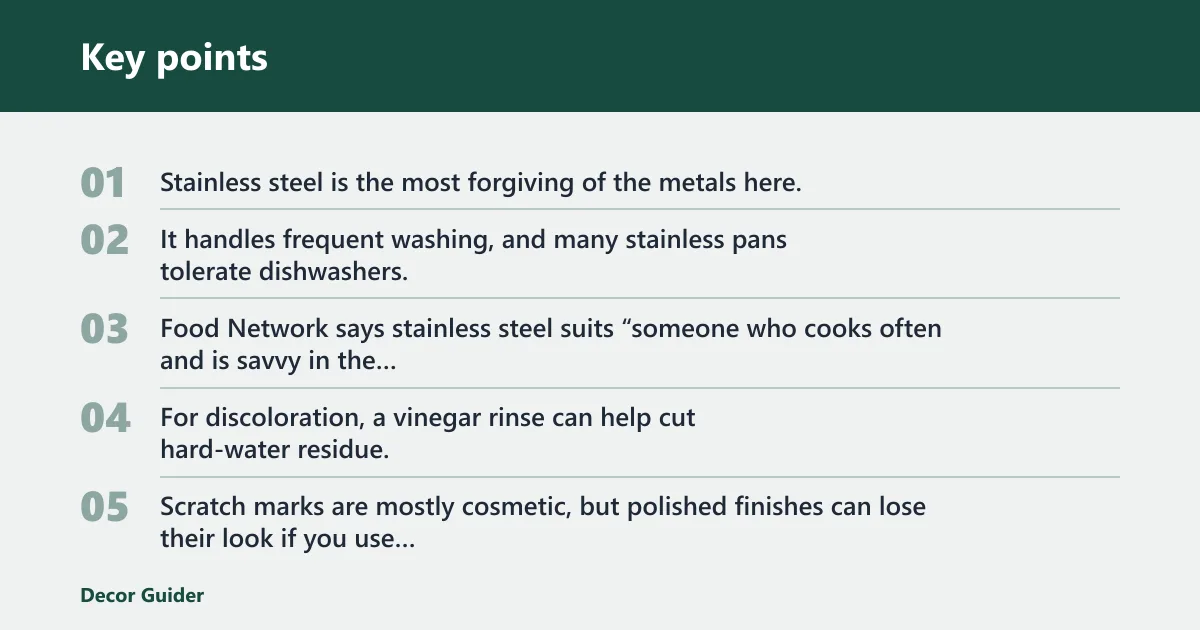
Stainless steel is the most forgiving of the metals here. It handles frequent washing, and many stainless pans tolerate dishwashers, although immediate drying helps prevent spotting and mineral haze. Food Network says stainless steel suits “someone who cooks often and is savvy in the kitchen.”
For stuck-on food, add hot water to the pan after it cools a bit, then use a nylon scrubber or a pan scraper. For discoloration, a vinegar rinse can help cut hard-water residue. Scratch marks are mostly cosmetic, but polished finishes can lose their look if you use steel wool or harsh powder cleaners.
Cast iron care
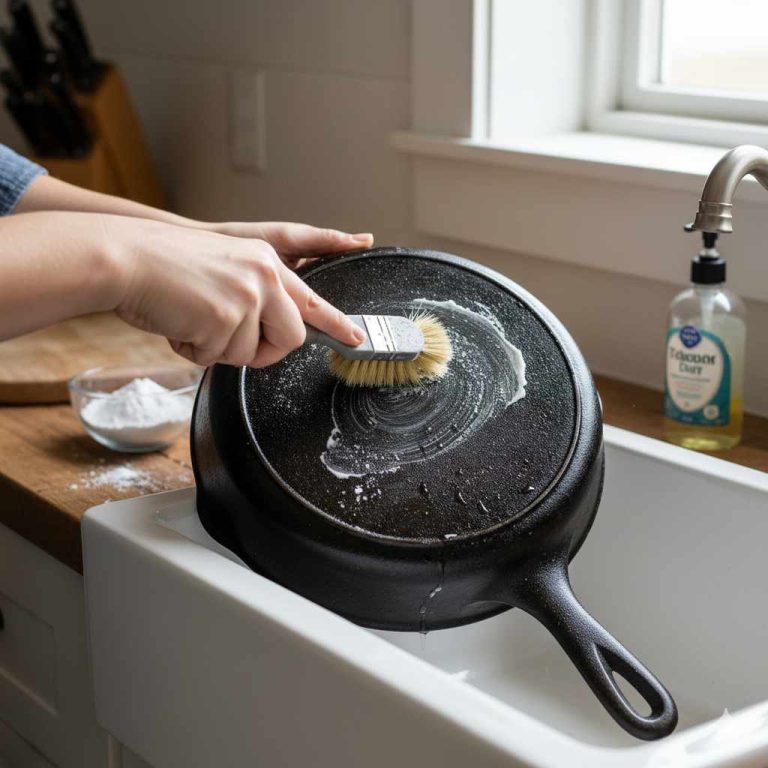
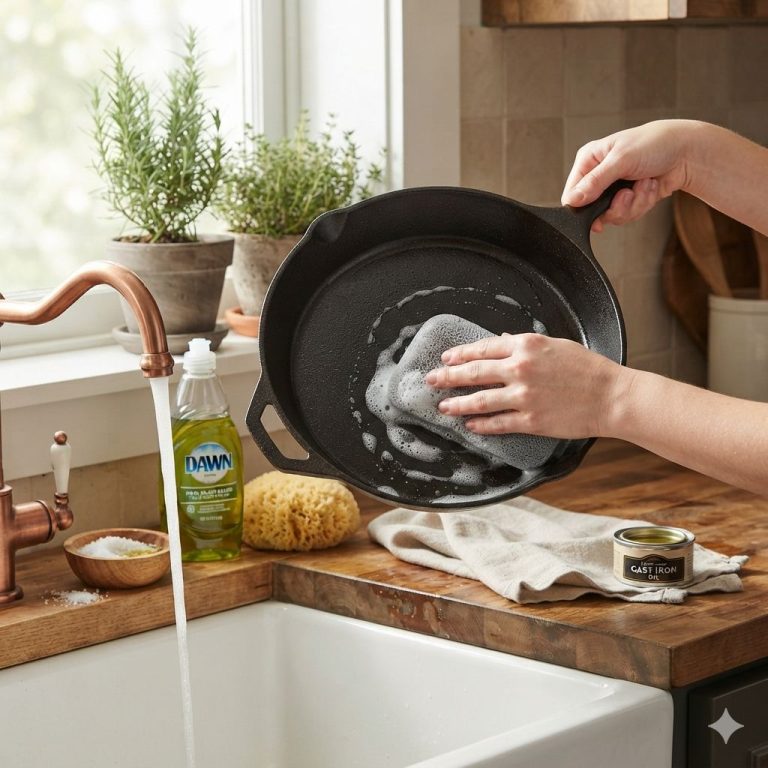
Cast iron needs seasoning to stay stable. Clean it soon after cooking, especially after salty or acidic food, then dry it with heat and wipe on a thin coat of oil. Soap is acceptable in small amounts when you need to remove residue, but long soaking is a fast route to rust.
A common first-timer mistake is leaving a cast-iron skillet in the sink overnight after tomato sauce. The surface can flash rust by morning, and the seasoning may feel rough or patchy. If the pan looks dry, gray, or sticky after washing, it needs re-seasoning before regular use resumes.
Carbon steel care
Carbon steel behaves like cast iron’s lighter cousin. It heats faster and weighs less, but it also wants seasoning upkeep and fast drying. Clean it with mild soap after cooking, then dry on heat and wipe with a small amount of oil. Acidic foods can dull the seasoning, so deglaze carefully and avoid leaving sauces in the pan.
If the surface turns blotchy, rust-specked, or sticky, re-season it. If rust returns after cleaning and oiling, the pan may be too far gone for routine rescue.
Hard-anodized aluminum care
Hard-anodized aluminum is valued for even heating and lighter weight, but the surface is less abrasion tolerant than bare stainless steel. Hand washing is the safest default. Use a soft sponge and mild soap, then dry promptly so mineral marks do not build up on the finish.
Avoid metal scourers and harsh cleaners because they can roughen the anodized surface. If the pan also has a nonstick layer, treat that topcoat by the coating rules, not by bare aluminum rules. Hard-anodized pans often spread heat well, so medium heat is usually enough for everyday cooking.
PTFE nonstick care
PTFE nonstick performs best when you keep heat moderate and avoid preheating empty pans for long periods. Use silicone or wood tools. Hand washing is the safest choice, even if some labels allow dishwashers, because dishwasher performance varies by model and detergent strength.
Do not use aerosol sprays. They can leave a sticky film that bakes onto the coating. Once PTFE starts peeling, blistering, or losing release across most of the cooking area, cleaning will not restore it. That is a replacement sign, not a polishing problem.
Ceramic nonstick care
Ceramic nonstick likes low to medium heat. Food Network identifies ceramic cookware sets as best for higher heat and oven use, but you still need to follow the brand’s maximum temperature and handle limits. Clean it gently after cooling, and do not use aerosol sprays on the surface.
Over time, ceramic nonstick often loses slickness before it peels. That wear is common. A soft sponge and mild soap can remove residue, but they cannot rebuild the coating. If food starts sticking across the pan rather than in one spot, the finish is nearing the end of its usable life.
Say your 10-inch ceramic nonstick skillet is set on medium-high heat for an empty preheat, then used for eggs. If the center browns quickly and the release fades within months, the problem is the heat pattern and coating wear, not the cleaning routine. Lower heat and gentler tools help, but they do not fix a worn coating.
What cleaning tools and products are safe?
Use non-scratch tools first. Nylon scrubbers, soft sponges, pan scrapers, wood spoons, and silicone spatulas cover most jobs without cutting seasoning or coating. If the residue still does not move, change the method before you change to a harsher product.
Nylon scrubbers, pan scrapers, and soft sponges
Nylon scrubbers are the workhorse for stainless steel, cast iron, carbon steel, and many coated pans. Pan scrapers help lift browned fond from stainless steel and seasoned metal. Soft sponges are best for everyday washing, especially on nonstick and anodized surfaces.
Wood, silicone, and other non-scratch utensils
Wood and silicone are safer than metal utensils on PTFE and ceramic nonstick, and they reduce edge wear on seasoned pans too. Wooden spoons are especially useful for deglazing and for loosening food while the pan is still warm. Silicone spatulas are a good fit when you want a flexible edge without scraping the coating.
What to avoid: abrasive pads, steel wool, and harsh cleaners
Abrasive pads and steel wool can cut through polished stainless finishes, strip seasoning from cast iron and carbon steel, and rough up anodized aluminum. Harsh cleaners, including oven cleaner and strong chlorinated products, are poor choices unless the manufacturer specifically allows them. Aerosol nonstick sprays are also a common source of sticky buildup.
How do you handle stuck-on food and stains?
Stuck-on food is a cleaning problem, not always a damage problem. Stainless steel can often be soaked and scraped. Seasoned metal needs a different approach because aggressive scrubbing can remove the layer that keeps food from sticking. Coated pans should be treated gently so residue comes off without tearing the finish.
Deglazing and soaking for stainless steel
For stainless steel, add water to a still-warm pan, then bring it back to a gentle simmer if needed. That loosens browned bits. A nylon scrubber or scraper can finish the job. For stubborn grease, a paste of mild cleaner and water is safer than a hard abrasive.
Mineral buildup and water spots
White spots on stainless steel and anodized aluminum often come from hard water. Drying immediately after washing prevents most of it. If spotting keeps returning, a short vinegar rinse can help break mineral residue. Dry again right away so the rinse itself does not leave a film.
Suppose a stainless sauté pan dries with cloudy circles every time, even after soap and a soft sponge. That is usually hard-water residue, not corrosion. A quick vinegar rinse, followed by towel drying, usually does more than scrubbing harder.
Cloudy residue, discoloration, and stubborn film
Cloudiness on stainless steel can come from detergent residue, mineral buildup, or heat tint. Brown film on nonstick often comes from oil that was heated too high or spray residue that baked on. On ceramic and PTFE coatings, the film may look cleanable at first, but a slickness loss usually means surface wear, not just dirt.
When do you need to re-season or re-condition?
Re-seasoning applies to cast iron and carbon steel. Re-conditioning is a looser term for removing buildup, drying fully, and restoring a stable oil layer or clean surface. Nonstick coatings do not get re-seasoned in the cast-iron sense, and oil cannot restore a worn coating.
Cast iron seasoning signs
Cast iron needs re-seasoning when it looks dull gray, feels dry, or starts to stick after normal cooking. Rust spots, a tacky finish, and patchy color are other signs. If the food release worsens after washing and drying, the protective layer needs another round of oil and heat.
Carbon steel seasoning signs
Carbon steel needs re-seasoning when the dark layer turns blotchy or thin, especially after acidic food or repeated scrubbing. If you see orange specks, pale patches, or uneven release, clean the pan, dry it fully, then rebuild the surface with a thin layer of oil and heat.
When a nonstick surface has moved past recovery
For PTFE and ceramic nonstick, the cutoff is simple: peeling, blistering, exposed base, or broad loss of release means replacement. You can remove residue and reduce buildup, but you cannot rebuild a worn coating into a safe, durable surface. That is especially true after overheating damage.
What should you check for heat and oven limits?
Oven-safe ratings and handle limits vary by model, even within the same brand. Always check the specific pan, lid, and handle before using high heat. Cookware care changes when a pan goes from stovetop to oven because knobs, silicone grips, and nonstick coatings may have lower limits than the body.
Brand-specific oven-safe temperatures
Consumer Reports lists All-Clad Essentials as a 10-piece set in hard-anodized aluminum, oven-safe to 500°F, with lids to 350°F. The same source lists Caraway Ceramic-Coated Non-Stick cookware at 14 pieces, with an oven-safe limit of 550°F. The same source lists GreenPan Spectra Thermobond Hybrid as oven-safe to 850°F, with lids to 425°F.
Handle and lid temperature limits
Handles and lids often limit the whole pan before the body does. A metal pan body may tolerate more heat than a glass lid or a silicone-wrapped handle. If the lid limit is lower, remove the lid before the oven step or keep the whole pan below the lid rating.
Heat settings for ceramic and nonstick cookware
Low to medium heat is the safe lane for most ceramic and PTFE nonstick. High heat shortens coating life, can warp lightweight pans, and can cause discoloration that looks like dirt but is actually heat damage. If the pan smokes while empty, the setting is too high.
Induction compatibility and storage basics
Induction cookware must have a magnetic base. Stainless steel is not automatically induction-ready; the base must be magnetic. Hard-anodized aluminum and many nonstick pans need a bonded magnetic disc or core. Check the bottom marking or product details before you count on induction use.
Magnetic base checks
A simple magnet test tells you whether a pan will work on induction. If the magnet sticks firmly to the base, the pan is more likely to work. If it barely grabs, the cooktop may not detect it well. Lighter pans with thin bases can heat unevenly on induction even when they are technically compatible.
Base thickness and heat response
Thicker bases usually spread heat more evenly, which matters on induction, gas, and electric ranges alike. Thin bases respond faster but can warp sooner if overheated or cooled too fast. That is one reason storage and drying matter; corrosion and warping both shorten the working life of a pan.
Storage habits that reduce scratches and rust
Store pans fully dry. Stack only with pan protectors, soft cloths, or paper towels between layers. Do not trap moisture inside cast iron or carbon steel lids. For nonstick, avoid nesting with sharp metal edges that can scratch the release layer during removal.
Frequently asked questions
How do I care for ceramic coated cookware?
Clean ceramic coated cookware with a soft sponge, mild soap, and cool-to-warm water after the pan has cooled. Use low to medium heat while cooking, avoid aerosol sprays, and dry it fully before storage. If food begins sticking across the surface, the coating is wearing out rather than dirty.
How do I care for All-Clad cookware?
For the All-Clad Essentials hard-anodized aluminum set, hand washing is the safer default, and Consumer Reports lists the set as oven-safe to 500°F, with lids to 350°F. Use soft tools, avoid abrasives, and dry right away to limit spotting. Check the lid and handle limit before oven use.
What is the best way to clean stainless steel cookware?
Wash stainless steel with hot water, dish soap, and a nylon scrubber, then dry it right away. For stuck-on food, soak briefly or deglaze with water while the pan is warm. A vinegar rinse can help with hard-water spots and cloudy residue that soap does not remove.
Can nonstick cookware go in the dishwasher?
Sometimes, but hand washing is the safer choice for both PTFE and ceramic nonstick. Dishwasher detergent, heat, and spray patterns can shorten coating life, and some brands warn against it entirely. If a label allows dishwashing, that is a limit, not a best practice, especially for long-term use.
What heat should I use for ceramic nonstick cookware?
Use low to medium heat for ceramic nonstick. High heat can damage the coating, cause smoke, and leave brown film that is hard to remove. If you need a hotter oven step, check the exact brand limit first, because oven-safe ratings and lid limits vary widely.
What cookware material is easiest to maintain?
Stainless steel is usually the easiest to maintain because it tolerates more aggressive cleaning than seasoned or coated pans and can often handle dishwashers. Still, it needs immediate drying to avoid spots. If you want the least fussy daily cleanup, stainless steel usually asks for fewer special steps.
What cookware material lasts longest with proper care?
Cast iron and stainless steel often last the longest when cared for correctly. Cast iron can survive for decades if seasoning stays intact and rust is kept away. Stainless steel also lasts a long time because its cooking surface is not a coating that can peel off.
How to care for ceramic coated cookware
Clean ceramic coated cookware with a gentle sponge, mild soap, and low-pressure scrubbing after it cools. Avoid aerosol sprays and high heat. Dry it completely before stacking. If the surface keeps losing release or shows broad sticking, the coating is worn and the pan needs replacement.
How to care for all clad cookware
For All-Clad hard-anodized cookware, use hand washing, soft tools, and prompt drying. The same source lists the All-Clad Essentials set as oven-safe to 500°F, with lids to 350°F, so check the lid before oven use. Do not use abrasive pads that can roughen the anodized finish.
Products related to this article
Sponsored / affiliate links. As an Amazon Associate I earn from qualifying purchases. I may earn additional commission from eligible campaigns.