Scotch-Brite Non-Scratch Sponge Review
Claims about sanitizing cycles, review counts, and speed are attributed below to manufacturer-published product details unless otherwise noted.
Verdict
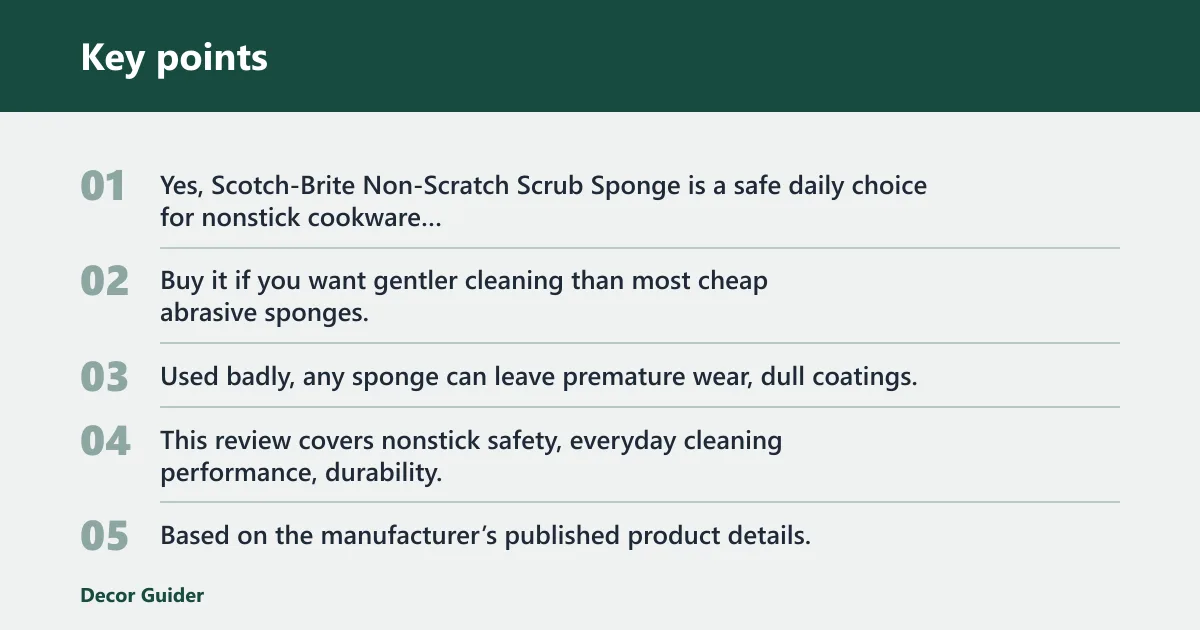

Yes, Scotch-Brite Non-Scratch Scrub Sponge is a safe daily choice for nonstick cookware when you use light pressure and skip dried-on, gritty debris. Buy it if you want gentler cleaning than most cheap abrasive sponges. Used badly, any sponge can leave premature wear, dull coatings, and stubborn residue that takes more effort to remove later. This review covers nonstick safety, everyday cleaning performance, durability, and whether it beats cheaper alternatives.
Based on the manufacturer’s published product details, this sponge fits best as an everyday maintenance tool rather than a heavy-restoration tool. The claims you will see most often are that it is safe for nonstick cookware, made with 100% recycled plastic fibers, and can be sanitized in the dishwasher top rack up to 20 times. Scotch-Brite also markets the sponge as cleaning up to 3x faster than value brands; that is a manufacturer claim, not an independently verified benchmark in this article. The practical tradeoff is that odor and wear can still become issues with frequent use, and baked-on residue usually needs a stronger tool.
Specs at a glance
| Spec | What to know |
|---|---|
| Product type | Dual-layer kitchen sponge |
| Scrubbing surface | Non-scratch scrubbing side |
| Nonstick compatibility | Safe for nonstick cookware |
| Other surfaces noted in published details | Glass, ceramic, stainless steel, and countertops |
| Sanitizing method | Dishwasher top rack |
| Sanitizing claim | Can be sanitized up to 20 times |
| Scrub fiber material | 100% recycled plastic |
| Value comparison claim | Presented as cleaning up to three times faster than value brand sponges |
| Review volume cited | Over 63,000 reviews |
| Rating cited | 4.7 stars |
| Price cited in supplied facts | About $5 for a pack of six |
Who it
This sponge suits home cooks who want one daily-use cleaner for nonstick pans, glass, countertops, and other smooth kitchen surfaces. It also fits buyers who want a reusable sponge they can refresh in the dishwasher instead of tossing after a short run.
It is less suitable if your cleaning routine centers on scorched sugar, thick burnt sauce, or heavily textured cookware that traps residue. In those cases, a scraper, brush, or abrasive pad usually does the job with less effort.
Pros and cons
- Pros: safe for nonstick cookware; non-scratch scrubbing surface; dishwasher top-rack sanitizing; recycled plastic scrub fibers; described as faster than value-brand sponges for some jobs.
- Cons: not ideal for heavy baked-on messes; odor can become an issue with repeat use; lifespan feedback is mixed, with wear or tearing possible over time.
What works
The strongest case for this sponge is routine cleanup. Grease, film, and light stuck-on food are the kinds of messes it is built to handle without being harsh on a finish. For daily sink work, pan washing, and countertop wipe-downs, the non-scratch side gives you more control than a rougher scrubber.
On cookware maintenance, that matters. Nonstick coatings are delicate, so the goal is to lift residue without sanding the surface. A non-scratch sponge helps you clean while keeping pressure low, which is the safer approach for coatings that can wear down from repeated abrasion.
Picture a 10-inch nonstick skillet with a thin layer of scrambled egg and oil film. A few passes with a gentle sponge usually make sense here. A heavy scouring pad does not, because the job does not require abrasion to begin with.
Say your stainless-steel pot has a ring of sauce and some light grease at the rim. This sponge can handle that kind of cleanup, but it is most useful when the soil is loose enough to wipe away after soaking or a quick rinse.
What does not?
It is not the best tool for burnt-on residue, heavy grease build-up, or neglected cookware with rough texture. Once food has hardened into a crust, a non-scratch sponge often becomes the wrong first step because it can smear the mess around without breaking it down fast enough.
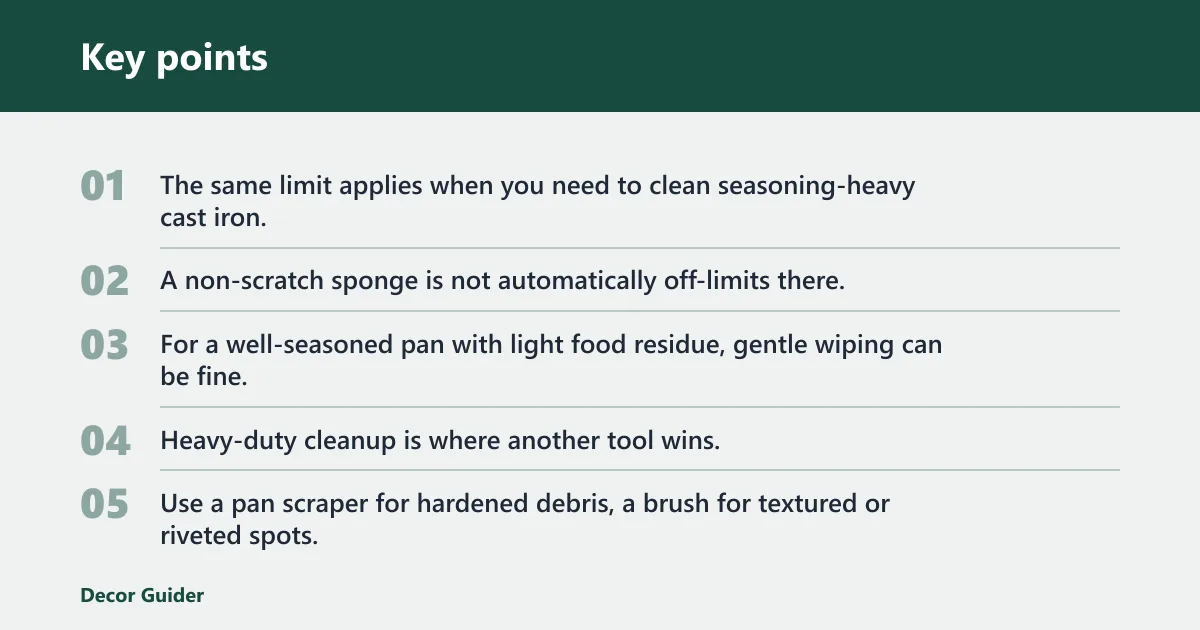
The same limit applies when you need to clean seasoning-heavy cast iron. A non-scratch sponge is not automatically off-limits there, but the real question is how much abrasion the pan can tolerate and whether soap, scrubbing pressure, or residue removal threatens the seasoning. For a well-seasoned pan with light food residue, gentle wiping can be fine; for stuck-on carbonized bits, a scraper or brush usually works better.
Heavy-duty cleanup is where another tool wins. Use a pan scraper for hardened debris, a brush for textured or riveted spots, and an abrasive pad only when the surface can tolerate that level of scrubbing.
Sponge decision table
| Cookware surface | Safe use | Ideal mess type | Hygiene risk | When to switch tools |
|---|---|---|---|---|
| Nonstick | Yes, with light pressure and no gritty debris | Grease, film, loose food, light stuck-on bits | Low if you rinse promptly and sanitize often; food residue can linger if the sponge stays damp | Switch to a scraper or soak first if residue is dried, crusted, or sandy |
| Stainless steel | Yes for routine washing and gentle scrubbing | Oil, sauce, water spots, everyday stuck-on food | Moderate if you use it across raw-food messes without washing the sponge well | Switch to a non-scratch pad or scraper for browned-on stains and stubborn polymerized grease |
| Ceramic | Yes if the glaze is intact and you avoid force | Light grease, food smears, countertop transfer | Low on intact surfaces; higher if the glaze is chipped because debris can collect in damaged areas | Switch to a brush or targeted scrub tool for embedded residue in chips, seams, or textured edges |
| Cast iron | Conditionally yes, depending on seasoning and the amount of pressure | Loose food, light residue, post-cook cleanup | Moderate, because moisture left behind and aggressive scrubbing can threaten seasoning maintenance | Switch to a scraper or stiff brush for stuck-on bits, and avoid over-scrubbing seasoned surfaces |
How does Scotch-Brite non-scratch sponge compare with value-brand sponges?
Against value-brand sponges, the main selling point is speed and consistency. The product is presented by the manufacturer as cleaning up to three times faster than value brand sponges, which matters if you wash pans, plates, and sink items every day and want fewer passes on ordinary messes.
The cheaper alternative can still be enough for light-duty sink work or backup rotation. The tradeoff is that a basic sponge may lack the same scrubbing efficiency and may not give you the same confidence on delicate surfaces. If your routine is mostly rinsing plates and wiping counters, a budget sponge can be acceptable; if you regularly clean nonstick cookware, the Scotch-Brite option is the safer fit.
Odor and durability are the other separators, and neither is perfect here. Buyer feedback is mixed on smell over time, and lifespan comments vary enough that you should expect some wear if you use it daily. Sanitizing helps, but it does not make a sponge maintenance-free.
Should you buy it?
Choose Scotch-Brite Non-Scratch Scrub Sponge if you want a gentle daily cleaner for nonstick pans, glass, ceramic, stainless steel, and countertop work. It makes the most sense in a kitchen where you care about protecting finishes, refreshing sponges in the dishwasher, and handling everyday grease without reaching for an abrasive pad.
Skip it if your sink routine leans heavily toward burnt-on casseroles, scorched pans, or rough cleanup on textured cookware. In that case, a scraper, brush, or stronger scrubber will do more of the work. A common first-timer mistake is trying to force a non-scratch sponge through a dried sauce ring; soaking first usually saves both time and elbow grease.
For households that want a budget-friendly rotation sponge with sanitizing built in, this is a solid choice. For households that prioritize odor resistance above all else, or expect a long, problem-free lifespan from every sponge, the value is less clear because the maintenance burden still exists.
Pros and cons recap
- Good fit: daily nonstick-safe cleaning, easy sanitation, recycled plastic scrub fibers, wide general-kitchen use.
- Less convincing: heavy baked-on residue, odor control over time, and long-term wear under frequent use.
Alternatives
Scotch-Brite Zero Scratch Scrub Sponge is the closest substitute if you want the same brand’s non-scratch cleaning approach and a similar everyday-use profile. It is also described as safe on nonstick surfaces and aimed at grease, grime, and dirt, but the alternative listing in this review set is better treated as a comparison option than a separate recommendation. The main drawback is the same one that applies to most non-scratch sponges: it still is not the best answer for heavy baked-on soil.
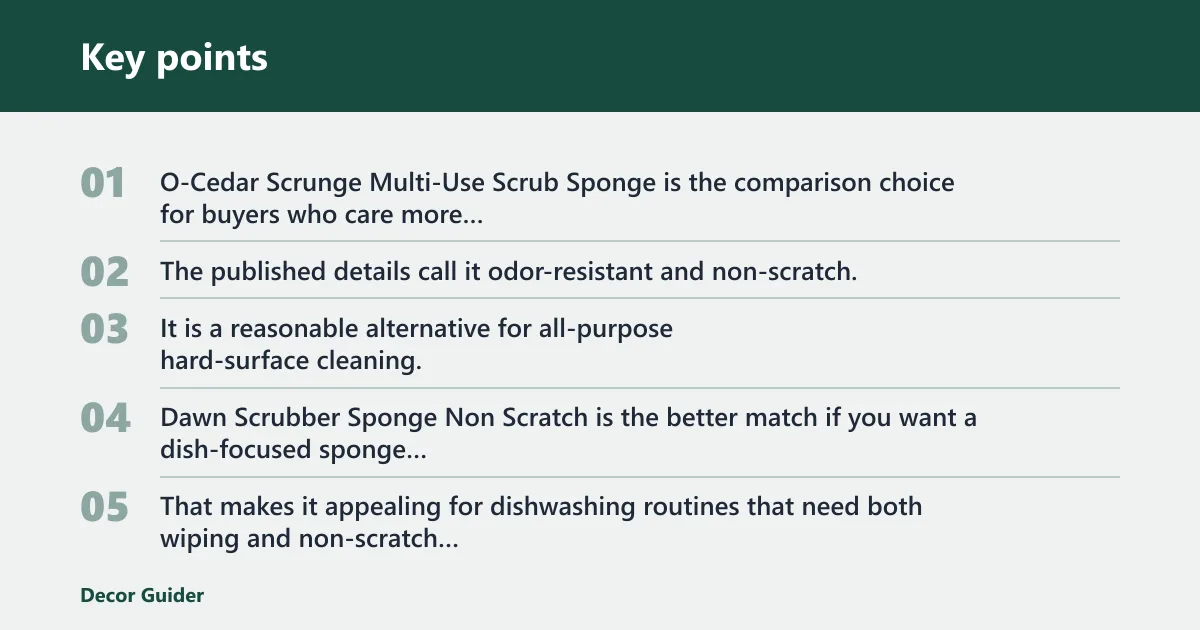

O-Cedar Scrunge Multi-Use Scrub Sponge is the comparison choice for buyers who care more about odor resistance than a cheapest-possible rotation. The published details call it odor-resistant and non-scratch, but the higher listed price makes it a different value proposition, not a better default. It is a reasonable alternative for all-purpose hard-surface cleaning, though the cost is harder to justify if you mainly want a basic nonstick-safe sponge.

Dawn Scrubber Sponge Non Scratch is the better match if you want a dish-focused sponge with a soft cellulose side and a top-rack dishwasher-safe reuse claim. That makes it appealing for dishwashing routines that need both wiping and non-scratch scrubbing. The tradeoff is that the published price is much higher than the Scotch-Brite option in the supplied data, so it is a less budget-friendly path.
Frequently asked questions
Is Scotch-Brite non-scratch sponge safe for nonstick pans?
Yes, it is described as safe for nonstick cookware, and that is the use case that makes the most sense for it. Keep pressure light, rinse away gritty particles first, and stop if the pan has crusted-on residue. Nonstick finishes do best with gentle cleaning, not repeated force.
How long does Scotch-Brite non-scratch sponge last?
The product details do not give a lifespan figure, and buyer feedback appears mixed on longevity. The practical takeaway is that daily use can lead to wear, tearing, or a tired feel over time. If you clean often, plan on replacing it before the sponge starts to smell, fray, or lose shape.
Does Scotch-Brite non-scratch sponge smell bad over time?
Odor resistance is not a guaranteed strength here. User feedback is mixed, and smell depends heavily on how well you rinse, dry, and sanitize the sponge. If it sits wet in a sink caddy, it is more likely to develop an off smell than if you refresh it regularly and let it dry between uses.
Can I sanitize Scotch-Brite non-scratch sponges in the dishwasher?
Yes. The sponge can be sanitized in the dishwasher top rack, and the manufacturer claim says that sanitizing can happen up to 20 times. That makes it a stronger fit for kitchens that want a reusable sponge with a built-in hygiene refresh, though sanitizing does not replace regular replacement.
Is Scotch-Brite non-scratch sponge worth it for everyday dishwashing?
For many households, yes. It is a sensible everyday sponge if you want gentle scrubbing, nonstick safety, and the option to sanitize in the dishwasher. It is less compelling if your routine is mostly burnt-on cleanup, because that work belongs to a scraper, brush, or abrasive pad.
What surfaces can Scotch-Brite non-scratch sponge clean without scratching?
Published details point to nonstick cookware, glass, ceramic, stainless steel, and countertops. That range makes it useful as an all-purpose kitchen sponge, but the key limit is pressure and debris type. Smooth, intact surfaces are the best fit; rough or damaged areas need a different tool.
Products related to this article
Sponsored / affiliate links. As an Amazon Associate I earn from qualifying purchases. I may earn additional commission from eligible campaigns.