Best Bookshelf Ideas for DIY Beginners: 7 Easy Builds
For DIY beginners, the best bookshelf ideas are a simple open-box shelf, a wall-mounted picture ledge, and a basic cube shelf. Pick the one with the fewest cuts and the shortest unsupported span. Bad choices warp, tip, or split, and that turns a first project into wasted lumber and extra hardware. This guide sorts beginner bookshelf builds by difficulty, tool needs, and structural risk so you can choose a safe first project.
This guide is part of our Bookshelf guide: build, style, and organize series.
What is the easiest bookshelf to build first?


A freestanding bookcase can be a very beginner-friendly first build because it sits on the floor, uses straightforward cuts, and can be made stiff with a back panel. A ladder shelf can also be simple if it leans securely and carries light loads. Wall-mounted shelves need more careful layout, fastening, and wall finding than they first appear.
The first-project filter is plain: fewer parts, fewer long spans, and fewer load-bearing decisions. That is why a plain box bookcase usually beats a decorative form on a first try.
Beginner bookshelf decision table
| Style | Difficulty | Estimated time | Tool count | Material cost band | Max safe shelf span | Best use case |
|---|---|---|---|---|---|---|
| Freestanding open bookcase | Low | Weekend | 4-6 | Low to mid | Under 32 inches without center support | First build, books, decor |
| Adjustable-shelf bookcase | Low to medium | Weekend | 5-7 | Mid | Under 32 inches without center support | Mixed book heights, flexible storage |
| Ladder bookshelf | Medium | Weekend to 1 day more | 5-7 | Low to mid | Short shelves only | Small rooms, light decor |
| Wall-mounted bookshelf | Medium to high | Weekend | 6-8 | Low to mid | Short spans only, stud support matters | Renters with permission, tight floor plans |
| Built-in bookshelf | High | Multiple days | 7-10 | Mid to high | Depends on framing and support | Permanent room upgrade |
This table reflects the practical beginner tradeoff: safe span, simple fastening, and manageable cost matter more than looks. A design with fewer risk points is a better first project than a style that looks polished but needs exact wall work or long unsupported shelves.
According to 10 Easy DIY Bookshelf Ideas Anyone Can Build – Anika’s DIY Life — A modern DIY bookcase uses 2X10 boards.
What wood should I use for a simple bookshelf?
3/4-inch plywood is often a beginner-friendly choice for a simple bookcase because it cuts into cabinet parts reasonably well, stays fairly stable, and can handle everyday loads. It is also easy to square up, which helps a first build look intentional instead of improvised. Solid lumber works, but it is less forgiving when parts are not perfectly straight.
For a first shelf, the practical question is not “What looks best?” It is “What gives the least trouble while staying stiff enough for books?” Plywood usually wins that test.
Why 3/4-inch plywood works well for first builds
3/4-inch plywood is common for carcasses, shelves, and sides because it holds screws better than thin sheet goods and resists seasonal movement better than many solid boards. Homesthetics says most builds can be achieved for under $60 in lumber, and that kind of budget is easier to hit with a simple plywood box than with higher-grade hardwood stock.
A modern plywood bookcase can be made from a single sheet of maple plywood. That matters for beginners because it reduces part count and keeps the project focused on straight cuts and square assembly.
When solid lumber makes sense and when it does not
Solid lumber makes sense for face frames, decorative edges, or a narrow shelf with short spans. It does not make as much sense for wide shelves in a first build, where movement and twist can create fit problems later. A beginner usually gets a cleaner result from plywood and a simple trim detail.
Back panel choices and why 1/4-inch plywood is common
A back panel adds racking resistance, which is the side-to-side stiffness that keeps a bookcase from turning into a wobbling rectangle. Homesthetics says a 1/4-inch plywood back stiffens the carcass against racking. That is why tall units often feel far more solid once the back is installed.
For a beginner, a back panel does two jobs at once. It squares the case during assembly, then helps keep it square after books go in.
How do I stop a DIY bookshelf from wobbling?
Wobble usually comes from weak racking resistance, loose joints, or a tall unit that is not anchored. A back panel, square assembly, and a few well-placed fasteners solve most of it. For a tall freestanding bookcase, wall anchoring adds another layer of safety and is worth doing.
If a bookshelf feels unstable before books are added, the problem will not improve later. It will usually get worse.
Back panels and racking resistance
The easiest way to stop wobble is to install a back panel during the build, not as an afterthought. Even a thin sheet can keep the frame square if it is fastened well along the edges. That is why many simple bookcases look plain but feel solid.
Wall anchoring for tall units
Tall freestanding bookcases should be anchored to the wall, especially in homes with children or in rooms with traffic. Anchoring protects against tipping and reduces sway. It matters most when the unit is loaded with heavy books near the top.
Joinery choices that improve stiffness
Pocket hole joinery is a common beginner woodworking method because it is direct and strong enough for many simple DIY builds. Used with glue and square clamping, it helps a small bookcase resist movement better than loose butt joints alone. It is especially helpful on face frames and dividers.
Bookshelf styles ranked by beginner difficulty

The safest beginner order starts with a freestanding bookcase, then an adjustable-shelf version, then a ladder shelf, and finally a built-in. That ranking reflects tool needs, layout risk, and how much structural judgment the project asks from the builder. Looks come after stability.
Freestanding bookcase
This is the safest default for most beginners. It is floor-supported, easy to measure, and works well with 3/4-inch plywood, a back panel, and pocket hole joinery. The main risk is shelf span, not mounting failure.
Adjustable-shelf bookcase
Adjustable shelves are a practical beginner upgrade for books and decor because they let the builder move shelf heights later. The hardware adds a little complexity, but the tradeoff is flexibility. A modern DIY bookcase uses 2X10 boards in one common approach, and the adjustable shelf built-in bookcase uses 2X10s as well.
Ladder bookshelf
A ladder bookshelf leans against the wall and uses a compact footprint, which makes it useful in small rooms. It is best for light items, not heavy libraries. The open form is simple, but the angle and base support need care so it does not creep or slide.
Built-in bookshelf
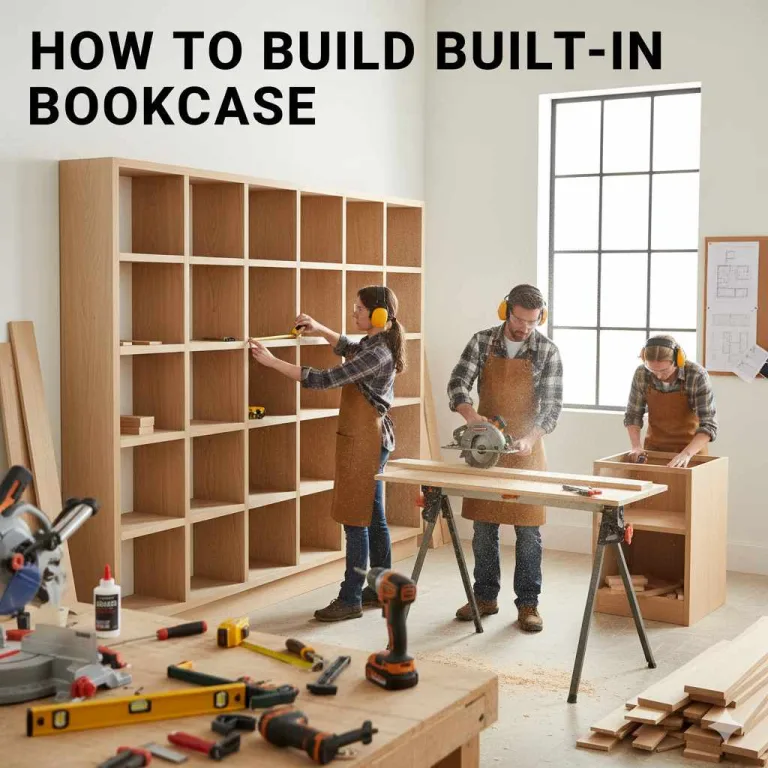
Built-ins are higher complexity because they need tight fit, wall-to-wall planning, and more finish work. They look integrated, but they demand more time and more exact measurements than a first project should usually ask for. A beginner can do one later.
What tools do I need to build a DIY bookshelf?
Most beginner bookshelf builds need a tape measure, square, saw, drill or driver, clamps, sandpaper, screws, and glue. That basic set covers layout, cutting, assembly, and cleanup. A wall-mounted or built-in project usually adds a stud finder and a level to the list.
The fewer specialty tools a plan needs, the easier it is to finish without frustration. That is another reason simple bookcases rank first.
- Measure the space and the longest shelf span.
- Cut sides, top, bottom, and shelves.
- Dry fit the case and check for square.
- Join the box with glue and screws or pocket holes.
- Install the back panel and confirm stiffness.
- Anchor the unit if it is tall or wall-mounted.
How much does a beginner DIY bookshelf cost?
A beginner DIY bookshelf often lands in the low-to-mid material range if the design stays simple and the cuts are efficient. Costs rise with hardwood, decorative trim, specialty hardware, and larger sheets. A basic plywood box usually costs less than a built-in or rotating design with extra parts.
One kids’ bedside book storage project is said to cost less than $10, which shows how far a tiny, simple build can go. At the other end, a built-in or wall-mounted project can climb quickly once anchors, hardware, and finish materials are included.
What drives price up
Material choice is the biggest cost driver. 3/4-inch plywood is beginner-friendly, but higher-grade plywood or hardwood can push the price up. Extra shelves, face frames, edge banding, and wall hardware also add cost. The more custom the layout, the less likely it is to stay cheap.
How wide can a bookshelf shelf be without sagging?
Shelf span is the unsupported length of a shelf, and that is where sag risk starts. For 3/4-inch plywood or pine without a center support, Homesthetics recommends keeping spans under 32 inches. Wider shelves need thicker stock, a center support, or both if the goal is a clean, long-term result.
Long shelves fail in a familiar way: the middle drops first. Books make that worse because they load the shelf evenly over time.
Where sag starts
Sag often begins before the shelf looks dramatic. A small bow can collect dust, throw off shelf spacing, and make the unit seem poorly built. If a shelf is meant to carry heavy hardcovers, short spans are safer than trying to stretch one board too far.
When a center support is worth adding
Add a center support when the shelf is wide, the load will be heavy, or the material is thinner than ideal. It is easier to plan that support at the start than to repair a shelf later. A divider can also help break one long span into safer sections.
Should I build a wall-mounted or freestanding bookshelf?
Choose a freestanding bookshelf if this is the first build and the goal is low risk. Choose a wall-mounted bookshelf when floor space is scarce and the wall can accept secure fastening. The two are not interchangeable because wall-mounted units depend on studs, anchors, and careful installation.
A wall-mounted shelf saves floor space and can work well in small rooms, but it rewards careful layout. A freestanding unit is more forgiving if the cuts are slightly off.
When wall-mounted makes sense
Wall-mounted shelves work well in renters with permission, narrow entry areas, and rooms where every inch matters. They also suit lighter items better than dense book storage. A picture ledge style is often the easiest wall-mounted form for a beginner.
When freestanding makes more sense
Freestanding bookcases are better for beginners, heavy books, and rooms where a floor unit can sit against a wall without crowding the space. They are also easier to adjust if the wall is uneven or the floor is not perfectly level.
What bookshelf style is best for small spaces?
For small spaces, a wall-mounted shelf, ladder bookshelf, or rotating bookcase can save floor area. The right pick depends on whether the room needs fixed storage, a light visual footprint, or access from more than one side. Small rooms punish bulky designs fast.
A rotating bookcase can be a smart choice in a corner or kids’ room because it gives 360-degree access with Lazy Susan hardware. That idea is less common than standard shelving, but it solves access problems in tight areas.
Rotating storage with Lazy Susan hardware
A rotating bookcase uses Lazy Susan hardware, which lets the unit turn in place. That makes sense for kids’ rooms, corners, and small areas where one side of the shelf would otherwise be hard to reach. It is more complex than a plain box, so it belongs after a first build.
Front-facing storage for kids
Low-height, front-facing storage keeps books visible and reachable for children. It reduces climbing risk and makes cleanup easier. A small, simple unit with short spans is usually better than a tall, narrow tower in a child’s room.
How long does it take to build a DIY bookshelf?
A beginner DIY bookshelf can often be built in a weekend if the design stays modest and the parts are straightforward. The actual time depends on cut count, drying time, sanding, and whether the shelf needs paint or finish. Simple box builds finish much faster than built-ins.
The modern DIY bookcase is framed as a 5-step project, and that kind of structure is realistic for a first-time builder. More steps usually means more chances to drift out of square or lose a full day to adjustments.
Typical weekend scope
A weekend project should stay compact: one carcass, a few shelves, a back panel, and a simple finish. That scope keeps the build within reach for someone learning layout and assembly at the same time.
Can a beginner build a bookshelf in a weekend?
Yes, a beginner can often build a bookshelf in a weekend if the design is simple, the cuts are limited, and the shelf spans are modest. A freestanding plywood bookcase is the most realistic choice. Built-ins and complex wall-mounted units usually need more time and more setup.
The difference between success and a stalled project is usually scope. A beginner should aim for square, sturdy, and finished, not ornate.
Frequently asked questions
What is the easiest bookshelf to build for a beginner?
The easiest bookshelf for a beginner is a simple freestanding open bookcase made from 3/4-inch plywood with a back panel. It uses straight cuts, standard screws, and short shelf spans. That combination lowers the risk of wobble, sag, and layout mistakes on a first project.
Products related to this article
Sponsored / affiliate links. As an Amazon Associate I earn from qualifying purchases. I may earn additional commission from eligible campaigns.