How Much Does a Built-In Bookcase Cost?
A built-in bookcase often costs about $1,500 to $8,000 for a basic wall unit, while custom floor-to-ceiling or detailed millwork can sometimes reach about $10,000 to $20,000 or more. Poor sizing or material choices can add hundreds in change orders and leave you with storage that looks off. This guide breaks down price by material, size, and installation complexity so you can estimate your budget before calling a carpenter.
Budget to premium: what drives built-in bookcase pricing
Think in three bands. A painted MDF or poplar wall unit often lands in the budget range, white oak usually sits in the middle, and walnut library walls sit at the top. The final number depends on width, bay count, finish level, and whether the unit needs doors, base cabinets, or site fitting work.
Typical homeowner price ranges
For a simple painted build, a single-bay unit can start around the low four figures. A wider wall with base cabinets moves up quickly because you are paying for more cabinetry, more finishing, and more fitting time. Premium library walls cost much more because they add taller runs, more joinery, and finer material.
What drives the widest price swings
Width and bay count usually matter first, but they do not act alone. Ceiling height, out-of-plumb walls, corners, fireplaces, and old-house framing can all raise labor. The finish type also matters: paint-grade MDF or poplar is usually less expensive than white oak or walnut with a natural finish.
When a rough estimate is enough
A per-linear-foot estimate works when the wall is straight, the ceiling is standard, and the shelf depth is ordinary. For planning, a common depth assumption is 11 to 14 inches. Once the room has uneven floors, angled ceilings, or built-in cabinets below, you need a line-item quote.
Bookcase cost estimator
This table gives a homeowner-style estimate, not a final carpenter quote. It shows how width, height, material, storage options, and site conditions change the budget. Use it to compare a painted wall, a white oak unit, and a walnut library wall before you ask for bids.
| Width | Height | Bay count | Material tier | Door/base options | Finishing type | Site complexity | Low estimate | High estimate |
|---|---|---|---|---|---|---|---|---|
| 36 in. | 96 in. | 1 | Painted MDF or poplar | Open shelves, no base cabinet | Painted | Low | $900 | $1,800 |
| 72 in. | 96 in. | 2 | Painted MDF or poplar | Base cabinets with simple doors | Painted | Low to moderate | $1,900 | $3,600 |
| 108 in. | 96 in. | 3 | White oak | Base cabinets included | Natural finish | Moderate | $4,800 | $8,000 |
| 120 in. | 100 in. | 4 | White oak | Upper doors and base cabinets | Natural finish | Moderate to high | $6,000 | $10,000 |
| 150 in. | 102 in. | 5 | Painted MDF or poplar | Upper doors and lower cabinets | Painted | Moderate to high | $8,000 | $13,000 |
| 144 in. | 108 in. | 4 to 5 | Walnut | Glass-front upper doors, base cabinets | Natural finish | High | $14,000 | $24,000 |
| Per linear foot | Floor to ceiling | Varies | Painted MDF or poplar | Open shelves only | Painted | Low | $250 | $400 |
| Per linear foot | Floor to ceiling | Varies | White oak | Upper doors and base cabinets | Natural finish | Moderate | $700 | $1,100 |
| Per linear foot | Floor to ceiling | Varies | Walnut | Glass-front doors, ladder rail, base cabinets | Natural finish | High | $1,000 | $1,600 |
Per-linear-foot pricing breaks down when the room stops behaving like a simple rectangle. At that point, a carpenter has to account for ceiling changes, trim conditions, doors, outlets, patching, and fitment at each side of the wall. The quote should then move to a line-item estimate.
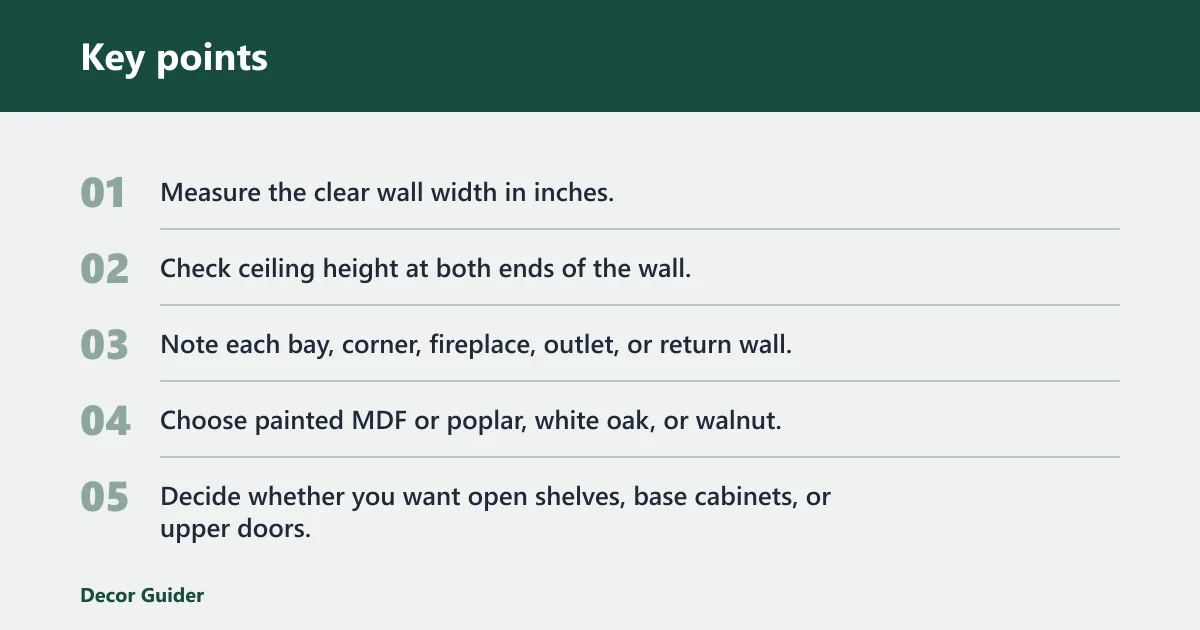
- Measure the clear wall width in inches.
- Check ceiling height at both ends of the wall.
- Note each bay, corner, fireplace, outlet, or return wall.
- Choose painted MDF or poplar, white oak, or walnut.
- Decide whether you want open shelves, base cabinets, or upper doors.
- Ask for a separate line for delivery, installation, finishing, and site repair.
Three sample scenarios
Budget painted wall: A 72-inch wall with two bays, painted MDF or poplar, and base cabinets often fits the $1,900 to $3,600 range. That works best when the wall is straight and the carpentry can stay close to standard cabinet construction.
Mid-range oak unit: A 108-inch white oak unit with base cabinets usually lands near $4,800 to $8,000. The jump comes from white oak plywood, solid white oak face frames and trim, and the extra work required for a natural finish.
Premium library wall: A 144-inch walnut wall with glass-front upper doors and a rolling ladder rail belongs in the highest tier. That kind of project often lands between $14,000 and $24,000 because the materials, hardware, and fitting time all climb.
How much does a built-in bookcase cost?
A built-in bookcase usually costs $1,500 to $8,000 for a straightforward wall unit, with premium work moving far higher when the wall is full height or heavily detailed. The biggest jump comes from moving from open shelves to cabinet bases and doors, then again from painted materials to white oak or walnut.
Budget painted MDF or poplar builds
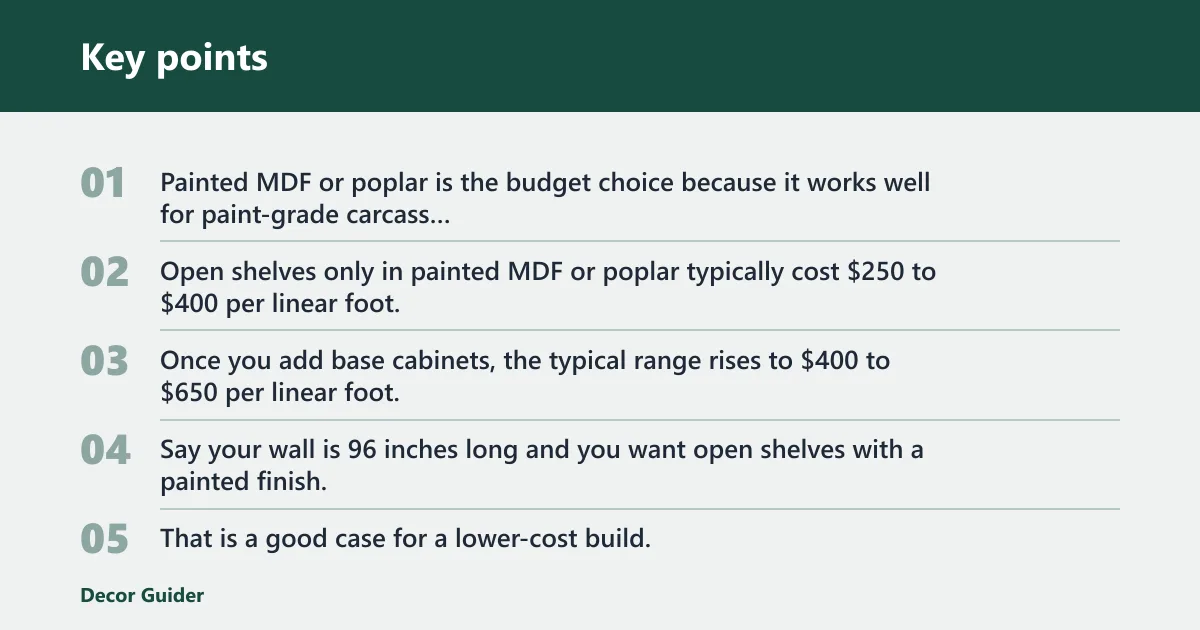
Painted MDF or poplar is the budget choice because it works well for paint-grade carcass and face-frame construction. Open shelves only in painted MDF or poplar typically cost $250 to $400 per linear foot. Once you add base cabinets, the typical range rises to $400 to $650 per linear foot.
Say your wall is 96 inches long and you want open shelves with a painted finish. That is a good case for a lower-cost build, especially if the room has straight walls and no special trim conflicts. Add lower cabinets and the same wall becomes more labor-heavy.
Mid-range white oak builds
White oak is the usual step up when the owner wants a natural-finish look instead of paint. White oak plywood, solid white oak face frames, and matching trim push the price above painted units. White oak natural-finish built-ins with open shelves and base cabinets typically cost $550 to $900 per linear foot.
When you add upper doors to the same material tier, white oak natural-finish built-ins with upper doors and base cabinets typically cost $700 to $1,100 per linear foot. That extra cost reflects door construction, fitting, hinges, and the finish work needed for visible grain.
Premium walnut library walls
Walnut sits at the top of the range because it is used for a more formal library-wall look. Full library walls with rolling ladder rail and walnut can cost $14,000 to $24,000. Walnut full library walls with doors, ladder, and base cabinets typically cost $1,000 to $1,600 per linear foot.
Picture a 12-foot wall with glass-front upper doors, lower cabinets, and a ladder rail. That build is no longer a simple shelving quote. It is a millwork project with higher-grade material, more hardware, and more careful layout.
What changes the price the most?
The largest price swings usually come from total wall coverage, bay count, and ceiling conditions. A shallow single bay is faster to build than a full wall of multiple bays, and a room with square corners is much easier than one with settled framing or uneven plaster.
Linear feet versus total wall coverage
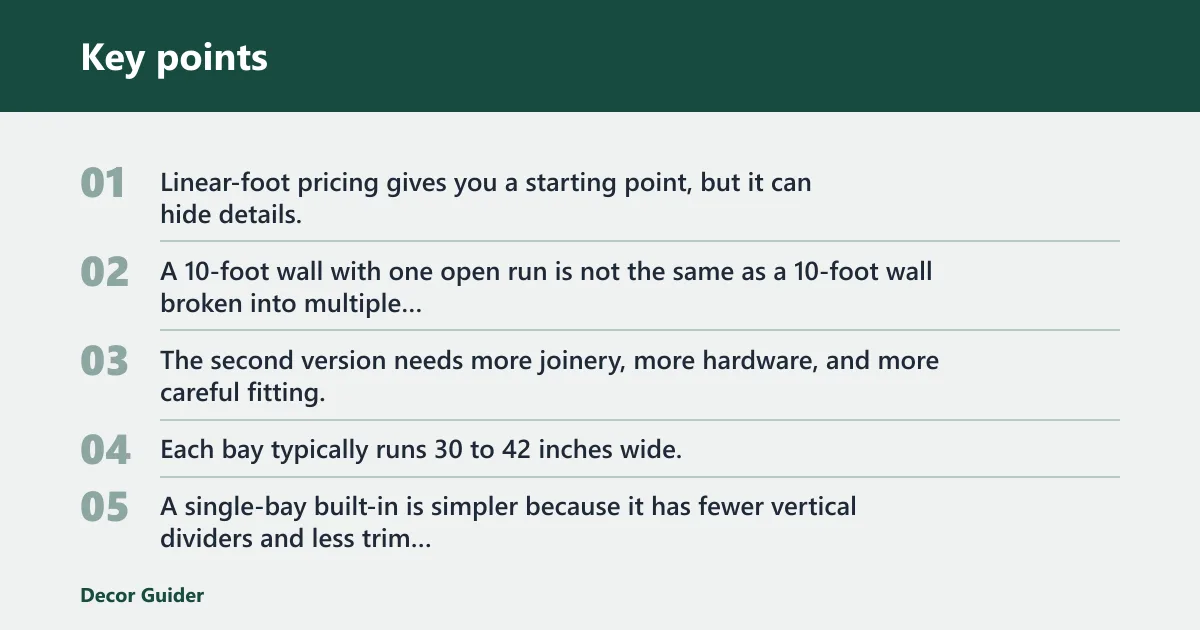
Linear-foot pricing gives you a starting point, but it can hide details. A 10-foot wall with one open run is not the same as a 10-foot wall broken into multiple bays with doors and cabinets. The second version needs more joinery, more hardware, and more careful fitting.
Single-bay and multi-bay layouts
Each bay typically runs 30 to 42 inches wide. A single-bay built-in is simpler because it has fewer vertical dividers and less trim work. A multi-bay layout increases build time, especially if one section gets drawers or closed storage while the others stay open.
A single bay adds 6 to 10 hours of build time. That matters because labor is often the largest share of the quote after materials. More bays mean more time for assembly, finishing, transport, and on-site adjustment.
Ceiling height and scribing work
Ceiling height changes both the visual scale and the fitting work. A tall unit needs more material and more handling, but the hidden cost often comes from scribing. Scribing is the custom trimming needed to fit a unit against uneven floors, out-of-plumb walls, or a ceiling that is not level.
Old houses often need more of this work. Corners, fireplaces, and sloped ceilings are common failure cases because they force the cabinetmaker to cut around irregular conditions instead of building a simple rectangle.
Material tiers and their cost impact
Material choice changes more than appearance. It also changes labor, finishing steps, and how the unit gets assembled. Painted MDF or poplar is usually the easiest budget path. White oak brings a premium. Walnut sits above both because the final look is expected to be more refined.
Painted MDF and poplar
Painted MDF or poplar is the most budget-friendly option for built-in shelving. It works well for paint-grade carcass and face-frame construction, especially when the goal is a clean built-in wall without visible wood grain. It also suits homeowners who want to match existing trim or wall paint.
The tradeoff is that paint-grade work still needs careful sanding, caulking, and touch-up around the site. That finishing labor is part of the quote, even when the material cost is lower.
White oak plywood with solid trim
White oak built-ins cost more because the material is visible and expected to look finished without paint. A common construction package uses white oak plywood for the carcass and solid white oak for face frames and trim. That combination raises the material bill and the finishing standard at the same time.
Walnut with glass-front doors and ladder rail
Walnut is the premium tier because the grain, color, and hardware need to read like a library wall, not a basic storage unit. Glass-front upper doors, a rolling ladder rail, and carefully matched trim push both material and installation costs higher. This is the tier most likely to require a detailed cabinetmaker quote.
Base cabinets, doors, and hidden storage
Base cabinets are a major cost step because they add enclosed storage below the shelves. They require more parts, more fitting, and often more hardware than open shelves alone. Doors and drawers also change the labor plan because each opening has to align cleanly.
Why base sections add labor
Base sections increase labor because the cabinetmaker has to build a box, fit doors, and often scribe the base to the floor and wall. If the base sits under open shelves, the whole unit must align as one built-in system. That takes more time than setting shelves on brackets.
Drawer boxes versus simple shelves
Drawer optionality matters because drawer boxes are more complex than fixed shelving. They need slides, square alignment, and enough clearances to open smoothly. A simple shelf stack is faster to build and easier to finish, so it usually costs less than a base with drawers.
Hardware, hinges, and fitting allowances
Hardware is often treated as a small line item, but it adds up quickly. Hinges, pulls, drawer slides, and door catches all affect the final figure. The fitment work is just as important because doors that do not close cleanly make the whole unit look unfinished.
Suppose a homeowner plans a painted wall unit but later asks for lower drawers and two cabinet doors. That single change can move the project from a simple shelf quote into a cabinet quote with more labor, more hardware, and more finish touch-up.
When does per-linear-foot pricing break down?
Per-linear-foot pricing breaks down when the wall stops being a standard installation. It works best for floor-to-ceiling units with ordinary depth and a straightforward layout. Once the wall has slope, corners, or site conflicts, the estimate needs to become a full quote instead of a simple rate.
Floor-to-ceiling assumptions
Most per-foot estimates assume a floor-to-ceiling built-in and standard depth of 11 to 14 inches. That is helpful for budgeting, but it misses trim details, crown transitions, and the exact way the unit meets the ceiling. A tall wall with a full top enclosure usually needs more labor than a shorter open shelf run.
Uneven walls, sloped ceilings, and corners
Uneven walls and out-of-plumb rooms create scribing work. Sloped ceilings can change the cabinet height from one end to the other. Corners and fireplaces interrupt the run and often force custom fillers, returned ends, or a shift in bay layout. Those details are hard to price from a simple linear-foot number.
Why you need a line-item quote
A line-item quote should separate fabrication, finishing, delivery, installation, and site repair. That separation matters because a homeowner can see what is included and what is not. It also helps compare bids from a carpenter, cabinetmaker, or millwork shop without mixing up scope.
Site prep can sit outside the bookcase quote. Electrical relocation, baseboard removal, carpet cuts, and wall repair often show up as separate trades or extra charges. Those costs can be small or large depending on the room, but they should never be assumed free.
Frequently asked questions
How much does a built in bookshelf cost?
A built-in bookshelf cost is often similar to a built-in bookcase cost because the same factors apply. Open shelves in painted MDF or poplar are the low end, while white oak and walnut push the quote upward. Depth, ceiling height, and trim details can change the total quickly.
How much should a built in bookcase cost?
It should cost enough to cover fabrication, finishing, delivery, installation, and any fitting needed at the wall. For many homeowners, that means budgeting from the low thousands for a simple painted unit to well into five figures for a full walnut library wall with ladder rail.
How much does a custom built in bookcase cost?
A custom built-in bookcase cost is usually higher than a prefabricated or semi-custom shelf system because the quote includes room-specific sizing and site work. Expect a wide range. The narrower the wall and the simpler the finish, the closer the project stays to the lower end.
How much do built in bookcases cost?
Built-in bookcases cost from budget painted builds to premium millwork, so the best answer depends on material and scope. A painted single-bay unit can be far less than a walnut wall with glass doors and a ladder rail. The final number rises with labor more than many homeowners expect.
How much does it cost to build a built in bookcase?
Building a built-in bookcase costs more than assembling shelves because the work includes framing, fitting, trimming, and finishing. A standard project may fit within the homeowner ranges above, but old-house walls, sloped ceilings, and base cabinets can push the builder into a custom quote very quickly.
Products related to this article
Sponsored / affiliate links. As an Amazon Associate I earn from qualifying purchases. I may earn additional commission from eligible campaigns.