How to Add Lighting to a Bookshelf
Choose strip LEDs for shelves about 8 inches deep or more, puck lights for spotlighting, and plug-in or battery options based on outlet access and rental limits. Poor shelf lighting can cause glare, show cords, or leave holes you cannot undo. This guide helps you pick the right fixture, power source, and mounting method before you buy.
Bookshelf lighting decision table


Start with shelf depth, then check power access and whether the install must come off cleanly later. That order avoids the common mistake of buying a strip that is too wide, too bright at the edge, or hard to power without exposed wiring.
| Shelf depth | Power access | Rental status | Best lighting type | Why it fits |
|---|---|---|---|---|
| Shallow | Outlet nearby | Permanent install | COB LED strip | High-density chip layout reduces visible dots and gives a soft continuous glow at the front edge. |
| Shallow | No outlet or awkward cord path | No-drill | Battery-operated strip or compact puck lights | Flexible placement without wiring, useful when you cannot run a cord through the wall or case. |
| Standard | Hidden cord path available | Low-adhesive | LED strip lights, 12VDC | Good for even shelf washes, especially when the strip can sit under a lip or inside a groove. |
| Deep | Outlet nearby | Permanent install | LED strip lights with driver and dimming | Deep shelves hide the strip and wiring more easily, so you can cover a larger area with fewer visible parts. |
| Any depth | Smart-home setup already in place | Permanent or semi-permanent | LED strip lights with DIRIGERA hub support | App control and voice control matter more when the physical fit is already solved. |
If your shelf is shallow, the main question is whether the front edge will reveal the diode pattern. If it will, a COB LED strip is the safer choice. If the shelf is deeper or has a hidden underside lip, a standard LED strip can work well and is usually easier to source.
Say your bookcase shelf is about 6 inches deep and the front edge is open. A standard strip may leave visible dots across the white back panel. A COB strip or a very narrow profile reduces that effect, especially if the shelf holds glass, framed prints, or glossy objects.
What lighting works best for your shelf?
The best bookshelf lighting method depends on whether you need an even wash, a focused accent, or a no-drill install. LED strip lights work well for general shelf lighting. COB LED strip options suit shallow shelves. Puck lights fit spotlighting, but they show more separate light pools and less continuous coverage.
Led strip lights for general shelf lighting
LED strip lights are flexible linear lighting with self-adhesive options, and they can be cut to fit shelf length. For many bookcases, that makes them the simplest setup. Use them when you want a broad, hidden source under a shelf lip or inside a groove.
These strips commonly come in 5VDC and 12VDC variants. A 12VDC strip often suits longer runs and cleaner power planning. A 5VDC strip can make sense for smaller, shorter layouts, but you still need to match the driver and cord to the full load.
COB strip for shallow shelves
A COB LED strip uses a high-density chip layout, so it avoids visible light spots and produces a soft continuous glow. That matters on shallow shelves, where the strip sits close to the front edge and the eye catches every diode.
Use COB when the shelf opening is tight, the finish is glossy, or the books sit close to the light source. It is also a better fit when you want the shelf to read as evenly lit from the front, not striped.
When a very narrow profile matters
Some cabinets and bookcases have narrow gaps, thin lips, or tight side clearance. The strip-light guidance calls for a very narrow 4mm board width in those cases. That slimmer profile helps when you need to hide the light in a small groove or cabinet edge.
Also check bending radius before you plan corners. The strip-light guidance mentions a strict 15mm bending radius. Sharp bends can damage the strip, create dark sections, or make the adhesive lift at the corner.
How do you add lights to a bookshelf?
The cleanest path is to measure first, map the cord route second, and mount in a fixed order. IKEA says cabinet and bookcase lighting is made in 4 easy steps, and it recommends lighting above or below shelves. That approach works best when the strip, driver, and cord all have a planned home.
Measure shelf depth and clearance first
Check the usable depth, not just the outside case dimension. Measure the front lip, shelf thickness, and any back panel recess. If the shelf is too shallow for a standard strip, switch to COB or a narrower profile before you buy hardware.
Also look at shelf clearance under the board. A low profile matters when you want the strip hidden from the seating position, but still bright enough to light the shelf face and objects.
Map the wire route before mounting anything
Decide where the cord will exit before you stick down the strip. If the power source is to one side, route the cable behind books, through a rear corner, or along the underside where it will not show from the front. For rental-safe work, pick a route that avoids drilling and avoids cord pinch points.
If the shelf already holds books, clear only the shelf you are wiring and work one level at a time. That reduces strain on the case and makes it easier to hide a connector at the rear instead of forcing it into the visible opening.
Install the strip, driver, and cord in order
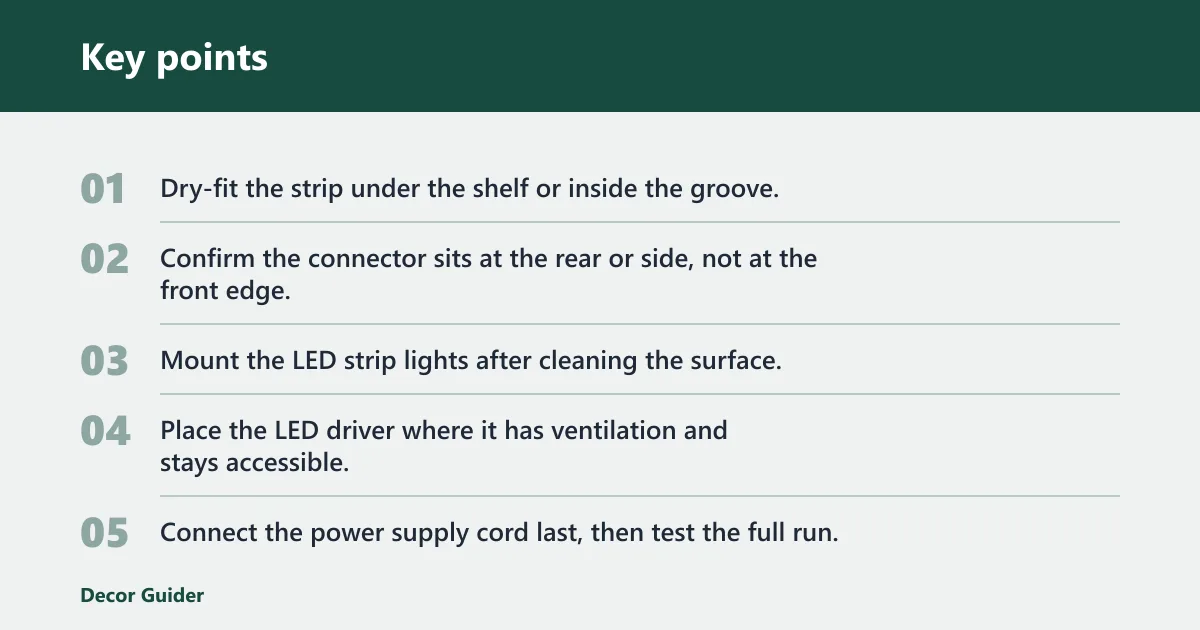
- Dry-fit the strip under the shelf or inside the groove.
- Confirm the connector sits at the rear or side, not at the front edge.
- Mount the LED strip lights after cleaning the surface.
- Place the LED driver where it has ventilation and stays accessible.
- Connect the power supply cord last, then test the full run.
Use a power supply cord when the system requires a separate connection between the lighting and the driver. In smart setups, that cord may be a separate accessory rather than part of the strip itself. Keep the connector accessible in case you later need to swap a driver or add another shelf.
Test for glare, hotspots, and hidden wires
Turn the lights on before putting every book back. Look from standing height and from a seated angle. If you see bright points, move the strip farther back, add diffusion, or switch to COB. If you see a cable at the front edge, reroute it before the adhesive sets fully.
A common first-timer mistake is placing the strip too close to the front lip on a glossy shelf. The shelf looks bright in photos, but the light source is visible every time you sit down. Moving the strip back a small amount often fixes the glare without changing the whole layout.
What power and control parts do you need?
Match the driver to the total wattage first, then add control features. A driver powers multiple lights, but only within its wattage limit. After that, decide whether a remote control, app control, or both will actually help with daily use.
Choose the right LED driver wattage
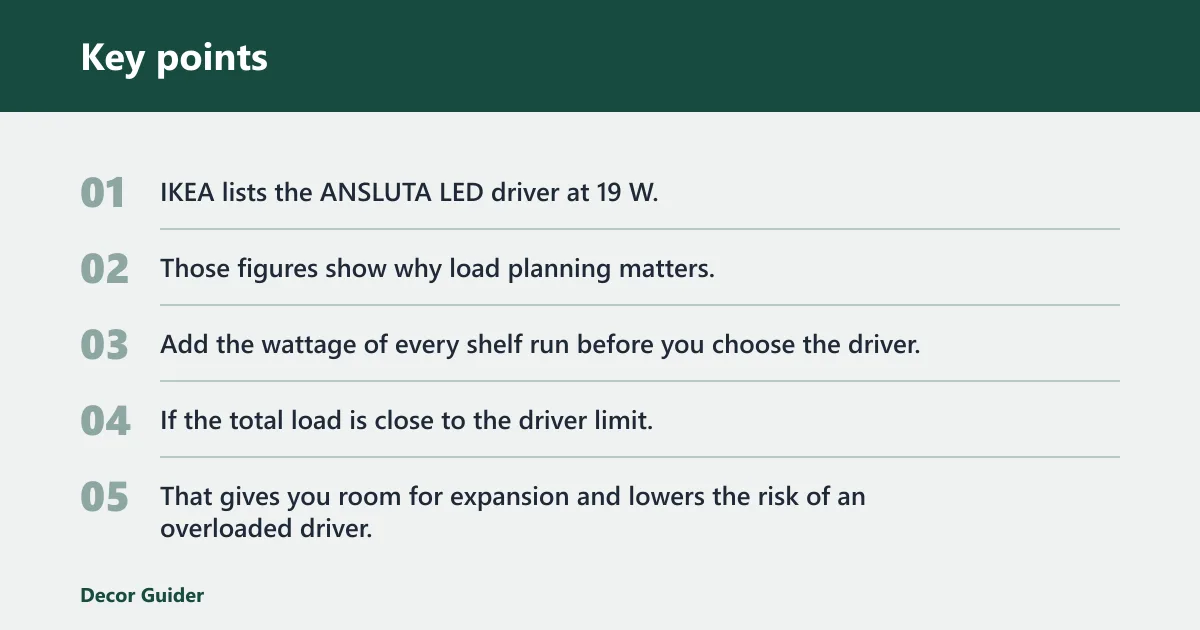
The same source lists the ANSLUTA LED driver at 19 W, the TRÅDFRI LED driver 10 W for up to 3 light sources, and the TRÅDFRI LED driver 30 W for up to 9 light sources. Those figures show why load planning matters. Add the wattage of every shelf run before you choose the driver.
If the total load is close to the driver limit, move up a size rather than crowding the system. That gives you room for expansion and lowers the risk of an overloaded driver. For multiple shelves, list every strip, puck, or accessory before you buy the power unit.
When you need a power supply cord
Use a power supply cord when the driver is not directly at the light source or when the lighting system calls for a separate lead. This is common in bookcases where the driver sits behind furniture or off to one side. Plan the cord path so the wire does not hang below the shelf line.
For rental-safe installs, the cord should exit at the back, behind the case, or through an existing opening. If the run crosses a walking path, keep it secured and out of reach. Loose cords are the part most likely to look unfinished.
Remote control vs app control and dimming
A remote control gives simple on/off control and dimming, which is enough for many shelf installs. That is useful when the goal is to reduce glare or shift the shelf from task light to mood light without opening an app.
App control is better when the shelf lights are part of a larger room setup. It gives more scheduling and scene control, but it should come after the basic wiring, wattage, and placement decisions are settled.
DIRIGERA hub compatibility and smart-home control
The same source says the DIRIGERA hub works as a Matter bridge and is compatible with Apple Home, Google Assistant, and Amazon Alexa. Use that only if you already want smart-home control. It does not fix poor shelf depth, bad cable routing, or a mismatched driver.
For a simple bookshelf, a remote may be the cleaner choice. For a whole room with scenes and voice control, the hub adds a useful layer after the install is physically sorted.
Bookshelf lighting checklist
Use this checklist before you add lighting to a bookcase. It turns specs into decisions you can check at the shelf, not only on the package.
| Check | What to confirm | Why it matters |
|---|---|---|
| Driver sizing | Total wattage stays below the driver limit; choose 10 W, 19 W, or 30 W only if the full load fits. | Prevents overload and avoids a driver that cannot power all shelves. |
| Cable routing | Wire exits at the back or side, with no visible front run. | Keeps the shelf looking clean and reduces snag risk. |
| Connector placement | Connector sits in the rear corner, behind books, or inside a hidden lip. | Stops the plug from showing at the front edge. |
| Glare prevention | Light source is hidden from seated eye level; COB is used if dots show. | Reduces visible hotspots and harsh reflections. |
| CRI / Ra rating | Choose a Ra90 light when natural-looking finishes, paper, or objects need accurate color. | Improves how wood tones, book jackets, and decor colors read under light. |
| IP rating | Use IP20 for dry indoor cabinet use only. | Matches the normal bookshelf environment and avoids overspecifying for a dry room. |
| Bending radius | Corners stay within the 15mm bending radius. | Prevents damage where the strip turns. |
| Shelf clearance | Profile fits the shelf gap; a 4mm board width is useful in tight cabinet spaces. | Helps the strip disappear inside shallow or narrow furniture. |
How do you install lights on floating shelves?
Floating shelves usually call for a no-drill or low-adhesive method because the wall and the shelf edge both stay visible. Use compact strip lights or puck lights, keep the wire path hidden at the rear, and choose a light source that does not hang below the shelf line. If the shelf is shallow, a COB strip often looks cleaner than a standard strip.
Hiding wires on wall-mounted shelves matters more than on bookcases with side panels. Run the cable straight down the wall edge, behind a decorative object, or through an existing opening where possible. If the shelf is in a rental, avoid permanent wall cuts unless the lease allows it.
How do you add lights to a Billy bookcase?
A Billy-style bookcase usually gives you enough regular shelf spacing for strips, but the fixed layout means you need to plan around the existing heights. Use LED strip lights under the shelf lip when you want a hidden line of light, or a COB strip if the shelf is shallow and the dots would show.
Routing power without visible cords is the main challenge. The cleanest result comes from placing the driver behind the case, keeping the cord at the back edge, and avoiding a front-facing plug. If the shelves are already loaded, work one shelf at a time so the setup stays organized.
Suppose a bookcase has three loaded shelves and only one outlet on the left side. If the cord crosses the front, it will show every time you reach for a book. If you route the driver behind the case and use a rear corner exit, the same setup looks far cleaner.
Frequently asked questions
How do I add LED lights to a bookshelf?
Pick a strip that fits the shelf depth, clean the mounting surface, and place the strip where the front edge will not expose the diodes. Then connect the driver, hide the cord at the rear, and test for glare before loading the shelf back up.
What is the easiest way to put lights in a bookshelf?
The easiest path is a plug-in LED strip with adhesive backing and a hidden rear cord route. If the shelf is shallow or the finish is glossy, a COB strip is often easier to live with because it avoids visible light spots. Battery options are simpler still when no wiring is possible.
How do I add lights to bookshelves without visible wires?
Keep the cord path behind books, along the rear edge, or inside an existing groove. Place the connector at the back corner, not at the front lip. If the shelf has a side panel, use that side as the wire exit so the front stays clean.
What lighting is best for a shallow bookcase?
COB LED strip lighting is usually the best fit for a shallow bookcase because it gives a soft continuous glow without obvious diode spots. A very narrow profile also helps when clearance is tight. Standard strips work only when the shelf depth hides the source well enough.
Products related to this article
Sponsored / affiliate links. As an Amazon Associate I earn from qualifying purchases. I may earn additional commission from eligible campaigns.