Kallax Shelf Unit Review: Is It Worth It?
IKEA KALLAX is worth buying if you want square, modular storage that works best with inserts, doors, or casters. As a plain open shelf, it is only average. Pick the wrong size or skip the add-ons, and you get wasted space, sagging-looking stacks, and a unit that stores less than a basic bookcase. This guide covers the configurations, add-ons, load limits, and use cases that make KALLAX better for books, records, toys, offices, dividers, and rentals.
Whether to buy KALLAX or a standard bookcase


KALLAX is a smart buy when you need cube-based storage that can shift uses over time. It works best as a modular system, not as a bare bookcase. Add doors, drawers, fabric boxes, or the right orientation, and it becomes far more useful than a simple open shelf. Leave it empty and overloaded, and it can feel underbuilt for the space it takes.
That makes the decision pretty simple. For books, media, kids’ items, and mixed storage, KALLAX is often the better choice than a basic open bookcase because it gives you fixed compartments and accessory options. For deep bookshelves, heavy hardback collections, or a pure display wall, a conventional shelf often wins on capacity and weight handling.
Best use cases in one sentence
Buy KALLAX when you want storage that can change with your room: books now, toys later, file boxes or records in between, with room-divider potential if the layout calls for it.
When a basic open bookcase is the better buy
A standard open bookcase is usually better if you need maximum shelf depth, flexible shelf height, or uninterrupted vertical storage for large book runs. KALLAX cubes are fixed in size, so tall art books, oversized binders, and mixed-height collections can waste space fast.
Bottom-line verdict by room type
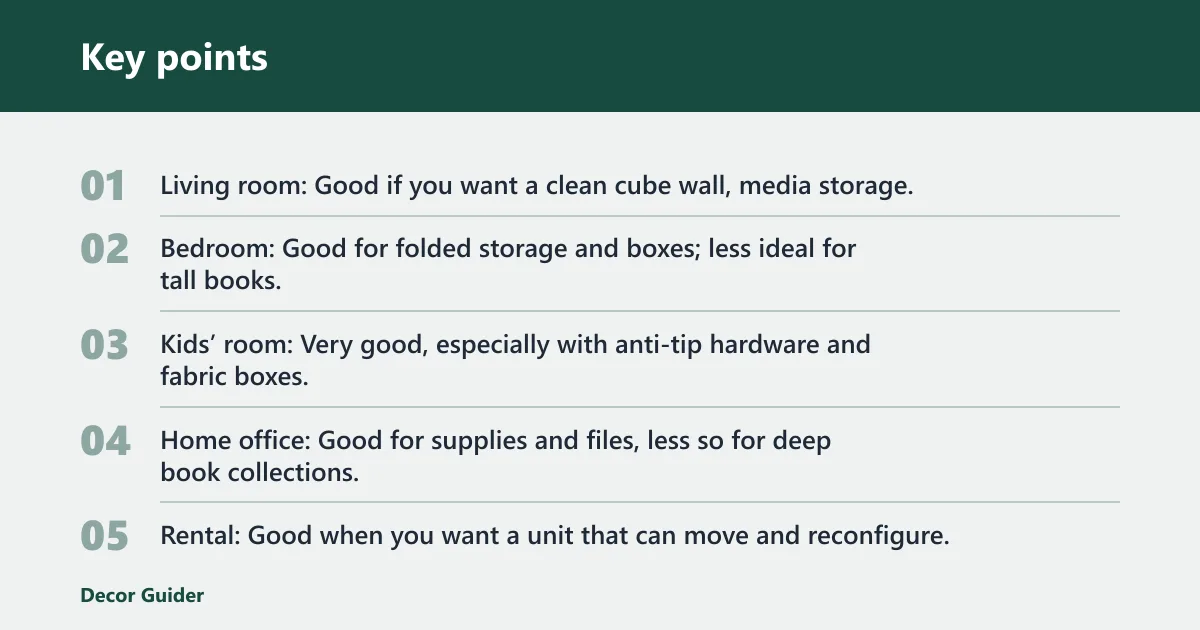
- Living room: Good if you want a clean cube wall, media storage, or a low sideboard-style piece.
- Bedroom: Good for folded storage and boxes; less ideal for tall books.
- Kids’ room: Very good, especially with anti-tip hardware and fabric boxes.
- Home office: Good for supplies and files, less so for deep book collections.
- Rental: Good when you want a unit that can move and reconfigure.
KALLAX storage decision table
| Use case | Best cube count | Orientation | Must-have accessories | Likely failure mode | Right buy? |
|---|---|---|---|---|---|
| Books | 2×2 or 2×4 | Vertical for tall wall use; horizontal for low storage | Bookends or fabric boxes for mixed items | Overfilling one side or using too many heavy hardbacks in one section | Yes, if you want cube-style sorting more than deep shelving |
| Records | 2×4 | Horizontal | None required, though record dividers help | Center sag from uneven heavy loading | Yes, for LP storage and sorting |
| Toys | 2×4 or 4×4 | Vertical with wall anchoring | Fabric boxes such as DRONA | Loose toys crowding open cubes and top-heavy loading | Yes, especially for kid-accessible sorting |
| Office supplies | 2×2 or 2×4 | Either, depending on floor space | Drawer inserts and doors | Visual clutter if you skip closed storage | Yes, if you need mixed open/closed storage |
| Room divider | 4×4 or larger | Vertical | Doors or bins on both sides if visible from two rooms | Tipping risk and clutter visible from both directions | Yes, with anchoring and careful loading |
| Rental-friendly storage | 2×2 or 2×4 | Horizontal or vertical | Boxes and, if needed, casters | Buying too many accessories for a temporary layout | Usually yes, if you may move again soon |
Is KALLAX sturdy enough for books and records?
KALLAX is sturdy enough for books and board games within its intended cube format, but it is not a deep-duty shelving system. Each cube opening is about 13 x 13 inches inside, which can suit LPs, standard board games, and many storage bins.
Cube size and load limits
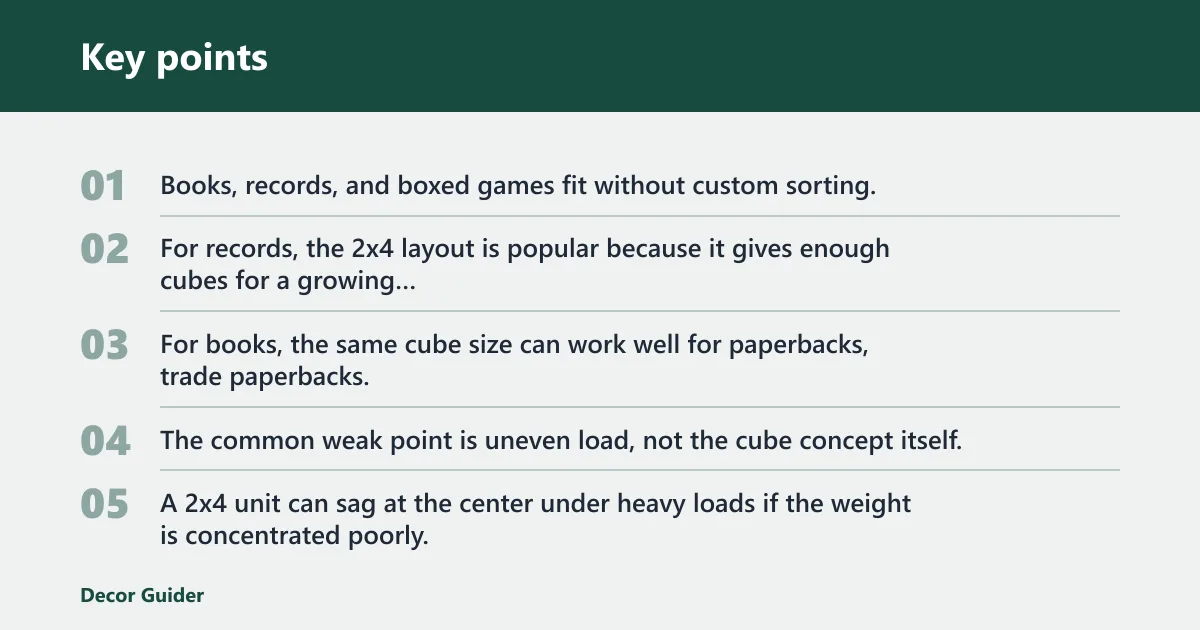
The opening size is the main advantage. Books, records, and boxed games fit without custom sorting, and the unit is easy to organize, especially when you want clean visual lines instead of mixed shelf heights.
For records, the 2×4 layout is popular because it gives enough cubes for a growing collection and keeps LPs upright. For books, the same cube size can work well for paperbacks, trade paperbacks, and board games, but it is not a substitute for adjustable shelving if your collection includes many tall volumes.
Where sagging or tipping becomes a risk
The common weak point is uneven load, not the cube concept itself. A 2×4 unit can sag at the center under heavy loads if the weight is concentrated poorly. Tall units also need wall anchoring, especially when fully loaded or used in a child’s room.
Picture a 2×4 packed with records on the two end columns and lighter boxes in the middle. That load pattern may look tidy, but it can put more stress where the span is weakest. Even loading across the base is the safer move.
What uneven loading changes
Uneven loading changes both appearance and function. One cube stuffed with heavy hardbacks next to a nearly empty cube can make the unit look crooked and can concentrate stress on one side. The fix is simple: spread weight across the frame, keep the heaviest items low, and avoid stacking dense items only at the ends.
Pros and cons
Pros that matter for shoppers
- Modular cube storage.
- Can be used upright or on its side.
- Accepts inserts with drawers or doors for closed storage.
- Useful as a TV bench, sideboard, or kids’ toy storage.
Cons that can change the buy decision
- Open cubes waste space if your items do not fit the square format.
- Heavy, uneven loads can create sagging risk in longer layouts.
- Tall configurations need anti-tip hardware.
- Accessory costs can climb quickly once you add doors, drawers, boxes, and underframes.
- It is not ideal for deep, adjustable book storage.
Accessory costs that add up
KALLAX often looks affordable at the frame level, then becomes less so once you price the extras. Doors, drawer units, fabric boxes such as DRONA, and any underframe or caster setup can change the budget quickly. That is not a flaw if you need closed storage, but it matters when comparing it with a plain open bookcase.
One competitor review lists the IKEA KALLAX Shelf Unit, and another notes that the unit is modular, customizable, and affordable. Those points can all be true at once. The frame is one cost; the usable system is another.
Who should buy KALLAX?
KALLAX is a strong fit for renters, small spaces, and people who need storage that can be rearranged without replacing the whole unit. It is especially good if you want one piece to move between rooms, support bins or inserts, and shift from open display to closed storage.
Best for renters and modular storage needs
Choose KALLAX if you expect to reconfigure your storage later. The system can go on the floor, on a wall, or into desk use. That flexibility makes sense when your room plan may change.
Best for media, toys, and flexible layouts
It fits record collectors, families sorting toys, and anyone who wants visible cube zones instead of a flat shelf run. Say your entry area needs one cube for shoes, one for mail bins, and one for supplies. A 2×2 or 2×4 KALLAX handles that mix better than a standard bookshelf.
Skip it if you need fixed shelving or deep book storage
Skip KALLAX if your main need is tall, heavy, or irregular books. You will likely be happier with a basic open bookcase that gives you adjustable shelf spacing and more uninterrupted storage depth. KALLAX is a better organizer than a generic shelf only when the cube format fits the job.
Can you use KALLAX horizontally or vertically?
Yes. KALLAX can be used upright or on its side, and that orientation changes both storage and safety. Vertical use works for room dividers and tall storage walls. Horizontal use works better as a low bench, media unit, sideboard, or even a desk base.
2×4, 4×4, and other common layouts
The 2×4 unit is one of the most discussed formats because it balances footprint and usable cubes. The 4×4 unit measures about 57.875 x 57.875 x 15.375 inches, has 16 storage cubes, and is often used as a room divider. Smaller versions are easier to move, while larger ones create stronger visual separation.
Room divider, TV bench, sideboard, and desk base uses
KALLAX units can be configured as a TV bench, sideboard, or kids’ toy storage. That is where orientation matters most. Horizontal placement gives you a lower profile and easier top access, while vertical placement creates more separation and more visible cube zones.
Suppose you place a 4×4 in the center of a studio apartment. It can split the room visually, but only if you keep the loading balanced and use anti-tip hardware where needed. A top-heavy display of books on one side and empty cubes on the other defeats the point.
How orientation changes safety and function
Vertical KALLAX makes wall anchoring more important. Horizontal KALLAX reduces tip risk, but it can still sag if overloaded in a long span. If you are choosing between the two, think first about what you store, then about where you stand when you reach it.
Assembly, anchoring, and reassembly
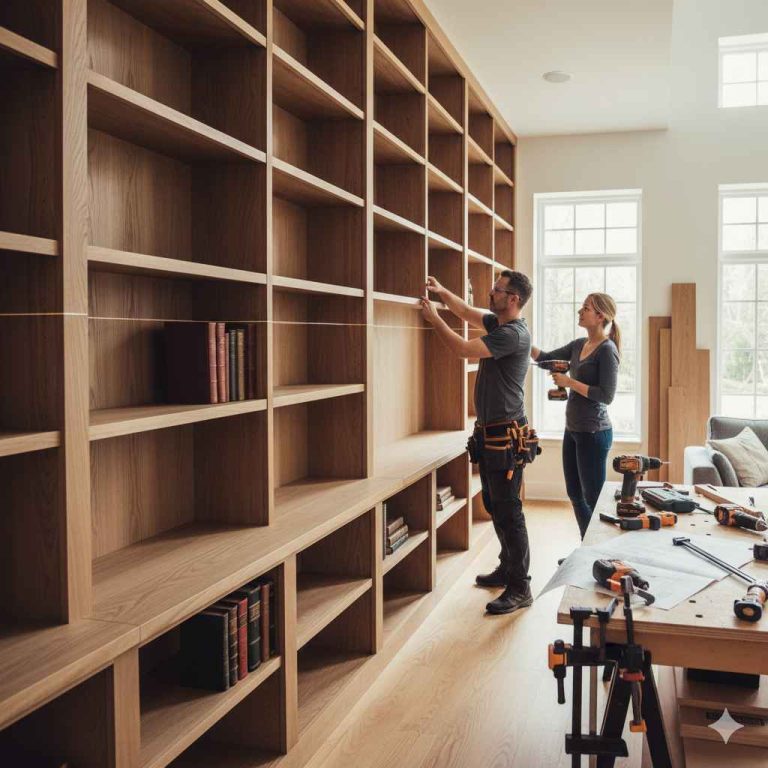
Assembly typically takes about 60-90 minutes solo, and some users may find two people helpful for aligning panels. The build is straightforward enough, but the panels are large and awkward once the frame starts to close. A clear workspace matters more than speed.
Typical build time and help needed
For a single unit, plan on roughly an hour to an hour and a half. Larger sizes take more handling, especially when you are trying to keep corners square. The main issue is not technical difficulty. It is managing the size of the panels while fastening the frame cleanly.
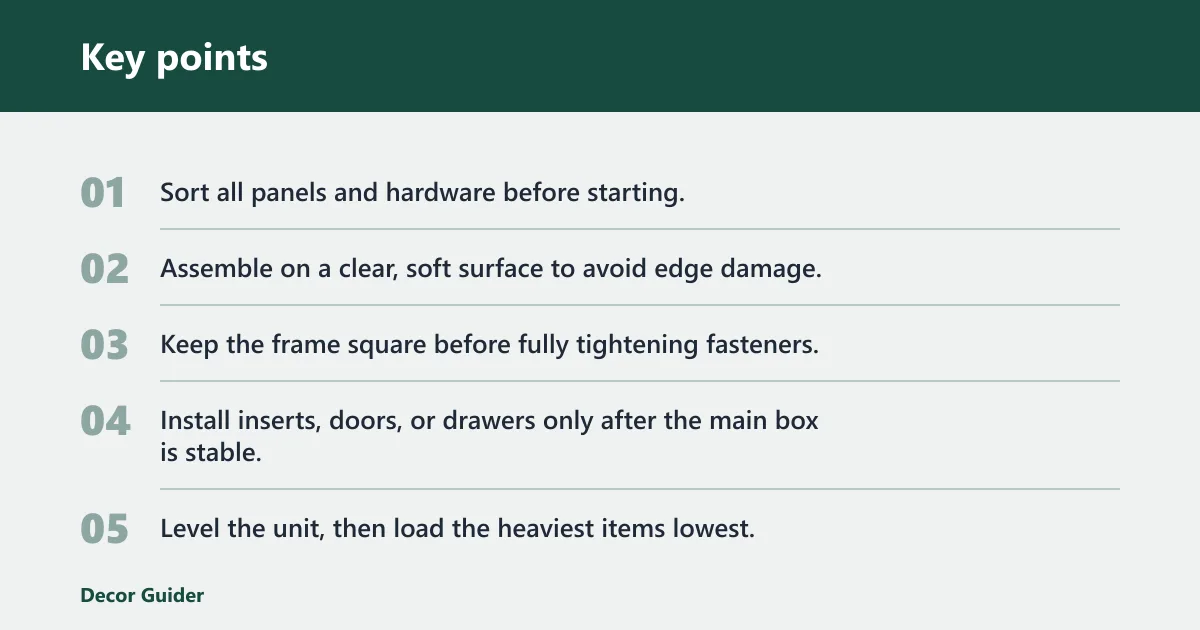
- Sort all panels and hardware before starting.
- Assemble on a clear, soft surface to avoid edge damage.
- Keep the frame square before fully tightening fasteners.
- Install inserts, doors, or drawers only after the main box is stable.
- Level the unit, then load the heaviest items lowest.
Wall anchoring and anti-tip hardware
Anti-tip hardware matters for child- or pet-safe use, especially in tall configurations and in any loaded unit that could be pulled or climbed. If you plan to use KALLAX vertically, treat anchoring as part of the installation, not an optional extra. Safety and function are tied together here.
Taking KALLAX apart and moving it
Can you take a KALLAX shelf unit apart and reassemble it? Usually, yes, if you keep the hardware organized and the panels undamaged. That said, repeated disassembly can be annoying, and the unit is easier to move within a house than to break down often. Buyers who move frequently should expect a manageable but not ideal repeat-build process.
A common first-timer mistake is filling the unit before checking the wall anchor plan. Put the anchor in place first, then load the heaviest cubes. That avoids having to empty half the shelf just to reach the mounting point.
Frequently asked questions
Is the IKEA KALLAX shelf unit sturdy enough for books and board games?
Yes, for normal book and board-game storage, KALLAX is sturdy enough when you stay within the cube format and spread the load. It is less suitable for very heavy, uneven stacks or oversized books. The fixed cube openings are the strength here, but they also set the limits.
How long does it take to assemble a KALLAX shelf unit?
Most buyers should plan on 60-90 minutes for one unit, with two people making some steps easier. Larger layouts and add-ons take longer. The assembly is manageable, but careful alignment matters because the frame needs to stay square before the final tightening.
What sizes does the KALLAX shelf unit come in?
KALLAX comes in multiple sizes. That range is part of the appeal, since you can start small and scale up to a larger wall or divider setup. The same system can work in a tight apartment or a larger family room.
Can the KALLAX be used horizontally and vertically?
Yes. KALLAX can be used upright or on its side, and that changes the way it works in a room. Vertical use suits dividers and taller storage. Horizontal use suits TV benches, sideboards, and lower storage runs where top access matters more.
Does the KALLAX need to be anchored to the wall?
It should be anchored in any tall, heavily loaded, child-accessible, or pet-accessible setup. Anti-tip hardware is the safer choice, especially for vertical units. Even if the frame seems stable at first, wall anchoring is the right call whenever tipping would be a concern.
What inserts fit the KALLAX shelf unit?
KALLAX accepts inserts with drawers or doors, plus fabric boxes such as DRONA. Those pieces change the unit from open display to closed storage. That matters because the frame alone is only part of the system; the inserts decide how tidy and useful it feels day to day.
Products related to this article
Sponsored / affiliate links. As an Amazon Associate I earn from qualifying purchases. I may earn additional commission from eligible campaigns.