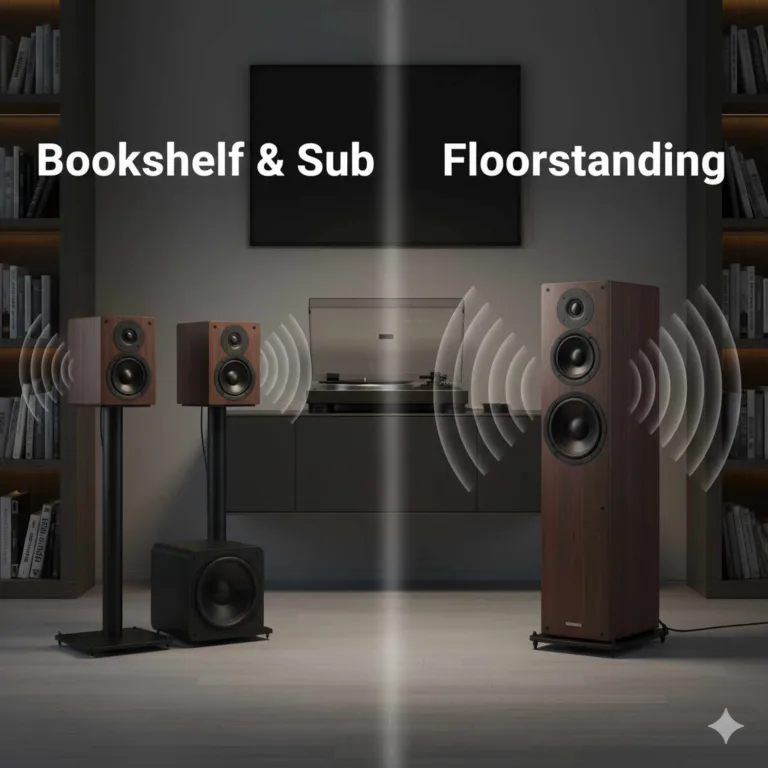
Bookshelf Speakers Vs Tower: Essential Showdown
Bookshelf speakers vs tower speakers: The choice depends on your space and listening goals. Bookshelf speakers offer compact size and flexibility for smaller rooms or desktop setups, while tower speakers deliver deeper bass and fill larger spaces with robust sound quality. Evaluate your room size and desired performance before deciding.

Rockville
Rockville RockTower 68B Black Home Audio Tower…
- Package Includes: (2) Rockville RockTower 68B Black Home Audio Tower Speakers Passive 8 Ohm
- Power and performance: Each RockTower 68B handles 125-Watt RMS per speaker and a 500-Watt Peak burst rating for dynamic transients…
- Three-way drivers and enclosure: RockTower 68B uses a smart 3-way configuration: (2) 6.5-in woofers drive bass, (1) dedicated 6.5-…
As an Amazon Associate I earn from qualifying purchases.
Are you ready to seriously upgrade the sound in your living room or office? Picking out new speakers can feel overwhelming. You see big, tall towers and small, tidy boxes, and the names all start to blur together. Choosing between bookshelf speakers vs tower speakers is a common puzzle for anyone diving into home audio. Don’t worry! We are here to make this crystal clear. By the end of this guide, you will know exactly which type fits your room, your ears, and your budget. Let’s break down the differences, the benefits, and figure out the best fit for your setup.
Understanding Speaker Foundations: What’s the Big Deal?
Before we compare the two styles, it helps to know what we are looking at. Speakers take electrical signals from your stereo or amplifier and turn them into the music or movie sounds you hear. The main difference in bookshelf and tower speakers usually comes down to size, which directly impacts how they perform.
The Anatomy of Sound: Drivers and Cabinets
Every speaker, big or small, has a few key parts:
- Drivers: These are the cone-shaped parts that actually move to make sound waves. You usually have a woofer (for low sounds/bass) and a tweeter (for high sounds/treble).
- Cabinet (The Box): This wooden or plastic enclosure is crucial. It supports the drivers and controls how sound reflects inside, stopping unwanted vibrations.
- Porting: Many speakers have small holes (ports) to help push out more bass; this is called a “ported” design.
The size of the cabinet dictates how big the drivers can be and how much air the speaker can move. This simple difference is the core of the bookshelf vs tower debate.

Deep Dive: Bookshelf Speakers (The Compact Powerhouses)
Bookshelf speakers, sometimes called “standmounts,” are designed to sit on a shelf, a sturdy stand, or perhaps your desk. They are the workhorses of compact audio systems.
Pros of Choosing Bookshelf Speakers
Bookshelf speakers are popular for many excellent reasons. They are adaptable and often fit better into everyday life.
- Space Saving: This is their biggest win. They take up very little floor space and can easily fit on existing furniture.
- Versatility in Placement: You can place them higher up, aiming them right at ear level, which is often ideal for clear dialogue in home theaters or focused listening in an office.
- Generally More Affordable: For the quality delivered, bookshelf speakers often cost less than their full-sized tower siblings because they use fewer materials.
- Great for Smaller Rooms: If your listening area is a bedroom, small office, or apartment living room, they provide plenty of sound without overwhelming the space.
Cons of Bookshelf Speakers
They aren’t perfect for every situation. The main drawback is related to physics—size matters when it comes to low notes.
- Limited Deep Bass: Because they have smaller cabinets and smaller woofers, they struggle to reproduce the very lowest frequencies (deep rumbles or the lowest notes on a bass guitar). You might notice the “oomph” is missing.
- Often Require Stands: To sound their absolute best (placing tweeters near ear level), you usually need to buy separate, sometimes expensive, speaker stands. They don’t sound great sitting directly on the floor.
When Bookshelf Speakers Are Your Best Bet
If you are setting up a 2.0 system (just two speakers) for music primarily, or if you are building a compact 5.1 surround setup where the subwoofer handles the hard bass work, bookshelf speakers are a fantastic choice. They work wonderfully for near-field listening—meaning you sit relatively close to them, like at a computer desk.
Deep Dive: Tower Speakers (The Room Fillers)
Tower speakers, often called “floorstanding speakers,” are the tall, elegant audio pillars you see in dedicated home theaters. They stand directly on the floor.
Pros of Choosing Tower Speakers
When you want sound that physically fills a room and hits you in the chest, towers are hard to beat.
- Superior Full-Range Sound: Towers house larger drivers and much bigger cabinets. This allows them to produce much deeper, more authoritative bass naturally, without needing a subwoofer as urgently.
- Volume Capability: They can generally play louder and handle more power before distorting, making them perfect for parties or large open-plan living areas.
- Aesthetic Centerpiece: Let’s be honest—many people find that a pair of tall, matching tower speakers looks impressive as the centerpiece of an entertainment system.
- Self-Contained Performance: They need less help. While they sound even better with a subwoofer, they can often provide a satisfying low end all by themselves.
Cons of Choosing Tower Speakers
Their size is their primary strength, but also their biggest weakness in certain environments.
- Space Hog: They take up significant floor space. In a small apartment, even one speaker can look bulky and dominate the room’s layout.
- Higher Cost: More cabinet material, larger drivers, and more complex engineering generally mean a higher price tag than comparable bookshelf models.
- Placement Challenges: Getting the distance and angle (toe-in) just right requires more experimentation, and they often need to be placed further away from the back wall than smaller speakers.
When Tower Speakers Are Your Best Bet
If you have a large living room (20 feet by 20 feet or more), enjoy intense cinematic experiences, or are an audiophile who prioritizes rich, natural bass response across all types of music (rock, electronic, cinematic scores), tower speakers provide the classic, immersive experience.
Bookshelf Speakers Vs Tower: The Head-to-Head Comparison
To make the decision easier, let’s put the core specifications side-by-side. This comparison focuses on typical models across various price points.
| Feature | Bookshelf Speakers | Tower Speakers |
|---|---|---|
| Typical Size | Small to Medium Box (10–15 inches tall) | Tall Floor Unit (30–50+ inches tall) |
| Bass Extension | Good, but often requires a subwoofer for deep rumble. | Excellent; can produce satisfying low frequencies naturally. |
| Floor Space Needed | Minimal (often sits on furniture or stands). | Significant; requires dedicated floor space. |
| Placement Sweet Spot | Flexible; works well near ear level. | Requires careful distance from walls and optimal height positioning. |
| Typical Price Range | Entry to Mid-Range | Mid-Range to High-End |
| Ideal Room Size | Small to Medium (Up to 15×15 ft) | Medium to Very Large (15×15 ft and up) |
The Missing Link: How Subwoofers Change the Equation
Whenever we talk about bookshelf speakers vs tower speakers, we must talk about the subwoofer. A high-quality subwoofer allows bookshelf speakers to compete with towers in a surprising way.
The Subwoofer Factor
A subwoofer is a dedicated speaker designed only to handle the deepest bass notes (below about 80 Hertz).
When you pair a good pair of bookshelf speakers (which excel at clear mid-range and treble) with a capable subwoofer that handles the low end, you create a powerful “2.1” system. This setup can often sound better than a mid-range tower system that lacks an equally good subwoofer.
If your budget is split, consider investing heavily in a great subwoofer and a solid pair of bookshelf speakers, rather than stretching your budget thin for mediocre tower speakers.
Practical Considerations: Setting Up Your Audio Gear
Choosing the right speaker is only half the battle. Where you put them matters just as much. This is where real-world compatibility comes into play, especially for everyday drivers who need practical solutions. Think about this like choosing the right tire—a massive off-road tire won’t fit well on a compact sedan, and a small commuter tire won’t handle deep mud.
Placement Principles for Bookshelf Speakers
Since these are often placed in existing furniture or on stands, placement is key to unlocking their potential.
- Ear Height is King: Try to position the tweeters (the tiny speakers usually at the top) at the same height as your ears when you are sitting in your main listening spot. This ensures you hear the high frequencies directly.
- Avoid the Shelf Edge: If they are on a shelf, pull them forward slightly so the front baffle (the faceplate) is past the front edge of the shelf. This reduces sound bouncing off the shelf surface and muddying the sound.
- Distance from the Wall: Experiment! Placing them too close to the back wall often artificially boosts the bass, making it sound boomy and indistinct. Pull them at least a foot away if possible.
Placement Principles for Tower Speakers
Towers need breathing room, both for sound dispersion and stability.
- Set Them Wide, Aim In: They should generally be spaced wider than the distance between them and your listening position (forming a near-equilateral triangle).
- Toe-In Adjustment: Gently angle the speakers inward (“toe-in”) so the sound beams cross slightly behind your head. This sharpens the stereo image (where instruments appear in the soundstage).
- Clear the Back: Towers need airflow around the whole cabinet, especially if their ports (if they have them) are located on the rear panel. Do not shove them right up against furniture or walls. For detailed guidance on setting up a home audio system, reliable sources like those from university extension programs often have great acoustic guidelines that apply universally.
Budgeting for Quality: Where Your Money Goes
The concept of “good enough” changes depending on your goals. Are you looking for background music while working, or critical listening sessions where you analyze every note?
The Mid-Range Sweet Spot
For many beginners, the best value often resides in the middle of the road.
High-end audio equipment often shows diminishing returns—you pay double the price for maybe 10% better sound quality. For most people, a good pair of $400–$800 bookshelf speakers or $1,000–$1,800 tower speakers will provide fantastic, reliable audio for years.
Example Budget Allocation (2.1 System Focus)
If you opt for bookshelf speakers, you can spread your budget across more components for a balanced sound.
| Component | Bookshelf Focus (2.1 System) | Tower Focus (2.0 System) |
|---|---|---|
| Main Stereo Speakers | $500 (Good Bookshelfs) | $1,400 (Entry-Level Towers) |
| Subwoofer | $400 (Quality Powered Sub) | $0 (Included in initial budget) |
| Stands/Spikes | $100 | $0 |
| Total Estimated Cost | $1,000 | $1,400 |
As you can see, a well-balanced 2.1 system built around capable bookshelf speakers can sometimes outperform a 2.0 tower system at a similar price point because the bookshelfs specialized in the mid-range while the sub handled the heavy lifting of the bass.
Visual Style Matters: Aesthetics in Your Space
We aren’t just buying electronics; we are buying furniture that makes sound. The look of the speakers plays a huge role, especially in shared living spaces.
Bookshelf Style
Bookshelf speakers are easy to integrate. They come in many finishes—glossy black, wood veneer, white—and are simple to place on existing media consoles, floating shelves, or dedicated stands that can be matched to your existing décor.
Tower Style
Tower speakers are statement pieces. They demand attention. If you have a modern, minimalist look, a sleek, thin tower speaker can look fantastic. If your room is already busy with furniture, adding two large towers can sometimes feel visually cluttered. Always check the depth; some towers are surprisingly deep and can stick far out into a room.
Bridging the Gap: 3-Way Towers and “Stands”
Not all tower speakers are the same. Some are designed to be full-range powerhouses, while others are slightly smaller and are sometimes called “mid-towers” or “slim towers.”
The Mid-Tower Concept
These are sometimes seen as the compromise option. They are taller than a bookshelf but shorter than a massive reference tower. They often feature three drivers in a line (a woofer, a mid-range driver, and a tweeter) which helps them cover the full range more evenly than a standard two-way bookshelf design. They are a great choice when floor space is limited but you still want full-range sound without a dedicated subwoofer.
How Driver Configuration Affects Sound
The number of drivers matters for clarity:
- Two-Way (Common in Bookshelfs): One woofer handles lows/mids, and one tweeter handles highs. Simple and effective, but the woofer has to work hard across a wider range.
- Three-Way (Common in Towers): Separate drivers for Lows (Woofer), Mids (Mid-range driver), and Highs (Tweeter). This separation allows each driver to focus on its specific job, usually resulting in much cleaner sound, especially when the music gets busy.
This improved driver separation is another key reason why high-quality tower speakers often sound more layered and detailed than budget bookshelf models.

Frequently Asked Questions (FAQ) for Beginner Audio Buyers
Here are quick, straightforward answers to boost your confidence in making this choice:
Q1: If I buy bookshelf speakers, will I absolutely need a subwoofer?
A: Not strictly, but it is highly recommended, especially if you listen to music with deep bass or watch action movies. Bookshelf speakers handle the clarity (mids/highs) very well, but a subwoofer adds the essential low-end “thump” you miss without it.
Q2: Can I use tower speakers in a very small room?
A: You can, but you must be careful with placement. Putting large towers too close to walls or too close to each other in a small room will cause the bass to sound overwhelming, muddy, and echoey. Bookshelf speakers are usually safer for tight spaces.
Q3: Which type is better for music listening versus movie watching?
A: For music purity (critical listening), a quality pair of bookshelf speakers on stands partnered with a high-quality subwoofer often provides a more detailed and accurate sonic picture than many standard tower speakers. For movies, the dynamic impact and scale of tower speakers often feel more cinematic.
Q4: Do I need special stands for bookshelf speakers?
A: Yes, for optimal performance. While you can put them on any shelf, specialized speaker stands are designed to eliminate vibrations that travel through furniture. Getting the tweeters to ear level is the main goal, and stands make this easy.
Q5: Are tower speakers truly only for large spaces?
A: While they excel in large spaces, they work well in medium rooms if you have the space to keep them at least 2–3 feet away from the nearest wall. If your room is tiny (under 10×10 ft), you’ll likely get better performance from well-placed bookshelf speakers.
Q6: If I buy bookshelf speakers now, can I upgrade to towers later?
A: Absolutely! This is one of the great benefits of modular audio systems. You can keep your current amplifier, buy bookshelf speakers for your starter system, and when you move to a larger place or upgrade your budget, those bookshelf speakers can easily become excellent surround sound rear channels for a new tower setup.
Q7: Are there brand differences I should know about concerning size?
A: Yes. Some brands design their towers slightly smaller knowing they will be used in “medium” rooms. Other brands make their bookshelf speakers incredibly powerful, sometimes rivaling smaller towers. It always comes down to reading the specific speaker’s specification sheet regarding frequency response (how low they play).
Conclusion: Bookshelf Speakers vs Tower — Choose Smart for Your Space
When it comes to bookshelf speakers vs tower speakers, there is no universal “better” option — only the better choice for your room, listening habits, and budget.
If you have a small to medium-sized room, limited floor space, or prefer a flexible setup, bookshelf speakers are incredibly smart. They’re compact, budget-friendly, and when paired with a quality subwoofer, they can deliver powerful, balanced sound that rivals many tower systems. They’re especially ideal for apartments, offices, and desktop listening environments.
On the other hand, if you have a larger room, love cinematic movie nights, or want deep, room-filling bass without relying heavily on a subwoofer, tower speakers shine. Their larger cabinets and multiple drivers allow them to move more air, play louder, and naturally reproduce deeper low frequencies. They offer that big, immersive experience many people associate with premium home audio.
Here’s the simple breakdown:
- Tight space + flexibility → Bookshelf speakers
- Big room + full-range impact → Tower speakers
- Balanced performance on a budget → Bookshelf + Subwoofer
- Minimal extra components → Tower speakers
Remember, room acoustics and placement matter just as much as speaker size. Even the most expensive tower speakers can sound poor if crammed into a corner. Likewise, properly positioned bookshelf speakers can sound astonishingly good.
At the end of the day, great sound isn’t about size alone — it’s about matching the speaker to your space and goals. Make your decision based on how you listen, where you listen, and how much room you have to let your speakers breathe.
Related pick: Check today's price on Amazon
Products related to this article
Sponsored / affiliate links. As an Amazon Associate I earn from qualifying purchases. I may earn additional commission from eligible campaigns.