How to Organize a Small Bookshelf: Shelf-by-Shelf Plan
Give each shelf one job: storage, display, or overflow. As a rule of thumb, leave some open space so the unit stays balanced and easy to use, and use the heaviest items on the lowest shelves. This guide shows how to sort items, set shelf roles, and arrange a small bookshelf so it looks organized without losing storage space. If you are starting from a larger purge, pair this with decluttering tips, then use book donation guidelines to decide what leaves, and keep overflow in a storage box instead of on the shelf. For styling help, see small-space decorating ideas.
How do you organize a small bookcase?


Start with a full reset, then assign each shelf a clear role before anything goes back. A small bookcase generally works best when the bottom shelf holds the heaviest books or boxes, the middle shelves carry the main book collection, and the top shelf stays lighter with some open space.
Sort first, place second. That order keeps you from packing the shelf by instinct and ending up with a top-heavy layout. If the bookcase also stores chargers, notebooks, or remote controls, treat those as overflow items and keep them in boxes or on one designated shelf.
What you’ll need
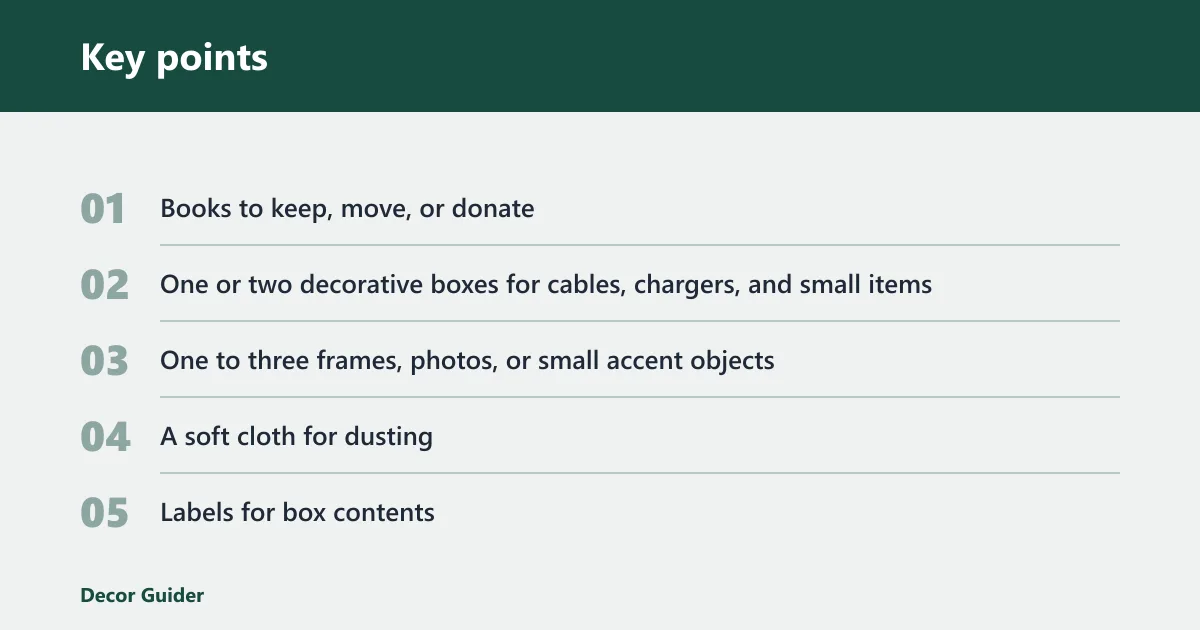
- Books to keep, move, or donate
- One or two decorative boxes for cables, chargers, and small items
- One to three frames, photos, or small accent objects
- A soft cloth for dusting
- Labels for box contents
- A measuring tape for shelf height
- Empty the bookcase completely and wipe each shelf.
- Sort everything into keep, maybe, and donate piles.
- Choose one order system: size, color, or alphabetically.
- Set the bottom shelf for heavier items and the top shelf for lighter ones.
- Place books back in groups, leaving open space between clusters.
- Use boxes for cables, chargers, and other small items that would break up the order.
- Add decor only after the main book layout is stable.
- Recheck each shelf after every few additions.
Best ordering system for a small bookshelf
Choose the system that matches the shelf’s main job. If you reach for the same titles often, alphabetizing is usually the fastest. If the shelf is visually busy, size-based sorting keeps the line cleaner. If the bookshelf is doing more display work than storage, color or theme grouping can look calmer.
| Ordering system | Best for | Tradeoff | Best use case |
|---|---|---|---|
| Alphabetical | Quick access and frequent retrieval | Can look visually mixed if book heights vary a lot | Reference books, favorite reads, shared household shelves |
| By size | Tight shelves and uneven shelf heights | Less intuitive if you need to find one title fast | Small bookcases, mixed storage, stacked books |
| By color | Display-led shelves and decorative rooms | Harder to locate specific titles | Living rooms, styled nooks, shelf decor |
| By theme | Grouped collections | Needs ongoing upkeep when the collection grows | Cookbooks, children’s books, hobby books, office books |
Bookshelf shelf-plan matrix
This shelf-by-shelf plan matches shelf height to item type, so a small bookcase stays useful instead of crowded. Use it as a guide when shelf spacing is tight or the unit has only a few levels.
| Shelf position | Typical shelf height | Best use | Do | Don’t |
|---|---|---|---|---|
| Top | Short to medium | Decor, a few upright books, or open space | Keep it light; a common rule of thumb is to use one small group of about 3 or 5 items. | Load it with heavy books or tall objects that raise the center of gravity. |
| Middle | Medium | Upright books and short horizontal stacks | Mix vertical and horizontal stacks to control height. | Pack the shelf edge to edge. |
| Bottom | Tall or wide | Box storage, large books, or stacked books | Place the heaviest pieces here. | Use fragile decor as the main load-bearing items. |
| Any shelf with leftover room | Varies | Negative space | Leave some room free for a cleaner read. | Fill every gap just because it exists. |
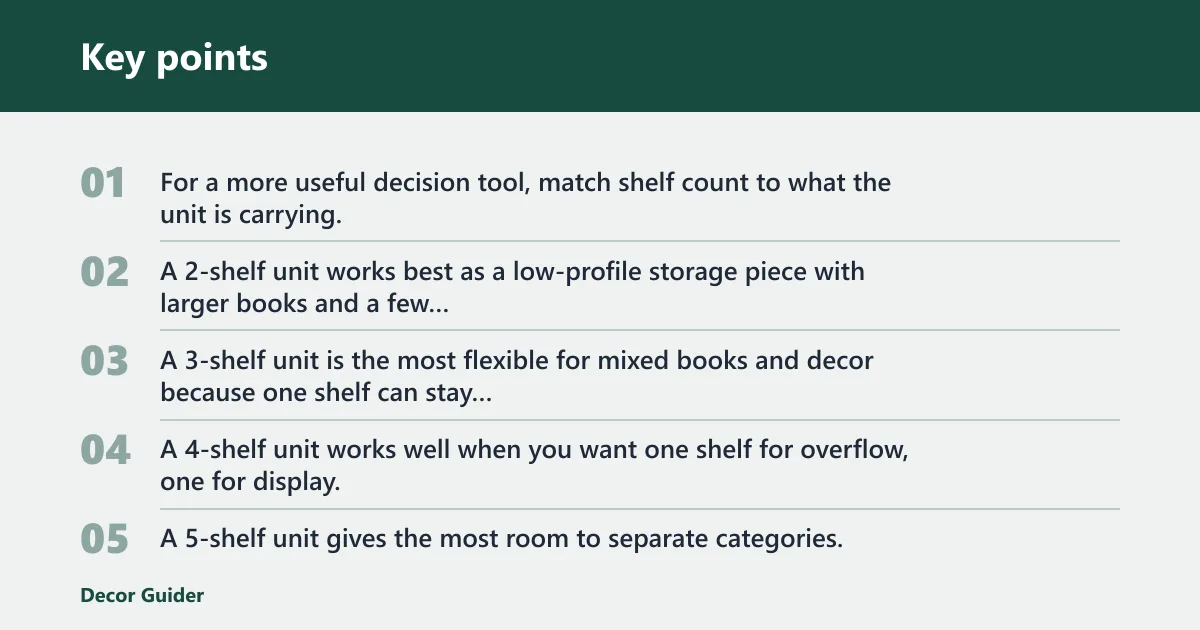
For a more useful decision tool, match shelf count to what the unit is carrying. A 2-shelf unit works best as a low-profile storage piece with larger books and a few decor items. A 3-shelf unit is the most flexible for mixed books and decor because one shelf can stay more open. A 4-shelf unit works well when you want one shelf for overflow, one for display, and the rest for books. A 5-shelf unit gives the most room to separate categories, but it can look crowded faster if every shelf is filled.
| Shelf count | Recommended use | Stack limit | Decor count | Where to leave negative space |
|---|---|---|---|---|
| 2 shelves | Best for a simple storage setup, oversized books, or a low console-style display | One short horizontal stack per shelf, or one stack plus upright books | 1 to 2 accents total | Leave the top shelf more open so the unit does not feel heavy |
| 3 shelves | Best all-around choice for books plus a few accents | One main stack on the lower or middle shelf; keep the top stack small | 1 accent per shelf at most | Leave the top shelf or one middle section open to break the visual block |
| 4 shelves | Best for separating categories such as reading, decor, office, and overflow | Two shelves can hold stacks; two should stay mostly upright | 3 to 4 accents total | Leave one shelf lighter than the others, ideally near the top |
| 5 shelves | Best for larger collections that still need visual breathing room | Limit each shelf to one stack cluster so the unit does not become dense | 4 to 5 accents total | Leave negative space on alternating shelves, not only at the top |
Use the shelf height to decide what goes where. Low shelves work best for large-format books, bins, or heavier items. Medium shelves are best for mixed book rows and a short stack. Tall shelves are useful for upright books, small decor, or a deliberate pocket of empty space. If the shelf height is fixed, let the item size adapt rather than forcing the layout to fill every inch.
Common mistakes
Top-heavy styling: putting tall decor and stacked books on the top shelf can make the unit look unstable. Move heavier books lower and keep the top shelf lighter.
Overcrowded shelves: if every inch is filled, the bookcase reads as cluttered and books are harder to remove. Remove one item for every new object you add until the shelves still feel breathable.
Uneven shelf spacing: if shelf height is fixed, do not force tall objects into short spaces. Put those items on a lower shelf or move them into a box.
How do you mix books with decor?
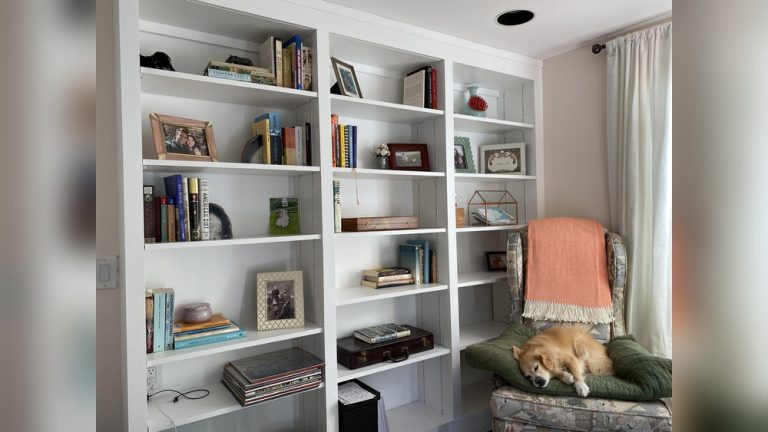
Use decor as punctuation, not filler. Frames, photos, vases, and figurines work best in small groups and should sit beside books, not fight them for attention. A shelf with a limited number of items usually reads more settled than a shelf crowded with many unrelated objects.
Keep accent objects small enough to sit beside a book stack or break up a row of spines. A vase can balance a horizontal stack; a framed photo can soften a tall column of books; a figurine can add a pause between sections. One or two accents per shelf is usually enough.
Suppose a 30-inch shelf holds 18 books already. Adding three more objects may push it into a cramped look. Remove a few books, leave a blank section, then place one frame and one small vase.
Composition rules for small shelves
Small shelves look best when the composition is intentional. A practical starting point is a 70/30 split between books and decor on the shelves that are meant to hold both. That keeps the bookshelf useful first and decorative second.
Use a heavy-to-light vertical flow: place the densest books, bins, or stacked volumes low, then move toward lighter books and smaller accents as the shelves rise. One focal object per shelf is usually enough; if a shelf has a frame, let that be the anchor and keep everything else quieter.
Balanced layouts often use one of these patterns:
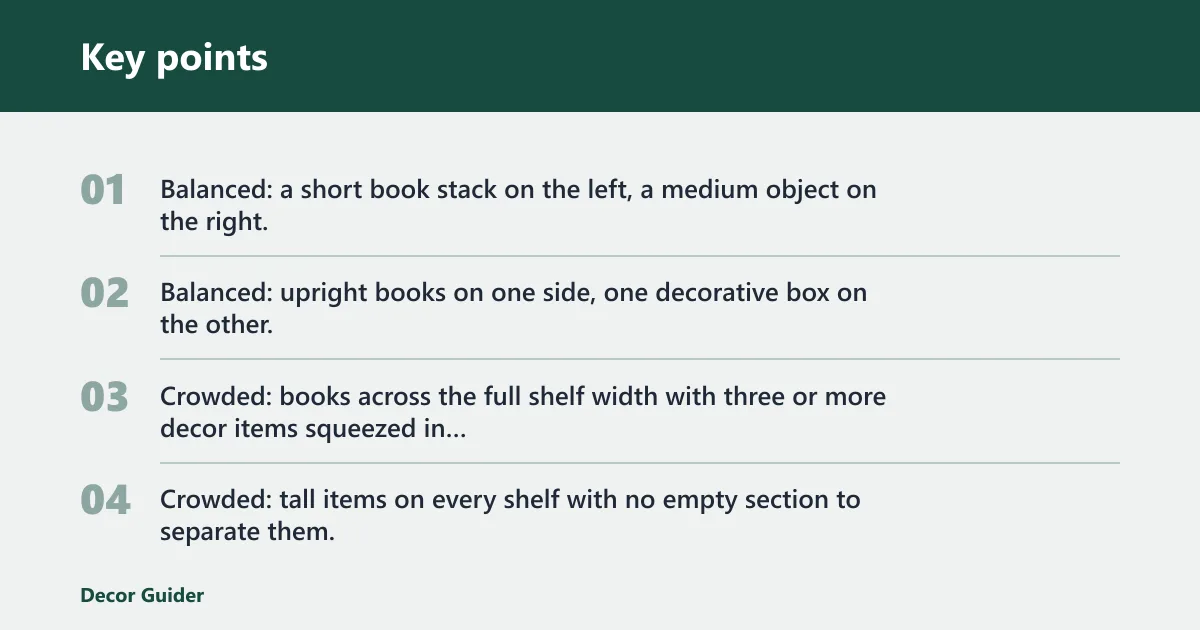
- Balanced: a short book stack on the left, a medium object on the right, and open space above the stack.
- Balanced: upright books on one side, one decorative box on the other, and a small gap in the center.
- Crowded: books across the full shelf width with three or more decor items squeezed in front.
- Crowded: tall items on every shelf with no empty section to separate them.
If the shelf still feels busy, remove one object before adding another. The easiest way to improve balance is often to simplify the number of objects, not to rearrange endlessly.
Where can I store books without a bookshelf?
You can store books in several places besides a bookshelf, as long as the container or surface supports the weight and keeps the books dry and easy to reach. Choose the option that fits how often you use the books and how much visual clutter you can tolerate.
- Under-bed bins: work best for books you keep but do not need every day, especially in small bedrooms.
- Credenzas: good for mixed storage when you want books hidden behind doors or drawers.
- Carts: useful for frequently used books that need to move between rooms.
- Wall ledges: best for a few display books or current reads when floor space is limited.
- Bedside stacks: work for active reading piles, but keep the stack short so it does not become unstable.
- Closed cabinets: best for longer-term storage, reference books, or collections you want out of sight.
If you need quick access, keep books in a cart or bedside stack. If you want a cleaner room, use a credenza, cabinet, or under-bed bin. If the books are mostly decorative, wall ledges can work well, but they should hold only a few volumes at a time.
How much empty space should you leave?
As a rule of thumb, leave some open space rather than filling the shelf edge to edge. That amount keeps the bookcase from looking packed and gives the eye a place to rest. It also makes it easier to pull books out without bumping nearby objects.
Free space does not mean blank everywhere. It means each shelf should have breathing room around the book groups, decor, or boxes. Use symmetry on one shelf and a zigzag placement on the next if the bookcase starts to feel stiff.
If the wall color behind the shelf already has enough depth, skip extra changes. If the unit still looks flat, a darker or contrasting back panel can add depth without adding more objects.
When should you donate books?
Donate books after you build the keep pile and set aside a maybe pile. If a book no longer fits your shelf plan, has not been used for a long time, or duplicates a better copy, it is a strong candidate for leaving the bookcase.
Check the receiving rules first. Some libraries, schools, or community groups accept books in good condition, while others only take specific subjects or age ranges. If a book is damaged, outdated, or unlikely to be accepted, recycle or discard it according to local rules.
Use the maybe pile for one final review. If a title still feels useful, keep it. If not, donate it so the shelf holds only what deserves space.
Build the layout shelf by shelf
Use a simple order: heavy items low, mixed stacks in the middle, lighter decor up top. Alternate horizontal and vertical book stacks so the shelf height stays controlled. Start with the largest objects, then fill in smaller books and accents around them.
- Place the heaviest books on the bottom shelf.
- Stand the most-used books upright on middle shelves.
- Lay a short stack of books horizontally where shelf height is limited.
- Leave a gap, then add one accent object or box.
- Repeat the pattern with a zigzag placement from shelf to shelf.
- Recheck each shelf after every two additions and stop before it looks full.
Books can be sorted by size, color, or alphabetically. If you need quick access, alphabetized order works well for frequently used books. If you want a calmer visual line, group similar shades together on one shelf. If the shelf mixes fiction, reference books, and notebooks, sort by size first, then place the most-used titles where you can reach them fast.
What ordering system works best?
There is no one-size-fits-all approach. Alphabetical order is easiest when you reach for the same books often. Size-based sorting helps a small shelf stay level. Color-based sorting is better when the shelf is doing more display work than storage.
A simple decision path helps: if access matters most, use alphabetizing; if the shelf is visually busy, sort by color or shade; if the bookcase contains mixed-height items, sort by size first; if the shelf is mostly display, group by theme and keep only the strongest pieces.
For the cleanest result, edit down to favorites before you reorganize. Fewer books make the system easier to keep up.
How do you prevent a bookshelf from looking crowded?
Give each shelf a single job. A shelf that holds books, boxes, photos, and decor all at once usually looks heavier than one that has a clear purpose. Preserve some open space on each shelf, and use boxes when small items would otherwise scatter across the unit.
Keep boxes visually plain and label them. Decorative boxes can hide wires, chargers, and other small items while reducing visual clutter. A common approach is to use one box per category if possible, such as office supplies, charging cords, or spare remotes.
A common first-timer mistake is filling every shelf edge with objects and then trying to fix the look with one frame. That usually makes the shelf feel even tighter. Remove one cluster instead.
Frequently asked questions
What is the best way to organize a bookshelf?
The best setup depends on how you use the books. If you need quick access, alphabetize them. If the shelf is mainly decorative, sort by color or size. For mixed-use storage, combine upright books, short stacks, and one or two boxed items.
How do I organize my bookshelf without making it look crowded?
Limit the number of objects per shelf and keep the biggest items low. Use only a few accents, leave some open space, and store small clutter in labeled boxes. If the shelf still feels full, remove one item from each shelf.
Should I sort books by size, color, or alphabetically?
Sort by alphabet if you pull books often. Sort by size if the shelf has uneven heights or mixed storage. Sort by color if the bookshelf is mainly for display. A shelf can also use one method on the top level and another on the middle shelves.
How much empty space should I leave on a bookshelf?
Leave some of the shelf free. That amount gives the arrangement room to breathe and helps prevent top-heavy styling. If you add a new book or object, remove something else unless the shelf still stays comfortably open.
How do I decorate a bookshelf without overloading it?
Use frames, vases, and figurines sparingly, and keep them in small groups of about 3 or 5 when the shelf can handle a cluster. Pair them with books rather than placing them everywhere. A single accent object on one shelf can do more than several pieces spread across the whole unit.
Products related to this article
Sponsored / affiliate links. As an Amazon Associate I earn from qualifying purchases. I may earn additional commission from eligible campaigns.