Deep Bookshelf vs Shallow Bookshelf: Which Fits Best?
Choose a deep bookshelf (12-15 inches) for oversized art books, binders, or mixed storage; choose a shallow shelf (8-10 inches) for standard paperbacks and tight rooms. Pick the wrong depth and books jut out, floor space disappears, and the room feels tighter. This guide compares depth by book size, room clearance, and display needs so you can pick the right fit.
Deep bookshelf vs shallow bookshelf: the core trade-off



The main trade-off is fit versus footprint. Deep shelves take larger items and leave room for display objects, but they project farther into the room and can push standard novels too far back. Shallow shelves use less floor area and feel lighter in compact rooms, yet they stop working once your collection includes oversized books or storage boxes.
| Decision factor | Deep Bookshelf | Shallow Bookshelf | Winner |
|---|---|---|---|
| Best match for item size | Oversized books, binders, display objects | Paperbacks, slim hardcovers, narrow accessories | Depends on the collection |
| Room intrusion | Higher; projects farther into the room | Lower; better for tight circulation zones | Shallow Bookshelf |
| Risk of wasted space | Higher with standard novels and small décor | Lower for paperback-heavy collections | Shallow Bookshelf |
| Front-to-back stability for large items | Better support for broad items and boxes | More likely to leave oversized items overhanging | Deep Bookshelf |
| Best visual fit in small rooms | Can feel bulky | Usually looks lighter and less intrusive | Shallow Bookshelf |
Deep bookshelf: what it does well
A deep bookshelf is the safer choice for large-format art books, atlases, vinyl records, binders, and mixed storage. It gives you enough front-to-back room so items do not hang over the shelf edge or get pressed against the back panel.
Shallow bookshelf: what it does well
A shallow bookshelf suits paperbacks, slim hardcovers, hallways, above-desk storage, and narrow rooms. Teebooks says most home libraries only need 15 cm shelves, and it defines shallow shelves as 15 cm deep. That tells you many residential collections do not need oversized depth.
Where standard depth fits between them
Standard bookshelf depth sits in the middle. The commonly cited standard bookshelf depth is 25 to 30 cm, and George’s Furniture lists most residential bookshelves at 10 to 12 inches, or 25 to 30 cm. That range fits most hardcovers and general home use without the bulk of a very deep unit.
📊 George’s Furniture lists deep storage shelves as 12 to 15 inches. Source: Bookshelf Depth Guide: Standard Sizes & How to Choose.
How deep is a bookshelf, really?
Most bookshelves fall into three practical depth bands: shallow, standard, and deep. Shallow shelves are often 6 to 9 inches deep, standard shelves are commonly 10 to 12 inches deep, and deep storage shelves are usually 12 to 15 inches deep. Built-ins can vary, but usable depth matters more than the catalog number.
Typical shallow, standard, and deep depth ranges
George’s Furniture lists narrow depth bookshelves as 6 to 9 inches, average bookshelf depth as 10 to 12 inches, and deep storage shelves as 12 to 15 inches. Teebooks defines shallow shelves as 15 cm deep, standard depth shelves as 25 cm deep, and deep shelves as 35 cm deep. Different sources use different reference points, which is why item fit matters more than the label.
Usable shelf depth versus exterior cabinet depth
Usable shelf depth is the internal depth you can actually store items in. Exterior cabinet depth can be larger because frame thickness and back panels reduce the interior opening. If you buy from the outside dimension alone, you may end up with books that fit on paper but sit too tight in practice.
Why frame thickness and back panels matter
Frames take space at the front and sides, and back panels eat into the rear. That means a shelf sold as “12 inches deep” may offer less usable room once the cabinet structure is included. Always check the internal measurement if you plan to store hardcovers, boxes, or anything with a rigid cover.
What fits on each shelf depth?
The right depth depends on the tallest and deepest item in your collection, not the average one. Teebooks says paperbacks include B-format at 13 cm by 19.8 cm and trade paperbacks at 15 cm by 23 cm, while standard hardbacks fit comfortably on a 15 cm shelf. Vinyl LPs are 31.4 by 31.4 cm, which is why record storage needs more depth than a paperback shelf.
Paperbacks and standard hardcovers
Paperbacks are the easiest fit for shallow shelves. Standard hardcovers usually fit on standard-depth shelving, and Teebooks specifically says standard hardbacks fit comfortably on a 15 cm shelf. If your collection is mostly novels, a deep shelf often wastes room without adding real value.
Art books, atlases, and oversized volumes
Large-format art books and atlases need depth because they are both broad and stiff. If a shelf is undersized, the front edge can press into the cover or leave the book sticking out past the shelf face. That creates a cleaner look problem and a handling problem.
Binders, vinyl records, and mixed storage
Binders and vinyl records are where deep shelves start to earn their keep. Vinyl LPs are 31.4 by 31.4 cm, so a shallow shelf is the wrong tool for the job. Mixed storage also benefits from deeper units when you want books, storage boxes, and display pieces on the same run.
How room size changes the right depth

Room size changes the answer because shelf depth cuts into walkable floor space. A deep shelf may fit the books, but still fail the room if it blocks circulation in a hallway, entryway, or narrow home office. The best depth is the deepest shelf that still leaves the room comfortable to use.
Hallways, entryways, and narrow rooms
Shallow shelving is usually the safer choice in hallways and entryways. These areas need clear passage, and even a modest increase in shelf depth can make a route feel tight. A visually lighter profile also matters when the shelf sits in a high-traffic zone.
Small apartments and home offices
In small apartments and home offices, every inch of projection matters. A standard or deep shelf can crowd a desk chair, door swing, or narrow path. If the shelf must sit beside a work area, shallow depth is often the cleaner fit unless you store larger items.
Walkway loss from 8-inch, 12-inch, and 15-inch shelves
Here is a simple way to think about room impact: an 8-inch shelf removes 8 inches from the wall, a 12-inch shelf removes 12 inches, and a 15-inch shelf removes 15 inches. That 7-inch spread between 8 and 15 inches is the difference between a shelf that tucks away and one that becomes a room boundary. In a narrow passage, that difference is easy to feel.
- Measure the deepest item you plan to store.
- Add room for the item to sit fully on the shelf, not partly hanging off the front.
- Check how much floor space the shelf will remove from circulation.
- Leave clearance above the tallest item.
- Choose the shallowest shelf that fits the collection without crowding the room.
Shelf height, clearance, and stability
Depth and height work together. Shelf clearance is the vertical space above books, and a common rule of thumb is 1–2 inches of clearance above the tallest stored item. If the clearance is too tight, books can scrape the shelf above; if it is too loose, the shelf space is poorly used.
How much vertical clearance books need
Match the shelf opening to the tallest item in that section. A mixed collection often needs different shelf heights for paperbacks, hardcovers, and taller décor pieces. Adjustable shelves help because they let you tighten the spacing around each category instead of leaving wasted vertical air.
What happens when shelves are too shallow for the load
A shelf that is too shallow can cause books to sit too close to the front edge or lean forward. That makes the stack look unstable and raises the chance of slipping when a book is removed. Front-heavy displays are especially awkward on shallow shelves because the weight wants to tip outward.
When adjustable shelves help a mixed collection
Adjustable shelves are the most practical choice for mixed collections. They let you reconfigure for paperbacks one week and art books or binders the next. That flexibility matters in built-ins and freestanding units alike, especially when décor and storage share the same cabinet.
Depth comparison table and decision matrix
The quickest way to choose is to match item type to minimum usable depth, then check room constraints. This matrix uses the stored object first, because the shelf must fit the object before it can fit the room.
| Item type | Minimum usable depth | Room type | Risk if undersized | Best-use scenario |
|---|---|---|---|---|
| Paperbacks | 6 to 9 inches | Hallways, narrow rooms, above desks | Front overhang, wasted room if too deep | Shallow wall shelves in compact spaces |
| Standard hardcovers | 10 to 12 inches | Home offices, living rooms, bedrooms | Books sit too close to the edge if too shallow | Standard residential shelving |
| Large art books and atlases | 12 to 15 inches | Library walls, media rooms, built-ins | Cover damage, protrusion, awkward stacking | Deep shelves for oversized volumes |
| Vinyl records and binders | 12 to 15 inches or deeper | Home offices, music rooms, storage walls | Items overhang or bind at the front edge | Deep storage where square formats need support |
| Mixed books and décor | 10 to 15 inches, depending on the largest item | Small apartments, built-ins, display walls | Poor fit if one section must do everything | Adjustable shelves with measured zones |
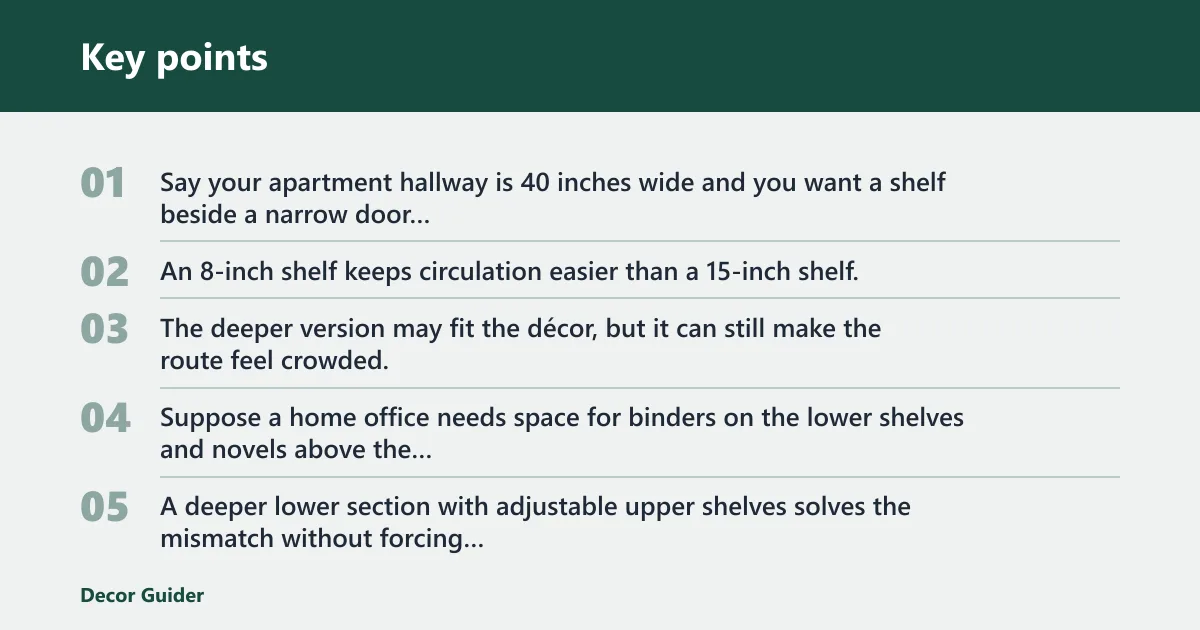
Say your apartment hallway is 40 inches wide and you want a shelf beside a narrow door swing. An 8-inch shelf keeps circulation easier than a 15-inch shelf, especially if the shelf also needs to hold a basket or plant. The deeper version may fit the décor, but it can still make the route feel crowded.
Suppose a home office needs space for binders on the lower shelves and novels above the desk. A deeper lower section with adjustable upper shelves solves the mismatch without forcing every shelf to be the same depth. That is the kind of mixed-use plan that prevents wasted space.
Choose shallow bookshelf if…
Choose a shallow bookshelf if your collection is mostly paperbacks, slim hardcovers, or a few light décor pieces. It is also the better choice for hallways, entryways, narrow rooms, small apartments, and above-desk storage. Go shallow when circulation space matters as much as storage.
Choose deep bookshelf if…
Choose a deep bookshelf if you store oversized art books, atlases, vinyl records, binders, or storage boxes. It also works better for mixed storage when the largest item needs real front-to-back support. Go deep only when the added projection is worth the space it removes from the room.
Choose standard bookshelf if…
Choose a standard bookshelf if your collection is mostly hardcovers and you want a middle-ground fit for general home use. Standard depth is commonly cited at 25 to 30 cm, and George’s Furniture places most residential bookshelves in that same 10 to 12 inch range. It is the default when your collection is varied but not oversized.
Frequently asked questions
how deep is a bookshelf
A bookshelf is usually described in one of three ranges: shallow, standard, or deep. Common residential shelves run from 6 to 9 inches for narrow units, 10 to 12 inches for average shelves, and 12 to 15 inches for deep storage. The right depth depends on what you store and how much room you can spare.
how deep is a typical bookshelf
A typical bookshelf is commonly around 10 to 12 inches deep, which is also the range George’s Furniture lists as average. That depth works for many hardcovers and general home use. If your collection is mostly paperbacks, a shallower shelf can often do the job with less room intrusion.
how deep is a standard bookshelf
A standard bookshelf is commonly cited at 25 to 30 cm. Teebooks defines standard depth shelves as 25 cm deep, and George’s Furniture lists most residential bookshelves at 25 to 30 cm as well. This middle range fits many home-library needs without the bulk of a deeper cabinet.
how deep is the average bookshelf
The average bookshelf depth in most homes is about 11 to 12 inches, according to George’s Furniture. That sits close to the standard range and works well for mixed residential use. It is deep enough for many hardcovers, but not so deep that it dominates a room.
which bookshelf depth is best for paperbacks, hardcovers, art books, and binders?
Paperbacks usually fit best on shallow shelves, standard hardcovers fit well on standard depth, and art books or binders usually need deep shelving. Teebooks says most home libraries only need 15 cm shelves, but it also notes that standard hardbacks fit comfortably there. Once items get larger, 12 to 15 inches becomes the safer fit.
when is a shallow bookshelf a bad choice?
A shallow bookshelf is a bad choice when the collection includes oversized books, binders, vinyl records, or storage boxes that need more front-to-back support. It is also a poor choice if the shelf must hold mixed items and display pieces without overcrowding. In those cases, shallow depth can cause overhang and awkward stacking.
Products related to this article
Sponsored / affiliate links. As an Amazon Associate I earn from qualifying purchases. I may earn additional commission from eligible campaigns.
 Acovy 30 Inch Floating Shelves, 9.3" Deep Floating Shelf Wall Mounted, 30" Wall Shelves, Rustic Deep Bookshelf, Large Display Shelves & Storage Shelves for Bedroom, Living Room, Brown, Set of 2
 Acovy 40 Inch Floating Shelves, 12" Deep Floating Shelf Wall Mounted, 40" Wall Shelves, Rustic Deep Bookshelf, Extra Deeper & Thicker Display Shelves for Bedroom, Living Room, Oak, Set of 2