Narrow Bookshelf vs Wide Bookshelf: Which Fits Best?
Pick a narrow bookshelf when floor space and traffic flow matter most; pick a wide bookshelf when you need easier access, heavier storage, and a steadier base. A bad fit can block walkways, make books hard to reach, and raise tip risk. This guide compares footprint, reach, safety, and room flow so you can size the right shelf for books, decor, and mixed-use rooms.
This guide is part of our Bookshelf guide: build, style, and organize series.
| Decision factor | Narrow Bookshelf | Wide Bookshelf | Winner |
|---|---|---|---|
| Floor footprint | Saves floor space by going vertical | Spreads across more horizontal wall space | Narrow Bookshelf |
| Access | Top shelves may need a step stool | Standing reach is easier for most shelves | Wide Bookshelf |
| Stability | Higher tip risk; should be anchored | More stable because of the low center of gravity | Wide Bookshelf |
| Room fit | Best for narrow gaps and high ceilings | Best for long walls and low ceilings | Depends on room |
| Secondary use | Mostly storage or display | Can also work as a TV stand or console | Wide Bookshelf |
Narrow bookshelf vs wide bookshelf: the core trade-off



The trade-off is direct: a narrow bookshelf uses less floor area, while a wide bookshelf takes more wall width but gives easier access and a steadier base. Ceiling height matters too, because tall units suit 8-foot-and-up ceilings and wide units fit low ceilings more easily.
Footprint and wall coverage
Tall bookcases save floor space by going vertical. That makes them a strong fit for a narrow nook, a small apartment, or any room where you cannot spare much walking space.
Wide bookcases spread across more horizontal wall space, so they need a longer open wall to avoid crowding a room. That extra width can fill a bare wall, but it can also take over a compact room if the span is too large for the layout.
Reach, access, and daily use
Wide bookcases are easier to use day to day because most shelves sit within standing reach. Tall bookcases often need a step stool for top-shelf access, which matters if you plan to grab books often or rotate decor frequently.
Suppose a family keeps school books, a printer tray, and baskets for chargers on the same shelf unit. A wide layout usually keeps those items within arm’s reach, while a tall layout may turn the top shelves into low-use storage.
Stability, anchoring, and ceiling fit
Wide bookcases are more stable because of their low center of gravity. Tall bookcases have higher tip risk and should be anchored, especially in homes with active children or in earthquake-prone areas.
Tall bookcases are best for 8-foot-and-up ceilings, where the vertical line feels balanced instead of cramped. Wide bookcases work with low ceilings too, because they do not push so much mass upward and leave less empty space above the furniture.
📊 The FACBOTALL Triple Wide Bookshelf is listed at 74 inches high and 58.7 inches wide. Source: Tall vs Wide Bookcase: Which Wins? (2026).
How width, depth, and shelf span change performance
Width is only part of the story. Shelf depth, shelf span, and material thickness shape how much a bookcase can hold, how bulky it looks, and how it ages under load.
What shelf depth means for books and bins
Bookcase depth affects shelf depth, storage-box compatibility, book capacity, and visual bulk. Shallow shelves work for paperbacks, decor, and slim storage boxes, while deeper shelves fit larger bins and oversized books but can make the unit feel heavier in the room.
A deep shelf can also tempt overloading because it looks roomy. If the unit is too deep for the room, it may project farther into a walkway and change room flow more than the buyer expected.
How shelf span affects load support and sag
Shelf span matters because long unsupported shelves carry more load across the middle, which raises sag risk over time. A longer span needs better material thickness and stronger joinery if you plan to store heavy books rather than light decor.
In practical terms, a wide bookcase with long shelves can be less forgiving than it looks. Even if the frame feels sturdy, the shelf surface itself may flex first when books are packed tightly from end to end.
Why material thickness matters for heavy books
Thicker shelf boards usually handle weight better than thin boards, especially on long spans. That matters most for dictionaries, art books, cookbooks, and other dense volumes that concentrate weight in one area.
A common first-timer mistake is treating a display shelf like a library shelf. If the shelves are mostly for small decor, a lighter build may be fine; if they are for heavy books, shelf thickness and span should carry more weight in the decision.
Which bookshelf shape works in a small room?
For a small room, a narrow bookshelf usually works better because it preserves walking space and keeps the furniture mass closer to the wall. A wide bookshelf can still fit if the room has a long open wall, but only when the width does not pinch circulation or crowd nearby furniture.
Small apartment
In a small apartment, a narrow bookcase often wins because floor space is limited and every inch of passage matters. Vertical storage is useful here, but the unit should not make the room feel top-heavy or block light.
Narrow nook
A narrow nook usually points straight to a tall bookcase. The vertical footprint lets you use a dead corner or gap beside a door without taking over the room’s main traffic path.
Low ceiling versus 8-foot ceiling
Low ceilings favor wide bookcases because they sit lower and avoid a cramped look. For 8-foot-and-up ceilings, a tall bookcase can rebalance the wall by pulling the eye upward and using space that would otherwise sit empty above shorter furniture.
Choose narrow bookshelf if you need vertical storage
A narrow bookshelf is best when floor-space efficiency matters more than quick access. It works well in narrow gaps, tight apartments, and rooms that need storage without losing circulation or visual openness.
Tall bookcase in narrow gaps
Tall bookcases fit places a wide unit cannot, such as the strip beside a closet, a reading corner, or a wall section between windows. The tall bookcase category includes compact options like the DUMOS 5-Tier Narrow Bookcase, which is described as a tall open display shelf for small spaces.
The benefit is not only footprint savings. A vertical shape can also make a small room feel more organized when the shelves rise cleanly along the wall rather than spreading outward.
Top-shelf access and step-stool use
A tall bookcase often needs a step stool for top-shelf access. That is fine for seasonal items, spare decor, or books you do not pull down often, but it is less convenient for daily-use storage.
If you need the top shelf often, measure your reach against the shelf height before buying. The format can be efficient and still be inconvenient if the highest tier becomes a constant stretch.
Wall anchoring and anti-tip safety
Tall bookcases should be anchored. Anti-tip anchoring should go into wall studs whenever possible, because studs provide the strongest hold for a loaded, upright unit.
That matters even more in earthquake-prone areas, where a tall unit’s higher center of mass can turn a small wobble into a serious hazard. If you rent, check whether stud-safe anchoring is allowed before choosing a tall frame.
Choose wide bookshelf if you need easy access and a low profile
A wide bookshelf is the better pick when reachability, display access, and a lower visual profile matter most. It suits daily-use books, mixed storage, and rooms where the furniture should feel grounded rather than tall.
Daily-use books and decor display
Wide units keep more shelf surface within easy reach, which makes them practical for books you handle often. They also work well for decorative styling because the longer span gives you room to separate objects without stacking them tightly.
The FACBOTALL Triple Wide Bookshelf is listed at 74 inches high and 58.7 inches wide, which shows how a wide format can still be tall enough for substantial storage while spreading across the wall.
Console or TV stand use
A wide bookcase can double as a TV stand or console. That makes it useful in a living room, studio, or entry area where one piece needs to hold media, baskets, and decor at the same time.
That use case works best when the shelf top is deep enough for the equipment and the wall width can absorb the full span without crowding doors or seating.
Low ceiling and long wall placement
Wide bookcases work with low ceilings too, because they do not force the room upward. They are often the cleaner choice under short ceilings where a tall frame would leave the room feeling compressed.
They also suit a long wall, where the horizontal line helps fill space evenly. If a room has broad blank wall area and little vertical height to spare, a wide bookcase usually looks more settled.
Decision matrix: narrow vs wide bookshelf by room scenario
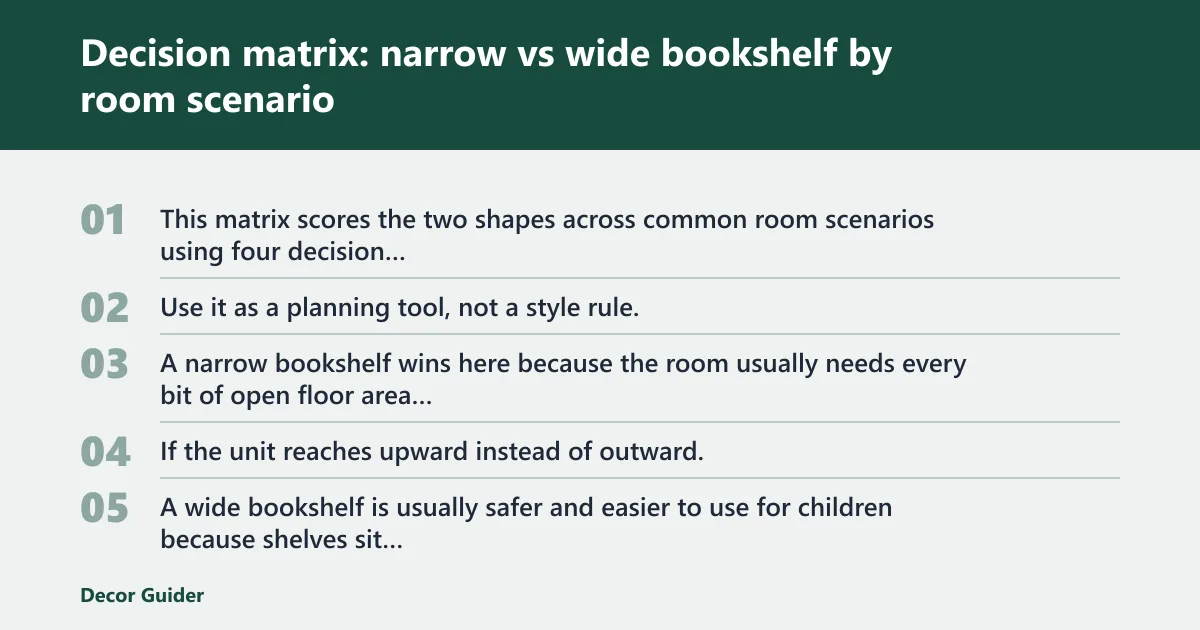
This matrix scores the two shapes across common room scenarios using four decision factors: footprint, reach, stability, and storage density. Use it as a planning tool, not a style rule, because room layout and how often you use the shelves still matter.
| Room scenario | Narrow bookshelf | Wide bookshelf | Best fit |
|---|---|---|---|
| Small apartment | Strong on footprint and traffic flow; moderate on reach; needs anchoring | Good access and stability, but uses more wall and floor space | Narrow bookshelf |
| Kids’ room | Good for bins and vertical storage, but higher tip concern | Better stability and easier reach for children | Wide bookshelf |
| Home office | Good for spare files and vertical overflow storage | Better for daily-use books, printers, and mixed display | Wide bookshelf |
| Long wall | Can look undersized unless grouped or repeated | Uses the wall span well and can anchor the room visually | Wide bookshelf |
| Rental | Useful when floor space is tight and layout may change | Better if you want flexible surface use and easier access | Depends on wall width and lease rules |
Small apartment
A narrow bookshelf wins here because the room usually needs every bit of open floor area it can keep. If the unit reaches upward instead of outward, you preserve circulation and still gain useful storage.
Kids’ room
A wide bookshelf is usually safer and easier to use for children because shelves sit lower and the base is steadier. If a narrow unit is the only fit, wall anchoring becomes non-negotiable.
Home office
A wide bookshelf usually works better in a home office because it can hold reference books, supplies, and a mix of storage boxes without forcing frequent step-stool use. If the office wall is short, a narrower unit may still be the right fit.
Long wall
Wide units are the natural match for a long wall because they use the available horizontal width instead of leaving large empty gaps. A narrow unit can still work, but it may read as too small unless the room has other tall elements nearby.
Rental
Renters often need flexibility. A narrow bookshelf may be easier to reposition through doorways and around future furniture changes, while a wide bookshelf can be better if the lease allows a stable, low-profile storage piece that also functions as a console.
Choose narrow bookshelf if… / Choose wide bookshelf if…
Choose a narrow bookshelf if you need to fit a tall unit into a narrow gap, want to protect walking space, or have a room with higher ceilings that can visually support vertical storage. It also makes sense when the shelf is mostly for overflow books or decorative items rather than frequent daily access.
Choose a wide bookshelf if you need easy reach, better stability, or a lower profile under a short ceiling. It is also the stronger choice for kids’ rooms, home offices with regular use, and any setup where the top needs to double as a TV stand or console surface.
Say your apartment has a narrow nook beside the sofa and a standard ceiling height. A narrow bookcase can turn that dead strip into storage without blocking the walkway. By contrast, a wide unit in the same spot would likely squeeze the seating area and feel oversized.
Picture a rental living room with a 9-foot blank wall and a low ceiling. A wide bookshelf can fill the wall more naturally, keep the room grounded, and stay easy to reach without a stool. The same room with a tall, skinny frame may look top-heavy and require anchoring that the lease may complicate.
Frequently asked questions
Is a narrow bookshelf better than a wide bookshelf?
A narrow bookshelf can be a good choice when floor space, walkway clearance, and vertical storage matter most. A wide bookshelf can be a better choice when you want easier access, more stability, and a lower profile. The better choice depends on room width, ceiling height, and how often you use the shelves.
Which bookshelf is better for a small room, tall or wide?
A tall, narrow bookshelf usually fits a small room better because it saves floor space by going vertical. A wide bookshelf can still work if the room has a long open wall and enough clearance around doors, seating, and traffic paths. Measure the wall first.
Do narrow bookshelves tip over more easily?
Tall narrow bookcases can have more tip risk and are often best anchored. That risk rises when the unit is loaded high, placed on an uneven floor, or used in a home with active children. Anti-tip hardware into wall studs is the safest standard approach.
How wide should a bookshelf be for heavy books?
There is no single width that guarantees safe heavy-book storage for every setup. What matters more is shelf span, shelf thickness, and how the load is distributed. For dense books, shorter spans and thicker shelves are usually safer than long, thin shelves packed from edge to edge.
What is the best bookshelf shape for a low ceiling?
A wide bookshelf is usually the best shape for a low ceiling because it stays lower and avoids making the room feel cramped. Tall bookcases suit 8-foot-and-up ceilings better. In a low room, a wide unit also makes top-shelf reach easier.
Can a wide bookshelf work as a TV stand or console?
Yes, a wide bookshelf can double as a TV stand or console if the top surface is deep enough and the span fits the wall. This is useful in small living rooms and studio layouts. Check cable access, equipment depth, and whether the shelf height suits screen placement.
How do I choose a bookshelf for a narrow wall?
Match the bookcase width to the usable wall section, not the full wall. Leave room for baseboards, outlets, door swing, and nearby furniture. Narrow bookcases work best in tight wall sections, while a wide unit needs a longer uninterrupted span to avoid crowding.
Which is safer for kids, a narrow bookshelf or a wide bookshelf?
A wide bookshelf is usually safer for kids because it has a lower center of gravity and is less likely to tip. A narrow tall unit can still work, but it should be anchored to wall studs. Keep heavier books on lower shelves in either format.
Products related to this article
Sponsored / affiliate links. As an Amazon Associate I earn from qualifying purchases. I may earn additional commission from eligible campaigns.