
How to Replace Futon Mattress Covers
Replace a futon mattress cover by matching the cover to the mattress’s exact length, width, and thickness, then fitting it with the zipper or closure lined up to the frame. A wrong size leads to bunching, split seams, hard folding, and faster wear during daily sofa-bed conversion. This guide shows how to measure, choose the right cover style, fit thick or shrunken mattresses, and handle pet and care issues.
Quick futon cover replacement guide
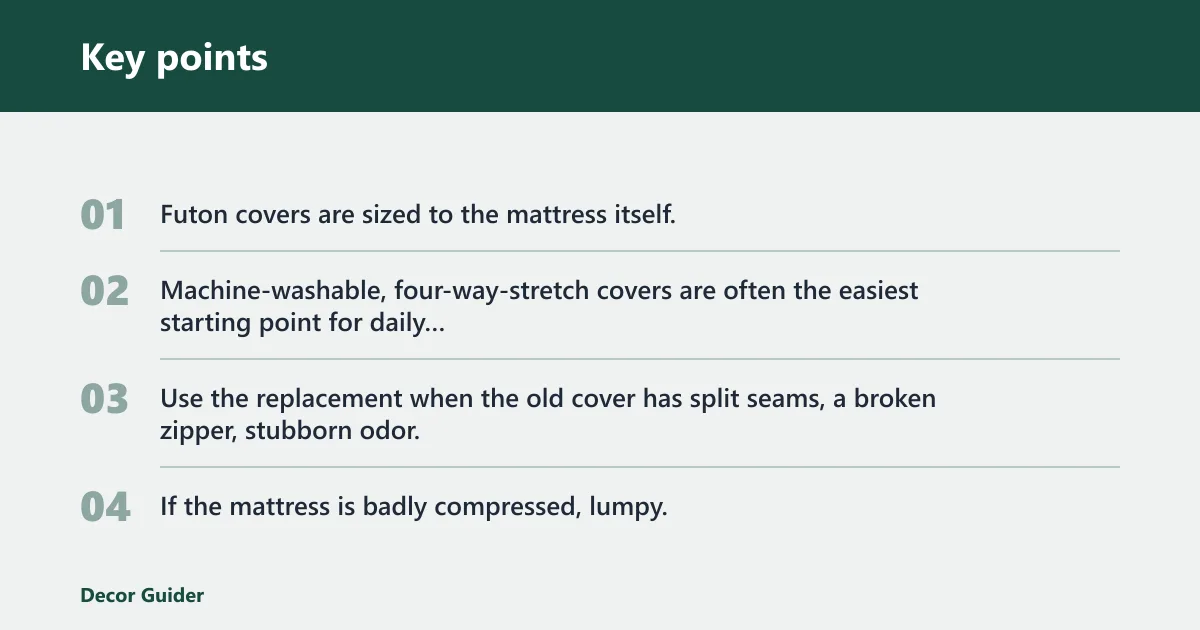


Start with the mattress dimensions first. Futon covers are sized to the mattress itself, and fit depends on thickness as much as width and length. Machine-washable, four-way-stretch covers are often the easiest starting point for daily use, while tighter woven covers usually work best only when the mattress dimensions are nearly exact.
Use the replacement when the old cover has split seams, a broken zipper, stubborn odor, or shrinkage that makes folding difficult. If the mattress is badly compressed, lumpy, or too thick for the depth shown on the cover label, a new cover may not solve the fit problem.
What you’ll need
- Replacement futon cover sized to the mattress, not the frame
- Tape measure
- Helper for thick or heavy mattresses
- Clean, flat floor or large bed for removal and installation
- Soft brush or lint roller for pet hair
- Detergent that matches the care label
- Drying space or dryer setting allowed by the label
How do you measure the futon mattress?

Measure the mattress while it lies flat. Record width, length, and thickness, because pocket depth can make or break the fit on thicker futon mattresses. For a full futon mattress, a common size is 54 inches by 75 inches. A queen futon mattress is commonly 60 inches by 80 inches.
Measure width, length, and thickness
- Lay the mattress flat on a clean surface.
- Measure straight across the width from edge to edge.
- Measure the length from end to end.
- Measure thickness at the thickest point, including any loft that stays after compression.
- Write the three numbers down before you shop.
Match pocket depth to mattress thickness
Pocket depth must match the mattress thickness. Typical full-futon thickness is 6 to 10 inches, and typical queen-futon thickness is 8 to 12 inches. That extra depth matters most on 8 to 12 inch mattresses, where shallow covers tend to ride up, strain the zipper, or pull off the corners during folding.
Say your full futon measures 54 inches by 75 inches and 9 inches thick. A cover labeled for the right length and width can still fail if the pocket depth is short by an inch or two. The first symptom is usually corner lift after the frame changes from sofa to bed.
Stretch or non-stretch cover?
Four-way stretch covers are often a practical starting point for repeated folding and daily use. They are usually made from a polyester-spandex blend and help reduce loose fabric on the seat. Two-way stretch or rigid woven covers fit best when the dimensions are nearly exact, and they are less forgiving on thick or oversized mattresses.
Four-way stretch cover
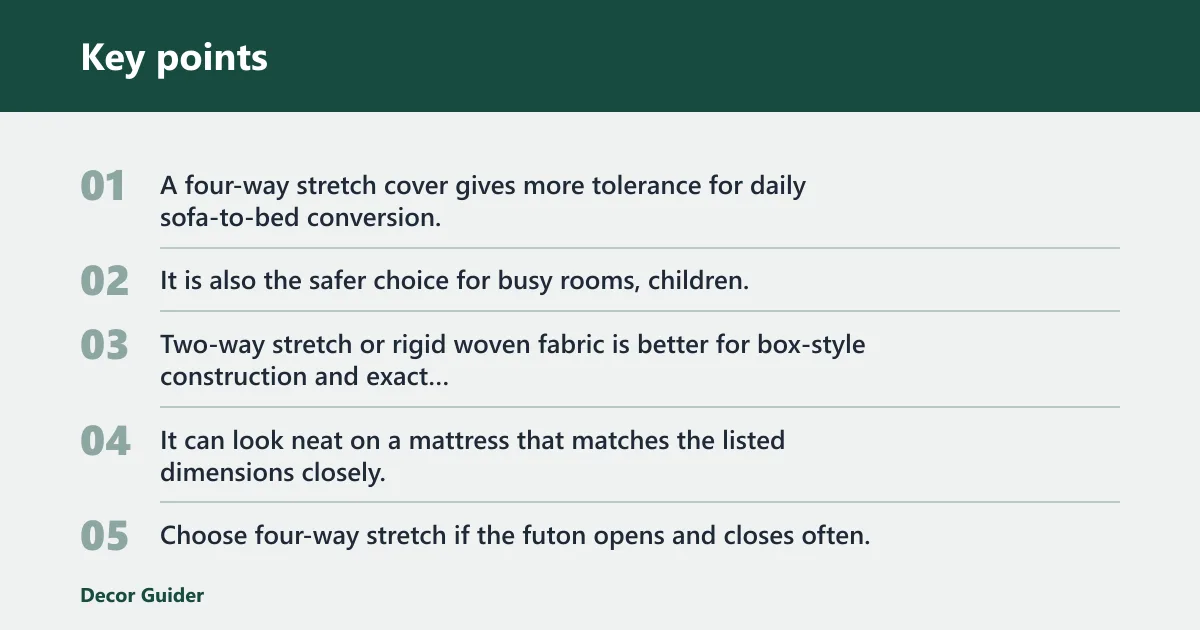
A four-way stretch cover gives more tolerance for daily sofa-to-bed conversion, especially when the mattress compresses unevenly. It is also the safer choice for busy rooms, children, and pet households because the fabric moves with the mattress instead of fighting it.
Two-way stretch or rigid woven cover
Two-way stretch or rigid woven fabric is better for box-style construction and exact sizing. It can look neat on a mattress that matches the listed dimensions closely, but it is less forgiving when the mattress is thicker than expected or when the cover is washed and shrinks.
Which cover type fits daily folding better?
Choose four-way stretch if the futon opens and closes often. Choose a tighter woven cover only if the mattress is close to the stated size and the closure opens wide enough for installation. For hot rooms or guest-room use, material choice matters less than getting the depth and closure right first.
Futon cover fit matrix
| Mattress size | Thickness | Cover type | Closure type | Likely fit risk | Best use case |
|---|---|---|---|---|---|
| Twin | 6 to 8 inches | Four-way stretch | Reinforced zipper | Low if measurements match | Daily sitting and sleeping |
| Full | 6 to 10 inches | Four-way stretch | Elastic opening or zipper | Moderate if the mattress has extra loft | Frequent sofa-to-bed conversion |
| Queen | 8 to 12 inches | Four-way stretch | Reinforced zipper | Higher at the upper end of thickness | Daily sleeping in a primary room |
| Loveseat or chair | Varies by model | Two-way stretch or rigid woven | Elastic opening | Higher if dimensions are not exact | Guest room or light-use seating |
Material choice should stay practical. Polyester is the safest all-purpose choice, microfiber polyester works well for smoother hand feel, and a cotton-polyester blend gives a more familiar fabric look. A cover with around 3% to 8% spandex or elastane usually provides enough stretch for routine folding without turning the fit loose.
Install the new cover
Work on a clean surface and keep the mattress flat for each step. The goal is even tension, not brute force. Pulling too hard can stretch seams before the cover is fully closed.
- Remove the old cover carefully and unzip or unfasten it fully.
- Brush off loose hair, dust, and grit from the mattress surface.
- Turn the new cover so the opening faces the correct edge.
- Align the mattress corners with the cover corners before pulling the fabric over the body.
- Pull the cover on evenly from end to end, then close the zipper or secure the elastic.
- Smooth wrinkles, then fold the futon once and reopen it to check seam strain and corner lift.
Adjust in about 2-inch sections if the cover resists one corner. Work around the mattress instead of yanking one end. That keeps pressure off the zipper teeth and reduces the chance of a split seam.
Suppose a queen futon in a daily-use den has a cover that closes but wrinkles near the center after the first fold. The likely fix is not a tighter pull at the ends. Re-seat the corners, smooth the center panel, and check whether the pocket depth matches the mattress thickness.
Can you machine-wash a futon cover?
Many futon covers are machine-washable, but the care label sets the wash and dry limits. Washability matters for fit because shrinking after laundering can make a cover too tight, especially on thick mattresses or rigid woven fabric. A clean cover is useful only if it still closes without strain.
Check the care label before washing
Look for water temperature, cycle type, and dryer instructions before washing. If the label calls for line drying, do not assume a hot dryer will be fine. Heat is a common cause of shrinkage after laundering.
Wash and dry limits for polyester blends
Polyester and microfiber polyester usually tolerate routine washing better than many natural-fiber-heavy covers. Cotton-polyester blends can still shrink if dried too hot. Zip the cover before washing so the opening keeps its shape and the teeth do not snag other fabric.
How to avoid shrinkage after laundering
Use the coldest setting that the care label allows and remove the cover promptly after the cycle. Dry it only as directed. If the cover fits tightly before washing, check it again after it dries, because even a small amount of shrinkage can turn a good fit into zipper strain.
Common mistakes
The biggest failures come from sizing and force. Most of them are easy to avoid once you know where the fit actually breaks down.
- Buying by frame size only: measure the mattress, not the frame.
- Ignoring pocket depth: thick mattresses need the depth listed on the cover.
- Forcing the zipper: stop if the zipper binds, then reseat the fabric.
- Stretching seams too far: use a stretch cover when daily folding is part of the use case.
- Skipping pet cleanup: remove hair and grit before installation so debris does not work into the fabric.
- Ignoring shrinkage after washing: recheck fit after laundering before putting the cover back into service.
Picture a loveseat futon in a guest room that looks tidy after installation but pulls diagonally at one corner each time it is folded flat. That usually means the cover is too rigid for the mattress shape, or the closure opening does not reach far enough for even placement.
If that did not work, try the next larger depth range only if the width and length still match the mattress. If the zipper still strains after you confirm the dimensions, replacement of the mattress may be smarter than buying another cover.
How do you keep a futon cover from slipping or bunching?
Keep the cover aligned by matching the corners before closing it, using a closure that opens far enough for installation, and choosing four-way stretch when the futon folds often. Slipping and bunching usually come from loose fit, shallow pocket depth, or a cover that cannot move with the mattress.
For recurring bunching, recheck the thickness first. A cover that fits a 6-inch mattress may slide on an 11-inch mattress because the corners cannot settle fully. Reinforced zippers and well-secured elastic openings both help, but only if the cover size is correct.
Are futon covers good for pets and frequent spills?
Yes, provided you choose a washable cover and treat it as a removable barrier rather than a stain cure. Polyester and microfiber polyester are commonly used for pet hair, dust, and routine spills. For homes with children, pets, or frequent spill risk, the best choice is a machine-washable four-way-stretch cover with a reinforced closure.
For odor control, remove hair before washing and clean spills as soon as possible. If a cover smells stale after repeated use, washing may help, but deep odor in the mattress itself is a warning sign. At that point, a new cover may not be worth more than a new mattress.
Frequently asked questions
How do you replace a futon mattress cover?
Measure the mattress first, choose a cover that matches its length, width, and thickness, then remove the old cover and install the new one with the corners aligned. Close the zipper or elastic evenly, smooth the fabric, and fold the futon once to check for seam strain or corner lift.
Do I measure the futon mattress or the frame?
Measure the mattress. Frame size can differ from the actual mattress dimensions, and the cover must match the mattress, not the frame. Record width, length, and thickness while the mattress lies flat so you can compare those numbers with the cover label before buying.
What size futon cover do I need for a full futon mattress?
A full futon mattress is commonly 54 inches by 75 inches, but thickness still matters. A full-size cover should generally match the mattress dimensions and allow enough pocket depth for the actual thickness, which is often about 6 to 10 inches.
What is the difference between stretch and non-stretch futon covers?
Four-way stretch covers move in more directions and are better for repeated folding and daily use. Two-way stretch or rigid woven covers fit best when the mattress dimensions are nearly exact. The tighter styles can look neat, but they are less forgiving on thick mattresses.
Can I wash a futon mattress cover in a machine?
Many covers are machine-washable, but the care label controls the cycle and drying limits. Wash in the temperature and setting listed on the tag, then dry only as directed. That helps prevent shrinkage, which can make the cover too tight after laundering.
What should I do if my futon mattress is thicker than the cover depth?
Choose a cover with greater pocket depth or move to a four-way-stretch style if the current cover is only slightly short. If the mattress is 8 to 12 inches thick and the cover still strains, forcing it will usually damage seams or the zipper before it improves the fit.
Products related to this article
Sponsored / affiliate links. As an Amazon Associate I earn from qualifying purchases. I may earn additional commission from eligible campaigns.