How To Make A Futon More Comfortable: Easy Fixes
Making a futon more comfortable involves addressing its inherent firmness. This is often achieved by adding layers of cushioning, improving the mattress support, and enhancing the overall feel with soft textiles. The goal is to create a softer, more supportive surface for both sitting and sleeping.

CIRCLESHOME
CirclesHome White Futon Mattress Toppers with Anti-Slip…
- FUTON MATTRESS TOPPER: The Futon Mattress Topper is the extra added comfort your Futon has been in need of. Let CirclesHome change…
- MULTIPLE USES: The Futon Topper was designed to be an extra layer of comfort for your futon, but it can be used for a bed or sofa…
- SIZE: The Futon Topper is designed for a full size, which is 54 x 75 X 2.
As an Amazon Associate I earn from qualifying purchases.

Understanding Futon Comfort Challenges
Futons are designed to be efficient. They often start as a sofa. Then, they fold out into a bed.
This dual purpose means the mattress needs to be firm enough to support you when upright. It also needs to be durable. This dual role often leads to a mattress that’s quite stiff.
It lacks the plushness you might find in a traditional bed. Think about the frame too. Sometimes, the frame itself can feel hard against your back.
This is especially true when the mattress is thin or has sagged over time.
The materials used can also play a big part. Many futon mattresses are filled with cotton or foam. While these materials are common, they can compress over time.
This loss of loft makes the surface feel flatter and harder. Overuse can lead to lumps or uneven spots. This makes resting difficult.
It’s like trying to sleep on a lumpy pillow. You shift and turn, but nothing feels quite right. The dream of a comfortable futon can seem far away.

Why Futons Can Feel Uncomfortable
The core reason a futon feels uncomfortable often comes down to its design. It’s built for versatility, not just supreme comfort. A traditional mattress has springs and multiple layers designed for softness and support.
A futon mattress is usually a single, dense unit. It has to be stiff enough not to fold or buckle when used as a couch.
When you lie on it, your body doesn’t sink in. It rests on top. This can put pressure on your hips, shoulders, and back.
Over time, this pressure causes discomfort. It can even lead to aches and pains. This is why many people find themselves tossing and turning.
They’re searching for a position that doesn’t feel like a hard surface.
Another issue is wear and tear. Futon mattresses, especially older ones, can lose their shape. They might develop dips or bumps.
This unevenness makes finding a comfortable spot even harder. The frame might also contribute. If the slats are too far apart or have lost their spring, they can create pressure points through the mattress.
You feel every single one.
My Futon Story: The Night I Learned About Layers
I remember buying my first futon. It was for my tiny studio apartment. I thought it was the perfect solution.
It was a sofa for my living space and a bed for guests. The problem? I decided to try sleeping on it myself one night.
It was an experience I won’t forget. The mattress felt like a dense slab of foam. My back protested loudly after just a few hours.
I woke up feeling stiff and sore. It was worse than sleeping on the floor, which I’d actually done once!
That morning, I looked at the futon with a mix of frustration and regret. It was supposed to be practical, not painful. I knew I had to fix it.
I couldn’t stand the thought of another night like that. And I certainly didn’t want my guests to suffer. I started researching.
How could I make this thing…soft? It felt like a design flaw that I, the owner, had to solve. This led me down a rabbit hole of mattress toppers, blankets, and creative layering.
It was a journey of trial and error.
Adding Layers: The Power of Softness
The quickest and most effective way to make a futon more comfortable is by adding layers. Think of it like giving your futon a soft hug. You’re not trying to replace the mattress, but rather enhance it.
These added layers provide extra padding and comfort.
A mattress topper is your best friend here. These are like thick blankets that sit on top of your existing futon mattress. They come in different materials.
Memory foam toppers are very popular. They mold to your body and relieve pressure points. This is great for side sleepers.
They help cushion your hips and shoulders. Other options include fiberfill or down alternatives. These offer a softer, more cloud-like feel.
Even simple, thick blankets can make a difference. Layering a few cozy blankets can add a surprising amount of softness. This is a budget-friendly option.
It’s also a good way to test out what kind of comfort you like. You can mix and match different types of blankets to find your perfect feel. This gives you control over the firmness.
Quick Comfort Boosters: Layering Guide
What to Layer:
- Memory Foam Topper: Great for pressure relief.
- Egg Crate Foam: Adds a bit of bounce and softness.
- Thick Comforter: Easy to add and remove.
- Quilted Mattress Pad: Provides a bit of extra cushion.
- Soft Blankets: Multiple layers can add significant softness.
How to Layer:
- Start with your futon mattress.
- Place your chosen topper or pad on top.
- Add blankets for extra softness.
- Finally, put on your fitted sheet.
Choosing the Right Mattress Topper
When you look for a mattress topper, consider what kind of comfort you’re after. Are you someone who likes to feel like they’re sinking into a cloud? Or do you prefer a little more support with softness?
This will guide your material choice.
Memory foam toppers are excellent for pressure relief. They contour to your body’s shape. This is fantastic if you experience pain or stiffness.
They absorb movement, so you won’t feel your partner tossing and turning as much. However, some people find memory foam too warm. Look for toppers with cooling gel infusions if this is a concern.
Latex toppers offer a different kind of comfort. They are more responsive, meaning they bounce back quickly. This gives a feeling of buoyancy.
Latex is also naturally breathable and hypoallergenic. It’s a good choice if you tend to sleep hot or have allergies.
Fiberfill or down-alternative toppers are the softest. They give that plush, hotel-bed feel. They are lighter and often more affordable.
However, they might not offer as much support as foam or latex. They can also compress more over time, needing to be fluffed.
Enhancing Support: Beyond the Mattress
Sometimes, the problem isn’t just the mattress itself. The futon frame and the way the mattress sits on it can also affect comfort. The frame provides the base support for your mattress.
Many futon frames have wooden slats. These slats should be evenly spaced. If they are too far apart, the mattress can sag between them.
This creates uncomfortable dips. You might feel the individual slats pressing into your back. Check your frame to see if the slats are intact and well-supported.
If the slats are the issue, you can fix this. One common trick is to add extra support. You can place a piece of plywood or a thin, sturdy board across the slats.
This creates a more solid, even surface for the mattress to rest on. Make sure to cut it to the right size. This simple addition can dramatically improve the feeling of support.
Frame Fixes for Better Support
Check Your Slats:
- Are they spaced too far apart?
- Are any broken or warped?
Quick Solutions:
- Add Plywood: Cut a piece of thin plywood to fit over the slats. This creates a solid base.
- Reinforce Slats: If some slats are sagging, add extra supports underneath.
- Use a Bunkie Board: This is a thin, rigid board designed to go under a mattress for extra support.
Another factor is the mattress itself. If your futon mattress is old and worn out, adding layers might not be enough. It might be time for a new one.
But even a new, firm mattress can benefit from added support underneath. A bunkie board is designed for this. It’s a thin, rigid board that sits directly on the frame.
This board acts as a solid foundation. It prevents the mattress from sinking between the slats. It also helps distribute your weight evenly.
This makes the mattress feel firmer and more supportive. It’s like building a stronger base for your comfort. A good bunkie board can make a world of difference.
Fabric and Textiles: The Finishing Touch
Once you’ve addressed the core comfort layers, think about the fabrics. The sheets, blankets, and throws you use can significantly impact the overall feel. Rough fabrics can make even a soft mattress feel less appealing.
Choose soft, breathable materials for your bedding. Cotton sheets are a classic choice. Look for high thread counts for extra softness.
Bamboo or linen sheets also offer a cool, smooth feel. These are especially good for warmer climates or for people who tend to overheat.
Don’t forget about throw blankets and pillows. A few plush throw pillows can make sitting on the futon more enjoyable. They add extra support for your back and arms.
A soft, cozy throw blanket invites you to relax. These small touches can transform the aesthetic and feel of your futon.
Think about the texture of your futon cover too. Some futon covers are made of coarse materials. If yours is like that, consider getting a softer slipcover.
Or, simply use a large, soft blanket draped over the top. This acts as a protective layer and adds immediate softness. It’s a simple upgrade that makes a big impact.
Smart Solutions for Small Spaces
Futons are often used in smaller homes or apartments where space is limited. The solutions you choose should fit this reality. Luckily, many comfort improvements are space-efficient.
A thin memory foam topper can be easily rolled up and stored when the futon is used as a sofa. This is perfect for multi-functional furniture. You get the comfort when you need it, and it doesn’t take up much space when you don’t.
Strategically placed pillows are another great idea. They add comfort and can also serve as decorative elements. Decorative pillows can make the futon look more inviting as a sofa.
They’re easy to move aside when it’s time to sleep.
Consider a futon that has built-in storage. Some futon frames have drawers underneath. This is a great place to store your extra blankets, pillows, or even a rolled-up topper.
Keeping these items organized makes the space feel tidier and more functional.
Space-Saving Comfort Tips
Topper Storage:
- Roll and Tie: Most foam toppers can be rolled up tightly. Use straps to keep them secure.
- Under the Futon: If there’s space, slide the rolled topper underneath the frame.
- In a Storage Ottoman: If you have one, it’s a perfect hiding spot.
Pillow Power:
- Mix and Match: Use a variety of sizes and textures for maximum comfort and style.
- Back Support: Place larger pillows behind your back when sitting.
- Arm Support: Use smaller pillows to rest your arms.
When to Consider a New Futon Mattress
While adding layers and support can do wonders, there comes a time when a new mattress might be necessary. If your current futon mattress is very old, lumpy, or has significant sagging, it might not be salvageable. Trying to make a truly worn-out mattress comfortable can be an endless battle.
A new futon mattress is an investment. They are designed with comfort in mind. Look for mattresses that are thicker than your old one.
Many modern futon mattresses offer different firmness levels. You can choose one that suits your preference. Some are made with gel-infused foam or pocketed coils for better comfort and support.
When shopping for a new futon mattress, check the reviews. See what other people say about its comfort for sleeping and sitting. Pay attention to the materials used.
Look for warranties. A good warranty can give you peace of mind. It shows the manufacturer stands behind their product.
A new mattress can be the ultimate solution.
Real-World Scenarios: Futon Comfort in Action
Let’s imagine a few situations. Your son has friends over. They need a place to sleep.
You don’t have a guest room. Your futon is ready. You’ve added a thick memory foam topper and a plush comforter.
The friends sleep soundly, no complaints. They wake up feeling rested, not sore. That’s a win!
Or consider your own relaxation. You’ve had a long day. You want to curl up on the couch with a book.
Your futon, with its soft blankets and supportive pillows, feels inviting. It’s not just a hard surface anymore. It’s a cozy spot where you can truly unwind.
This transformation happens with thoughtful additions.
Even using it for movie nights becomes better. Instead of shifting uncomfortably, you can settle in. The layered comfort makes it a pleasant place to spend hours.
The key is that these aren’t drastic changes. They are small, smart additions that make a big difference in daily use.
What This Means for You: When is it “Comfortable Enough”?
The definition of comfortable is different for everyone. What feels perfect to one person might feel too soft or too firm for another. The goal is to find a balance that works for you.
This means your futon should feel pleasant when you sit on it for extended periods. It should also allow you to sleep through the night without waking up in pain.
When you add layers, you gain control. You can adjust the amount of softness or firmness. If your futon feels too hard, add another layer.
If it feels too soft, you might need to remove a layer or ensure your base support is solid. It’s about tuning the comfort to your personal needs.
Don’t be afraid to experiment. What works for one futon might not work for another. Your body’s needs change too.
What felt comfortable a few years ago might not now. Regularly check in with how your futon feels. Make small adjustments as needed.
Your comfort is the ultimate goal.
Consider the use case. Is this futon primarily for guests? Or is it your main sofa and bed?
If it’s your main sleeping surface, invest more in comfort. A high-quality topper and perhaps even a new mattress are worthwhile. If it’s for occasional guests, simpler layering might suffice.
The level of effort should match the level of use.
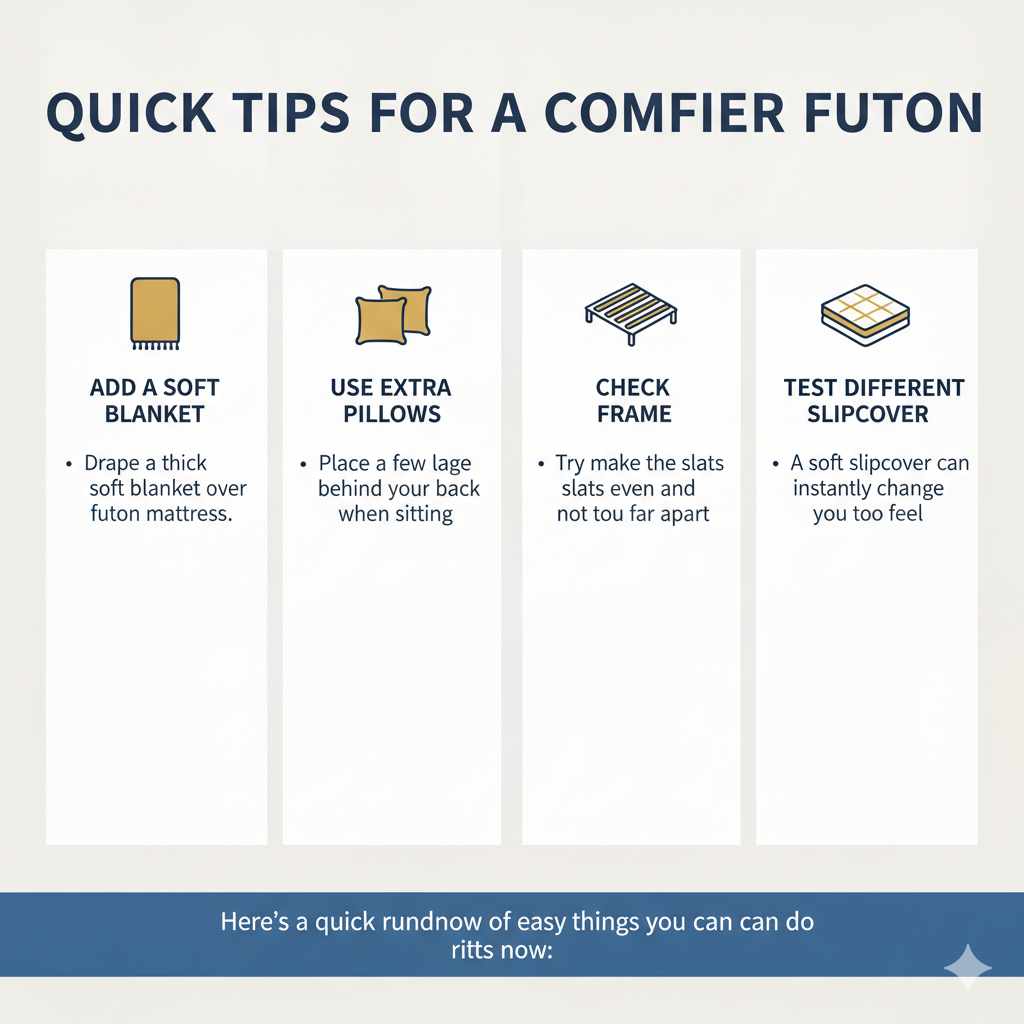
Quick Tips for a Comfier Futon
Here’s a quick rundown of easy things you can do right now:
- Add a Soft Blanket: Drape a thick, soft blanket over the futon mattress.
- Use Extra Pillows: Place a few large pillows behind your back when sitting.
- Check the Frame: Make sure the slats are even and not too far apart.
- Test Different Layers: Try adding a folded duvet or a thick quilt.
- Consider a Slipcover: A soft slipcover can instantly change the feel.
Frequent Questions About Futon Comfort
How can I make a very firm futon mattress softer?
The best way to soften a firm futon mattress is by adding layers on top. A thick memory foam or latex mattress topper is highly effective. You can also layer soft blankets or a plush comforter underneath your fitted sheet.
Ensure the topper is at least 2-3 inches thick for noticeable softness.
Will a mattress topper work for sleeping on a futon?
Yes, a mattress topper is excellent for sleeping on a futon. It adds cushioning and pressure relief, which futon mattresses often lack. Choose a topper made of memory foam, latex, or a thick fiberfill for the best sleeping experience.
Make sure it fits your futon mattress snugly.
How do I stop my futon mattress from feeling lumpy?
If your futon mattress is lumpy, adding a firming layer like plywood or a bunkie board underneath can help create an even surface. On top, a thick topper, especially memory foam, can help smooth out lumps. For severe lumps, it might be time to replace the mattress itself.
Can I use a regular mattress on a futon frame?
Generally, no. Regular mattresses are too thick and heavy for most futon frames. Futon mattresses are specifically designed to be thinner and more flexible.
Using a regular mattress can damage the frame and the mattress, and it won’t function correctly as a sofa.
What is the best type of topper for a futon?
The best topper depends on your needs. For pressure relief and a cradling feel, memory foam is great. For a more responsive and buoyant feel, latex is excellent.
For a super soft, plush feel, fiberfill or down alternatives work well. A 2-3 inch thickness is usually recommended for futons.
How often should I replace my futon mattress?
Futon mattresses typically need
Conclusion: Your Comfy Futon Awaits
Transforming your futon from stiff to snug is totally achievable. It’s about smart additions, not major overhauls. By adding soft layers, ensuring proper support, and choosing cozy textiles, you can create a comfortable space.
Your futon can be a welcoming spot for sitting and a peaceful place for sleeping. Enjoy your newfound comfort!
Related pick: Check today's price on Amazon
Products related to this article
Sponsored / affiliate links. As an Amazon Associate I earn from qualifying purchases. I may earn additional commission from eligible campaigns.