Best Futons for Everyday Sleeping (2026): we compared
For everyday sleeping, a full-size or larger futon with an innerspring or high-density foam mattress around 8 inches thick, plus a sturdy frame and a replaceable mattress, is often a practical choice. Thin cotton-fill futons sag fast, flatten hips and shoulders, and turn nightly sleep into back pain and constant replacements. I have seen that pattern repeat in real rooms, with real bodies, after months of use. This guide matches futon build, thickness, and firmness to body type, sleep position, and the failure points that show up after months of use.
Best futon for everyday sleeping: the top pick
The best overall pick is the NLDD 10-inch full-size futon mattress, because its thickness and high-density foam give nightly sleepers the safest buffer against bottoming out. It suits adults who want a floor-futon feel without the fast sag that ruins shallow builds.
Skip it if you need a lighter, easier-to-move bed or if your frame has tight space limits. Its bulk is the point, and bulk is not ideal for every room.
Quick picks
- Best overall: NLDD 10" Futon Mattress Full Size
- Best for side sleepers: Milliard Full Size Futon Mattress
- Best for heavier sleepers: NLDD 10" Futon Mattress Full Size
- Best for small spaces: JUIKURY 6 Inch Tri-Fold Memory Foam Mattress

Quick comparison
| Product | Badge | Best for | Price | ||
|---|---|---|---|---|---|
 |
ZINUS 6 Inch Green Tea Cooling Gel Memory Foam Mattress /Zinus | Budget pick | 6" · Full · Green tea cooling gel | $114.00
Price as of 24 Sep 2026
|
View |
 |
NLDD 10" Futon Mattress Full Size, Ultra Thick Futons SofaNLDD | Upgrade pick | 10" · Full · Faux fur cover | $153.99
Price as of 24 Sep 2026
|
View |
 |
6th Generation Japanese Floor Futon Mattress – Extra-ThickFeisaibaoly | Also great | 9-layer · Full XL · High-density foam | $82.99
Price as of 24 Sep 2026
|
View |
 |
JUIKURY 6 Inch Tri-Fold Memory Foam Mattress Full Size, 5JUIKURY | Our pick | 6" · Full · Tri-fold corduroy | $138.07
Price as of 24 Sep 2026
|
View |
 |
Milliard Full Size Futon Mattress, Light Grey, 71 x 52 x 6Milliard | Also great | 6" · Full · Memory foam + HD base | $199.99
Price as of 24 Sep 2026
|
View |
This shortlist is built for nightly use, not guest-room duty. Thickness and support layer, and the chance of long-term flattening matter more than a low sticker price.
The products below cover different room sizes and sleep styles, from thin tri-fold units to thicker floor mattresses and a replaceable sofa-bed style mattress.
How we chose
I picked for nightly support, pressure relief, heat control, and resistance to sagging. I also weighed whether the mattress can live on a frame or on the floor without turning lumpy.
I compared the listed specs, the construction style, and the likely failure mode for each design. A futon that feels soft for one week can still be a poor nightly bed if it compresses fast or traps heat.
What makes a futon good for everyday sleeping?
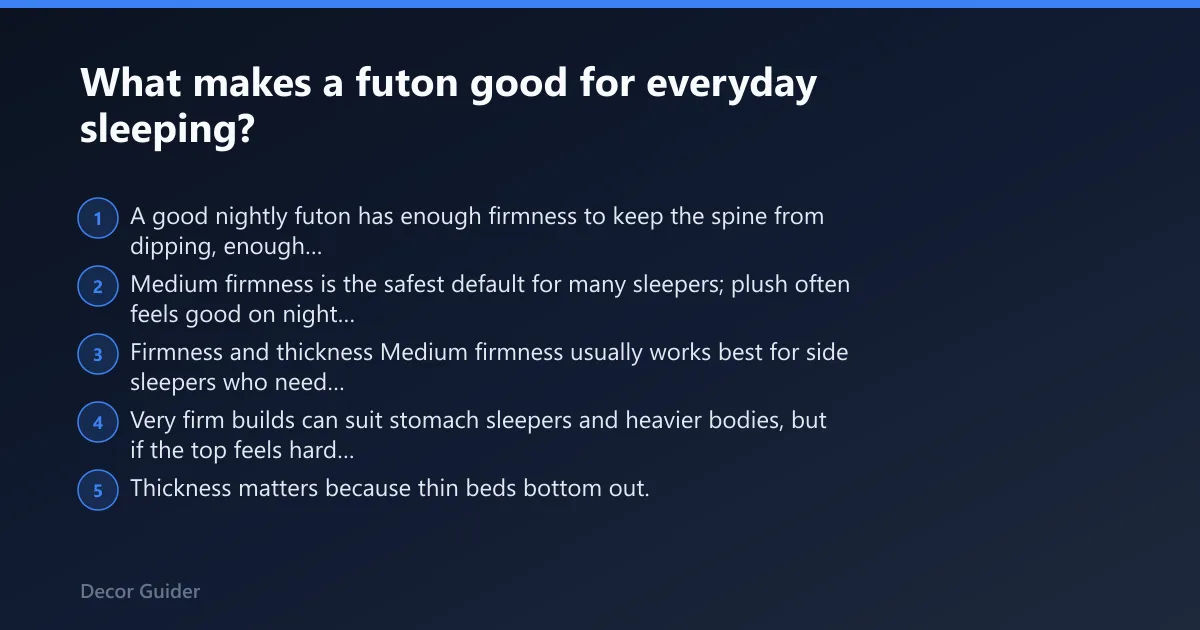
A good nightly futon has enough firmness to keep the spine from dipping, enough thickness to stop hips from touching the frame, and enough loft retention to stay useful after repeated folding. Medium firmness is the safest default for many sleepers; plush often feels good on night one and wrong by month three.
Firmness and thickness
Medium firmness usually works best for side sleepers who need shoulder give and back sleepers who need steady support. Very firm builds can suit stomach sleepers and heavier bodies, but if the top feels hard with little padding, hips and ribs can ache by morning.
Thickness matters because thin beds bottom out. Once that happens, the frame or floor starts doing the work, and the sleeper feels every hard point under the body.
Fill types: foam, cotton, latex, coir, and wool
Foam layers help with pressure relief and can slow bottoming out, especially in thicker builds. Cotton fill feels more traditional and breathable, but it compresses faster unless the futon is built with enough density and layering.
Latex adds elasticity and better motion absorption, which helps couples. Coconut coir brings firmer support and stronger airflow, while wool can help with temperature swings and works well as part of a mixed stack.
For material logic, cotton is the airiest and most familiar. Coconut coir is the firmest of the common natural layers. Latex gives the most spring and body contouring of the group.
Frame and size: full vs queen, plus tall sleeper fit
A futon’s mattress cannot do all the work if the frame is weak or the bed is too short. Full size works for one adult in many rooms, but queen is the safer choice for nightly use, partner sleep, and taller sleepers who need more length without headboard interference.
Convertible frame style matters too. Sofa bed, chaise, and lounger formats change how well the piece fits a studio or apartment, and a simple frame with a strong weight rating is usually easier to live with than a fussy one.
Best futon mattress types for nightly use
The best nightly futon type depends on whether the main problem is pressure points, heat, motion transfer, or sagging. Foam helps with pressure and bottoming out, cotton helps with airflow, and layered natural materials help when the sleeper needs both support and temperature control.
Foam-layer futons for bottoming-out resistance
High-density foam is the safest answer when the sleeper is heavier, the frame slats are wide, or the bed sits directly on the floor. It keeps the body off hard support surfaces longer than light cotton-only fills.
Cotton-based futons for breathability and a traditional feel
Cotton fill is useful for sleepers who get hot or want a more traditional Japanese-style feel. Nejfuton describes cotton as breathable and helpful for temperature and moisture control, which is exactly why cotton-based builds are common in warmer rooms.
Latex, coir, and wool blends for support and temperature control
Latex is elastic and adapts to body shape, so it can help with motion absorption and pressure relief. Nejfuton says coconut fiber helps airflow and reduces mold and mites, which makes it useful in damp rooms or for people who want firmer support. Wool is often best as a temperature-balancing layer inside a mixed build.
How to use the futon sleep-fit checklist

Use the checklist below to score a futon before buying. It turns vague marketing into a simple nightly-use filter, which is better than guessing from one soft showroom impression.
| Sleep profile | Firmness | Thickness | Support | Heat | Motion transfer | Durability |
|---|---|---|---|---|---|---|
| Side sleeper | Medium | 8/10 | Needs shoulder give | Medium | Medium | High if foam-led |
| Back sleeper | Medium-firm to firm | 7/10 | Needs even waist support | Medium | Medium | High if dense |
| Stomach sleeper | Firm | 8/10 | Needs low sink | Low to medium | Low to medium | High if core is stable |
| Combo sleeper | Medium-firm | 8/10 | Needs balance across positions | Medium | Medium | High if layered |
- Score firmness first. If the sleeper wakes with low-back strain, the bed is too soft or too thin.
- Check thickness next. A low profile is fine for floor use only when the fill is dense enough to resist compression.
- Watch for heat. Hot sleep often means too much closed-cell foam and too little breathable material.
- Check motion transfer if two people will sleep on it. Latex and denser foam usually do better than fluffy cotton.
- Look at long-term shape retention. If the center loses loft fast, daily use will become uneven and painful.
Failure signs are easy to spot. Hip pain usually means bottoming out. Shoulder pain often means the bed is too firm for a side sleeper. Heat points to poor airflow. Sagging means the mattress has already started its decline.
What futon mattress is best for everyday sleeping?
The best futon mattress for everyday sleeping is a thicker full-size or larger model with dense foam, a stable support core, and enough surface give for the sleeper’s position. That usually means a medium-firm to firm build, not a thin cotton-only pad that feels good for a weekend and fails under nightly load.
Match the mattress to the sleeper
Side sleepers usually need the most padding because shoulders and hips need room to sink without collapsing the spine. Back sleepers do well with medium-firm builds that keep the lower back steady. Stomach sleepers need the firmest surface because too much sink strains the lumbar area.
Match the mattress to the room
If the futon doubles as a couch, a convertible frame and a mattress that folds cleanly matter as much as thickness. For a bedroom-only setup, a larger and denser mattress can be the better trade, because the bed does not need to convert every day.
What size futon is best for everyday sleeping queen or full?
Queen is usually the safer choice for everyday sleeping, especially for taller sleepers, partner use, or anyone who shifts position a lot at night. Full can work for one sleeper in a smaller room, but it leaves less room for movement and can feel cramped on longer nights.
When full makes sense
Full size works best in tight apartments, dorm rooms, and guest spaces that still need a nightly bed. It is easier to fit through doorways and can be the right answer when floor space matters more than spread-out sleep.
When queen is the better buy
Queen is better when the futon will replace a bed, not merely support occasional sleep. It gives more room for side sleeping, partner sleep, and tall sleepers who need to avoid headboard interference or feet hanging near the edge.
How firm should a futon be for daily use?
A daily-use futon should usually land in the medium-firm to firm zone. Medium works best for most back and combo sleepers, while firm suits heavier bodies and stomach sleepers. Plush is the riskiest choice for nightly use because it tends to lose alignment first.
When medium beats plush
Medium is the safer balance when the sleeper wants pressure relief without sinking into the support layer. It is also the better default for couples with different body weights, because it reduces the chance that one person rolls into a soft center.
When firm beats medium
Firm is the safer call when the sleeper is heavier, sleeps on the stomach, or needs a bed that can sit on a thin frame without bottoming out. It also tends to hold shape better in mixed-use spaces where the mattress folds and unfolds every day.
How long does a futon last with everyday sleeping?
A futon used every night lasts only as long as its fill resists compression and its frame stays supportive. Dense foam, latex, and layered builds usually hold up better than light cotton-only mats, while cheap, thin constructions can flatten quickly and need earlier replacement.
What shortens futon life
Repeated folding, poor ventilation, heavy bodies on thin fill, and weak frame support all speed up sagging. Moisture matters too. If a futon stays damp, cotton can clump and natural layers can lose shape faster.
What extends futon life
Rotating the mattress, airing it out, and keeping it on a stable frame all help. A washable cover and a mattress that can be replaced separately also reduce the cost of keeping the whole setup usable over time.
Best for everyday sleeping: ZINUS 6 Inch Green Tea Cooling Gel Memory Foam Mattress
This is for sleepers who want a lower-cost mattress with a known foam build and a more traditional bed feel than a thin cotton futon. Based on the spec sheet and reviews, the cooling gel foam is the main reason it stays on the list for warm sleepers.
What stands out is the pressure relief and the 10-year limited warranty included in the listing. The drawback is the 6-inch profile, which is still thinner than the safest nightly-sleep futon builds for heavier bodies or side sleepers who need more cushion.
Best for nightly floor sleeping: NLDD 10" Futon Mattress Full Size
This is for adults who want the deepest cushion among the options listed here and plan to sleep on the floor or on a simple frame. The 10-inch thickness gives it the strongest case for daily use when bottoming out is the main concern.
What stands out is the high-density foam and the included straps for folding and storage. The drawback is size and bulk; it is not the easiest choice if the room needs a lightweight, quick-moving setup.
Best for layered support: 6th Generation Japanese Floor Futon Mattress
This is for buyers who want a thicker Japanese-style floor futon with more structure than a thin cotton mat. The 9-layer build makes it more suitable for nightly use than the simple roll-up style many shoppers picture.
What stands out is the high-density foam stack and the breathable microfiber fabric with 3D lattice. The drawback is that a full XL format can still feel narrow for couples or very tall sleepers who need more width and length.
Best for flexible rooms: JUIKURY 6 Inch Tri-Fold Memory Foam Mattress
This is for small apartments, guest rooms, and rooms that need a bed by night and open floor by day. The tri-fold layout makes conversion simple, and the washable cover is useful when the mattress gets moved a lot.
What stands out is the no-assembly design and the easy storage shape. The drawback is the 6-inch profile, which may be too thin for heavier sleepers or for anyone who wants a more mattress-like nightly bed.
Best for pressure relief: Milliard Full Size Futon Mattress
This is for sleepers who want a softer foam layer over a supportive base and prefer a washable cover. The 2-inch memory foam layer should help side sleepers more than a plain hard futon top.
What stands out is the CertiPUR-US certified hypoallergenic foam and the removable zippered cover. The drawback is the 6-inch total build, which may still be too slim for larger bodies or for those who need a deeper nightly cushion.
Which one should you buy
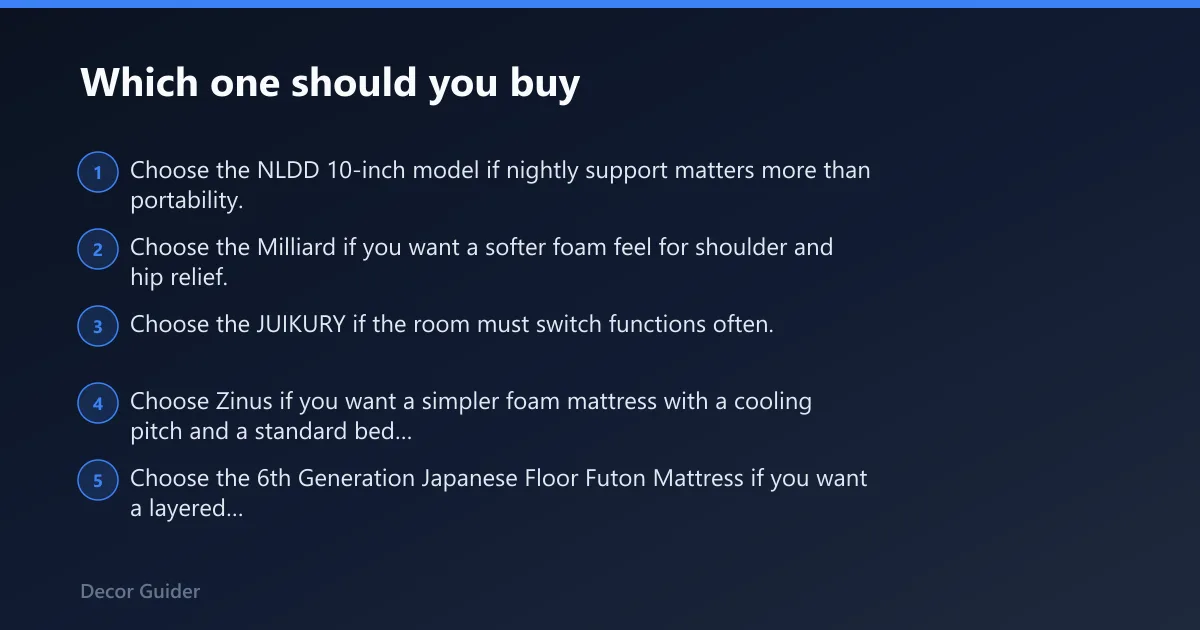
Choose the NLDD 10-inch model if nightly support matters more than portability. Choose the Milliard if you want a softer foam feel for shoulder and hip relief. Choose the JUIKURY if the room must switch functions often.
Choose Zinus if you want a simpler foam mattress with a cooling pitch and a standard bed feel. Choose the 6th Generation Japanese Floor Futon Mattress if you want a layered floor-futon style with more structure than a light roll-up mat.
For heavier sleepers, pick the thickest dense-foam build available. For side sleepers, pick more surface give. For stomach sleepers, pick the firmest structure you can still tolerate. For couples, move up to queen if the room allows it.
Also watch the frame. A convertible futon frame can work as a sofa bed, chair, chaise, or lounger, but the wrong frame turns a good mattress into a weak sleep setup. DHP Emily, for example, is described as a convertible couch, chair, or chaise lounger, with a maximum weight of 600, a seat height of 15 inches, and a back-rest height of 32 inches. The frame style must fit the sleeper’s nightly plan.
For size context, the guide also notes that DHP Hamilton is best for everyday sleeping. Emoor Japanese Original Futon comes in sizes from Twin to King, and it is described as plush and medium firmness. MainStay memory foam futon is listed at 71.6 by 33.5 by 32.5 inches, while Novogratz Brittany Premium Futon is listed at 81.5 by 34.5 by 31.5 inches. Those figures matter when room length and seating depth are tight.
The guide also covered different price ranges and intended uses, with under $200 and $150 as price categories. That matters because a cheap futon that flattens is not a bargain if it needs replacement soon after daily use begins.
Frequently asked questions
can you sleep on a futon every night
Yes, if the futon is built for it. A nightly futon needs enough thickness, enough support under the hips, and a fill that resists compression. Thin cotton-only mats can work for short stays, but they are a weak choice for regular sleep unless the sleeper is very light.
is it healthy to sleep on a futon
It can be healthy when the futon keeps the spine aligned and does not create pressure points. It can be unhealthy when it is too thin, too soft, or too firm for the sleeper’s position. A bad futon is often worse than a decent mattress.
are futons healthy to sleep on
They are healthy when the build matches the body. Back and combo sleepers often do well on medium-firm, denser builds. Side sleepers need more cushioning, and stomach sleepers need a firmer surface. Health comes from fit, not from the word “futon” itself.
what is the most comfortable futon for everyday sleeping
The most comfortable futon for everyday sleeping is usually a thicker full-size or queen model with layered foam or a foam-plus-natural-fill stack. Comfort lasts only when the mattress keeps its shape, so short-term softness should not outweigh support and sag resistance.
what materials are best in a futon for sleeping every night
High-density foam is the most dependable for daily use, latex is excellent for elasticity and motion control, cotton is good for breathability, coconut coir adds firm support and airflow, and wool helps with temperature balance. The best build often blends two or more of these materials.
Products related to this article
Sponsored / affiliate links. As an Amazon Associate I earn from qualifying purchases. I may earn additional commission from eligible campaigns.