Best Futons for College Dorm Rooms (2026): we compared
The best futon for a college dorm room is the one that matches your main need first, sleeping, sitting, or storage, then fits a 72-inch or smaller frame, a narrow doorway, and your dorm’s elevator or stair path. Pick the wrong size or frame and you end up with a couch that blocks traffic, will not move in, or turns into a poor mattress. This guide shows how to choose by function, measure your room and route, and compare the dorm-friendly futons worth buying.
Quick comparison
| Product | Badge | Best for | Price | ||
|---|---|---|---|---|---|
 |
COZYFUZY 4" Thick Japanese Futon Mattress – Space SavingCOZYFUZY | Our pick | 4" thick · Foldable · Twin | $68.75
Price as of 28 Sep 2026
|
View |
 |
SINWEEK 2 Inch Gel Memory Foam Mattress Topper, Twin SizeSINWEEK | Budget pick | 2" Gel Memory Foam · Twin | $26.99
Price as of 28 Sep 2026
|
View |
 |
Furnifact Metal Futon Sofa Bed Frame with Adjustable Back,Furnifact | Upgrade pick | Metal Frame · Full Size | $270.17
Price as of 28 Sep 2026
|
View |
 |
OctoRose Grey, Queen Size 60×80+10" Easy Fit Fitted FutonOctoRose | Pair with it | Queen 60×80" · Micro-Suede Cover | $52.99
Price as of 28 Sep 2026
|
View |
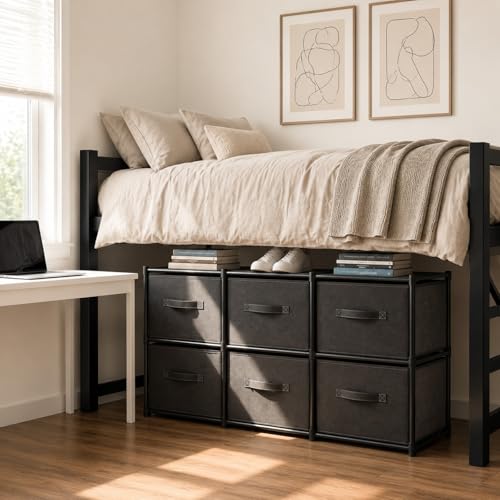 |
Geetery Under Dorm Bed Cube Organizer Shelf with 6 CubeGeetery | Also great | Under-Bed Shelf · 6 Cubes | $56.99
Price as of 28 Sep 2026
|
View |
Use the chart to sort by dorm fit before you compare finishes or extra features. In a small room, the move-in path and open-floor clearance matter as much as sleep comfort.
The biggest mistake is buying for the photo, not the room. I have seen futons that look compact online and still block a closet door, mini-fridge, or loft ladder once they are open.
How we chose
We compared the list through a dorm-only lens: footprint, frame type, assembly load, sleep use, and whether the design makes sense for a shared room. We also weighed move-in handling, cover care, and how each option fits campus rules that can limit materials or furniture type.
Nightly sleep support mattered more than guest-only comfort. So did the boring parts: box size, stair handling, and whether the piece can sit against a wall without stealing access to the rest of the room.
We also cut any vague small-space logic that ignores the real failure points. Door swings, desk clearance, and lofted-bed ladders decide whether a futon works.

COZYFUZY 4" thick Japanese futon mattress: best for the tightest dorm rooms
This is the best fit for students who need a low-profile sleep surface more than a sofa frame. The 4-inch build, foldable form, carry strap, and included dustproof cover make it easier to move and store than a bulkier convertible couch, especially in rooms where floor space is already spoken for.
What stands out is the practical dorm logic. A twin-size floor futon can slide against a wall, open on short notice, and disappear faster than a framed sleeper when roommates or rules leave almost no spare floor. Based on the spec sheet and owner feedback, the 3-layer support structure should feel firmer than a basic cushion mattress.
The drawback is obvious: it is a mattress, not a full sofa system. If you want upright back support for long study sessions or a more finished seating setup, this will feel minimal. The 4-inch thickness is better for occasional or moderate sleep use than for people who want a plush nightly bed.
SINWEEK 2 inch gel memory foam mattress topper: best for improving a campus bed
This is for students who already have a dorm bed or futon and need a softer top layer, not a full replacement seat. The twin-size gel memory foam is the easiest way to add comfort without adding much bulk, and it can help a thin futon feel less harsh for sleeping.
The strength here is comfort per inch. A 2-inch topper can improve pressure relief and even out a firm surface, which matters if the futon will be used mostly for sleeping. It also packs down more easily than a full mattress-style futon, which helps during move-in and storage shifts.
The drawback is that it is not a standalone futon solution. It adds comfort, but it does not solve seating posture, frame support, or room layout. It also depends on the surface underneath; on a weak base, the foam only masks the problem.
Furnifact metal futon sofa bed frame: best for nightly sitting and sleeping
This is the strongest choice for students who want a real convertible couch-bed for a shared dorm room. The adjustable backrest, metal frame, and full size make it better for sitting during the day and sleeping at night than a thin floor mattress.
Based on the spec sheet and range experience, metal frames usually bring better durability and more predictable support than cheap wood builds, though they can also be heavier and more awkward to carry up stairs. This one makes sense when the room can handle a fuller footprint and the user wants one piece to do both jobs well.
The drawback is move-in burden. Full-size futon frames can be harder to get through tight doors and stairwells, and assembly often takes longer than students expect. It is also the least forgiving option if the room has a tight closet swing or a mini-fridge placed near the wall where the futon would open.
OctoRose queen fitted futon cover: best for keeping a futon clean
This is best for students who already own a futon or daybed mattress and need a washable cover that handles daily use better. The micro-suede fabric, elastic backing, and machine-washable care make it useful in dorms where spills, dust, and hair are part of normal life.
The strength is maintenance. A removable cover is often the difference between a futon that stays usable and one that starts looking rough halfway through the semester. Based on the listing, the bonded fabric should also be less fussy than loose, slippy covers that shift every time someone sits down.
The drawback is fit. Queen sizing limits it to larger futons or daybeds, so it will not help most compact dorm setups. It is also a cover, not a comfort upgrade, so it will not fix a too-thin mattress or an undersized frame.
Geetery under dorm bed cube organizer shelf: best for storage under the bed
This is for dorms where floor space is too valuable for extra furniture. The cube shelf and fabric bins create organized storage under a bed or along a wall, which can free up enough room that a futon becomes possible in the first place.
Its advantage is simple space recovery. No-tool assembly and handled bins make it easier to move than heavy furniture, and the steel tubing gives it more structure than soft storage alone. For shared rooms, that extra order matters because it keeps clothing, toiletries, and school gear from spilling into the futon zone.
The drawback is that it does not function as seating or sleeping furniture. It is a support piece, not the main event. It also depends on the height under the bed, so low dorm frames may leave less usable space than expected.
Twin futon: best for the tightest dorm rooms
A twin futon is the right call when the room is so tight that every extra inch creates a problem. It fits narrow layouts better than full or queen options, leaves more room for a desk and mini-fridge, and is usually easier to move through dorm doors, stairwells, and elevators.
When twin works
Twin works best for one sleeper, a cramped shared room, or a setup where the futon must sit against one wall and still leave a clear path to the closet. It is also the safer choice when the campus limits large furniture or the move-in path includes tight turns.
A twin frame or mattress is especially useful if the futon may double as a guest bed only occasionally. It is easier to place, easier to carry, and more likely to fit the open-floor test without blocking a roommate’s side of the room.
When twin feels too cramped
Twin starts to feel small when the user wants nightly sleep plus daytime sitting in the same spot. It can also feel too narrow for anyone who moves a lot in sleep or wants the futon to function as the main bed for the semester.
If the room allows a larger footprint and campus rules permit it, a full-size frame usually gives a better middle ground. Twin is the safe bet. It is not always the most comfortable one.
Full futon: best for most shared dorm rooms
A full futon is the common middle ground because it gives enough width for real sleep use without jumping straight into queen-size territory. For many dorm rooms, it is the largest size that still has a chance of fitting along a wall, near a desk, and clear of the closet swing.
Why full is the common middle ground
Full size usually works better than twin for nightly sleep, but it is still manageable during move-in if the frame ships in flat-pack form. It can give one person a real sleeping surface and still leave some daytime seating value, which is why it fits many student setups better than a floor mattress.
For a shared room, full size is often the limit before the layout becomes awkward. Once the futon blocks mini-fridge access or leaves no walking lane from the door, the extra width stops being a benefit.
What to check before buying full
Measure the wall length where the futon will sit and compare it to the open length, not just the closed width. A full futon that opens cleanly can still fail if the room needs a wider swing path than expected.
Also check the frame weight and box size. Full-size metal frames can be durable, but they may be miserable to haul up stairs without help. If move-in access is bad, a smaller futon that arrives in easier pieces may be the smarter pick.
Dorm fit checklist: measure before you buy
Before buying any futon, record the room dimensions that decide whether it will actually work. The point is not just to know the room is small. The point is to know whether the futon can open fully, fit through the route, and leave access to the door, closet, and shared gear.
- Room length: measure wall-to-wall where the futon may sit.
- Room width: measure the clear walking lane after desk and bed placement.
- Doorway width: measure the narrowest opening the box or frame must pass through.
- Elevator depth: measure the deepest usable inside dimension if you will use a lift.
- Bed height: measure from floor to the bottom edge if the futon must fit near a loft or storage bed.
- Closet swing radius: open the closet fully and measure the arc the door takes.
- Mini-fridge access: confirm the futon will not block the door or vent side.
- Can it open fully? place tape on the floor and test the open length before ordering.
Room length, width, and wall placement
Most dorm rooms work better with the futon placed against a wall, not floating in the middle of the room. Wall placement preserves a path to the door and usually keeps the seating zone from swallowing the entire floor.
If the room is shared, the futon should not force one person to climb over it to reach the closet or desk. That is where a compact futon turns into a daily nuisance.
Doorway, stair, and elevator clearance
Check the tightest point in the move-in path, not just the front door of the building. Many futons fail in the hallway turn, stair landing, or elevator opening before they ever reach the room.
Flat-pack packaging helps, but box dimensions still matter. A package that fits the room may still be miserable to carry up stairs if it is long, awkward, or too heavy for one person.
Bed height, closet swing, and mini-fridge access
Many dorm beds sit high enough to create under-bed storage, which changes where a futon can go. High beds can block wall space, crowd the seating area, or make the futon interfere with a loft ladder.
Closet doors and mini-fridges cause more layout problems than students expect. If the futon sits where either one opens, the room stops working on day one.
Can it open fully? placement test
Use painter’s tape or masking tape to mark the futon’s closed footprint and its full open length on the floor. Then walk the room with the tape in place and check the route from the door to the desk, closet, and bed.
If the open futon blocks the mini-fridge, closet, or a roommate’s path, it does not fit. That is true even if the dimensions look fine on paper.
Which one should you buy?
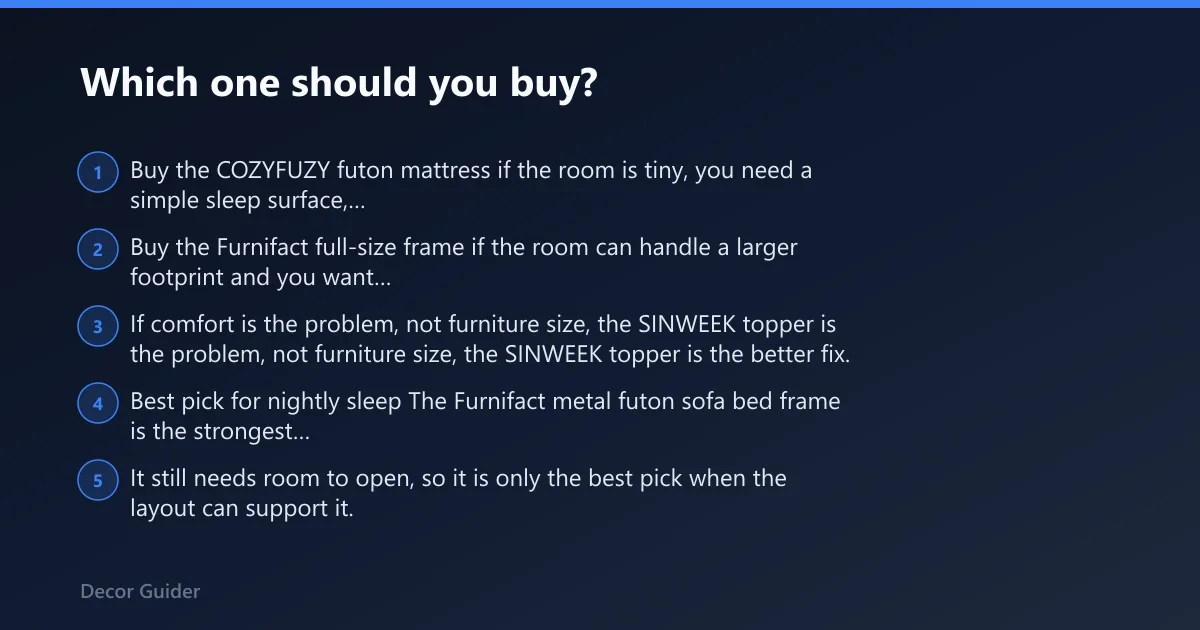
Buy the COZYFUZY futon mattress if the room is tiny, you need a simple sleep surface, and move-in access is difficult. Buy the Furnifact full-size frame if the room can handle a larger footprint and you want real sit-and-sleep use every day. If comfort is the problem, not furniture size, the SINWEEK topper is the better fix.
Best pick for nightly sleep
The Furnifact metal futon sofa bed frame is the strongest choice here for regular sleep, because the adjustable back and heavier-duty construction are more suited to repeated use than a thin floor mattress. It still needs room to open, so it is only the best pick when the layout can support it.
Best pick for the smallest room
The COZYFUZY 4-inch Japanese futon mattress is the safest choice for tight layouts. It has the smallest practical footprint among the options and avoids the assembly and transport hassle of a full frame.
Best pick for easy move-in
The Geetery storage shelf is the easiest to handle, but for actual futon buying, the COZYFUZY mattress is simpler to move than a framed sleeper. Flat-pack boxed frames can still be awkward on stairs, while a foldable mattress is easier to carry and position.
Best pick if campus rules are strict
When campus furniture rules are strict, the safest move is usually a low-profile, non-permanent piece that can be removed quickly. A foldable mattress or topper is less likely to conflict with room layout restrictions than a bulky couch frame, but the student still needs to verify flame-retardant and approved-furniture rules first.
Frequently asked questions
what size futon for dorm room
Twin is the safest size for the tightest dorms, especially when the room must also fit a desk, closet access, and a mini-fridge. Full is the usual middle ground for shared rooms if the open footprint still leaves a walking lane. Queen is rarely the right first choice in a standard dorm.
why are dorm room beds so high
Many dorm beds are raised to create under-bed storage, which helps compensate for the small floor area. High beds also let campuses use the same frame in different layouts, including lofted setups. That height can help storage, but it can make futon placement and wall clearance harder.
what is the best futon size for a college dorm room
The best futon size for a college dorm room is usually twin or full, depending on how much clear floor space remains after the bed and desk are placed. Twin is safer for transport and tight layouts. Full is better if the futon will be the main sleep surface and the room can still open fully.
will a futon fit in a dorm room
Yes, many futons fit in a dorm room, but only if the open length, doorway width, and placement path all work together. The room may still fail the fit test if the futon blocks the closet, mini-fridge, or door swing. Measure before buying, not after move-in.
is a futon comfortable enough for sleeping every night
Sometimes, but only the better-supported options are reasonable for nightly use. A fuller frame with solid support will usually sleep better than a thin floor cushion or low-density pad. If nightly sleep is the goal, mattress thickness, frame support, and weight capacity matter more than style.
what futon is easiest to move into a dorm
The easiest futon to move into a dorm is usually the smallest one that ships in flat-pack form or folds down into a carryable piece. A twin floor futon is simpler than a full metal frame, and both are easier when the route includes stairs, elevators, or tight turns.
what futon works best for a twin xl dorm bed setup
A twin XL dorm bed setup usually pairs better with a narrow, low-profile futon or a topper than with a bulky full frame. The key is keeping the floor open while still leaving room to get on and off the bed. Measure the bed height and the open futon path before ordering.
how do I choose a futon for a small dorm room
Start with the room layout, not the product photo. Measure the room, doorway, closet swing, and open placement area. Then decide whether the futon is mainly for sleep, sitting, or storage. The right futon is the one that fits the route in, opens fully, and does not block daily movement.
Products related to this article
Sponsored / affiliate links. As an Amazon Associate I earn from qualifying purchases. I may earn additional commission from eligible campaigns.