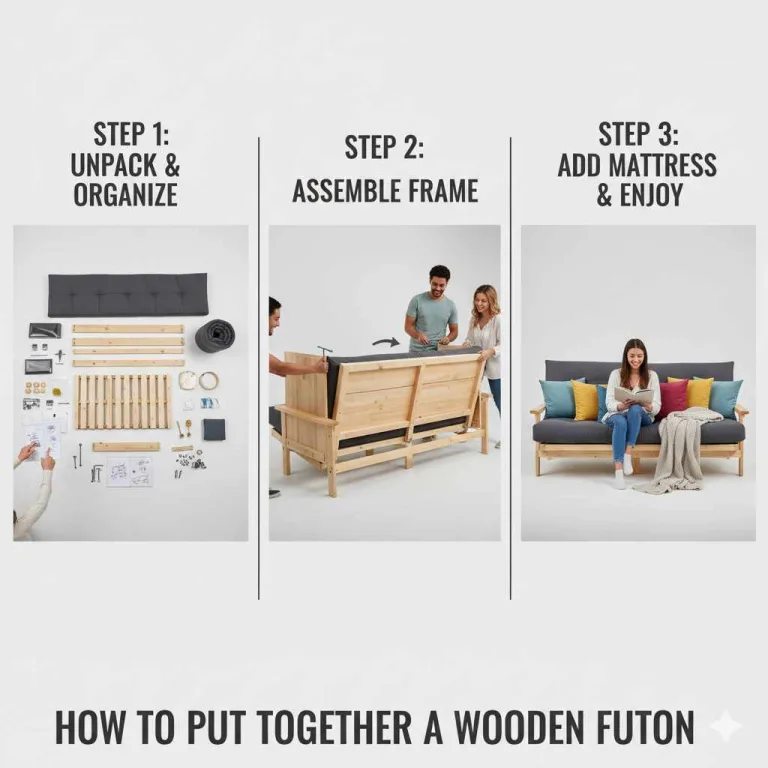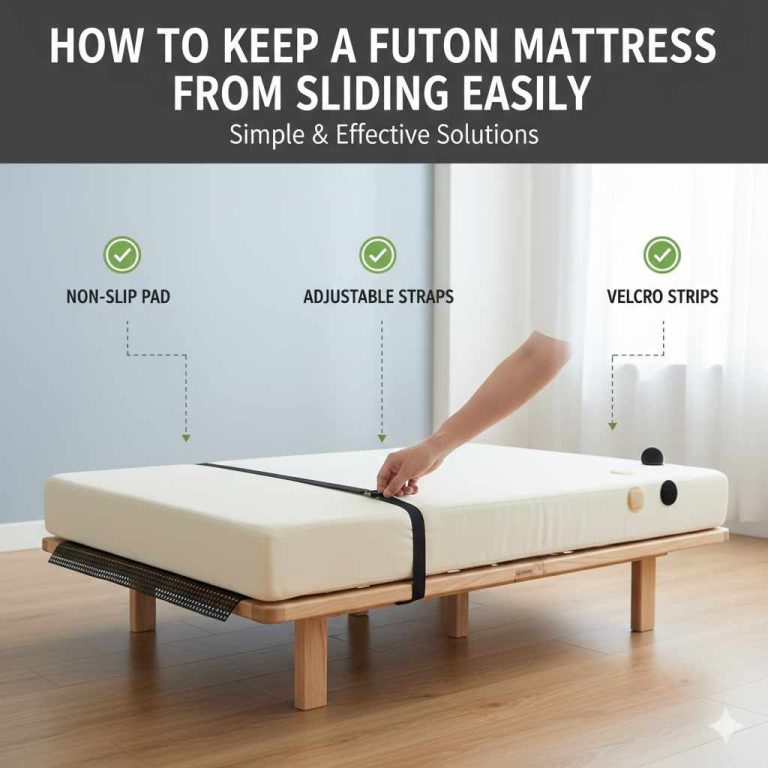
How to Make a Futon Look More Like a Sofa
Make a futon read like a sofa by using a full-length cover, about two to three large back cushions, one centered lumbar pillow, and a rug that helps anchor the seating zone. Without those cues, the futon reads as temporary seating and can make the whole room feel unfinished. This guide covers sizing, cushion layout, fabric choices, rug placement, and lighting that help a futon look intentional from across the room.
Why a futon reads as a bed



The eye notices low height first. A futon with a thin mattress, a flat back, exposed metal rails, or a loose pillow pile reads as sleep furniture before it reads as seating.
Seat depth matters too. If the front edge sits noticeably below standard sofa seating height — most sofas land around 17 to 19 inches from the floor — the piece can look collapsed instead of upholstered. A futon also changes in the room read: when it floats without a rug, lamp, or nearby storage, it feels temporary.
The visual cues that give it away
Three things usually signal “bed” from across the room: a low seat line, a mattress that looks folded in half, and pillows that are arranged like bedding. A wood frame with simple arms can look more sofa-like than bare metal, but only if the cover and cushion layout match that goal.
Futon mattresses vary in thickness, and thicker models usually read more like a real seat. That is part of why a more substantial build can help the room look finished, but the visual cues still depend on styling.
What the room sees first
From a distance, the room reads height, proportion, and contrast before it reads fabric detail. A futon that sits close to the floor beside a tall coffee table or large wall art looks low by comparison. A sofa-like setup keeps the seating zone in scale with the room.
Suppose an about 72-inch futon sits in a studio with about a 5-by-8 rug and one flat throw. The frame may be functional, but it still reads as a spare bed unless you add height at the seat, structure at the back, and a visual boundary under it.
Futon styling checklist
| Fast-start priority | Common futon flaw | Exact fix | Visual effect | Estimated cost band | Quick do/don’t note for studios, dorms, and guest rooms |
|---|---|---|---|---|---|
| Best visual change per dollar | Seat sits too low | If the seat sits too low, add compatible risers or leg lifts and check clearance first. | Lifts the silhouette toward sofa height | Low | Do in studios and guest rooms; don’t block dorm-room floor clearance or exits |
| Best renter-safe move | Exposed metal frame | Use a full-length cover that reaches the front rail. | Hides the bedlike base | Low to medium | Do in all three rooms; don’t leave shiny rails visible unless the frame is decorative |
| Best guest-room upgrade | Mattress crease shows | Choose a thicker cover and smooth the fold line with a topper layer | Softens the split between seat and back | Low to medium | Do in guest rooms; don’t overpad a dorm futon so it becomes hard to fold |
| Best quick sofa read | Too many small pillows | Use about two to three large back cushions plus one lumbar pillow. | Reads like a couch, not bedding | Low to medium | Do in studios; don’t cover the whole seat with small squares |
| Best daily-use comfort fix | Pillows look flat | Choose medium-firm fill that holds a clean edge | Creates a supported sofa profile | Low to medium | Do in daily-use living rooms; don’t use limp fills that slump by dinner |
| Best renter-safe texture upgrade | Cover looks slippery | Switch to linen-textured, velvet, or matte faux leather | Feels more upholstered | Medium | Do in studios and guest rooms; don’t default to shiny fabric in small spaces |
| Best low-effort finish | Loose, baggy slipcover | Tuck and smooth the edges or fit a tailored cover | Makes the frame look intentional | Low to medium | Do if the futon stays open often; don’t let fabric pool on the floor |
| Best softness without bed vibes | Blanket reads like a crumpled bedspread | Fold a medium-weight throw lengthwise and drape it over one arm or the back corner | Adds softness without hiding the shape | Low | Do in guest rooms; don’t toss a rumpled blanket across the middle |
| Best studio anchor | Room feels unfinished | Add a rug sized to sit under the front legs and a lamp with a tall shade line. | Anchors a real seating zone | Medium to high | Do in studios; don’t rely on overhead lighting alone |
| Best dorm-safe storage fix | Clutter under the futon | Use low baskets or bins that fit the clearance | Controls visual noise | Low | Do in dorms and studios; don’t stack visible items at different heights |
| Best larger-room balance | Frame looks too narrow for the room | Pair it with side tables or a wider rug to widen the seating zone | Balances the futon against the room scale | Low to medium | Do in larger living rooms; don’t use a tiny rug that makes the futon float |
| Best back-height fix | Back looks flat and low | Layer a long lumbar pillow across the center with two back cushions behind it | Builds a sofa-like back height | Low | Do in guest rooms and studios; don’t use one oversized bed pillow |
How do you make a futon look like a couch?

Raise the seat line, give the back some height, and keep the pillow count controlled. A futon looks more like a couch when its front edge does not sit too close to the floor, its back has structure, and the cushions read as upholstery rather than sleep bedding.
Raise the seat line
If the frame sits low, use leg lifts or risers that match the base shape and weight rating. The goal is a slightly taller silhouette, not a wobbly perch. A small lift changes the line of sight from “camp bed” to “compact sofa.”
For a sofa-like read, a seat that lands below about 16 inches usually looks low in most rooms. Standard sofa seat height is typically closer to 17 to 19 inches, so even a modest lift can help. Only use risers or lifts that are rated for the combined weight of the frame, mattress, and users, and do not stack unstable supports just to gain height.
Wood and metal frames respond differently. Wood usually reads warmer and more furniture-like, while metal can look lighter or more dorm-like unless the cover and cushions add visual weight. Armrest shape also matters: a squared, fuller arm looks more sofa-like than a bare or curved rail.
Use structure at the back and arms
Back height should match the room scale. A low back can work in a tight dorm, but in a living room it often makes the futon look temporary. Keep the back cushions tall enough to rise above the seat without swallowing it.
Overall width matters too. A futon that is too short for the wall can look like an afterthought, while one that is too wide for the room blocks circulation. Keep the visual mass balanced with the coffee table, rug, and adjacent wall space.
Control the pillow count
Use two to three large back cushions rather than a scatter of small ones. A single centered lumbar pillow helps the piece read like seating, and a medium-firm fill keeps the edges crisp. Too many pillows make the futon look dressed for sleep.
A common first-timer mistake is lining up four or five small squares across the back. That creates a bed impression fast. One lumbar pillow, sized to span the center of the seat back, gives a cleaner, more deliberate read.
What cover makes a futon look less like a bed?
A cover that fits cleanly, looks matte, and has upholstery-like texture will make the biggest visual difference. Tucked or tailored covers usually read more like a sofa, while loose covers work only if the drape is controlled and the fabric has enough body to keep shape.
Fit: tucked or relaxed
A tucked fit gives the clearest sofa line, especially on metal frames and tri-fold mattresses. A relaxed fit can work in guest rooms or casual studios if it is smooth at the corners and does not puddle on the floor. Baggy fabric makes the futon look undersized.
Full-length coverage is important. If the front edge, side rails, or crease line remains visible, the eye returns to “fold-out bed” instead of “couch.”
Texture and color choices
Linen, velvet, and faux leather all read more like furniture upholstery than a thin cotton sheet. Linen texture softens the look, velvet adds depth, and faux leather creates a firmer silhouette. Matte finishes usually work better than shiny ones for this job.
Choose a color value that fits the room, not the bedding aisle. Mid-tone neutrals usually look most sofa-like because they hide the mattress fold better than very light covers. Small patterns can work if they stay calm; large, busy prints can make the futon look like a guest bed.
Pattern scale that reads like upholstery
Keep patterns on a scale that would make sense on a couch cushion, not on a duvet. A fine weave, subtle stripe, or small textural pattern reads as upholstery. Oversized checks or bright novelty prints push the futon back toward bed styling.
If the room already has a strong rug or wall art, let the cover stay quieter. The futon should anchor the seating area, not compete with it.
What pillows make a futon look like a sofa?
Use pillows that create back support and structure, not bedding volume. Two or three larger pillows with medium-firm fill usually read better than a pile of soft squares. A centered lumbar pillow helps define the seat and keeps the setup looking finished.
Lumbar size and placement
A lumbar pillow should be long enough to span the center of the seating zone without covering the whole back. Place it in the middle, not off to one side. That placement creates a clear sofa-style focal point and breaks up the flat line of the back.
For a smaller futon, one long lumbar can do the work of several smaller cushions. For a wider futon, pair it with two larger back cushions at the ends so the middle stays structured.
Square pillow count and fill firmness
Keep the square count low. Two large squares can work on a full-size futon, while a trio is better for a wider frame. The fill should hold shape when leaned against, because soft, floppy cushions collapse into a bed look fast.
Foam or high-resilience fill usually gives a cleaner edge than loose fiber fill. The goal is an upright, tailored outline. If the pillows sink flat after a few minutes, they stop reading as seating support.
Color layering without a bed look
Layer one base color, one supporting tone, and one accent. For example, a charcoal cover, warm beige pillows, and one muted rust lumbar can look finished without becoming busy. Keep the palette close enough to feel intentional.
Do not build a blanket-and-pillow stack that resembles bedding. If the futon already has a textured cover, keep the pillows simpler so the overall effect stays sofa-like.
How do you raise a futon to sofa height?
Use leg lifts or risers only if the frame is stable, the clearance works for the room, and the added height improves the profile. Raising the seat line is one of the fastest ways to make a futon look more like a couch, especially in rooms where the floor-level look feels too temporary.
Leg lifts and risers
Choose risers that match the foot shape and spread the load evenly. Round feet and square feet need different support. Check that the frame still folds correctly and that the extra height does not fight the mattress or the hinge.
Weight capacity and stability matter more than the visual gain. A lift that wobbles defeats the purpose. If the futon will be used daily, the safest choice is the one that keeps the frame level and stable under normal seating.
When height helps the silhouette most
Height makes the biggest difference when the futon sits in a living room, under taller windows, or beside standard sofa seating. It matters less in a dorm where floor space is tight and the room already reads compact. In a guest room, a modest lift can help the piece feel more deliberate.
IKEA says sofa beds can offer a lounge area by day and a sleeping area by night, and the broader point applies here: a convertible seat only looks intentional when its proportions, cover, and layout support the room. Storage under the seats can help with pillows and blankets, but the visual read still depends on height, cover, and arrangement.
Room-specific styling moves
In a studio, anchor the futon with a rug that is large enough for the front legs to sit on it. In a dorm, focus on one neat cover, a lumbar pillow, and hidden storage under the frame. In a guest room, keep the bedding easy to remove so the futon can switch from sofa to bed without looking overloaded.
In a daily living room, the futon needs the strongest sofa cues. A lamp with a taller profile, a larger rug, and controlled pillow stacking do more than extra throw blankets ever will.
Futons vs sleeper sofas vs daybeds for this exact use case
If your goal is to make the room look like it has a sofa first and a bed second, sleeper sofas usually win on visual read, futons usually win on price and flexibility, and daybeds land in the middle with a more decorative profile. Sleeper sofas typically look most like a true couch when closed, futons are the easiest to re-style with covers and pillows, and daybeds can feel airy but often read as lounging furniture unless you add substantial bolsters.
For comfort, a futon can be perfectly workable when the mattress is thick enough and the back support is upgraded, while sleeper sofas usually feel more sofa-like in daytime use but can be heavier and bulkier in small rooms. Daybeds take up a similar footprint to a narrow sofa, but because they expose bedding more openly, they can read as a guest room piece rather than a main seating zone.
For footprint, futons are the most adaptable in studios and dorms, sleeper sofas are usually the strongest choice for a living room that needs real overnight capacity, and daybeds are best when the room can tolerate a more styled, semi-bedded look. If you want a tighter sofa read with no visual compromise, see sofa beds as the closest comparison point.
How can I style a futon for a living room?
Style it as the main seating zone, not as a spare mattress. Use a rug that defines the footprint, a lamp that gives the seating area height, and storage that hides blanket overflow. The futon should feel anchored to the room, with enough structure to read like real furniture.
Lighting and rug placement
A floor lamp or table lamp beside the futon adds vertical balance. A low, bare bulb can make the room feel dorm-like, while a lamp shade at seated eye level makes the arrangement feel more finished. The rug should be large enough to connect the futon to the table and nearby chair, if there is one.
Use the front legs or front edge of the futon to sit partly on the rug. That simple move visually pulls the piece into the room instead of letting it float. In a studio, a 5-by-8 rug can work if it lets the front portion of the futon sit on the rug; in a living room, an 8-by-10 rug or larger usually creates a stronger seating zone and keeps the futon from looking isolated.
Under-futon storage
Low baskets or bins keep blankets and pillows close without making the room look crowded. Aim for bin heights that fit the clearance under the futon, so the storage disappears into the footprint instead of sticking out like extra furniture.
Keep the contents simple: one or two throws, pillow inserts, or seasonal covers. Visible clutter under a low-slung futon makes the whole setup feel temporary.
Seasonal styling
Use heavier knits, velvet, or deeper color values in cooler months. In warmer months, switch to lighter linen textures and fewer layers. The shape should stay the same, but the surface weight can change with the season.
That keeps the futon looking intentional year-round. It also avoids the overstuffed, bedlike look that comes from stacking every soft item at once.
Frequently asked questions
How to make a bed look more like a sofa
Start by removing bedding cues: use a tailored cover, reduce pillow count, and add structure at the back. If the piece sits low, lift it slightly and place it on a rug that defines the seating area. The room should read “seating” before it reads “sleep.”
Products related to this article
Sponsored / affiliate links. As an Amazon Associate I earn from qualifying purchases. I may earn additional commission from eligible campaigns.