Futon Frame Dimensions Chart: Sizes, Clearances, and Fit
A futon frame’s footprint is often about 2 to 6 inches wider and longer than the mattress size, so measure for the frame, not the mattress label. Skip the clearance check, and the frame can block doors, scrape walls, or fail to fit through the delivery route. This guide gives a futon frame dimensions chart, mattress-size matchups, and the room, doorway, hallway, and stair measurements to confirm before you buy.
Futon frame chart


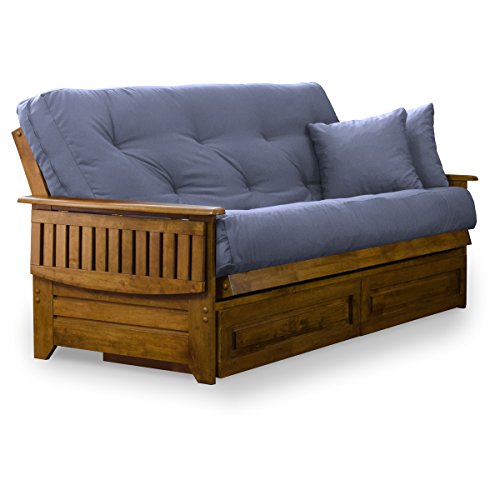
Use the outer footprint as the deciding number. The mattress label alone does not tell you how much floor space the frame needs, especially once arms, hinges, and recline hardware are included. Wood frames often take more width than metal frames because the arms extend farther out.
| Frame size | Mattress size | Typical outer footprint | Recommended room minimum | Conversion-clearance allowance |
|---|---|---|---|---|
| Twin | 38 x 75 inches | 40-43 x 77-80 inches | At least a compact room with walking space on one side and in front | Leave 18-24 inches for opening and folding |
| Full | 54 x 75 inches | 56-59 x 77-80 inches | Small rooms, guest rooms, dorms, and studio layouts with controlled traffic | Leave 18-24 inches for opening and folding |
| Queen | 60 x 80 inches | 62-65 x 82-85 inches | Medium rooms where the bed position will not hit a wall or window trim | Leave 20-30 inches for opening and folding |
| King | 76 x 80 inches | Varies by brand; often larger than queen frames and may use split construction | Large rooms with wide circulation paths | Leave 24-36 inches for opening, folding, and handling the split sections |
Measure the room before you buy
Measure the floor first, then compare it with the frame footprint in sofa, lounger, and bed positions. A futon can fit as a sofa and still fail as a bed if the backrest needs to swing out into a wall or walkway. Map the space on paper before you order.
-
Measure the room length and width. Record the clear floor space where the frame will sit. Use the smaller number as your limit, because arms and conversion hardware need room on both sides and at the front.
-
Check wall clearance. Leave space behind the frame for the backrest to move through the three positions. If the frame sits tight to a wall, the bed position may stop early or scuff paint.
-
Allow for opening space. Measure the depth needed when the frame shifts from sofa to lounger to bed. The mechanism can change the usable footprint by several inches, so the bed mode is the number that matters most.
-
Map the delivery path. Measure doors, halls, corners, and stairs before the frame ships. A frame can fit the room and still fail at a narrow turn or landing.
Match the mattress to the frame
A futon mattress is usually 4-8 inches thick, which affects both seating comfort and fitted-sheet choice. Thickness does not change the footprint much, but it does change how the frame feels in sofa mode and how snug the cover will sit. Match the mattress size to the frame size, then check thickness for the final fit.
- Twin futon mattresses are around 39 x 75 inches and work best for one sleeper or a child.
- Full futon mattresses are 54 x 75 inches and are common for single sleepers and small rooms.
- Queen futon mattresses are 60 x 80 inches and suit couples or one sleeper who wants more spread-out space.
- King futon mattresses are 76 x 80 inches and are rare in futon frames; split-frame construction is common when a maker offers this size.
What size is a full futon frame?
A full futon frame uses a 54 x 75 inch mattress, but the outer frame is usually 56-59 x 77-80 inches. That extra width and length come from the structure around the mattress, so a full frame needs more floor space than the mattress tag suggests. It suits one sleeper, a guest room, or a small apartment where every inch matters.
Why full-size buyers misread the label
The mistake is simple: compare the mattress size to the room, and the frame gets ignored. Wood arms, hinges, and the reclining back add bulk, so the true footprint can be several inches larger on both sides.
Say your room is 7 feet wide and you plan to use a full futon as both a sofa and a bed. The mattress may sound manageable at 54 x 75 inches, but the outer frame can reach 56-59 x 77-80 inches before you account for walking space.
How much space should you leave around a futon frame?
Leave room for the frame to open, recline, and clear the wall. A practical target is about 20-30 inches around a queen frame, with more room if the back swings out deeply or the arms are wide. The sofa position needs less clearance than bed mode.
Clearance by position
The required space changes with the setting. Sofa mode usually needs the least depth, lounger mode needs extra swing room, and bed mode needs the most open floor in front of the frame.
- Sofa mode: Leave enough room to sit and pass in front without bumping knees into the frame.
- Lounger mode: Keep a buffer behind and in front because the backrest sits partway down.
- Bed mode: Measure the full open depth, then add walking space if the frame sits in a bedroom or studio.
Wall space and walking space
Do not place the frame so tightly that the back touches trim, outlets, or baseboard heaters. If a room already has a narrow traffic lane, choose the smallest footprint that still leaves a clean path around the opened frame.
Will it fit through doors and stairs?
A futon frame can fit the room and still fail delivery. Check the doorway width, hallway turns, and stair landings before ordering, especially for wood frames with wide arms or large queen and king models. The delivery path matters as much as the final footprint.
Doorway width
Measure the narrowest door opening the frame must pass through, including trim and any hinges that reduce usable width. If the frame ships in one large box, compare the boxed size to the smallest doorway, not the finished frame size.
Hallway turns and stair landings
Long frames can snag on corners, and stair turns can block a straight carry path. Check the diagonal clearance at every turn. A king or split-frame model may move more easily in sections than one long assembled piece.
-
Measure the doorway clear width. Check the smallest opening from the entry point to the room. Write down the narrowest number, because a single tight door can stop delivery even when the room itself is large enough.
-
Measure hallway turns. Record the width at corners and the open space needed to pivot the box or frame. Wide arms and long rails are the parts that usually catch first.
-
Measure stair width and landings. Include the handrail side, the landing depth, and any turn in the stair run. A frame that clears a straight stair may still fail at the landing.
-
Compare boxed and assembled sizes. If the seller lists both, use the larger path requirement. Boxed delivery often needs more clearance than the assembled footprint because the package must rotate through the route.
A common first-timer mistake is choosing a queen frame for a studio without checking the swing path. The mattress size looks manageable on paper, but a 62-65 x 82-85 inch footprint can take over a small room once the bed opens toward a wall.
What changes the footprint?
Arm style, frame material, and conversion hardware all change the real footprint. Two frames can accept the same mattress size and still occupy different amounts of floor because one uses thick wood arms and the other uses a slimmer metal base.
Wood versus metal frames
Wood futon frames are often a bit wider and have a more traditional appearance. They are common in sofa, lounger, and bed positions, and the arms can add roughly 12-22 inches in width. Metal futon frames are often more compact and more mass-produced, and they are common in contemporary styles.
Three-position conversion depth
A three-position frame changes depth as it moves between sofa, lounger, and bed. That mechanism affects the amount of floor you need in front of the frame and behind it, so the open position should always guide the room plan.
Frame-only purchases need a compatibility check
If you are buying a frame without a mattress, match the frame size to the mattress you already own. A full mattress on a queen frame can leave gaps and poor support, while a queen mattress on a full frame is unlikely to fit correctly.
- Check the mattress tag for the exact size.
- Compare that size with the frame footprint, not only the label.
- Confirm thickness so your sheets and cover still fit.
- Confirm whether the frame uses arms that extend beyond the mattress edge.
Picture a wood futon with broad arms in a guest room. The mattress may be only 54 x 75 inches, yet the frame can require several more inches on each side, which is why a room that fits a mattress on the floor may still feel cramped with the frame installed.
Frequently asked questions
How long is a standard futon?
A standard futon usually matches the mattress size for the chosen frame, so the length depends on whether you buy twin, full, queen, or king. In common sizes, the mattress length is 75 inches for twin and full, and 80 inches for queen and king.
Do futon frame dimensions include the arms?
Often they do, but not always in the same way from one seller to another. Some dimensions list the outer edge of the arms, while others list only the base or sleep surface, so check the product diagram and compare it with your room measurements.
Will a full-size futon frame fit in a small apartment?
Often yes, but only if you account for the full footprint and the open clearance. A full frame is common in small rooms because its typical 56-59 x 77-80 inch footprint is compact enough for many apartments, yet you still need room for walking space and conversion.
What measurements do I need before buying a futon frame?
Measure the room length and width, the wall clearance behind the frame, the space needed for the frame to open, and the delivery path through doors, hallways, and stairs. If you are buying frame-only, also measure the mattress size and thickness so the new frame matches what you already own.
Products related to this article
Sponsored / affiliate links. As an Amazon Associate I earn from qualifying purchases. I may earn additional commission from eligible campaigns.